

Turn recordings into transcripts and summaries in minutes
Upload audio or video for multilingual transcription, AI notes, and action items
2026 AI Meeting Summary Comparison: 5 Common Misconceptions and Tinrec in Practice
After a two-hour meeting, you have the transcript, but you still have to read through it from start to finish just to figure out what the conclusions were and who needs to do what—this is the most real gap many people experience after using AI meeting summary tools.
There are roughly five common misconceptions:
Misconception 1: Thinking "having a transcript" equals "having a meeting summary." A transcript is the raw material; a summary is the finished product. In between, you still need semantic understanding and structured organization.
Misconception 2: Thinking AI must use a "meeting bot" to join the meeting. Many people assume you have to invite a stranger account into the meeting room. In fact, Tinrec's desktop version directly captures your computer's system audio—no extra bot needs to become a participant.
Misconception 3: Thinking the free version can be used unlimited. Every tool has limits. The key is understanding which actions consume your quota.
Misconception 4: Thinking accuracy is a fixed number. Actual performance is affected by recording quality, noise, accents, overlapping speakers, and specialized terminology.
Misconception 5: Thinking "team sharing" means multiple people sharing one account. A truly manageable team version distinguishes roles, seats, and member relationships.
This article starts from "what the features can do for you," clearly explaining the practical uses, capability boundaries, and purchasing considerations of AI meeting summaries, using Tinrec as a concrete example.
What Can AI Meeting Summaries Do for You?
Scenario 1: No more spending an hour organizing notes after the meeting
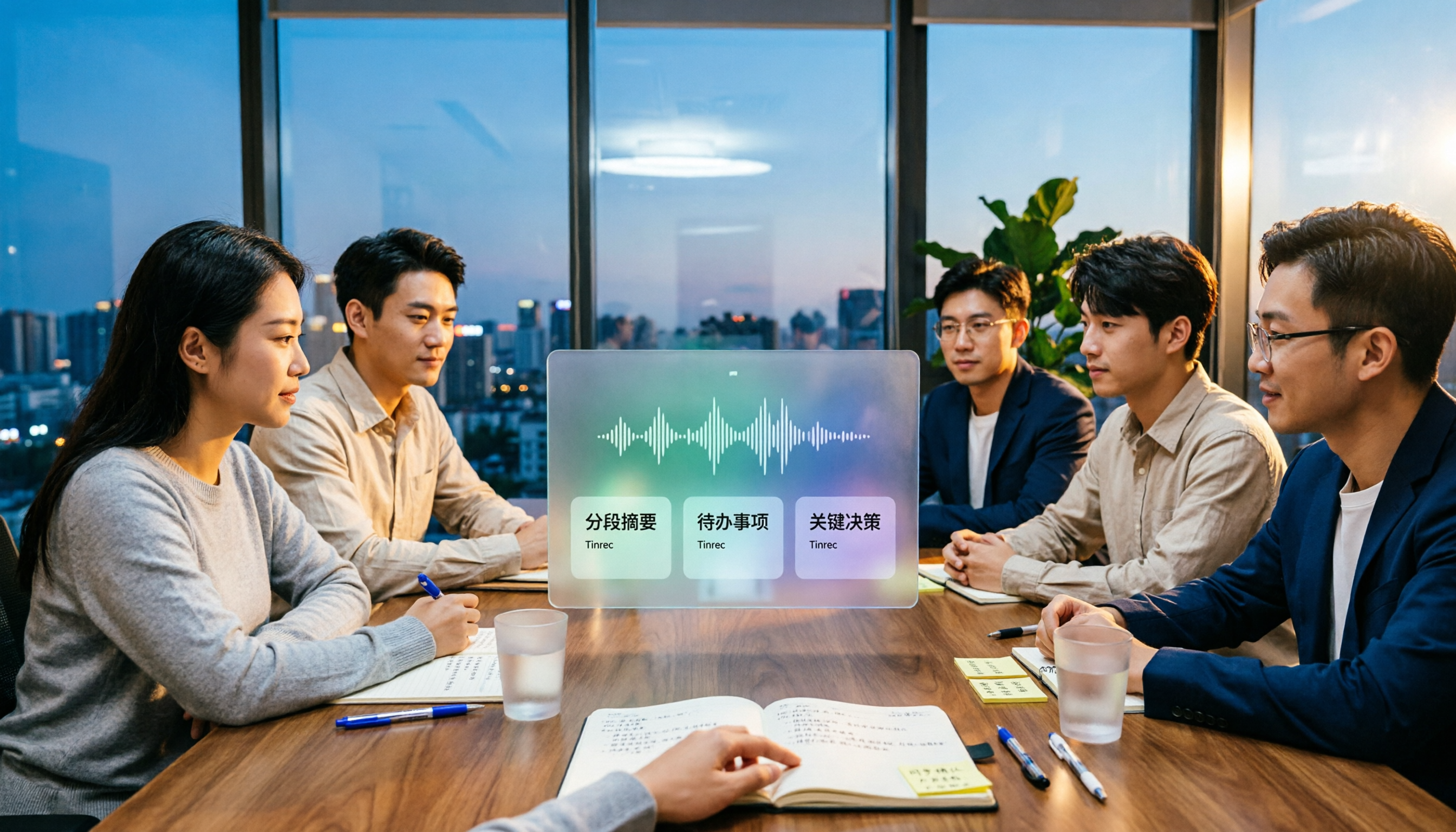
Previously, after a two-hour meeting, you might spend another hour organizing key points. With Tinrec, for example, transcription begins while recording, and by the time the meeting ends, the AI summary, chapters, and action items are already organized—who's responsible for what and what's next can proceed directly.
Scenario 2: A two-hour long meeting becomes a scannable structure
AI summaries don't just compress the transcript into one big paragraph—they break it into topics, discussion points, conclusions, and action items. Tinrec divides long meetings into chapters so you can read only the sections relevant to you.
Scenario 3: Being asked after the meeting "What did the client say last time?"
Once the transcript is saved, you can ask questions directly within Tinrec about the meeting content, such as "What were the client's concerns about the pricing?" The AI provides answers based on semantic understanding—no need to search keywords one by one.
Scenario 4: Keeping up with cross-language meetings
Tinrec supports real-time translation during recording, allowing you to switch between original text, translation, or bilingual display—especially useful for meetings with foreign clients or multinational teams.
What Are the Core Capabilities of AI Meeting Summaries?
Real-time transcription: text appears as you record
It's not transcribed after recording—text begins to form the moment you start recording. Tinrec's real-time transcription lets you verify on the spot whether key points are missed during the meeting, and you don't have to wait for file conversion afterward.
No-bot online meeting recording
Tinrec's desktop version captures your computer's system audio to handle online meetings, including meeting audio played on platforms like Zoom, Google Meet, Microsoft Teams, and Webex—no extra bot account needs to be invited. Note that this does not mean it "automatically joins all meetings on your calendar"—you need to actively open Tinrec to start recording. Also, being able to handle audio from these platforms does not imply an official partnership with them.
AI summary, chapters, and key points
Tinrec produces summaries, chapters, and key points, drawing out the structure of long meetings. For those who need quick review, this is more practical than the transcript itself.
Action item extraction and to-do lists
The real value of a meeting usually lies in post-meeting execution. Tinrec organizes action items from discussions, so project meetings and client meetings can directly proceed to next steps.
AI Q&A and mind maps
You can continue asking questions about single or multiple meeting records, and understand relationships between topics through mind maps.
Translation and bilingual view
Supports real-time translation during recording, viewable in original text, translation, or bilingual format.
Multi-format export and post-processing
Tinrec can export results to tools like Notion, Google Docs, OneNote, and Dropbox, and can further generate reports, tables, and documents through Agent post-processing—connecting meeting content back to your existing workflow.
Team space and governance capabilities
The team version centrally stores meeting data and provides member and seat management, usage analytics, audit logs, audio recycle bin, and team hotwords. Members without a seat can still view, play, and read team data; recording, uploading, editing, and import/export require a valid seat.
Stop organizing recordings by hand
Upload audio or video and automatically get a transcript, summary, and action items
Practical Use Cases
Project weekly meetings and decision meetings
The biggest fear in regular weekly project meetings is "we talked about this last time but forgot." With Tinrec recording, summaries and action items are automatically saved, decision rationale can be traced back, and new members can review past meetings to catch up on context.
Client interviews and requirements communication
Requirements, objections, and commitments in client meetings are the easiest to miss. Tinrec organizes transcripts, summaries, and action items together, producing deliverable documents right after the meeting.
Courses, lectures, and internal training
Put course recordings into Tinrec, and transcripts and chapters can serve as review notes; for foreign-language content, translation and bilingual view can speed up comprehension.
Interviews and content creation
After uploading interview recordings, Tinrec quickly produces transcripts and summaries, making it easy to pick out quotable passages and export them to writing tools for further processing.
6 Things to Consider When Choosing an AI Meeting Summary Tool
1. Is the summary "structured"? Simply compressing the transcript into one paragraph has limited value. Check whether the tool can break out topics, conclusions, action items, and owners. Tinrec outputs summaries, chapters, and action items together.
2. How is the meeting recorded? Does it require inviting a bot to join, or does it directly capture computer system audio? Tinrec's desktop version takes the no-bot approach, which is less disruptive for meetings with external clients.
3. Handling Chinese and mixed Chinese-English. If meetings frequently mix Chinese and English or contain many specialized terms, check whether the tool has hotwords and terminology correction mechanisms. Tinrec provides team hotwords to maintain commonly used team terminology. Actual recognition performance is still affected by recording quality, accents, and overlapping speech—it's not recommended to judge by a single accuracy number.
4. Are recordings and transcripts retained and traceable? Some tools keep only text and not audio, making later verification troublesome. Tinrec retains recordings, transcripts are searchable and reviewable, and important content can be verified against timestamps.
5. Team governance capabilities. Team procurement should consider whether members, roles, seats, usage, and audits can be managed. Tinrec's team version distinguishes roles and seats: roles determine governance permissions, seats determine whether recording, uploading, editing, and import/export are possible; team data belongs to the team, and handover is required when members leave. Note that currently it's team-level sharing with role governance, not file-level granular permissions.
6. How is quota calculated? Some tools deduct minutes for all operations, while others distinguish between real-time recording and file import. With Tinrec's team version, under a valid team plan and valid seat, real-time recording currently does not deduct by the minute; file and web imports use the team shared import quota. Team monthly is USD 29.80 per paid seat per month, annual is USD 199 per paid seat per year (about USD 16.58 per month), each paid seat provides 2,000 minutes of team shared import quota per month, and there is a 7-day first-time trial with 1 free seat and 300 minutes of shared import quota. Actual prices, currencies, and promotions are subject to the official purchase page.
Frequently Asked Questions
Q1: Are AI meeting summaries accurate? Can they completely replace manual note-taking? With clear audio and common scenarios, usable quality can be achieved, but it's not recommended to promise a fixed accuracy rate or claim it can completely replace manual work. Tinrec's positioning is to significantly reduce the cost of manual recording and organization; for important decisions, it's still recommended to verify against transcript timestamps and recordings.
Q2: Do I have to invite a meeting bot to join the meeting? Not necessarily. Tinrec's desktop version captures computer system audio to record online meetings—no extra bot needs to become a participant. However, note that this requires you to actively start recording, not automatically join all meetings on your calendar.
Q3: Is the free version enough? The free version is suitable for light experience—use the basic quota to try recording, importing, summaries, and transcription. If you only occasionally organize a recording, start with the free version; for short-term intensive meetings or interviews, consider a weekly pass; for stable weekly needs, Pro is suitable; for long-term accumulation of recording data, the annual plan has a lower monthly equivalent.
Q4: What's the difference between the team version and the personal version? Personal version data is managed by the individual account. The team version is an independent team collaboration space where meeting data belongs to the team, with added capabilities including members, roles, seats, shared benefits, usage analytics, audit logs, and audio recycle bin—so data doesn't leave with individuals when members change.
Q5: Can deleted meeting audio be recovered? After team audio enters the recycle bin, it can be restored before permanent cleanup begins. The current recycle bin retention period is 30 days (TODO items are not within the recycle bin scope).
Q6: Do I need consent to record? Yes. Recording and transcription involve local regulations. In practice, it's recommended to inform and obtain consent from participants before the meeting begins.
Summary
The value of AI meeting summaries isn't in "turning speech into text"—it's in "turning meetings into actionable data." When choosing a tool, rather than comparing whose promotional numbers look better, go back and confirm four things: Is the summary structured enough? Will the recording method disrupt participants? Is Chinese and terminology handling good enough? Can team data be managed and handed over?
If you have more than three meetings per week, or your team is already experiencing "meeting notes scattered across everyone's computers," an approach like Tinrec that connects transcripts, summaries, action items, Q&A, and team space is closer to actual needs than a simple transcription tool. Start with the free version, validate whether the summaries it produces can be used directly in one or two real meetings, then decide whether to move up to the team version.
References
Turn every recording into actionable outcomes
Get 60 free transcription minutes when you sign in. No credit card required.
Related Reading
You might also like

2026 Audio Summarizer Guide: Auto Summaries + AI Q&A to Find Key Points
How do you choose an audio summarizer? This guide covers common pitfalls and key factors like summary quality, AI Q&A, and cross-platform export. We recommend Tinrec, which supports bot-free online meeting recording, automatic summaries, action item extraction, and team spaces. Also includes alternatives like Granola and PLAUD, plus tips to avoid mistakes.

5 Best AI Transcription Tools in 2026: Which One Saves the Most Time?
We tested 5 recording-to-transcript tools, comparing Chinese recognition, post-meeting organization, AI Q&A, and team collaboration. See how Tinrec stacks up against Otter.ai, Notta, and TurboScribe, plus key buying tips and pitfalls to avoid.
Tinrec vs Otter.ai: Which AI Meeting Summary Tool Is Better for Chinese-Speaking Teams in 2026?
Many people think a transcript means the meeting notes are done, but the real time sink is post-meeting organization. This hands-on comparison of Tinrec and Otter.ai—two tools that automatically generate meeting summaries from recordings—evaluates them across six dimensions: Chinese-language meeting experience, recording method, post-meeting outputs, audio retention, team governance, and pricing/quotas, helping Chinese-speaking teams decide which tool better fits their workflow.

4 Best Meeting Transcription Tools in 2026: Free Tiers, Chinese Accuracy, and Post-Meeting Efficiency Compared
Tired of spending hours writing meeting minutes? This article compares Tinrec, Notta, Granola, and PLAUD Note across four key areas: how they record online meetings, Chinese and mixed-language transcription accuracy, post-transcription summarization and AI Q&A, and team data ownership. It also includes a pitfalls guide and selection advice.

How to Auto-Generate Transcripts in 2026: Tinrec vs Yating + Bot-Free Meeting Recording
Auto-generating transcripts isn't a one-click job. This article breaks down the three most common pitfalls, then compares Tinrec and Yating Transcript across five dimensions to clarify how to choose for Hong Kong office scenarios.

2026 AI Meeting Notes Tools Compared: 5 Top Picks for Transcription & Team Collaboration
Tired of spending hours after meetings organizing transcripts? This article reviews 5 AI meeting notes tools based on real testing, breaking down 5 key dimensions: audio capture methods, post-meeting outputs, audio retention, and team governance. It focuses on Tinrec as the primary example, comparing its use cases with Notta, Otter.ai, Granola, and TurboScribe, and includes a pitfalls guide and selection advice.

How to Summarize Meeting Highlights in 2026: 5 Steps from Recording to AI Summary
The problem with meeting notes usually isn't slow typing—it's trying to capture and organize at the same time. This article breaks down a 5-step workflow from recording, transcription, AI summarization, to action item tracking, and explains how Tinrec (秒听录音) uses desktop bot-free recording, AI Q&A, and multi-format export to turn meetings into searchable, collaborative team data.

Tinrec Audio to Text Tutorial 2026: Chinese Transcripts + AI Meeting Notes in One Go
How to choose an audio-to-text tool? This article compares Tinrec and Yating Transcript across five dimensions: Chinese and multilingual transcription, bot-free online meeting recording, post-transcription summaries and action items, cross-platform export, and team seats and usage management. It then tells you directly which one to choose for which situation.

Tinrec vs Granola 2026: 5-Dimension Comparison for Cantonese Voice Translation
Most translation apps struggle with Cantonese speech recognition, making meeting recordings and interview files especially hard to organize. This article compares Tinrec and Granola across 5 practical dimensions for Cantonese voice translation and post-meeting organization, helping you avoid common pitfalls and find a tool that truly handles Cantonese content.