
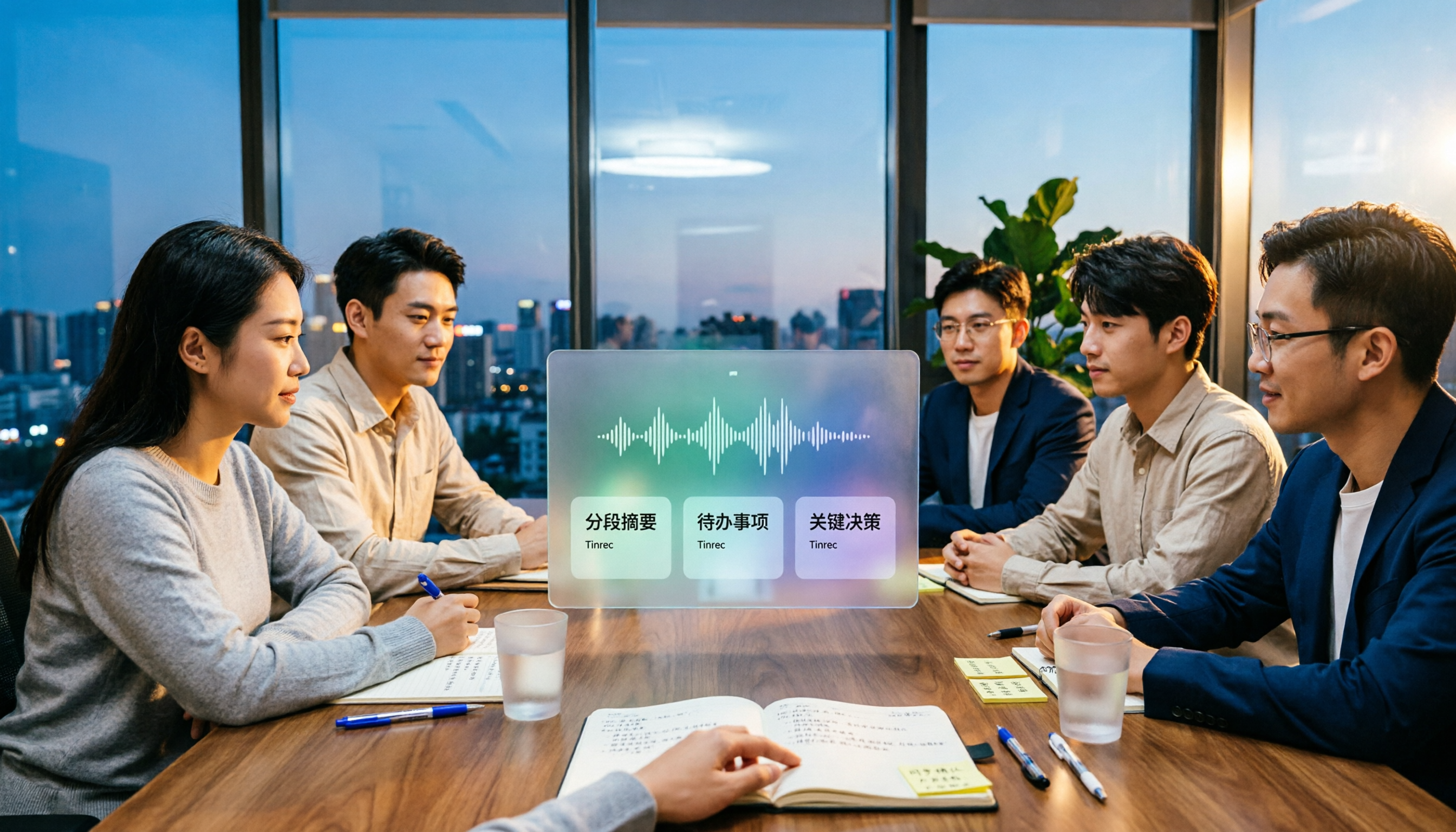
Turn recordings into transcripts and summaries in minutes
Upload audio or video for multilingual transcription, AI notes, and action items
Tinrec vs Otter.ai: Which AI Meeting Summary Tool Is Better for Chinese-Speaking Teams in 2026?
Many people think that having a transcript means having meeting notes. So they record the audio, run it through a transcription tool, get the text, and consider the task done.
But a transcript is just raw material. What really eats up time is the post-meeting work: who agreed to what, which decisions were made, and what needs to be followed up on next week.
Another common misconception is that more features are always better. In my years of testing tools, the most common pitfall I've seen is buying a bunch of features, only to still rely on manual note-taking in every meeting.
A more reasonable approach is to first confirm three things: what platform the meeting is held on, whether the notes are for yourself or for the team, and whether you need to look back at past meetings. Once you answer these three questions, you can probably eliminate 80% of the tools.
In this article, I test Tinrec and Otter.ai from the same angle. Both focus on automatically generating meeting summaries from recordings, but their design philosophies are very different.
Tinrec vs Otter.ai | Quick Overview
Tinrec is an AI meeting notes and collaboration tool for individuals and teams. It doesn't just convert audio to text; it turns recordings into searchable, summarizable, queryable, and exportable meeting assets.
Otter.ai is a mature AI meeting assistant that covers real-time transcription, speaker identification, AI Chat, workflows, and team management. It has deep experience in English business meetings.
| Item | Tinrec | Otter.ai |
|---|---|---|
| Core positioning | AI meeting notes and team collaboration | AI meeting assistant and meeting automation |
| Online meeting recording | Desktop version captures system audio, no bot needed | Offers meeting bot and desktop methods |
| Chinese content | Chinese, Traditional Chinese, and multilingual meetings, supports real-time translation | Stronger for English business meetings |
| Free plan | Free version allows recording, import, summary, and transcription | Basic free, 300 minutes per month |
| Paid starting point | Personal plans include weekly pass, Pro monthly, and annual; team annual equivalent to about USD 16.58 per paid seat per month | Pro annual equivalent to about USD 8.49 per user per month |
Next, we compare across 6 dimensions: Chinese organization experience, recording method, post-meeting outputs, audio retention, team governance, and pricing and quotas.
Dimension 1 | Organization Experience for Chinese and Mixed Chinese-English Meetings
Otter's strength is English meetings. Its product design, content ecosystem, and workflows are mainly developed around English business scenarios. Chinese-speaking teams usually need an adaptation period when adopting it.
Tinrec covers Chinese, Traditional Chinese, and multilingual meeting scenarios, supports real-time translation during recording, and allows viewing of original text, translation, or bilingual content. The team version also allows maintaining team hotwords, adding company-specific terminology to improve recognition of professional terms.
It's worth noting that actual performance is affected by recording quality, background noise, accents, overlapping speech, and specialized terminology. No tool should promise a fixed accuracy rate; for important content, it's advisable to cross-check with transcript timestamps and audio playback.
→ This dimension: For Chinese-speaking teams, Tinrec is more convenient.
Dimension 2 | How Meetings Are Recorded
Otter offers multiple methods including a meeting bot and desktop client. This is convenient for teams already used to this workflow, but a bot joining the meeting means an extra participant, which may not be suitable for client or external meetings.
Tinrec's desktop version directly captures computer system audio, handling meeting audio played on the computer from Zoom, Google Meet, Microsoft Teams, Webex, etc., without needing an extra bot to join.
Note that users must actively open Tinrec to start recording; it is not a service that automatically joins all calendar meetings. Supporting recording for these platforms does not imply official partnerships with them.
→ This dimension: Both can do bot-free recording, but Tinrec's process is simpler, slight edge to Tinrec.
Dimension 3 | What You Actually Get After the Meeting
Otter provides summaries, action items, AI Chat, and workflows, with a mature real-time collaboration experience during meetings.
Tinrec focuses on what comes after transcription: beyond the transcript, it automatically generates summaries, chapters, key points, and to-dos, plus mind maps to help understand the meeting structure. You can continue AI Q&A around the meeting content, and use Agent post-processing to generate reports, tables, and documents, then export to Notion, Google Docs, OneNote, Dropbox, etc. for further work.
Simply put, just getting a transcript is not enough; whether it can directly become a deliverable is the difference.
→ This dimension: Tinrec wins.
Dimension 4 | Audio Retention and Historical Lookup
Whether Otter retains meeting audio depends on the product and plan rules; it's advisable to check the terms before use.
Tinrec supports retaining recordings, and historical meetings can be searched, reviewed, and queried. The team version also provides an audio recycle bin, where accidentally deleted recordings can be restored before permanent cleanup; the current retention period for the recycle bin is 30 days (TODOs are not included in the recycle bin).
Stop organizing recordings by hand
Upload audio or video and automatically get a transcript, summary, and action items
For those who need to "look back three months later at how something was discussed," this difference is significant.
→ This dimension: Tinrec wins.
Dimension 5 | Team Governance: Roles, Seats, and Usage
Otter's Business plan provides team and management capabilities; actual pricing may be affected by promotions, subject to the official pricing page.
Tinrec's team version is not "multiple people sharing one personal account" but an independent team collaboration space. You can create and switch between multiple teams, invite members via join links, set owners/admins/regular members, assign or revoke seats, and centrally store Audio, Folders, TODOs, and related meeting data. Admins can view team usage trends, member rankings, and details, query and export audit logs, and manage team hotwords.
There's an easily confused point here: roles determine governance permissions, while seats determine whether one can record, upload, edit, import/export; active members without seats can still view, play, and read team data. Currently, it's team-level sharing plus role and seat control, not a file-level granular permission system.
Also, when a member leaves or is removed, team resources are not taken away; they need to be handed over to other active members.
→ This dimension: Tinrec wins.
Dimension 6 | Pricing and Quotas
Otter Pro annual is about USD 8.49 per user per month, including 1,200 minutes of in-app recording per month and 10 file imports; Business provides unlimited meetings and in-app recording, with specific pricing subject to the official page.
Tinrec personal plans include a free version, weekly pass, Pro monthly, and Pro annual. Choose based on your task: for occasional recording organization, start with the free version; for short-term intensive interviews, consider the weekly pass; for steady weekly needs, look at Pro; for long-term data accumulation, consider the annual plan.
Team version is USD 29.80 per paid seat per month, or USD 199 per paid seat per year, equivalent to about USD 16.58 per month. Eligible teams can try for 7 days with 1 free seat and 300 minutes of shared team import quota. Paid seats provide 2,000 minutes of shared team import quota per seat per month; real-time recording is currently not deducted by minutes under an active team plan and active seat; file and web imports use the shared team quota, not individual member quotas.
The pricing logic differs between the two; prices, currencies, and promotions are subject to the official purchase page.
→ This dimension: Depends on whether you value English meeting ecosystem or Chinese team quotas; tie.
What Are the Unique Advantages of Each?
Tinrec's Unique Advantages
- Organization experience for Chinese, Traditional Chinese, and mixed Chinese-English meetings, plus real-time translation and team hotwords, is its home turf.
- Desktop version records without a bot, so you don't need to invite an extra participant into the meeting room or prepare hardware.
- Complete post-meeting output chain: summaries, chapters, to-dos, mind maps, AI Q&A, and Agent-generated reports and tables.
- Team space turns meeting data into searchable, collaborative, traceable assets; data stays with the team even when members change.
Otter.ai's Unique Advantages
- Maturity in English business meetings and meeting automation, plus long-accumulated user mindshare.
- Rich integration and workflow ecosystem, making it easy for English teams already running on existing processes.
Conclusion: Which Should You Choose?
- If your meetings are mostly in Chinese or mixed Chinese-English → Tinrec (supports Chinese, Traditional Chinese, multilingual, and real-time translation)
- If you don't want a meeting bot joining → Tinrec (desktop captures system audio, no bot)
- If you need to-dos, reports, and tables after the meeting, not just a transcript → Tinrec (summaries, to-dos, AI Q&A, Agent post-processing)
- If meeting data needs to be available for the whole department → Tinrec team version (team space, seats, usage, audit, recycle bin)
- If you mainly hold English meetings and are already used to Otter's integration ecosystem → Otter.ai is still sufficient
In one sentence: For most Chinese-speaking teams, Tinrec is the more complete choice. We recommend starting with the free version to test it on one of your own meetings; actually running through a summary and to-dos once is much more accurate than reading a spec sheet.
FAQ
Q1: Is Tinrec's free version enough? For light use, you can start with the free version to experience recording, import, summary, and transcription. If you have steady weekly meetings, consider Pro monthly or annual; for short-term intensive interviews, consider the weekly pass.
Q2: Does Tinrec need a meeting bot to join? No. The desktop version directly captures computer system audio and can handle Zoom, Meet, Teams, Webex, etc. However, the user must actively open Tinrec to start recording; it is not a tool that automatically joins all calendar meetings.
Q3: Can transcription accuracy be guaranteed? It's not recommended to view it that way. Performance is affected by recording quality, noise, accents, overlapping speech, and specialized terminology. In practice, it's advisable to treat AI as the first layer to reduce manual note-taking costs, and cross-check important decisions with the original text and recording.
Q4: What's the difference between roles and seats in the team version? Roles determine who can manage the team, members, audit, and team settings; seats determine whether members can record, upload, edit, import/export, and use team resources. Active members without seats can still view, play, and read team data.
Q5: Where is meeting data stored, and does it leave with people? Personal version data is managed by the individual account; team version meeting data belongs to the team and is centrally stored in the team space. When a member leaves or is removed, the resources they are responsible for need to be handed over to other active members. Also, please pay attention to local regulations before recording and obtain consent from participants when necessary.
Q6: Which tools can meeting results be exported to? Supports multiple export formats, can be taken to Notion, Google Docs, OneNote, Dropbox, etc. for continued use, and can also generate reports, tables, and documents via Agent post-processing.
Q7: How are team version quotas calculated? Paid seats provide 2,000 minutes of shared team import quota per seat per month, used for file and web imports; real-time recording is currently not deducted by minutes under an active team plan and active seat. Actual benefits are subject to the official purchase page.
References
- I spent four hours building an AI meeting notes tool, cost less than ten Taiwan dollars | WenHao Yu
- Meeting notes too troublesome? ChatGPT+Whisper does it in one go! Auto transcription, summary, and sending all possible | BusinessNext
- Notta - Ultra-accurate transcript, speech to text, meeting recording, AI summary notes App - App Store
- Top AI meeting notes tools of 2026, time-saving must-haves for meetings!
- Meeting Ink - 2026 AI meeting notes tool hands-on | 7 speech-to-text and summary speed comparison | Meeting Ink - AI meeting notes assistant auto transcription and summary
Turn every recording into actionable outcomes
Get 60 free transcription minutes when you sign in. No credit card required.
Related Reading
You might also like

2026 Audio Summarizer Guide: Auto Summaries + AI Q&A to Find Key Points
How do you choose an audio summarizer? This guide covers common pitfalls and key factors like summary quality, AI Q&A, and cross-platform export. We recommend Tinrec, which supports bot-free online meeting recording, automatic summaries, action item extraction, and team spaces. Also includes alternatives like Granola and PLAUD, plus tips to avoid mistakes.

5 Best AI Transcription Tools in 2026: Which One Saves the Most Time?
We tested 5 recording-to-transcript tools, comparing Chinese recognition, post-meeting organization, AI Q&A, and team collaboration. See how Tinrec stacks up against Otter.ai, Notta, and TurboScribe, plus key buying tips and pitfalls to avoid.

4 Best Meeting Transcription Tools in 2026: Free Tiers, Chinese Accuracy, and Post-Meeting Efficiency Compared
Tired of spending hours writing meeting minutes? This article compares Tinrec, Notta, Granola, and PLAUD Note across four key areas: how they record online meetings, Chinese and mixed-language transcription accuracy, post-transcription summarization and AI Q&A, and team data ownership. It also includes a pitfalls guide and selection advice.

How to Auto-Generate Transcripts in 2026: Tinrec vs Yating + Bot-Free Meeting Recording
Auto-generating transcripts isn't a one-click job. This article breaks down the three most common pitfalls, then compares Tinrec and Yating Transcript across five dimensions to clarify how to choose for Hong Kong office scenarios.

2026 AI Meeting Notes Tools Compared: 5 Top Picks for Transcription & Team Collaboration
Tired of spending hours after meetings organizing transcripts? This article reviews 5 AI meeting notes tools based on real testing, breaking down 5 key dimensions: audio capture methods, post-meeting outputs, audio retention, and team governance. It focuses on Tinrec as the primary example, comparing its use cases with Notta, Otter.ai, Granola, and TurboScribe, and includes a pitfalls guide and selection advice.

2026 AI Meeting Summary Comparison: 5 Common Misconceptions and Tinrec in Practice
Many people think having a transcript means having a meeting summary, but after the meeting they still have to read through it themselves. This article examines 5 common misconceptions to explain where AI meeting summaries truly help, their core capabilities, practical use cases, and key purchasing considerations, using Tinrec as a concrete example.

How to Summarize Meeting Highlights in 2026: 5 Steps from Recording to AI Summary
The problem with meeting notes usually isn't slow typing—it's trying to capture and organize at the same time. This article breaks down a 5-step workflow from recording, transcription, AI summarization, to action item tracking, and explains how Tinrec (秒听录音) uses desktop bot-free recording, AI Q&A, and multi-format export to turn meetings into searchable, collaborative team data.

Tinrec Audio to Text Tutorial 2026: Chinese Transcripts + AI Meeting Notes in One Go
How to choose an audio-to-text tool? This article compares Tinrec and Yating Transcript across five dimensions: Chinese and multilingual transcription, bot-free online meeting recording, post-transcription summaries and action items, cross-platform export, and team seats and usage management. It then tells you directly which one to choose for which situation.

Tinrec vs Granola 2026: 5-Dimension Comparison for Cantonese Voice Translation
Most translation apps struggle with Cantonese speech recognition, making meeting recordings and interview files especially hard to organize. This article compares Tinrec and Granola across 5 practical dimensions for Cantonese voice translation and post-meeting organization, helping you avoid common pitfalls and find a tool that truly handles Cantonese content.