

Turn recordings into transcripts and summaries in minutes
Upload audio or video for multilingual transcription, AI notes, and action items
Two-hour meeting, three hours of organizing? You don't need a recording tool—you need meeting notes you can actually use
Have you ever counted how much time you spend organizing after a one-hour meeting? Listening to the recording from start to finish, typing the transcript while listening, and rewinding repeatedly when multiple people talk over each other. Worse, after finally finishing, the next meeting you need to look back and find "who said the budget should be cut last time"—you can only Ctrl+F through a pile of text.
This article aims to solve that choice: there are many meeting transcription tools on the market, from free to paid, but what most people really need is not "turning voice into text" but "turning meetings into searchable, queryable, actionable data."
So we tested several tools, including Tinrec, Otter.ai, Granola, PLAUD Note, and more, and compiled the key dimensions to consider when buying. If you're looking for a solution to save time on post-meeting organizing, this can serve as your decision checklist.
Before choosing a meeting transcription tool, understand these 5 key points
1. How meetings are recorded: meeting bot or bot-free?
A common approach is to send a "meeting bot" to join Zoom, Meet, or Teams as a participant. This is convenient, but some meetings are not suitable for extra participants, such as external client meetings or sensitive internal discussions. Another approach is desktop software that directly captures computer system audio without adding meeting members. Tinrec's desktop version takes the bot-free route, which is more natural for those who don't want a bot in the meeting.
2. Recognition experience with Chinese and mixed Chinese-English
Meetings in Taiwan rarely use standard Chinese throughout; mixed Chinese-English, Taiwanese vocabulary, and product codes are common. When choosing a tool, don't just look at English demos. Check how it handles Chinese, Traditional Chinese, and multilingual mixing, and whether it has team hotwords for custom terminology. Tinrec emphasizes Chinese meetings and multilingual scenarios, and also offers team hotword management.
3. What you can do after transcription: summaries, action items, AI Q&A
A tool that only provides a transcript leaves the organizing work to you. What you should look for: Can it automatically generate summaries and chapters? Can it extract action items? Can you ask questions directly about the meeting content? In addition to transcripts, Tinrec supports AI summaries, chapters, action items, mind maps, and AI Q&A—this is the biggest difference from pure transcription tools.
4. Team data ownership and member management
For personal use, storing meeting notes in your own account is fine. But for team use, consider whether data disappears when a member leaves, whether new members can view historical meetings, and whether admins can control seats and usage. Tinrec's team version provides independent team spaces, role and seat management, usage analytics, and audit logs, with meeting data owned by the team.
5. Free quota and payment methods
Free versions usually have minute limits, while paid versions offer monthly, annual, or per-seat pricing. Tinrec has a free personal version, and the team version is priced per paid seat. When choosing, first estimate how many meetings you'll record per month, then compare with the plan's quota—don't buy a plan you won't fully use.
Tinrec—our top pick after testing
Tinrec is an AI meeting notes and collaboration tool for individuals and teams, supporting iOS, Android, and web, with a desktop version that can directly capture computer system audio. In one sentence: it turns meetings into searchable, collaborative, actionable team data.
During the meeting: bot-free recording, transcribe while recording
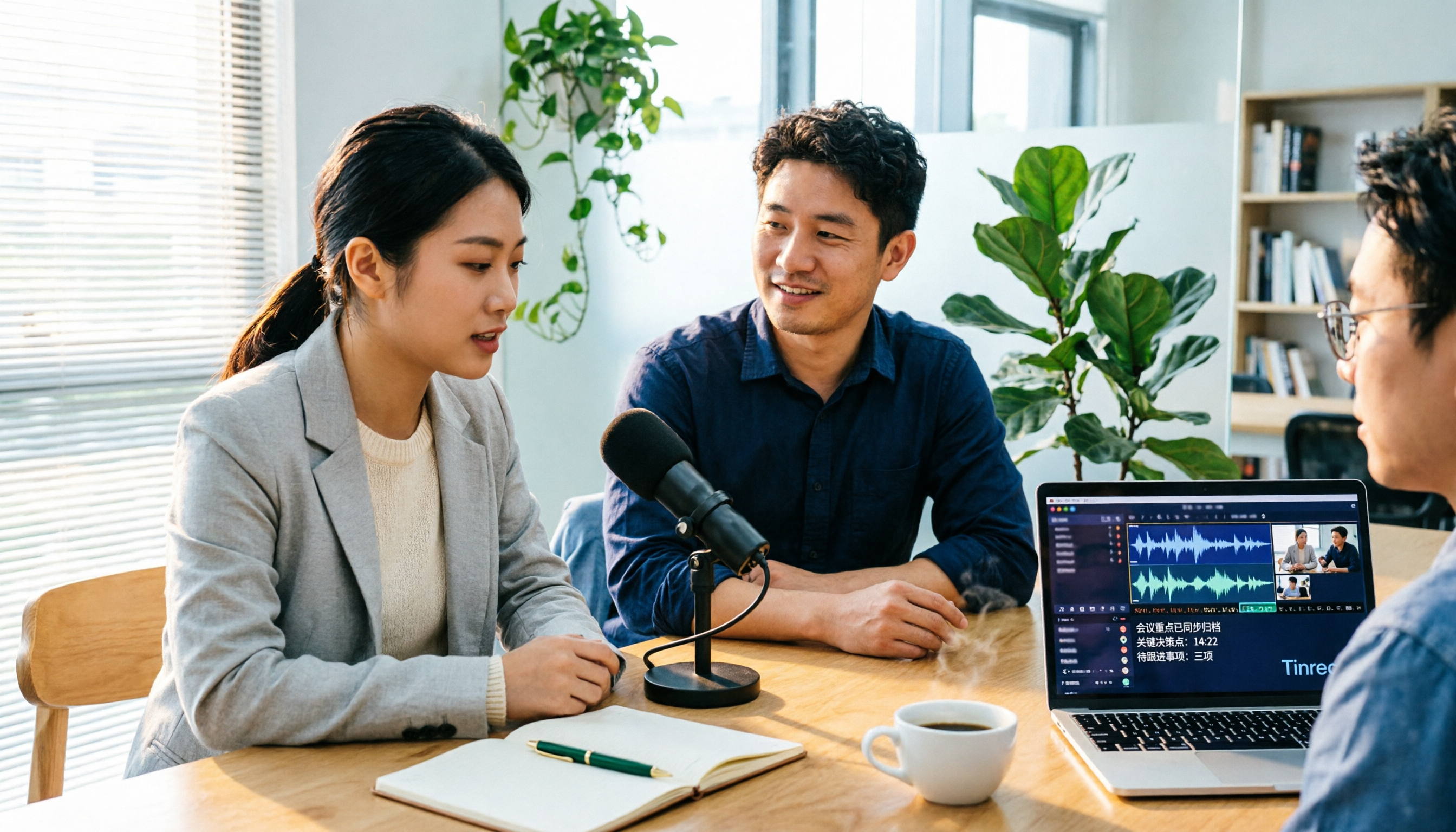
In our test, we held a ~40-minute discussion on Google Meet without inviting any meeting bot. We opened Tinrec's desktop version to capture system audio, and the transcript appeared in sync during the meeting. This is very practical for teams that don't want a bot joining the meeting. Tinrec also supports uploading existing audio or video files, suitable for organizing historical meetings and interview recordings.
After the meeting: summaries, chapters, and action items all at once
As soon as the meeting ends, Tinrec automatically generates a summary and chapters, breaking long meetings into readable sections. Even more useful is action item extraction—who is responsible for what and when it's due, organized from the discussion. For a project weekly meeting, this saves the time of manually organizing action items after the meeting. It can also generate mind maps to help understand relationships between topics.
The most noticeable difference: AI Q&A, ask directly about meeting highlights
Tinrec supports AI Q&A around meeting content. For example, you can ask: "Who mentioned the budget adjustment in the last meeting?" It doesn't just give you keyword search results but answers directly based on semantic understanding. Most competitors at the same price point currently lack this feature. After recording, historical meetings can also be queried further, which is much faster than manually flipping through transcripts for those who need to trace decision context.
Stop organizing recordings by hand
Upload audio or video and automatically get a transcript, summary, and action items
Other notable features
- Real-time translation: for cross-language meetings, you can view original text, translation, or bilingual content.
- Multi-format export: results can be taken to Notion, Google Docs, OneNote, Dropbox, etc. for further use.
- Agent post-processing: generate reports, tables, and documents based on meeting content, suitable for post-meeting deliverables.
- Team space: the team version centralizes meeting recordings, transcripts, summaries, and action items in one space, shareable among members. Admins can manage roles, seats, usage, and audits.
Pros summary
- Bot-free recording of online meetings, no extra meeting participants, suitable for external or sensitive meetings.
- Complete post-transcription workflow: summaries, chapters, action items, Q&A, translation, export all in one.
- Team version turns meeting data into team assets; data remains with the team even when members leave.
Limitations to note
The free version has a basic quota; heavy users need to upgrade. Also, Tinrec's accuracy can be affected by recording quality, background noise, accents, and overlapping speakers; for important content, it's recommended to verify with transcript timestamps and recording playback. For team version capabilities, please refer to the official purchase page before public promotion.
Who it's for
If you frequently hold online meetings, don't want a meeting bot to join, need Chinese meeting notes, and want to use AI to find key points, extract action items, and export to work documents after the meeting, Tinrec is a very suitable choice. For team use, its team space and seat management also allow meeting data to accumulate continuously.
Besides Tinrec, what other options are there?
Otter.ai
Otter.ai is a mature English meeting assistant. The free version offers 300 minutes per month, and Pro annual billing is about USD 8.49/user/month, supporting Zoom, Teams, and Google Meet. If your meetings are almost entirely in English, Otter offers great value. However, note that its Chinese meeting experience is not its focus, and Tinrec's bot-free desktop recording, Chinese hotwords, and AI Q&A post-processing are smoother in Chinese scenarios. If you only record English meetings, you can include it in your comparison.
Granola
Granola is also a bot-free AI meeting notes tool that transcribes via desktop system audio and microphone. It has a free version, and Business is USD 14/user/month. Its feature is combining user handwritten notes to generate content, but Granola does not support uploading pre-recorded audio files and does not save meeting audio. If you need to keep recordings, organize historical files, or import existing audio, Tinrec is more complete in this regard.
PLAUD Note / NotePin
PLAUD is a representative of AI recording hardware. NotePin costs USD 159, Note Pro is USD 189, and membership plans are extra. It's suitable for those who like portable recording and phone call recording. But you need to buy an additional device, whereas Tinrec can handle online meetings and file imports directly via web, desktop, and mobile without extra hardware. If you already have a PLAUD device, the two can be used together; if not, starting with a software solution is more budget-friendly.
Pitfall guide: 4 most common mistakes when choosing meeting notes tools
Pitfall 1: Only looking at transcription accuracy, ignoring post-meeting organization
Many tools advertise "98% accuracy," but the value of meeting notes is not just transcription. What really takes time is organizing key points, extracting action items, and looking back for decisions. If the tool only gives a transcript, you still have to read it all yourself. When choosing, put "summaries, action items, AI Q&A" on equal importance with "transcription."
Pitfall 2: Thinking a meeting bot must join
Meeting bots are convenient, but not all meetings are suitable. For external client meetings or sensitive internal discussions, an extra bot may make people uncomfortable. Now there are bot-free desktop recording methods, such as Tinrec's desktop version directly capturing system audio, without a bot becoming a participant. If your meeting types are diverse, this is a more flexible choice.
Pitfall 3: Ignoring team data ownership
For personal use, storing data in your own account is reasonable. But for team use, if a member leaves, will meeting notes be taken away? Tinrec's team version data is owned by the team; when a member exits or loses their seat, their responsible resources can be handed over to other members. When choosing a team plan, be sure to clarify data ownership and handover mechanisms.
Pitfall 4: Buying a tool but only using transcription
Using an AI meeting tool only as "voice-to-text" means using only one-third of its capabilities. For example, Tinrec's AI Q&A lets you directly ask "What was the budget conclusion this quarter?" without manually flipping through a 30-minute transcript. Team hotwords, real-time translation, and Agent-generated reports are the same. After buying, spend 10 minutes familiarizing yourself with these features—the time saved will be more than you imagine.
Conclusion: Which one should you choose?
Overall, if your need is "meeting transcription" and you want to use it directly afterward, Tinrec is our top pick after testing. The reason is simple: it puts bot-free recording, Chinese transcription, AI summaries, action item extraction, AI Q&A, export, and team space into one workflow.
Scenario-based recommendations:
- Need bot-free recording of Zoom, Meet, Teams meetings → Tinrec
- Meetings mix Chinese and English, need Chinese and multilingual processing → Tinrec
- Want to use AI to ask "What was the conclusion of the last meeting?" after the meeting → Tinrec
- Team needs to share meeting data, manage seats and usage → Tinrec team version
- Budget is 0, and meetings are almost entirely in English → Otter.ai (free version 300 minutes/month)
- Prefer portable recording hardware → PLAUD Note / NotePin
We suggest starting with Tinrec's free version, running your own meeting recording through it, and seeing if the transcript, summary, and AI Q&A meet your expectations. If you find it useful, consider upgrading—no need to pay from the start.
References
- 搞定會議紀錄!AI語音轉逐字稿怎麼做?Gemini Notebook、Gemini、EchoScript操作解析|104職場力
- 會議紀錄用AI怎麼做?會議逐字稿如何整理?|AI語音轉逐字稿教學|104職場力
- 最近蠻多人問我,有沒有什麼 AI 工具可以做會議記錄? 他們現在還是手工打字,常常沒法一心二用,又蠻浪費時間。 我一律回答 —— SeaMeet 為什麼推薦?幫大家整理重點: -綁 Google Meet,線上會議同步轉逐字稿,又有即時摘要,超方便。 -不用特別重新整理,會議結束後,直接發信給所有會議參與者。 -操作簡單到爆,完全沒玩過 AI 工具的中老年人,我 10 分鐘就教會他們。 -實體會議
- 我花四小時做了一個 AI 會議記錄工具,成本不到十塊台幣 | WenHao Yu
- Meeting Ink - 2026 AI 會議紀錄工具實測|7 款語音轉文字與摘要速度大比拚 | Meeting Ink - AI 會議紀錄助手 自動轉錄逐字稿總結會議摘要
Turn every recording into actionable outcomes
Get 60 free transcription minutes when you sign in. No credit card required.
Related Reading
You might also like

Instant Messaging Benefits in 2026: 5 Key Advantages and How to Fill the Meeting Notes Gap
Instant messaging is fast, free, and versatile, but messages get lost after meetings. This article breaks down 5 key benefits of instant messaging and explains how Tinrec uses live transcription, AI summaries, action item extraction, and team spaces to bring those benefits into meetings.

Tinrec vs Notta 2026: 5-Dimension Comparison for Chinese Meeting Notes
How to choose a meeting notes generator in 2026? This article compares Tinrec and Notta across five dimensions: Chinese recognition, meeting entry methods, post-meeting value, pricing, and team collaboration. It explains how Tinrec uses bot-free online meeting recording, AI summaries and Q&A, and team spaces to turn meeting recordings into searchable, trackable, and useful data.

iPhone Recording Not Showing in 2026: 5 Troubleshooting Steps + Tinrec Comparison
When iPhone recordings don't show up, it could be due to iCloud sync, iOS version, or permission settings. This article outlines 5 troubleshooting steps and compares iPhone's built-in Voice Memos with Tinrec in terms of recording visibility, transcription organization, cross-platform access, and team collaboration to help you choose the right recording workflow.
Tinrec vs Notta 2026: 5-Dimension Comparison for Video-to-Text in Chinese Scenarios
How to choose a video-to-text tool? This article compares Tinrec and Notta across 5 dimensions, from meeting recording methods, post-transcription processing, Chinese language experience to team data management, and organizes practical use cases, purchasing considerations, and FAQs to help you determine which tool better fits your needs.

2026 Comparison of 5 Meeting Summary Generators: How to Choose for Chinese Meetings, Bot-Free Recording, and Team Plans
How do you choose a meeting summary generator? This article compares 5 common approaches, breaking down meeting capture methods, Chinese transcription, post-meeting organization, and team knowledge retention. Using Tinrec as a practical example, it helps you decide where to invest your budget and time before purchasing.

4 Traditional Chinese Transcription Tools Compared: Which One Lets You Query Key Points with AI Right After Recording?
How do you choose a Traditional Chinese transcription tool? This article compares Tinrec, Yating Transcription, MyEdit, and Google Recorder App from real-world usage scenarios, covering 5 key selection criteria, 4 common pitfalls to avoid, and selection advice. It also explains features like AI Q&A, bot-free meeting recording, export workflows, and team collaboration to help you find the transcription tool that best fits your workflow.

4 Course Lecture Transcription Tools Tested: Which AI Summary Actually Saves You Time?
Recorded lectures all semester but never opened them? This article tackles common mistakes and tests four course recording transcription tools—Tinrec, Notta, Otter.ai, and TurboScribe. It covers four key buying factors: Chinese recognition, post-transcription AI summaries and Q&A, online class recording methods, and free tiers. Includes a pitfalls guide and scenario-based recommendations.

5 Best AI Meeting Minutes Generators in 2026: Real-World Comparison to Save You Time
Tired of spending hours organizing meeting minutes after the meeting ends? This article compares Tinrec, Otter.ai, Notta, Granola, and other tools across five key aspects: Chinese language recognition, bot-free recording, post-meeting summaries and action items, AI Q&A, and team data ownership. We break down who each tool is best for, where its limitations lie, and provide buying advice for different scenarios.

2026 Smartphone Recording Features Compared: Built-in, Call Recording, and AI Transcription—Which Is Enough?
How do you enable recording on your phone? This guide covers the steps for call and in-person recording on ASUS, Samsung, iPhone, Motorola, and Huawei, plus key legal reminders for recording consent in the U.S. Then it compares Tinrec, Otter.ai, Notta, and PLAUD for post-recording organization to help you decide which approach saves the most time.