

Turn recordings into transcripts and summaries in minutes
Upload audio or video for multilingual transcription, AI notes, and action items
2026 AI Office Tools Free Plans Compared: 4 Options Reviewed
"I've installed a bunch of AI tools, but meeting notes still aren't done" — What you're missing isn't tools, it's a workflow
I have about 15 meetings a week. Over the past few years, the question colleagues ask me most is "Which AI office tool is best?" And the most common misconception I hear is: "Just install a few more—this one for slides, that one for translation, another to take notes for me."
I thought the same way last year. The result was that I only used 10% of each tool, and after meetings ended, I still had to organize everything myself.
You've definitely encountered these three scenarios:
Scenario 1: After the weekly meeting, your boss asks, "Who was responsible for that budget item last time?" You flip through notes, LINE messages, and emails for three minutes but still can't answer.
Scenario 2: In cross-department coordination, things agreed verbally in the meeting weren't written down. Two weeks later it becomes "I thought you would do it."
Scenario 3: You recorded an online meeting, but it's gathering dust in cloud storage. Because you'd have to listen to 50 minutes again just to find that critical 3 minutes.
The real problem isn't that there aren't enough tools—it's that there's no single set of tools that handles the entire "meeting" process from start to finish: record → understand → act → collaborate. If you only "record" or "transcribe," you've only completed half the job.
Before choosing an AI office tool, understand these 4 key points
1. Does it solve "recording" or "using"? Many tools simply convert voice to text. But a transcript is just raw material, not a finished product. What you really need is "What was the conclusion of this meeting, what are the action items, who's responsible"—these can only be generated through summaries, chapters, action items, and AI Q&A.
2. For online meetings, is it a "bot joining" or "desktop recording"? The common approach is to send a meeting bot to join. The problem is that when meeting with clients, an unfamiliar account appears on their list, and sometimes you have to explain it. Another approach is to capture the computer's system audio directly from the desktop, so no extra participant appears in the meeting.
3. How is the free quota calculated? For free versions, what matters isn't "how many minutes" but "is it enough for you to finish your meetings in a week." Some free versions have a per-session limit (e.g., max 3 minutes per session), so a 40-minute meeting has to be split into several parts—that's not free, that's a hassle.
4. Does the data belong to the individual or the team? This is the most overlooked point. If meeting notes are stored in personal accounts, when the responsible colleague leaves, the data scatters. To use it as a team asset, you need to check if it has team spaces, member and seat management.
Once you think through these four points and look back at the various tools, you'll find there aren't many choices.
Tinrec — The one I kept after testing
Bottom line first: out of the four, the one I kept in my workflow is Tinrec.
Tinrec is an AI meeting notes and collaboration tool for individuals and teams, available on web, desktop, and mobile. Its positioning isn't just "audio-to-text" but turning meetings into searchable, queryable, actionable data.
How does it handle meetings? The desktop version captures system audio directly, handling online meetings on Zoom, Google Meet, Microsoft Teams, and Webex without inviting a meeting bot. This is key for me—when meeting with external clients, no unfamiliar account appears on the list. While the meeting is in progress, the transcript is generated simultaneously; when the meeting ends, the summary, chapters, and action items are also ready, making it clear who's responsible for what and what's next.
After recording is where the real value is. The transcript is just the starting point. Tinrec lets you ask questions directly about the meeting content, such as "Who mentioned the budget in the last meeting?" It doesn't give you a bunch of keyword search results but answers directly. This makes a huge difference when reviewing old meetings—previously I'd Ctrl+F and search slowly, now I just ask. It can also generate mind maps, reports, tables, and documents, and export results to Notion, Google Docs, OneNote, Dropbox for further processing. For cross-language meetings, there's real-time translation, allowing you to view the original, translation, or bilingual comparison.
How I tested it. I tried it on a roughly 45-minute cross-department online meeting (Teams, desktop recording, multiple speakers taking turns, content mixed with English product terms). After the meeting, I got a searchable transcript plus summary and action items. Honestly, where multiple people talk over each other, you still need to go back to the recording to verify—that's normal; but the "post-meeting organization" that used to take half an afternoon now takes about ten minutes to wrap up, and action items go straight into the group chat.
Three most practical points I found:
Stop organizing recordings by hand
Upload audio or video and automatically get a transcript, summary, and action items
- No meeting bot needed. The desktop version captures system audio, so no unfamiliar participant appears in external meetings—especially noticeable for sales and customer success teams.
- There's more after the transcript. Summaries, chapters, action items, AI Q&A, mind maps, reports, and tables—essentially connecting "meetings" directly to "work."
- Handling Chinese and mixed Chinese-English. Supports Chinese, Traditional Chinese, and multilingual meeting scenarios, and you can maintain team hotwords to feed internal product codes and terminology, making recognition more practical.
It's not without limitations. The free version provides a basic quota, fine for trying a few meetings, but if you're a heavy user who meets daily and organizes lots of historical files, you'll need to upgrade. Also, transcription accuracy is affected by recording quality, background noise, accents, and overlapping speakers; for important decisions, it's best to verify against the recording and timestamps rather than relying entirely on AI. For plan and quota details, refer to the official purchase page.
If you need a team, not just an individual. The team version is a separate team space, not "multiple people sharing one account." Meeting data belongs to the team; admins can manage members, roles, and seats, view usage trends and member details, and query and export audit logs; audio moved to trash can be restored within 30 days. When a member leaves or is removed, their team resources can be transferred to other active members, so data doesn't leave with the person. Currently, the team version offers a 7-day trial for first-time eligible users (1 free seat, 300 minutes of team shared import quota); paid seats are USD 29.80/month or USD 199/year (about USD 16.58/month), each paid seat provides 2,000 minutes of team shared import quota per month, and real-time recording under an active plan is currently not deducted by minutes. Actual prices and benefits are subject to the official purchase page.
Who is it for? If you mainly hold Chinese meetings, don't want a bot in the meeting, and want to use AI to find key points, generate action items and reports right after recording—Tinrec is the closest to this need among the four.
Besides Tinrec, what other options are there?
Otter.ai A mature AI meeting assistant, strong for English business meetings, free version 300 minutes per month, Pro annual billing about USD 8.49/user/month. If 90% of your meetings are in English and your team works entirely in English, it's still a great choice. However, its Chinese meeting organization, real-time bilingual translation, and team hotwords are relatively weak—and these are exactly what Chinese teams use daily.
Notta The competitor with the highest overlap with Tinrec, offering multi-platform transcription, meeting notes, document import, translation, and team plans. Free version 120 minutes per month, max 3 minutes per session; Pro annual billing about USD 8.17/month. Its strength is the breadth of transcription and subtitles. But bot-free desktop recording of online meetings, post-meeting AI Q&A, and Agent post-processing (directly generating reports, tables, and documents) are harder for it to match.
Granola An AI meeting note tool that also takes the bot-free route, using desktop to capture system audio and microphone, combined with your handwritten notes to generate content. Basic is free, Business is USD 14/user/month. Note that it doesn't support uploading pre-recorded audio files and doesn't save meeting audio files. If you need to keep recordings, replay for verification, or organize past meeting files, this will be a blocker—and keeping recordings and file import are exactly Tinrec's daily use.
Pitfall guide: 4 most common mistakes when choosing AI office tools
Pitfall 1: Only looking at advertised accuracy. No one can guarantee a fixed number. The same tool performs very differently in a quiet office versus a meeting room with air conditioning noise, keyboard sounds, and multiple people talking over each other. The best approach is to run your own meeting recordings through the free version, not just look at ads.
Pitfall 2: Treating the transcript as meeting notes. A transcript is raw material, not a finished product. A 60-minute transcript won't tell you "what the conclusion is, who does what." When choosing a tool, ask: can it provide summaries, action items, and queryable Q&A?
Pitfall 3: Ignoring "how the meeting gets recorded." If you have to manually pull a bot into every meeting or can only upload files afterward, you'll probably get lazy after two weeks. The more seamless the recording process, the more it will actually be used.
Pitfall 4: Only looking at personal versions, forgetting data ownership. This is the most common pitfall for teams. Data stored in personal accounts scatters when people leave. If you want meeting content to become a long-term reusable team asset, choose a tool with team spaces, member roles and seat management, and data handover—this is why I later brought my team onto Tinrec's team version.
Conclusion: Which one should you choose?
In one sentence: if you hold Chinese meetings, don't want a meeting bot to join, and want to use AI to ask for key points right after recording, Tinrec is the most suitable among the four.
Scenario recommendations for reference:
- Chinese-dominant, mixed Chinese-English meetings → Tinrec (supports Chinese, Traditional Chinese, and multilingual, plus team hotwords)
- Don't want a bot in meetings, client meetings need to be low-key → Tinrec (desktop captures system audio directly)
- After recording, want to directly ask "What's the conclusion, who's responsible" → Tinrec (AI Q&A is its core differentiator)
- Meeting data needs to stay with the team, members may change → Tinrec team version (team space, seat management, data handover, audit logs)
- Almost all English meetings, team already works in English → Otter.ai (the only exception in this article)
You don't have to jump to paid right away. Start with the free version's basic quota, run two or three of your most common meeting types, and see if the transcript and summary are sufficient for your actual scenarios; if they work, then decide whether to upgrade based on how many meetings you hold per week.
References
- 2026 Global 19 Strongest AI Tools Recommendation! Latest Top100 AI Hot List Here!
- Top 20 Must-Have AI Tools for the Workplace! Expert: 90% of Workers Will Need to Know AI in the Future | 104 Workplace
- Office AI Tools Decoded: Actually Asana Alone Is Enough? | Master Concept
- [AI Lazy Pack] Just Read This! 2026 Recommended AI Free vs Subscription Tools, Improve Work Productivity & Workplace Competitiveness! (Continuously Updated) | 104 Workplace
- 12 Best AI Productivity Tools You Can't Miss in 2026
Turn every recording into actionable outcomes
Get 60 free transcription minutes when you sign in. No credit card required.
Related Reading
You might also like

2024 AI Meeting Tools Compared: Which One Actually Turns Meetings into Action Items?
From the perspective of a mid-level manager who attends 15 meetings a week, this article breaks down common pitfalls when choosing app-based AI office tools in 2024. It explains core capabilities like live transcription, AI summaries and chapters, action item extraction, and AI Q&A, using Tinrec as an example to illustrate real-world use cases, purchasing considerations, and differences between personal and team plans.

5 Free AI Office Tools Tested for 2026: Which One Gives Students Enough Free Usage?
Opening your folder before finals and realizing you never organized a semester's worth of recordings? This article tests 5 free AI office tools from a student's perspective, covering free quotas, mixed Chinese-English recognition, AI Q&A, and cross-platform support. Find out which one actually saves review time and which 'free' plans hide single-use limits.

How to Choose an AI Office Toolbox in 2026: 5-Step Review and Buying Guide
Tired of juggling a dozen AI tools while still working overtime? This guide breaks down the 4 key factors for evaluating an AI office toolbox based on real work scenarios. We test Tinrec's bot-free meeting notes, AI Q&A, and team spaces, and briefly review Otter.ai, Notta, and Granola for their best use cases. Includes a pitfalls guide and selection advice.

Tinrec vs Otter.ai 2026: 5-Dimension Comparison — Which AI Meeting Tool Should You Choose?
There are countless AI office tools, but when it comes to meeting notes and team collaboration, should you choose Chinese-focused Tinrec or English business meeting veteran Otter.ai? This article compares them across 5 dimensions—Chinese transcription, bot-free recording, post-meeting workflow, team governance, and input sources—to help you decide which one better fits your team and budget.

2026 Free AI Office Tools Buying Guide: 4 Tested Picks and Recommendations
There are plenty of free online AI office tools, but free versions often limit session length, struggle with Chinese recognition, or lack key features. Based on real meeting scenarios, this guide covers 4 key factors for choosing a free AI office tool, compares the free tiers, Chinese support, and post-meeting organization of Tinrec, Otter.ai, TurboScribe, and Granola, and includes 4 common pitfalls to avoid plus scenario-based recommendations.

2026 AI Office Tools Free Plan Roundup: 4 Tools Tested and Compared
Compare the free plans and hands-on performance of four AI office tools—Tinrec, Otter.ai, Notta, and Granola—covering Chinese meeting transcription, bot-free recording, and team knowledge retention to help you find the best meeting notes tool.

Best AI Office Tools Online in 2026: 7 Tested, This One Leads for Chinese Meeting Notes
Looking for AI office tools you can use online for meeting notes, interview summaries, and team collaboration? We tested 7 web-based options—Tinrec, Otter.ai, Fireflies.ai, Notta, Granola, TurboScribe, and built-in platform transcription—comparing highlights, free tiers, and ideal users, plus our selection method and usage tips.
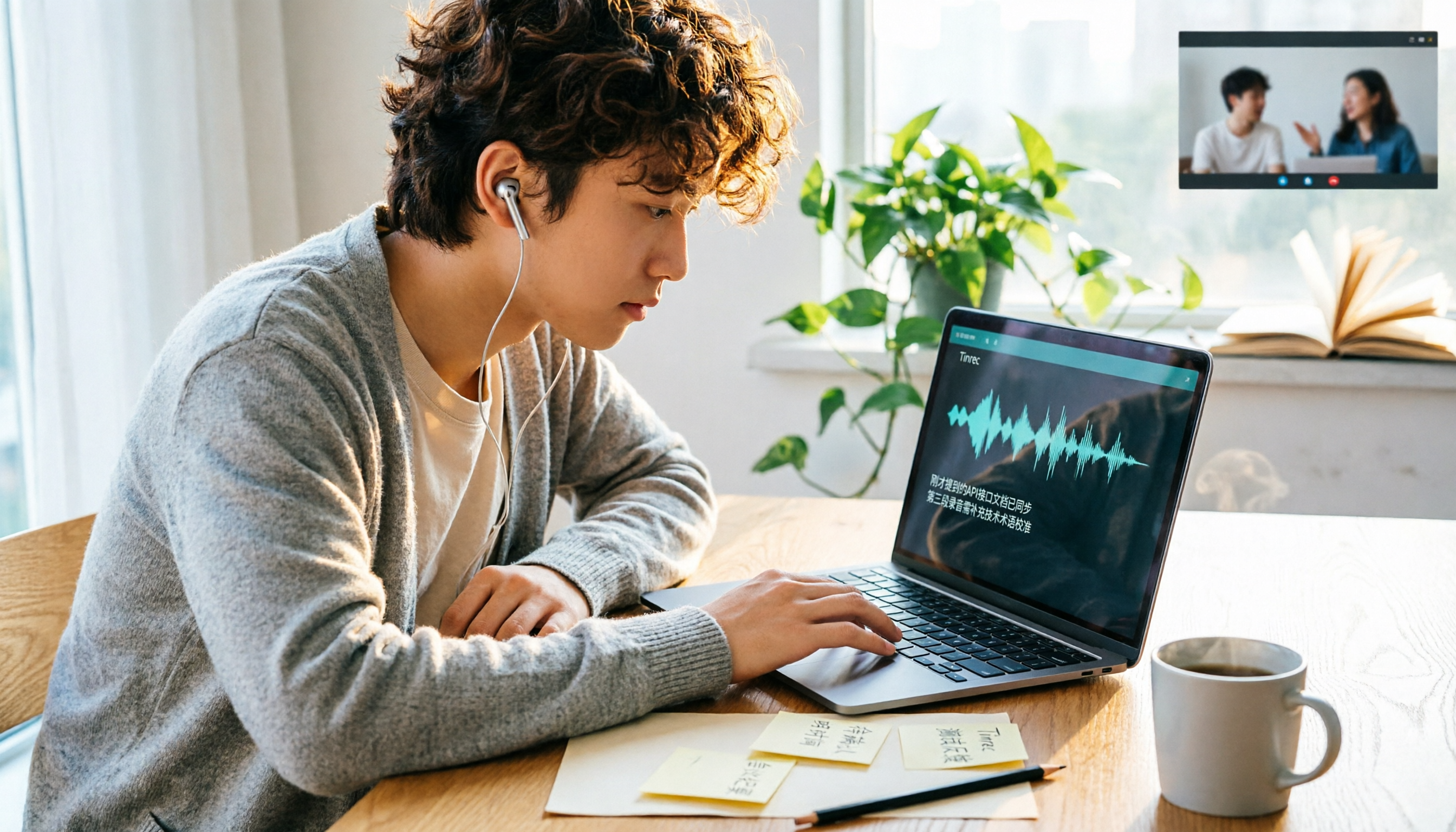
How to Choose the Best AI Office Tool in 2026: 5 Steps to Find Your Perfect Match
How to choose the best AI office tool in 2026? This guide starts from real student scenarios and walks you through 5 steps to decide which tool fits you: clarify your pain points, compare recording storage, online meeting recording methods, Chinese recognition, and free quotas. It also shares hands-on experience with Tinrec, including its limitations and team plan benefits, and wraps up with alternatives like Otter.ai, Notta, and Granola, plus common pitfalls to avoid.

4 AI Office Tools Compared for 2026: Which Is Easiest to Learn and Fastest to Master?
A 2026 side-by-side comparison of 4 AI office tools, focusing on learning curve and breaking down setup barriers, Chinese language support, post-meeting organization, and team adoption. Tinrec stands out as the top pick for its no-bot recording, AI Q&A, action item extraction, and team workspace, with comparisons to Otter.ai, Granola, and Notta on differences and ideal users.