
Turn recordings into transcripts and summaries in minutes
Upload audio or video for multilingual transcription, AI notes, and action items
Why You Need Video Summary AI Tools?
Whether it's a two-hour online course, a Teams or Google Meet recording, or a tutorial video on YouTube or Bilibili, the traditional "pause and type" note-taking method is extremely inefficient. Foreign language videos or content without captions are even harder to grasp quickly. In modern work and learning, people need a solution that quickly transforms "time-based content" into scannable, searchable, and actionable text.
This article will review the mainstream video summary AI tools on the market, provide a detailed evaluation comparison table, recommend 3 high-quality tools, and give specific step-by-step instructions. After reading, you'll learn how to convert videos into valuable text assets with one click.
Quick Navigation Tips:
- If you like to control AI prompts yourself and don't mind extra steps → Choose "Subtitle download extension + ChatGPT"
- If you focus on short videos and social media content analysis → Refer to "BibiGPT"
- If you need high-accuracy transcripts directly from video links and value subsequent query conversations and action items → Prioritize "Tinrec"
Core Evaluation Dimensions and Comparison Table for Video Summary AI Tools
When selecting tools, don't just consider whether they can convert to text; evaluate their "post-processing capabilities." Here are 6 key dimensions for choosing video summary AI tools and comparison of mainstream solutions:
| Dimension | ChatGPT + Subtitle Extension | BibiGPT | Tinrec (MiaoTing) |
|---|---|---|---|
| Operation Method | Manually download subtitles and paste into AI | Paste video URL | Supports URL paste, file upload, and live recording |
| Language Support | Depends on original subtitles and GPT capabilities | Multi-language support | Auto-detects 10 languages including Chinese, English, Japanese, Korean |
| Summaries and Action Items | Need to write your own prompts | Supports outline summarization | Auto-generates meeting minutes, conclusions, and to-do action items |
| AI Conversational Query | Supports dialogue but easily limited by token count | Supports dialogue and node jumping | Supports semantic AI dialogue, precise retrieval of recording highlights |
| Export and Integration | Copy text | Web viewer | Multi-format file export, seamless workflow integration |
| Pricing / Free Tier | ChatGPT free tier has usage limits | Offers limited free trial | Free tier: 100 minutes/month; paid plans start low |
3 Popular Video Summary AI Tools: Recommendations and Hands-on Tests
1. ChatGPT + Subtitle Download Extension
If you only need to summarize videos on Bilibili or YouTube that already have subtitles, this is a flexible combination. You can install a userscript like "Bilibili CC Subtitle Tool" to download subtitles as a .txt file, then copy and send to ChatGPT for key point extraction.
- Pros: High prompt flexibility; you can ask AI to play different roles to interpret content.
- Cons: Cumbersome steps; if the video has no CC or AI subtitles, this method won't work; long videos may exceed GPT's token limit.
2. BibiGPT
This is a tool specialized in summarizing online videos, supporting platforms like Bilibili and Xiaohongshu (Little Red Book). Users paste a URL, the system captures content and generates a summary with corresponding video timestamps.
- Pros: Relatively simple operation; clicking timestamps lets you quickly jump to verify original segments.
- Cons: Weak support for private meeting recordings or local audio files; more suited for public platform content.
3. Tinrec (MiaoTing)
Tinrec is a multi-platform (iOS, Android, Web) AI recording and video summary assistant. It goes beyond converting video to text, creating a complete workflow from recording/video to understanding to action. Whether it's online video links, local audio files, or live meeting recordings, all can be processed with one click.
Stop organizing recordings by hand
Upload audio or video and automatically get a transcript, summary, and action items
- Pros: Supports YouTube/podcast URL parsing; auto-generates structured minutes and to-dos. Built-in AI conversational query lets you "ask" the video directly.
- Cons: Free tier limited to 100 minutes/month; heavy users of long video summaries need to upgrade to Basic or Pro.
Hands-on Tutorial: How to Use AI Tools to Extract Video Highlights and Transcripts with One Click
Below, we use Tinrec's workflow as an example to demonstrate how to convert messy video content into actionable text.
1. Goal Description We aim to produce a full timestamped transcript, key takeaways, and actionable action items from a 30-minute online course or meeting video.
2. Preparation
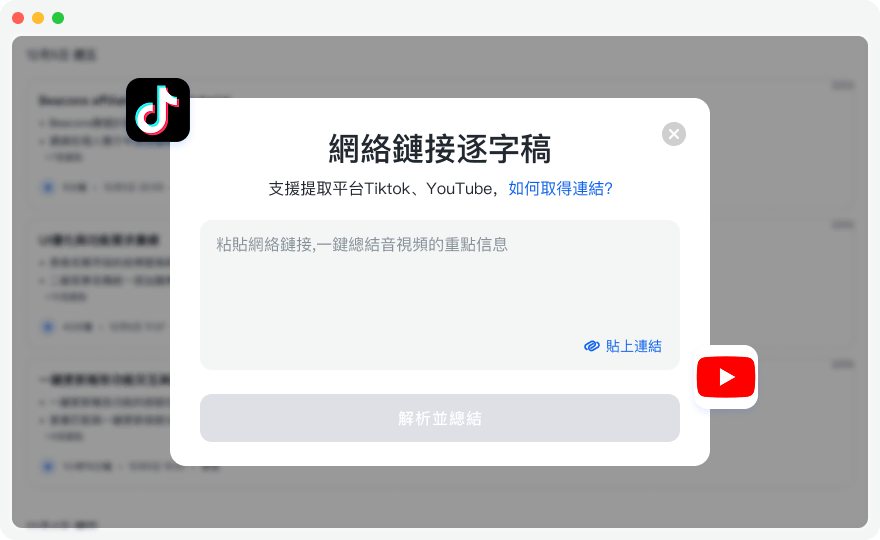
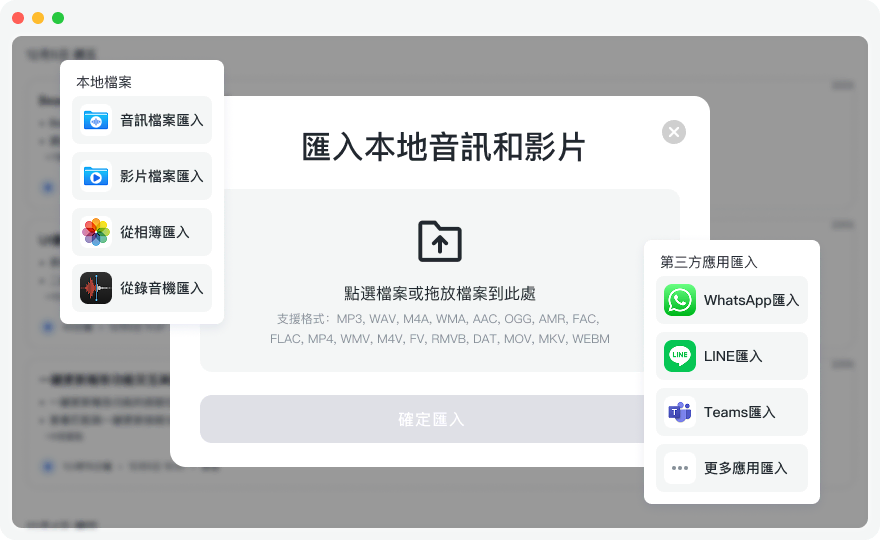
- Obtain the video link (e.g., YouTube URL) or prepare a local audio/video file (e.g., mp3, mp4).
- Ensure the video source has clear human speech, minimizing distracting background music.
3. 5-Step Standard Workflow
- Step 1: Import Video or Live Recording
- Action: For online videos, use the Podcast/Online Video to Text feature and paste the link; for a meeting in progress, turn on Live Recording to Text to capture audio.
- Expected Result: System receives the task and starts processing.
- Note: Make sure the video is set to publicly accessible before pasting the link.
- Step 2: Audio Parsing and Automatic Language Detection
- Action: Import local files using Audio File to Text; the system automatically detects up to 10 languages including Chinese, English, Japanese.
- Expected Result: A preliminary transcript with timestamps and speaker differentiation is generated.
- Note: For multilingual meetings, auto-detection greatly reduces manual language switching hassle.
- Step 3: Auto-Generate Decision Summary and Action Items
- Action: Click the summary panel to view AI-generated content.
- Expected Result: The system condenses the transcript into 3-5 core conclusions and lists follow-up tasks.
- Note: This is the key step to boost efficiency—you don't need to rewatch the video to grasp the big picture.
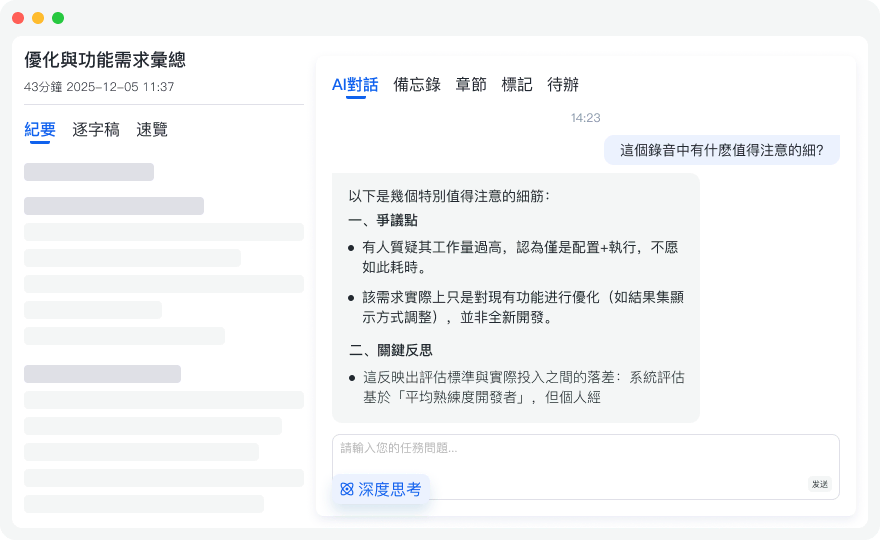
- Step 4: AI Conversational Query for Key Content
- Action: Use the AI Chat feature. In the dialogue box, enter specific questions like "What are the three marketing strategies mentioned in the video?"
- Expected Result: AI gives precise answers based on video content, not just keyword search.
- Note: Treat AI as your personal assistant; the more specific your question, the faster you find information.
- Step 5: Multi-Format Export and Application
- Action: Click the export button and choose the desired format to save.
- Expected Result: Get a clean document for archiving or sharing.
- Note: It's recommended to paste the summary directly into the work group chat and keep the transcript as an attachment for reference.
4. Common Errors and Troubleshooting
- Error: Overlapping speakers causing misidentification.
- Solution: Good tools usually have speaker differentiation; you can manually adjust speaker labels after generating the transcript.
5. Result Acceptance Criteria A "usable" video summary should meet the following: high accuracy in recognizing proper nouns, timestamps precisely matching original video seconds, and action items with clear responsible persons and tasks.

Frequently Asked Questions (FAQ) about Video Summaries and AI Tools
Q1: Can I summarize videos directly on my phone (iPhone/Android)? Most modern AI tools (including Tinrec) support cross-platform use on iOS and Android. You can copy a video link on your phone, open the app, and paste it to parse, or use the phone's microphone for live recording to text.
Q2: Can Teams or Google Meet recordings be converted to text? Yes. Just upload the recording file (mp4 or mp3) downloaded from Teams or Meet to the AI tool, and it will automatically generate a meeting transcript with speaker differentiation and summary notes.
Q3: How accurate are video-to-text transcripts? What about technical terms? Current mainstream models (e.g., Whisper) have high recognition rates. If the audio quality is clear, accuracy often exceeds 90%. For rare technical terms, use the AI conversational query feature to compare context and manually correct in the generated transcript.
Q4: Is there a free tier to test video summary features? Yes. Many tools offer basic free tiers; for example, Tinrec's free version provides up to 100 minutes of recording and video parsing per month, suitable for light users or initial testing.
Q5: Can AI tools summarize videos without captions? Absolutely. Good video summary tools directly parse the audio track of the video, converting speech to text via AI, so even if the creator didn't upload subtitles, a transcript can still be produced.
Q6: Can I translate the generated summary into another language? Some tools that support multiple languages can identify foreign languages during transcription and, via AI chat, allow you to request "Please translate the above summary into English." This is very helpful for learning overseas courses or handling cross-border meetings.
Turn every recording into actionable outcomes
Get 60 free transcription minutes when you sign in. No credit card required.
Related Reading
You might also like

How to Transcribe Interview Recordings in 2026: 5 Steps from Audio to Transcript
Transcribing interview recordings isn't about finding the tool with the highest accuracy—it's about building a workflow from recording to transcript. Using Tinrec as an example, this article walks you through real-time transcription, AI summaries, AI Q&A, multi-format export, and team collaboration, plus 5 buying tips and FAQs.

How to Choose a Transcription Tool for Students in 2026: 5-Step Guide
From not being able to finish taking notes in class, to no one remembering the conclusions of group discussions, to needing to transcribe interviews for graduation projects—this article uses a student's perspective to outline 5 steps for choosing a recording-to-text tool, and shares how Tinrec is used in classrooms, discussions, interviews, and online courses.

Free YouTube Video Analysis Options in 2026: A Look at Tinrec's 3 Plans
YouTube videos too long and you just want the highlights? This article rounds up free YouTube video analysis options in 2026 and uses Tinrec as an example to show how to turn video links or audio files into transcripts, AI summaries, chapters, to-dos, and Q&A notes. It also compares the free version, individual paid plans, and team plans to help you decide which approach best fits your viewing and organizing habits.

4 Short Video AI Summary Tools Tested: Which One Best Captures Key Points from Course Videos?
As a senior information management student, I used AI video summary tools this semester to turn online courses, lecture videos, and my own class recordings into reviewable notes. This hands-on comparison of 4 short video AI summary tools breaks down 4 key points to consider when choosing, 4 common pitfalls, and which tool fits which use case.

Tinrec vs PLAUD Note 2026: 6-Dimension Comparison for Audio Transcription — Which Should You Choose?
Many people think audio-to-text transcription is simple, but the real challenge is that the output isn't directly usable. This article compares Tinrec and PLAUD across six dimensions—ease of use, online meetings, post-meeting organization, Chinese translation, team governance, and pricing—to help you decide which approach better fits your needs.

Tinrec vs Notta 2026: 5-Dimension Comparison for Chinese Speech Recognition
How can Chinese speech recognition be used for meeting notes? This article uses Tinrec as an example to walk you through 5 steps: recording, transcription, proofreading, generating meeting minutes, and exporting. It also compares Tinrec and Notta across 5 dimensions and answers common questions about free quotas, online meeting recording, and team collaboration.

2026 Video Content Organization Tools Compared: Which Course Video Summarizer Saves the Most Time?
Discovering 18 hours of course videos before finals? This student-tested comparison of 4 video content organization tools covers Chinese course video transcription, AI summary chapters, conversational queries, and free version limits. Learn which tools suit remote classes, English courses, and group projects to find the one that truly saves time.

5 Best Audio to MP3 Converters in 2026: Free Online Tools Compared, Plus How to Turn Audio into Transcripts
Which audio to MP3 converter should you use? This guide compares five free online tools—Online Audio Converter, AConvert, Transcribe, VEED.IO, and FlexClip—across four key dimensions: supported formats, audio quality settings, ease of use, and file privacy. It also explains how Tinrec picks up where converters leave off, turning meetings and interviews into transcripts and action items.

2026 Comparison of 3 Google Audio-to-Text Solutions: Why Tinrec Is the More Complete Choice
How do you turn recordings in Google Drive into text? This article compares Google Docs voice typing, Google Cloud Speech-to-Text, and Tinrec, explaining how Tinrec fills the second half of the workflow with bot-free online meeting recording, existing audio file import, AI summaries, and conversational queries. It also breaks down personal and team plans, seats, and quota details to help you make a purchasing decision.