

Turn recordings into transcripts and summaries in minutes
Upload audio or video for multilingual transcription, AI notes, and action items
"If you could only read one first, would you choose Sweat or Ruined?"
This is where most people get stuck when looking into Lynn Nottage's work. She has won the Pulitzer Prize for Drama twice and remains the only woman to have done so, but most online resources stop at listing awards and rarely tell you directly which play suits you right now.
This article is not an encyclopedia entry. I've organized the five plays worth reading first, the key factors for choosing, and how to capture your discussions afterward—all in one place.
The challenge with reading Nottage isn't usually the English
The first issue is too many choices. She has been writing from the 1990s to the present, with works spanning different eras and cities. The awards line up, but you don't know where to start.
The second issue is that discussions evaporate. Everyone talks enthusiastically at a play reading group, but two hours later when it ends, no one remembers who mentioned the pacing problem in a particular scene, and the next meeting starts from scratch.
The third issue is picking the wrong first play. Her plays don't all share the same tone. If you happen to start with one that doesn't resonate, it's easy to misjudge her style.
None of these problems are hard to solve—first figure out what you want, then choose a play; then find a way to turn discussions into text. Let's start with how to choose.
Before choosing her plays, understand these 4 key points
1. Awards are a reference, not a ranking
Nottage's two Pulitzer Prizes for Drama were awarded for Ruined in 2009 and Sweat in 2017. She was the first—and remains the only—woman to win twice. Winning means critical acclaim, but it doesn't mean it will be the smoothest read for you.
2. Decide which era you want to explore
Her works span from the 20th to the 21st century, with settings ranging from a sandwich shop to a tailor's workshop. To understand her overall concerns, it's best to read one play from each era.
3. Do you care about the text or the production?
Some plays have notable stage versions to reference, such as the 2004 production of Intimate Apparel starring Viola Davis; it was later adapted into an opera composed by Ricky Ian Gordon and directed by Bart Sher, commissioned by The Met/Lincoln Center. Knowing whether you want to read the script or see a production will affect which play you choose.
4. Are you reading alone or with a group?
Reading alone, the focus is on textual rhythm and characters. For a play reading group, classroom read-aloud, or theater workshop, the focus shifts to "how to capture the discussion," which determines what tools you need to prepare.
5 Lynn Nottage plays most worth reading first
Let me give you the bottom line first. Her plays mostly focus on the working class, marginalized communities, and race relations in America. Her characters are almost all flawed, striving to find their place in the world. She herself has said that with every play she writes, she's thinking about "how a person who feels marginalized and invisible can simultaneously be powerful and autonomous."
1. Sweat — the most frequently cited
Her signature work, winner of the 2017 Pulitzer Prize for Drama and that same year the Edward M. Kennedy Prize (for plays inspired by American history). If you only want to read one first, starting with this one is the safest bet.
2. Ruined — her first Pulitzer in 2009
The first of her two Pulitzers. To understand why she is considered one of the most important contemporary playwrights, you can't skip this one.
3. Intimate Apparel — a play born from family memory
Inspired by her great-grandmother's personal experience, it deals with how Black working-class people have been erased from historical records. The 2004 production starred Viola Davis, and it was later adapted into an opera.
4. Fabulation, or The Re-Education of Undine — for her humorous side
This play won Best Play awards from the American Theatre Critics Association and the New York Drama Critics' Circle. If you think her works are all heavy, this one will change your impression.
5. The Darker Side of Verona — back to the beginning
The first play she completed before finishing high school, about an African American theater company touring Shakespeare through the American South. The writing is naturally less mature than her later works, but you can glimpse the themes she would continue to explore.
A bit of background: she is a MacArthur "Genius" Fellow, was named one of Time's 100 Most Influential People in 2019, is currently a professor of playwriting at Columbia University, and is an artist-in-residence at Park Avenue Armory. These titles explain her standing, but to truly know her work, you still have to go back to the plays themselves.
After reading, how do you turn discussions into usable notes? How to use Tinrec
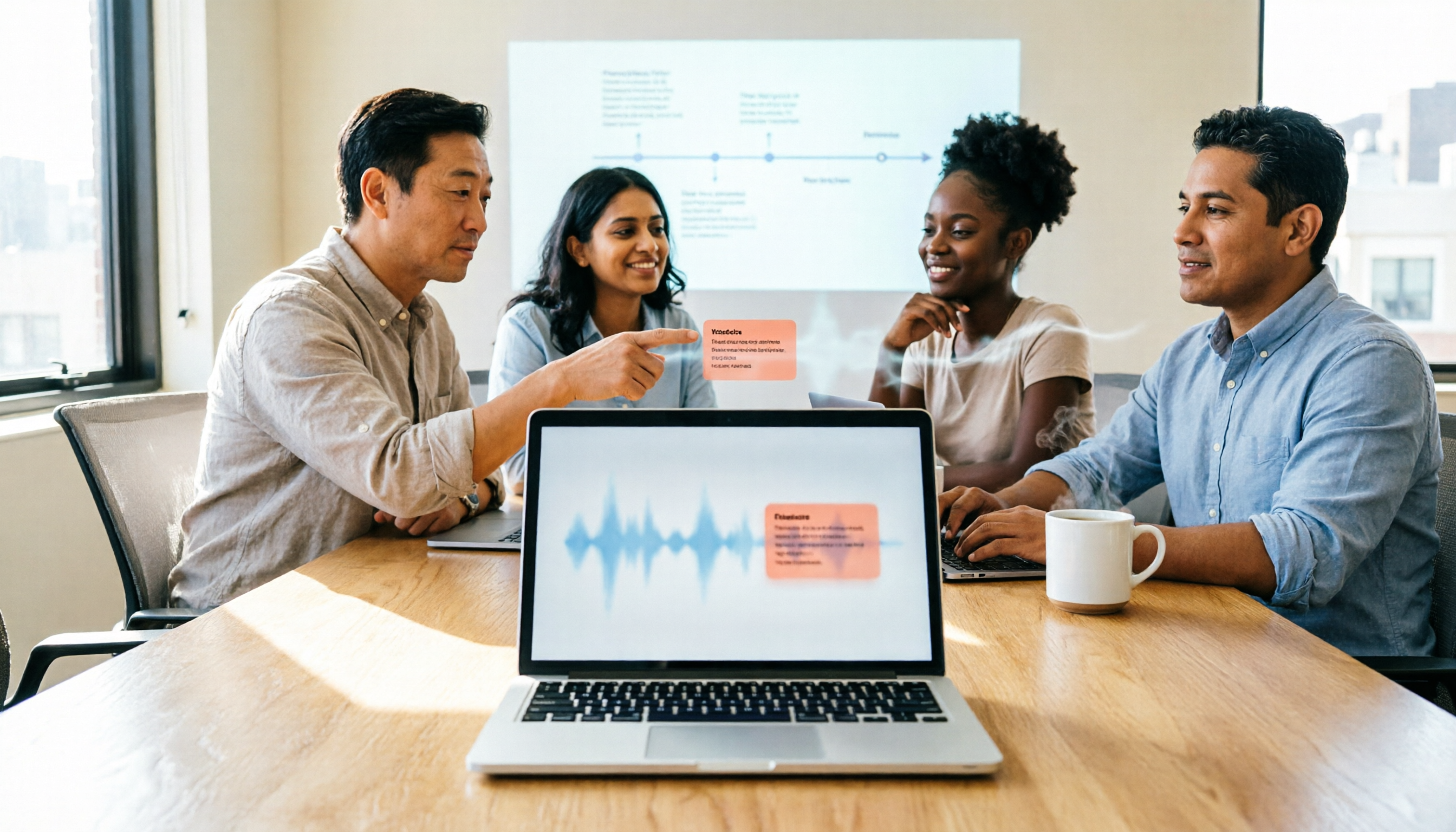
Tinrec is an AI meeting notes and collaboration tool for individuals and teams, available on mobile, desktop, and web. It doesn't just convert speech to text—it also organizes content into summaries, chapters, and action items, so discussions after reading a play don't disappear into thin air.
Stop organizing recordings by hand
Upload audio or video and automatically get a transcript, summary, and action items
What play reading groups most easily lose is the process. Who mentioned the pacing issue in scene three during the opening, who said a character's motivation wasn't clear enough—if no one records these verbal discussions, it's as if they never happened. Use Tinrec on your phone or desktop for real-time recording and transcription, and the transcript is ready by the time the meeting ends.
The same goes for online play reading groups. Through the desktop version, you can directly capture your computer's system audio, recording meetings on Zoom, Google Meet, Microsoft Teams, and Webex without inviting an extra meeting bot. This is especially practical for small theater companies or classroom read-alouds—not everyone wants to see a bot join the meeting.
If you have existing recordings or videos—such as class recordings, lectures, or interviews—you can upload them directly for transcription without listening through again. After transcription, the system generates summaries and chapters, so an hour-long discussion can be broken into sections for quick browsing.
I find AI Q&A to be the biggest time-saver. After a discussion, you can directly ask it "Who mentioned the stage direction issue just now?" or "What was our conclusion about this character?" It doesn't just throw keyword search results at you—it answers directly. This feature is not common among tools in the same price range.
When you need a written record, you can export to Notion, Google Docs, OneNote, or Dropbox for further editing; you can also use Agent post-processing to generate reports, tables, or documents from the discussion. For cross-language discussions, you can enable real-time translation and view in original, translated, or bilingual mode—especially useful when reading English plays and discussing in Chinese.
For theater companies, workshops, or regular class members, the team version's team space can centrally store transcripts and notes from each play reading group, and manage member roles and seats. Members without seats can still view, play, and read materials, but recording, uploading, and editing require a seat; administrators can view usage and activity logs, and team hotwords can improve recognition of proper nouns.
One caveat: the free version only has a basic quota. Heavy users should consider a weekly card or Pro monthly/annual plan. Also, transcription accuracy is affected by recording quality, accents, overlapping speakers, and proper nouns. For important content, it's best to cross-check with the recording or transcript timestamps—don't treat it as 100% accurate.
Current team version pricing is USD 29.80 per paid seat per month, or USD 199 per paid seat per year (about USD 16.58 per month). Eligible teams get a 7-day trial, 1 free seat, and 300 minutes of shared onboarding quota on first signup, and each paid seat provides 2,000 minutes of team shared onboarding quota per month. Actual pricing and benefits are subject to the official purchase page.
Honestly, if you're just reading plays on your own and occasionally looking things up, the free version is more than enough. The real time to pay is when you start holding regular play reading groups and need to preserve every discussion.
Besides Tinrec, what other options are there?
Otter.ai: A mature choice for English meetings, with 300 free minutes per month, and Pro annual billing at about USD 8.49 per user per month, including 1,200 minutes per month. If your play reading group is entirely in English and you don't need Chinese bilingual transcripts, it's good value; but Chinese meetings and real-time translation aren't its focus—Tinrec's experience is better there.
Notta: Good multilingual transcription, with a free version of 120 minutes per month and a 3-minute limit per session—clearly designed to encourage upgrading. Team plans have role permissions and usage reports, but bot-free desktop recording plus team knowledge retention is a combination Tinrec emphasizes more.
PLAUD Note/NotePin: AI recording hardware, starting at USD 159 for the device, with membership fees separate. Suitable for people who need to record in-person interviews or phone calls on the go. But if you're mainly organizing online play reading groups and existing audio files, you don't necessarily need an extra device—Tinrec works via web, desktop, and mobile.
Pitfall guide: 4 most common mistakes when reading Nottage
Pitfall 1: Choosing your first play based only on awards. Two Pulitzers look great on a resume, but they're not a good basis for choosing a book. First ask yourself whether you're doing research, directing a play, or just reading for pleasure—the answer will differ.
Pitfall 2: Assuming all her plays have the same tone. Her works span from the 20th to the 21st century, and her forms include opera adaptations. Reading just one and drawing conclusions can easily lead to misjudgment.
Pitfall 3: Ending the meeting without recording the discussion. This is the most common and most regrettable. Next time you meet, everyone only has vague impressions. Either assign someone to take notes or let a tool record the transcript for you.
Pitfall 4: Treating transcription tools as just "speech-to-text." If you only use it to produce transcripts, you're only using part of its capabilities. Summaries, chapters, Q&A, action items, and exports are where the real time savings are.
One final reminder: whenever you record in any setting, always inform participants and get their consent—this is basic courtesy and a legal requirement.
Conclusion: Which one should you actually start with?
In one sentence: first think about your purpose, then choose the play.
- Just want to read one representative work → Sweat
- Want to understand why she's considered an important contemporary playwright → Ruined
- Doing textual analysis, discussing history and class → Intimate Apparel
- Want to see her lighter, satirical side → Fabulation, or The Re-Education of Undine
- Want to know where she started → The Darker Side of Verona
If you're also organizing a play reading group or classroom discussion, I suggest trying Tinrec's free version with the basic quota first to see if transcripts and summaries help you, then consider upgrading if it works. Tools are supporting players; the play is the main event.
References:
- Lynn Nottage | Wikipedia
- Lynn Nottage Biography, Plays, and Awards | Britannica
- The Best Plays of Lynn Nottage | StageMilk
- Lynn Nottage in Five Plays | Breaking Character
- Lynn Nottage Official Website
References
Turn every recording into actionable outcomes
Get 60 free transcription minutes when you sign in. No credit card required.
Related Reading
You might also like
Notta AI Tutorial & Comparison 2026: Which of 3 Meeting Note Tools Saves the Most Time?
Starting from the real scenario of having to write transcripts after meetings, we walk through the complete Notta AI tutorial process, then compare Tinrec, Otter.ai, and Granola using the same criteria to see the actual differences in free tiers, Chinese transcription, and team collaboration.

Notta App vs. 3 AI Meeting Recorders Tested: Which Handles Chinese Transcription, Post-Meeting Summaries, and Team Knowledge Best?
Looking for Notta App reviews and pricing? This article starts with the decision point: are you recording meetings or files? We compare Notta, Tinrec, Otter.ai, and TurboScribe on meeting capture methods, post-meeting outputs, free tiers, and team collaboration, and honestly list each tool's limitations and pricing to help you make a regret-free choice before paying.

Nótt Ataşehir: Complete Guide 2026 – Address, Hours, Menu & What to Know Before You Go
Searching for notta ataşehir but finding conflicting info across platforms? This guide compiles the address, phone, hours, food and cocktail highlights, reservation tips, and common pitfalls for Nótt (Kitchen & Cocktail Bar) in Ataşehir, Istanbul—read this before you go.

Notta Chrome Extension Review 2026: 2 Tools Tested for Meeting Notes
Does installing the Notta Chrome extension automatically record all your meetings? Actually, it captures audio from browser tabs. This article addresses three common misconceptions, then compares Notta and Tinrec across five dimensions, including official pricing, quotas, and team governance differences, to help you decide which fits your meeting scenario.

2026 Notta Alternative: Tinrec Bot-Free Recording + AI Meeting Minutes
Looking for a Notta alternative? This guide focuses on what you need after a meeting, comparing Tinrec and Notta across 5 dimensions: desktop recording without a meeting bot, real-time translation for mixed Chinese-English meetings, AI Q&A and action item extraction, team spaces and seat management, plus practical use cases and a buying checklist.

How to Download AI Meeting Notes Tools in 2026: 5 Steps from Installation to Team Testing
From download to real-world testing, we break down the 5 installation steps and 4 key purchasing factors for AI meeting notes tools, and compare Tinrec, Notta, Otter.ai, and TurboScribe on free quotas, pricing, and post-meeting outputs to help you choose the one that truly fits your team's needs.

2026 AI Meeting Recorder Comparison: Meeting Ink App vs. Tinrec vs. Otter.ai — Which Handles Chinese Meetings Best?
How to choose between Meeting Ink App, Tinrec, and Otter.ai? This hands-on comparison tests everyday meeting workflows across four key areas: Chinese terminology, bot-free recording, post-meeting AI Q&A, and team collaboration. We also break down free and team plan pricing limits to help you pick the right tool for your meeting style.

4 Free AI Transcription Tools Tested for 2026: Is Notta's Free Plan's 120 Minutes Really Enough?
Notta's free plan offers 120 minutes per month with a 3-minute limit per file—is that enough? Starting from real meeting scenarios, this article breaks down the actual limitations and paid thresholds of Notta's free version, and compares the free quotas, post-meeting organization capabilities, and team usage differences of Tinrec, Otter.ai, and TurboScribe, helping you decide whether to stay on the free plan or switch tools.

2026 AI Meeting Notes Tools Cost Comparison: Beyond Notta, Which Has Lower Long-Term Costs?
Many people searching for notta ai costo only compare monthly fees, overlooking free plan single-session limits, AI features, and team seats. This article uses official public plans to estimate costs for Notta, Tinrec, and common meeting tools, helping you judge which option is better for long-term use based on post-meeting organization time, export needs, and team knowledge retention.