
Turn recordings into transcripts and summaries in minutes
Upload audio or video for multilingual transcription, AI notes, and action items
Before choosing a VOCOL column, I usually confirm three things first: whether your sample is a gas or highly volatile organic compound, whether you will use purge and trap or direct injection, and whether your method requires a sufficiently long column to gain resolution. These three answers directly determine which specification to look at, rather than comparing prices first.
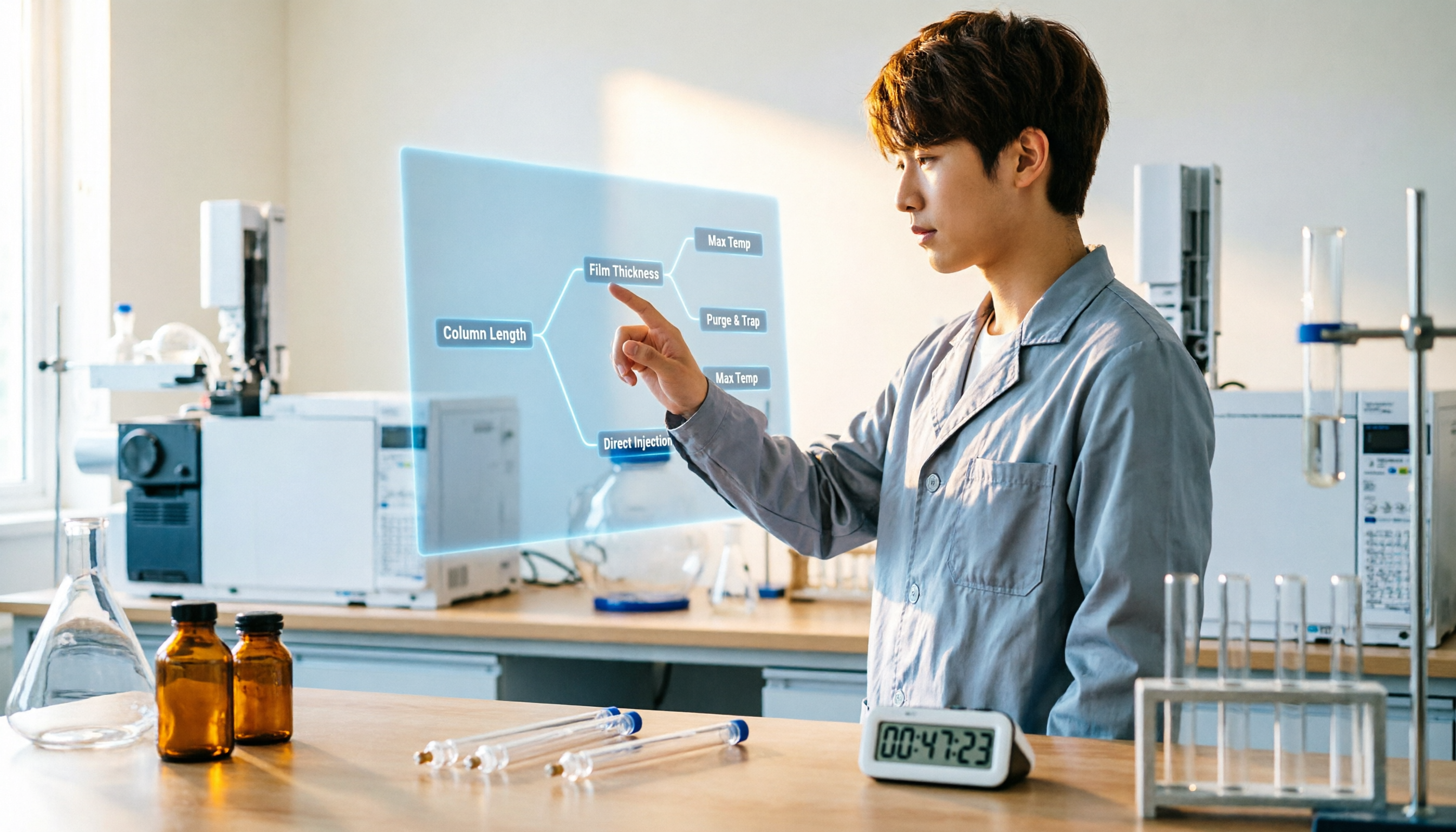
This article compiles three common VOCOL capillary GC column specifications from public sources, including length, inner diameter, film thickness, and maximum temperature. It then uses an FAQ to answer the most common purchasing questions.
What Is a VOCOL Capillary Column?
VOCOL is a capillary GC column series from Supelco (part of the Merck/Sigma-Aldrich organization). The manufacturer lists the stationary phase as diphenyl dimethyl polysiloxane with crosslinking moieties, the phase as Proprietary, and notes it as Bonded. The USP Code is listed as None.
A capillary GC column, also called an open tubular column, allows the carrier gas to travel through a central channel without obstruction along the entire column length. This is the biggest difference from a packed column.
Typical uses listed by the manufacturer include volatile organic compounds (VOCs) analysis, purge and trap technology, GC/MS analysis of 34 volatile organic compounds, and whole column cryotrapping.
One reminder: VOCOL is a registered trademark of Merck KGaA (Darmstadt, Germany), and some documents also list it as a registered trademark of Sigma-Aldrich Co. When writing reports or external documents, remember to include the trademark notation.
Side-by-Side Comparison of 3 Common Specifications
The three most commonly seen combinations on public pages are as follows:
| Specification | Length × I.D. | Film Thickness | Maximum Temperature | Common Positioning |
|---|---|---|---|---|
| 105 m × 0.53 mm | 105 m × 0.53 mm | 3.00 μm | 230 °C | Long column, large diameter, thick film; suitable for complex matrices and high-resolution needs |
| 60 m × 0.25 mm | 60 m × 0.25 mm | 1.50 μm | 250 °C | Compromise between length and separation; standard inner diameter |
| 30 m (df 1.5 μm) | 30 m (I.D. not stated on that page) | 1.50 μm | 250 °C (determined by pore size) | Shorter analysis time; suitable for early method development testing |
Generally, the longer the column, the higher the theoretical plate number and the better the ability to separate complex matrices, but analysis time also increases. A larger inner diameter provides better loading capacity at the same flow rate and is more suitable for pairing with purge and trap systems. A thicker film has a stronger ability to retain highly volatile compounds, but the maximum temperature usually must be lowered.
This is why the 105 m × 0.53 mm, df 3.00 μm version has a maximum temperature of 230 °C rather than 250 °C—it is not simply the same column with a different length; temperature and dimensions must be considered together.
Note that the 30 m version only lists length and film thickness on the public page; the inner diameter is not stated. If your method specifies an inner diameter, be sure to check the official specification page again before ordering.
How to Read the Maximum Temperature: Pore Size and Film Thickness Determine the Limit
The manufacturer writes the temperature limit as combinations of "inner diameter × film thickness" and directly gives four results:
| Inner Diameter | Film Thickness | Maximum Temperature (isothermal or programmed) |
|---|---|---|
| ≤ 0.32 mm | < 2 μm | subambient to 250 °C |
| ≤ 0.32 mm | ≥ 2 μm | subambient to 230 °C |
| ≥ 0.53 mm | < 2 μm | subambient to 250 °C |
| ≥ 0.53 mm | ≥ 2 μm | subambient to 230 °C |
There are two practical points here.
Stop organizing recordings by hand
Upload audio or video and automatically get a transcript, summary, and action items
First, the starting point of the temperature limit is subambient (below room temperature), meaning this series of columns is designed to be compatible with low-temperature operation, such as whole column cryotrapping. To run such methods, the peripheral cooling equipment must be prepared in advance.
Second, when film thickness crosses the 2 μm line, the limit drops from 250 °C to 230 °C. If your method includes high-temperature baking or high-boiling elution segments, this 20 °C difference is important—do not decide based only on column length.
Injection Methods and System Compatibility
The manufacturer's recommended use for this series is clear: use with a direct injection port or connect to a purge and trap system.
Purge and trap is a typical pretreatment method for volatile organic compound analysis. Volatile components in the sample are purged, trapped, thermally desorbed, and sent to the GC column, then to GC/MS for qualitative and quantitative analysis. The VOCOL stationary phase is designed for this workflow, and public materials directly link it to "purge-and-trap and GC/MS analysis of 34 volatile organic compounds."
If you are developing your own method, a public technical guide offers a starting point: use helium as carrier gas at a constant flow of 1.4 mL/min, hold the oven at 40 °C for 0.8 minutes, ramp at 19 °C/min to 125 °C, then continue ramping. Such conditions usually need adjustment based on sample matrix, desorption temperature, and detector; they are fine as starting parameters, but copying them directly may not suit your sample.
Things to Note When Purchasing
1. Confirm the pretreatment method first, then choose dimensions. If you will connect to purge and trap, look for larger diameter and thicker film. If your method already specifies direct injection, check injector compatibility and required resolution.
2. Look up the maximum temperature using "inner diameter + film thickness," not a single number. Both 250 °C and 230 °C are limits for this series; the difference depends on which cell your specification falls into.
3. Length is a trade-off between resolution and time. 105 m suits truly complex matrices; 30 m suits rapid scanning and method exploration. The middle 60 m is the compromise most people consider first.
4. USP Code is listed as None. If your laboratory method or customer contract requires a corresponding USP code, confirm this early—do not wait until acceptance to find out it does not match.
5. Specifications, availability, and pricing are subject to official pages. The length, inner diameter, film thickness, and maximum temperature in this article come from public product pages and technical documents. Actual shipping labels, packaging, and quotations should be based on official and distributor pages.
Frequently Asked Questions
What is the VOCOL column mainly used for?
Typical applications listed in public materials are volatile organic compound analysis, purge and trap technology, GC/MS analysis of 34 volatile organic compounds, and whole column cryotrapping. It is not a general-purpose column; it is usually chosen because the method specifically targets volatile components.
What is the maximum temperature of the 105 m × 0.53 mm, df 3.00 μm version?
According to the manufacturer's rule, for inner diameter ≥ 0.53 mm and film thickness ≥ 2 μm, the limit is subambient to 230 °C, applicable to both isothermal and programmed temperature operation.
How high can the 60 m × 0.25 mm, df 1.50 μm version go?
For inner diameter ≤ 0.32 mm and film thickness < 2 μm, the limit is subambient to 250 °C.
Can it be connected to a purge and trap system?
Yes. The manufacturer explicitly recommends use with a direct injection port or connection to a purge and trap system, which is also its most typical use scenario.
Does VOCOL have a USP Code?
The public page lists it as None. If your method requires a corresponding USP code, it is advisable to confirm with the supplier first or use a column that has one listed.
What is the inner diameter of the 30 m version?
The public page only lists 30 m length and df 1.5 μm film thickness; the inner diameter is not listed. Before ordering, check the official specification page—do not infer the inner diameter from other lengths.
Additional note: The product specifications and application descriptions in this article are compiled from public product pages from Supelco/Merck (Sigma-Aldrich), distributor pages from Fisher Scientific and Krackeler Scientific, and the BenchChem technical guide on the VOCOL stationary phase. The technical guide states that its content is for research reference only and does not constitute a guarantee of suitability for a particular use; actual method development should still be based on testing with your own samples.
References
- VOCOL® Capillary GC Column L × I.D. 105 m × 0.53 mm, df 3.00 μm | Sigma-Aldrich
- VOCOL® Capillary GC Column L × I.D. 60 m × 0.25 mm, df 1.50 μm | Sigma-Aldrich
- MilliporeSigma Supelco VOCOL Capillary GC Column, df 1.5 m 30 m | Buy Online | MilliporeSigma™ Supelco™ | Fisher Scientific
- An In-depth Technical Guide to the VOCOL® Column Stationary Phase
- VOCOL® Capillary GC Column | Krackeler Scientific, Inc.
Turn every recording into actionable outcomes
Get 60 free transcription minutes when you sign in. No credit card required.
Related Reading
You might also like

2026 AI Meeting Notes Comparison: Vocol.ai vs Tinrec — Which Is Better for Chinese-Speaking Teams?
Vocol.ai is a GPT-powered voice collaboration platform, and many users start looking for alternatives after trying it. This article examines three decision points—how to record online meetings, what you get after transcription, and how teams manage data—to compare Vocol.ai and Tinrec. It also covers Tinrec's features, real-world use cases, and pricing for personal and team plans, helping you decide which fits your meeting workflow.

Sweat by Lynn Nottage: 2026 Comparison of 3 Productions — Which Is Worth Seeing?
How to review Lynn Nottage's Sweat? This comparison covers the 2017 Broadway, 2018 Los Angeles, and 2026 Glasgow productions, with 4 key evaluation points and common pitfalls. Plus, if the play's interview-based writing inspires you, here's how to record, transcribe, and follow up on interviews.
Vocol B.V. vs Vocol Nederland B.V. in 2026: 5 Key Differences Between Two Same-Name Dutch Companies
Searching for "vocol bv" returns two Dutch companies: a trailer manufacturer and a Rotterdam tank storage firm. This article uses 5 dimensions—KVK number, industry code, address, size, and business activity—to distinguish them, and highlights practical tips and common pitfalls when researching Dutch company data.

4 AI Meeting Transcription Tools Tested in 2026: Notta AI Pricing Explained and Which Offers the Best Value?
Before asking how much Notta AI costs, understand the difference between annual billing converted to monthly price, per-recording limits, and seat-based pricing. This article, based on hands-on testing, breaks down the cost structures and use cases of Notta, Otter.ai, TurboScribe, and Tinrec, and highlights four common pitfalls that can lead to overspending, helping you choose the plan that truly fits your needs.
Free Vocal Remover Tools in 2026: A Buying Guide to 4 Options and Selection Tips
Want to remove vocals and keep only the instrumental? You don't need to install editing software first. This article covers four options: Notta Online Vocal Remover, Ultimate Vocal Remover, online Vocal Remover tools, and Tinrec. It explains format support, the 20-minute limit, free quotas, and practical limitations, with selection advice for practice singing, video scoring, interviews, and meeting notes.

Notta Sin Foods Review 2026: Sugar-Free Spread, Millet Snacks & Breakfast Cereal Compared
Notta Sin Foods review roundup: This Indian brand uses monk fruit and stevia instead of sugar to make palm oil-free chocolate almond spread, millet snacks, and breakfast cereals. We break down the specs, retailer ratings, and prices of three main products, plus four common pitfalls to watch out for before buying.
How to Use Notta in 2026: 5-Step Recording-to-Text Tutorial (with Tinrec Workflow Comparison)
Searching for a Notta tutorial but stuck on the first step? This guide breaks down the complete recording-to-text workflow into five steps: live recording or post-processing, transcription, proofreading, summary and action items, and export and sharing. It compares Notta and Tinrec at each stage so you can build a method that works even if you switch tools.

Tinrec vs Vocol.ai in 2026: 5-Dimension Comparison — Which Is Better for Chinese Meeting Notes?
Starting from a Dcard review of Vocol.ai, this comparison evaluates Tinrec and Vocol.ai across 5 dimensions: meeting capture, post-meeting organization, input sources, team governance, and pricing. It helps you decide which tool is better suited for Chinese meeting notes and team knowledge retention.

2026 Vocol Gubin Job Guide: 3 Meeting Recording Tools Tested – How to Choose for Interview Prep
What position does 'Vocol Gubin praca' refer to? This guide compiles public information about an office administrative job at a Gubin, Poland office (fixed-term contract, full-time, 40 hours/week, gross salary from 4,666 PLN). It also compares Tinrec, Otter.ai, Notta, and Granola from the perspective of a job seeker preparing for online and cross-language interviews and organizing notes afterward, highlighting differences and limitations, with a pitfalls guide and selection advice.