

Turn recordings into transcripts and summaries in minutes
Upload audio or video for multilingual transcription, AI notes, and action items
2026 Comparison of 4 Audio-to-Text Tools: What the Vocol Gubin Search Reveals About How Hong Kong Users Choose
Two-hour meeting, two more hours to organize—the problem isn't your self-discipline
At a 3 PM cross-department meeting, everyone speaks Cantonese mixed with English product names. Afterward, your manager asks, "What was the budget conclusion from last week?" You only remember recording it, but digging out one sentence from a one-hour file means listening to the whole meeting again.
What's worse is mixed languages. Cantonese, English, and Mandarin take turns, and the transcript comes out like gibberish—you end up retyping it manually.
So the real need isn't "recording"—it's getting something usable within ten minutes after the meeting: a transcript, summary, and action items, and ideally the ability to ask questions about it. This article is written for that.
First, let's break down "Vocol Gubin": What are you actually looking for?
If you typed "vocol gubin" looking for a company, here's the answer (compiled from public Polish business registration data):
- Full company name: "VOCOL" Spółka z ograniczoną odpowiedzialnością (limited liability company)
- Registered address: ul. Wyzwolenia 24, 66-620 Gubin, Lubusz Province, Poland
- Tax ID (NIP): 9291662583; KRS: 0000103001; REGON: 971299122
- Registered capital: 200,000 Polish złoty (zł)
- Main business: Manufacture of automotive bodies and trailers, including tank semi-trailers, bulk material transport semi-trailers, container tanks, etc.
In other words, this is a body and semi-trailer manufacturer based in Gubin, Poland, and has nothing to do with audio-to-text or AI meeting notes.
If your goal is actually to find a tool that turns meeting recordings into transcripts and minutes, then the content below is what you need.
Before choosing an audio-to-text tool, understand these 4 key points
1. Real-world performance with Cantonese and mixed Chinese-English
Official demos usually record standard speech in a quiet environment, but real meetings have air conditioning noise, keyboard clicks, and people talking over each other. The way to judge is simple: take your own five-minute meeting recording and test it, checking sentence by sentence—don't just look at promotional numbers.
2. How meeting content is captured
Some tools require you to invite a bot to join Zoom or Meet; others capture system audio directly on your computer, so no extra participant is needed. The difference is especially noticeable in external meetings (with clients or partners)—with the former, you have to explain why there's an extra person on screen.
3. Post-meeting output: Just a transcript, or can you ask questions?
A transcript is just raw material. Summaries, chapters, action items, and AI Q&A are the real time-savers. Tools that only give you a transcript still require you to read through an hour of text yourself.
4. Team knowledge retention and access permissions
Personal use is fine, but if data stays in individual accounts, it leaves with colleagues when they resign. For team versions, ask three things clearly: Is there a separate team workspace? How are roles and seats allocated? Can usage and activity logs be viewed?
Tinrec—our top pick after hands-on testing
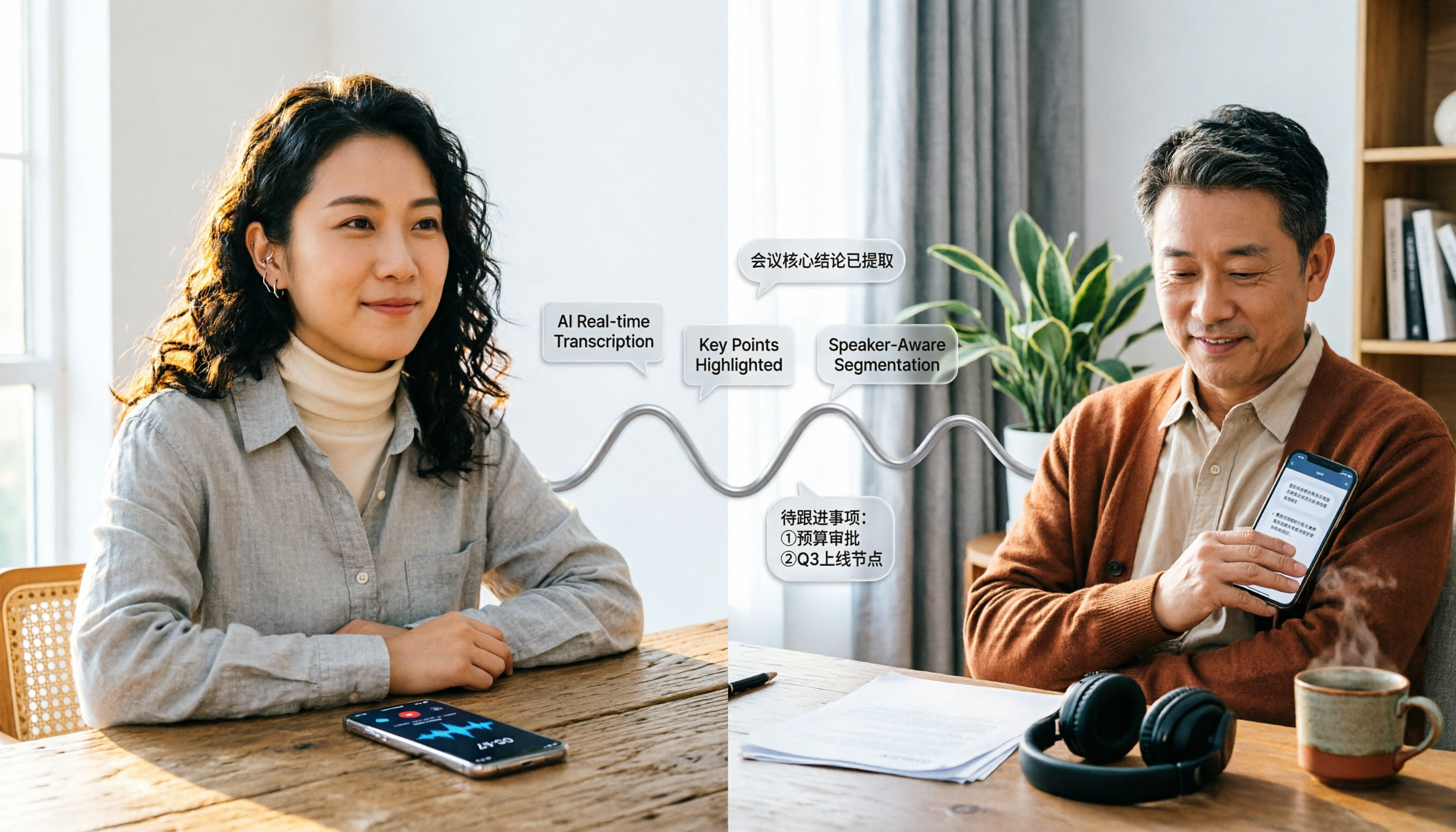
Tinrec is an AI meeting notes and collaboration tool for individuals and teams, available on iOS, Android, desktop, and web. It doesn't just convert audio to text—it organizes meetings into searchable, queryable, exportable, and further processable data.
Record online meetings without a bot. The desktop version captures computer system audio directly, handling Zoom, Google Meet, Microsoft Teams, Webex, and other meetings without an extra bot joining as a participant. Note that you still need to actively open Tinrec to start recording; it's not a bot that automatically joins all calendar meetings.
After recording, you can ask questions directly. This is the biggest difference from most similar tools: you can ask "Who mentioned the budget in the last meeting?" or "What were the three objections the client raised?" It answers based on semantic understanding, not by dumping a bunch of keyword search results for you to sift through. Currently, most similar tools only offer keyword search or summaries at this stage.
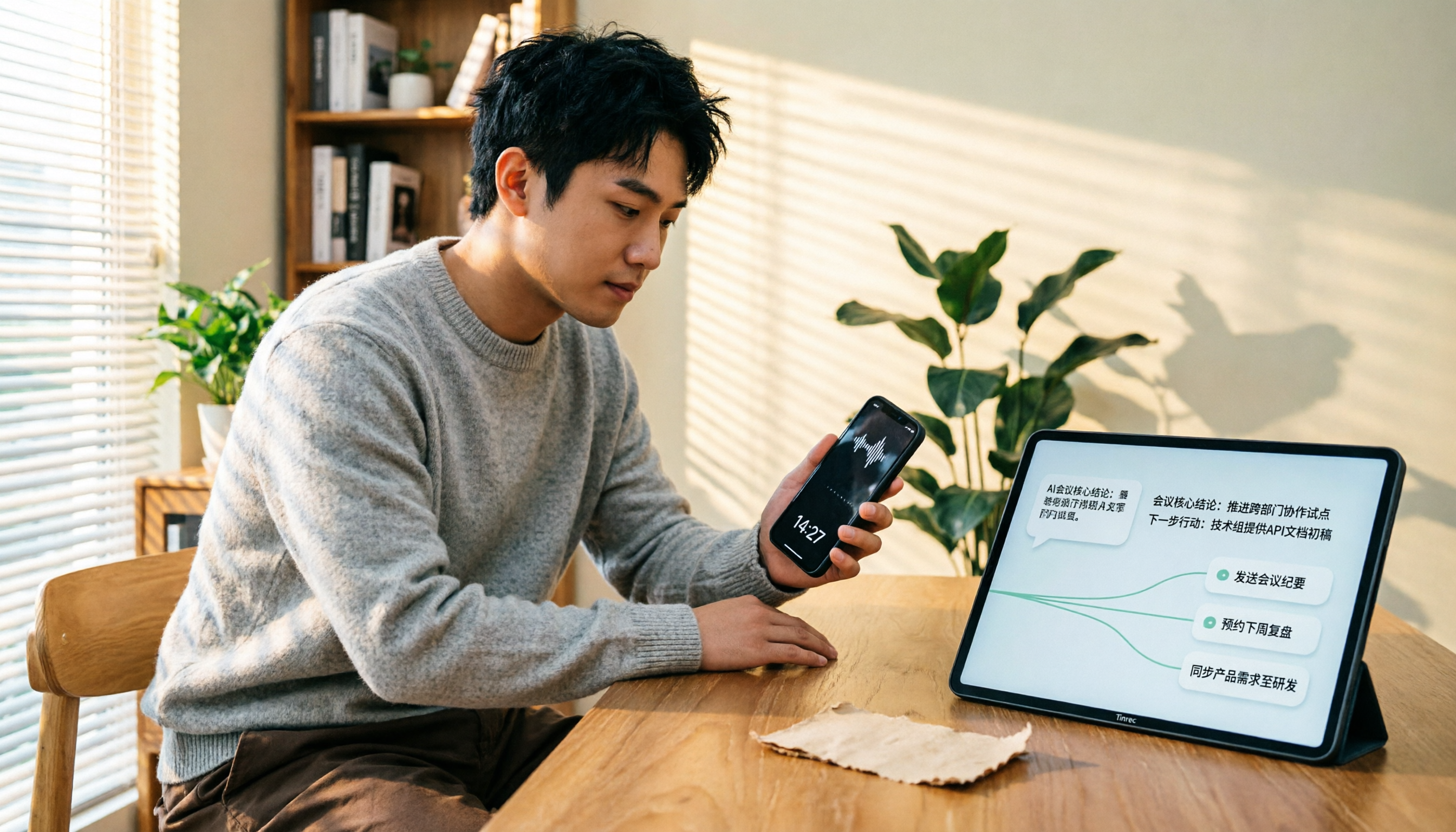
The transcript is just the starting point. After the meeting, it automatically generates summaries, chapters, and action items; you can use Agent post-processing to generate reports, tables, and documents; it supports export to Notion, Google Docs, OneNote, Dropbox, and other workflows. For cross-language meetings, you can enable real-time translation and view in original, translated, or bilingual mode; teams can also maintain a glossary to stabilize correction of internal product codes and proper nouns.
Stop organizing recordings by hand
Upload audio or video and automatically get a transcript, summary, and action items
Testing method (no vague numbers): We used the same five-minute Cantonese meeting recording, in an indoor environment with air conditioning background noise and two people occasionally overlapping, ran it on the same phone, and looked at three things: whether the transcript reads smoothly, whether the summary captures decision points, and whether action items match the speakers. In such everyday meeting scenarios, Tinrec's transcript reads smoothly, and proper nouns are more stable after glossary correction. Actual performance is still affected by recording quality, accent, noise, and overlapping speech—no tool should be considered 100% accurate.
Three reasons worth buying:
- Bot-free recording—no strange extra participant in client meetings, which is the most noticeable practical benefit.
- More than just a transcript—summaries, chapters, action items, Q&A, and export all in one place.
- Team version turns meetings into team assets—separate team workspace, role and seat management, usage analytics, audit logs, audio recycle bin (retained for 30 days, recoverable before permanent deletion).
Limitations to be clear about: The free version offers a basic quota; long-term high-frequency use requires payment. Team version file and web imports deduct from the team shared quota (each paid seat has 2,000 minutes of team shared import quota per month; real-time recording is currently not deducted by minute under an active plan and active seat), and not all capabilities are unlimited. Actual prices and benefits of individual plans are subject to the official website purchase page.
Who it's for: People who frequently record Cantonese or mixed Chinese-English meetings, need to submit minutes afterward, switch between phone and computer, or want to keep a searchable meeting archive for their team.
Besides Tinrec, what other options are there?
Otter.ai: A mature choice for English business meetings. Basic is free with 300 minutes per month; Pro annual billing works out to about USD 8.49/user/month. If your meetings are mainly in English, it's sufficient; but for Agent-style post-processing that directly generates reports and tables, public plans don't seem to describe corresponding features—Tinrec is more complete in this step.
Notta: Good multilingual transcription performance. Free is 120 minutes per month (3 minutes per session max); Business annual billing works out to about USD 16.67/seat/month. Strengths are transcription, subtitles, and translation; but bot-free system audio capture and team governance features like roles/seats/audit are less described—Tinrec is more complete in this part.
Granola: Also takes a bot-free approach. Basic is free; Business is USD 14/user/month. Note that it does not support uploading pre-recorded audio files and does not save meeting audio files; if you need to keep recordings, re-listen later, or import old files, Tinrec is clearly more suitable.
Pitfall guide: The 4 most common mistakes when choosing an audio-to-text tool
Pitfall 1: Only looking at advertised accuracy. Numbers measured in a quiet recording studio will be significantly discounted in a meeting room with air conditioning noise, accents, and people talking over each other. The right approach is to test with your own recordings—free quotas are for exactly this.
Pitfall 2: Ignoring "how the meeting gets in." Tools that require a bot to join need explanation in client meetings; desktop system audio capture is much more natural in such situations.
Pitfall 3: Treating the tool only as "audio to text." If you only take the transcript after recording, you're using only one-third of its capabilities. What really saves time is summaries, action items, and being able to ask it questions directly.
Pitfall 4: Not distinguishing team version roles and seats. Roles determine who can manage the team and members; seats determine who can record, upload, edit, and export. Active members without a seat can usually only view, play, and read data, and cannot perform resource usage operations. Be sure to ask clearly before purchasing, or you may find out after buying that colleagues can only view but not edit.
Conclusion: Which one should you choose?
In one sentence: If you want "Cantonese meetings recorded, queryable, and report-ready," Tinrec is the top choice in this article.
- Cantonese or mixed Chinese-English meetings, need to submit minutes afterward → Tinrec
- Don't want to invite a bot to client meetings → Tinrec (desktop system audio capture)
- Want to ask directly after recording "Who mentioned the budget last time?" → Tinrec (AI Q&A)
- Need to use on phone, computer, and web → Tinrec
- Pure English meetings, zero budget → Otter.ai (the only scenario in this article where a competitor is recommended)
- Only need bulk transcription of large, long documents → Notta or TurboScribe-type tools are more suitable
We suggest first using the free quota to run a segment of your own meeting recording, and consider upgrading if it works for you—no need to pay upfront. For teams, you can start a 7-day trial (1 free seat, 300 minutes of team shared import quota) to go through a complete workflow and see if members, seats, and export fit your habits.
Final reminder: Please comply with local regulations when recording and transcribing, and obtain participant consent when necessary.
Sources
- ALEO.com: VOCOL Sp. z o.o. company registration data (Gubin)
- Panorama Firm: Vocol Sp. z o.o., Gubin company page
- krs-pobierz.pl: Vocol Polish KRS registration data
- Crefo: Vocol sp. z o.o., Gubin business report page
- Otter.ai, Notta, Granola official pricing pages (prices and benefits subject to respective official websites)
References
- Company "VOCOL" SPÓŁKA Z OGRANICZONĄ ODPOWIEDZIALNOŚCIĄ, GUBIN - NIP, KRS, REGON, opinions, authorities, connections - Data fetched from KRS - Nadwozia i przyczepy | ALEO.com
- Vocol Sp. z o.o., Gubin ✦ Przyczepy samochodowe ✦ Panorama Firm
- Kontakt - Vocol Gubin - telefon, adres, NIP - GoWork.pl
- Vocol Spółka Z Ograniczoną Odpowiedzialnością | krs-pobierz.pl
- Vocol sp. z o.o., Gubin | Crefo
Turn every recording into actionable outcomes
Get 60 free transcription minutes when you sign in. No credit card required.
Related Reading
You might also like
5 Ways to Send Voice Recordings to LINE in 2026: Side-by-Side Comparison — Fix Large Files and Unwilling Listeners in One Go
Recorded audio but can't send it on LINE? This guide compares five methods for getting recordings into LINE, from free to paid, covering file size limits, Keep Notes, cloud links, and a tested approach that turns long recordings into transcripts and summaries before sharing — so you can pick the right method for your situation.

3 Ways to Find and Download LINE Voice Messages in 2026: Phone vs. Computer Speed Test
Can't find that LINE voice message you want to save? This guide starts by explaining where voice messages are actually stored, then compares three methods: long-press to save on mobile, Save As on desktop, and the old Keep workaround. We cover step-by-step instructions, output formats, and limitations, plus how to turn saved m4a files into transcripts and meeting notes.

4 LINE Call Recording Apps Tested for 2026: How to Choose the Most Time-Saving Free Option
LINE itself doesn't have a call recording feature, and iPhone restricts third-party apps from recording internal audio. Which so-called "free" solutions online actually work? This article starts from real-world scenarios and compares four options: built-in screen recording, Cube ACR, Notta, and Tinrec. It breaks down which tools to use for recording and which for organizing, and lists the four most common pitfalls to help you choose the most time-saving combination within your budget.

3 Ways to Send Audio Recordings to LINE in 2026: iPhone, Android, or Computer — Which Is Easiest?
Can't find the path to send a recording from your phone to LINE? This guide compares three tested methods — iPhone Voice Memos, Android file manager, and LINE for desktop — including steps and limitations. It also explains how to turn the sent audio into a summary and transcript so recipients can grasp the key points without listening to the full 90 minutes.

5 LINE Call Recording Methods Tested for 2026: Which One Actually Captures the Other Person's Voice?
LINE has no built-in call recording button. Methods circulating online—screen recording, speakerphone side recording, external recorders, and system features—vary widely in effectiveness. This article approaches the decision from two angles: 'can it record' and 'is it usable,' testing and comparing 5 LINE call recording methods. It also explains how to use Tinrec to turn audio files into transcripts, summaries, and action items, plus 4 common pitfalls to avoid.

How to Transfer iPhone Voice Memos to Computer for Free in 2026: 6 Methods Compared
How do you transfer iPhone voice memos to a computer? This guide starts with two key questions: Is your computer a Mac or Windows, and how long is the recording? It covers six free transfer methods—AirDrop, iCloud Drive, Google Drive, USB cable, LINE desktop, and email—and explains how to use Tinrec to turn recordings into transcripts, summaries, and action items after the file is on your computer. Includes common mistakes and selection advice.

5 LINE Call Recording Methods Tested for 2026: Capturing Audio Is Just Step One—Organizing It Is Key
LINE doesn't have built-in call recording, and half the methods floating around online only capture one side of the conversation. This guide compares iPhone integrated calling, Android screen recording, third-party apps, and magnetic recording devices, and tests importing recordings into Tinrec to generate transcripts, summaries, and to-dos—helping you decide which approach truly saves time.

3 iPhone Voice Memo to Ringtone Methods Tested for 2026: Which No-Computer Way Is Fastest?
Voice Memos recordings can't be set as iPhone ringtones directly because the format and length don't match. This article tests three conversion methods, provides a complete 5-step GarageBand tutorial without a computer, covers common pitfalls and tips, and adds a better way to organize recordings after you're done.
4 LINE Call Recording Solutions Compared for 2026: How to Turn Recordings into Useful Data
LINE doesn't have built-in recording, but there are 4 approaches available. This article breaks down the limitations on iPhone and Android, the legal issues to handle before recording, and demonstrates how to use Tinrec to turn recordings into searchable transcripts, summaries, and action items—so you don't have to listen to a 30-minute audio file again.