
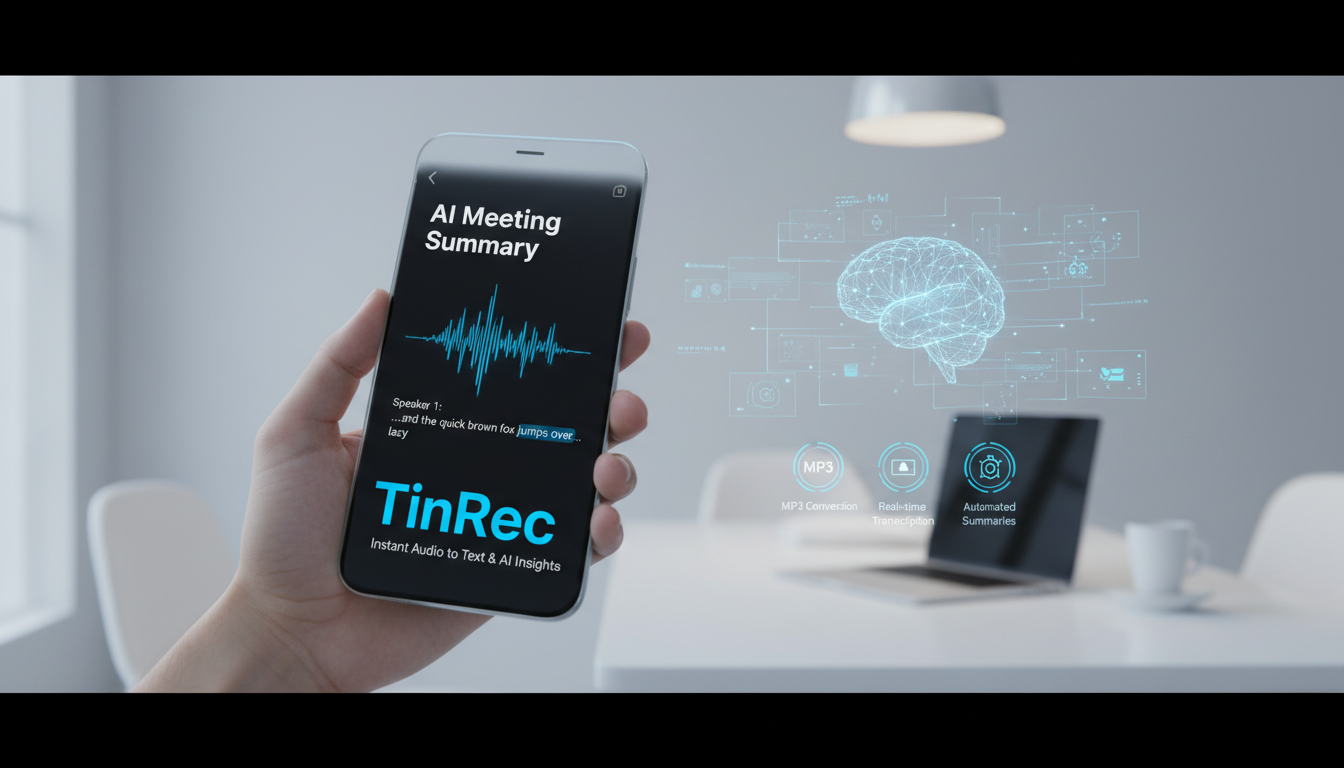
Turn recordings into transcripts and summaries in minutes
Upload audio or video for multilingual transcription, AI notes, and action items
For many graduate students, journalists, market researchers, and administrative assistants, creating interview transcripts is often the most painful part of the workflow. According to statistics, transcribing one hour of interview audio takes an average of 4 to 6 hours of manual typing. This is not only time-consuming but also mentally and physically draining.
With the maturity of AI technology, we no longer need to repeatedly pause and rewind like before. This article will show you how to efficiently create interview transcripts and introduce a tool that can significantly boost productivity—TinRec (Speech-to-Text)—helping you achieve more with less effort.
What Is an Interview Transcript? Format and Uses
An interview transcript (verbatim transcript) is a document that faithfully records audio or video content in written form. It plays a key role in qualitative research, news interviews, legal evidence gathering, and business meeting minutes.
A standard transcript typically includes the following elements:
- Speaker labels: Clearly distinguish between interviewer and interviewee.
- Timecodes: Make it easy to refer back to the original recording.
- Non-verbal cues: Such as (laughter), (silence), (interruption), which are especially important in academic research.
However, transcripts can be "full verbatim" (including filler words) or "clean verbatim" (removing filler words while preserving meaning). Which format you choose depends on your purpose, but either way, the initial "speech-to-text" task is an unavoidable burden.
Traditional Transcription vs. AI Auto-Transcription: Efficiency Showdown
In the past, there were two main ways to complete an interview transcript:
- Manual transcription: Highest accuracy, but extremely inefficient. For long in-depth interviews, fatigue can lead to errors.
- Outsourcing services: Saves effort but is expensive (usually per minute), and involves privacy risks for confidential content.
Now, a third option—AI speech-to-text tools—has become mainstream. New-generation AI tools not only boast impressive recognition rates but can also process large audio files almost instantly. A transcript that would take half a day to type can be generated in minutes as a draft, requiring only your final proofreading and editing.
Stop organizing recordings by hand
Upload audio or video and automatically get a transcript, summary, and action items
Why TinRec (Speech-to-Text) Is Your Best Assistant?
Among many AI transcription tools, TinRec (Speech-to-Text) stands out for its powerful integration of features, especially for professionals who handle large volumes of audio data. It is more than just a transcription tool; it is a comprehensive voice productivity platform.
TinRec's core strengths address several pain points in interview scenarios:
High-accuracy MP3 to text: Interviews are often recorded with voice recorders or smartphones, producing many MP3 or M4A files. TinRec supports uploading various audio formats and quickly converts hours-long interview recordings into text, with excellent recognition of Chinese contexts, significantly reducing subsequent editing time.
Call recording to text: Many interviews are conducted over the phone. TinRec has a call recording feature that can transcribe the content immediately after the call ends. This is an indispensable tool for phone interviews, client requirement confirmations, and similar scenarios.
Advanced Features: From Meeting Minutes to Video Content Creation
Beyond basic transcription, TinRec offers powerful AI-powered features tailored to modern workflows, maximizing the value of your interview data.
AI Meeting Summary and Minutes
Faced with lengthy interviews or meeting recordings, we often need to quickly extract key points. TinRec's AI meeting summary feature automatically analyzes the entire conversation, distills core ideas, action items, and decisions, and generates a well-structured AI meeting minutes. This is very helpful for organizing qualitative data from in-depth interviews, allowing you to quickly review the interviewee's main points.
YouTube Subtitle Generation
If you are a content creator and upload interview videos to YouTube, subtitles are essential. TinRec supports YouTube subtitle generation, allowing you to export transcribed text as an SRT subtitle file and directly apply it to your video, enhancing content reach.
Practical Guide: How to Produce High-Quality Interview Records
To create a perfect interview transcript, follow this "golden workflow":
- Ensure recording quality: Conduct interviews in a quiet environment and use a directional microphone to significantly improve AI recognition accuracy.
- Use TinRec for initial transcription: Upload the recorded MP3 file to TinRec or use its recording function directly to quickly obtain a text draft.
- AI-assisted summary: Use TinRec's AI summary function to first browse the interview highlights and establish an overall structural concept.
- Manual proofreading and polishing: Refer to timecodes to correct proper nouns or homophones misjudged by AI, and add non-verbal cues.
With this process, a task that originally took 5 hours can be reduced to under 1 hour, giving you more time to focus on analyzing and interpreting interview content.
Conclusion
In this efficiency-driven era, don't let "transcribing" consume your precious time. Leveraging technology tools not only improves work quality but also frees your creativity from tedious tasks.
Ready to experience the ultra-fast transcription powered by AI? Whether for academic interviews, meeting records, or video production, TinRec can be your strongest ally.
👉 Try it for free now and experience the power of instant speech-to-text: https://tinrec.com/
Turn every recording into actionable outcomes
Get 60 free transcription minutes when you sign in. No credit card required.
Related Reading
You might also like

2026 Live Transcription Free Options: 5 Plans Compared
From a mid-level manager's hands-on perspective, this guide breaks down 5 types of free live transcription options in 2026 and the most common pitfalls. It explains what live transcription can do for you, core capabilities, practical use cases, and 5 checkpoints for choosing a tool, using Tinrec's live recording, bot-free online meeting recording, AI summary to-dos, and team spaces as examples.

5 Live Transcription Platforms Tested and Compared in 2026: How to Choose Based on Free Quotas, Per-Minute Costs, and Team Plans
How is pricing calculated for live transcription platforms? This article tests and compares the free quotas and pricing models of 5 platforms including Tinrec, Yating Transcription, Clova Note, and inFin, and contrasts them with the market rate of $15-70 per minute for human transcription, helping you determine which plan is the most cost-effective.

2026 Real-Time Transcription Tools Compared: Which One Handles Chinese Meetings Out of the Box?
We tested four real-time transcription tools in 2026, comparing their ability to handle mixed Chinese-English speech, post-meeting summaries and action items, bot-free recording, team collaboration, and free tiers. Here's a breakdown of Tinrec, Yating Transcription, Notta, and Otter.ai to help you choose the one that truly works for you.

2026 Comparison of 5 Live Transcription Tools: Evaluation Criteria and Selection Guide
How to choose a live transcription tool? This article first clarifies the evaluation criteria, then compares tools like Tinrec, Notta, Otter.ai, and Granola, covering language recognition, post-meeting output, meeting audio capture methods, team permissions, and pricing quotas, helping you decide which one to pick.
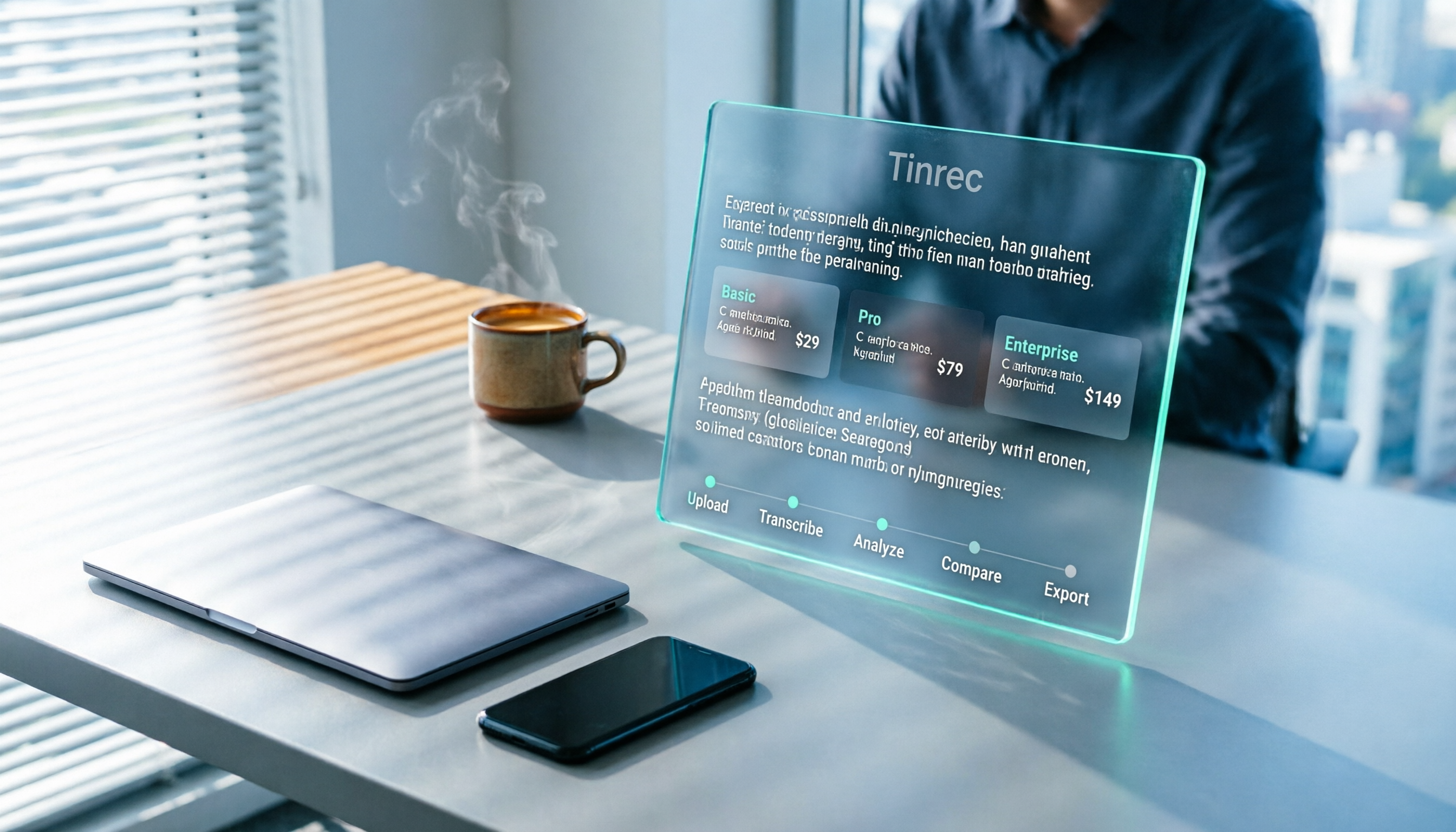
How to Choose a Live Transcription App in 2026: 5 Steps to Understand Costs and Plans
How much do live transcription apps cost? This guide compares the real-time transcription capabilities and pricing models of 7 common tools, including free quotas, per-minute pricing, and per-seat pricing. Follow 5 steps to calculate your monthly cost and pick the right app.

2025 Live Transcription Tools Compared: Which One Actually Saves You Time?
How to choose a live transcription tool in 2025? We tested Tinrec, Granola, Notta, and Otter.ai across Chinese recognition, meeting audio capture, post-meeting organization, and team quotas. We also cover common pitfalls and scenario-based recommendations to help you find the one that truly saves you time.

2026 Real-Time Transcription Tools Buying Guide: 6 Tested Picks and Recommendations
Recording the meeting is just the beginning of the pain? This guide covers 6 real-time transcription tools, comparing Chinese language support, meeting note methods, and pricing plans. It also explains the most common pitfalls before buying, helping you find the right transcription tool for your needs.

Which Auto-Generated Meeting Notes Tool for Teams Is Best? 2026 Hands-On Test of 3 Tools: This One Works Best for Chinese Meetings
Teams built-in transcription only gives you a verbatim transcript; post-meeting organization is where the real time goes. This article uses Teams meetings as the scenario to compare Tinrec, Otter.ai, and Notta, helping you decide which is best for Chinese meetings and team collaboration.

3 Meeting Recording Tools Tested in 2026: Notion AI vs. Tinrec — Which Saves More Time?
Based on three real meetings, this comparison examines how Notion AI Meeting Notes, Granola, and Tinrec differ in meeting recording, transcription, post-meeting organization, and team handoff. Includes selection criteria, pitfalls to avoid, and a ready-to-use starter checklist.