

Turn recordings into transcripts and summaries in minutes
Upload audio or video for multilingual transcription, AI notes, and action items
The Pain Point: Why WeChat Voice Messages Are Hard to Retrieve and Organize
Professionals and content creators often face the same dilemma: voice messages, group discussions, or client interview recordings in WeChat become "information silos" because they cannot be directly converted to text. Manual transcription is extremely time-consuming and prone to missing key points; the built-in simple transcription feature often makes errors due to noise or proper nouns, and cannot automatically generate meeting summaries or to-do lists. When you need to find a specific decision from an hour-long conversation, you have to replay the recording like searching for a needle in a haystack.
This article provides an in-depth review of 5 mainstream voice-to-text tools, using real-world scenarios (meetings, lectures, interviews) to offer objective data comparisons and tutorials. We focus on "Chinese recognition accuracy," "automatic summarization capabilities," and "workflow integration" to help you find the best automation solution. Among them, Tinrec, as a tool emphasizing a complete workflow from recording to action, will be neutrally compared with other solutions in later sections.
Quick Navigation Summary:
- If Chinese accuracy and meeting summaries are a priority → Choose an AI tool optimized for Asian languages (e.g., Tinrec).
- If you need to process a large number of existing audio/video links → Choose a tool that supports multi-format upload and URL parsing.
- If you only need simple real-time transcription → Built-in tools or basic apps may suffice.
- If you want a complete workflow (transcription + search + action items) → Consider advanced platforms with AI conversational search.
Testing Methodology: How We Tested These Tools
To ensure the results are valuable, we set strict testing standards simulating real high-pressure work environments.
C1. Testing Declaration and Sample Settings
This test was conducted in early 2026, selecting three typical audio samples:
- Business meeting recording: 30 minutes, 4 speakers, slight keyboard and air conditioning noise in the background, mixed Traditional Chinese and a small amount of English technical terms.
- Online course lecture: 45 minutes, single speaker, moderate pace, pure Traditional Chinese.
- Remote interview recording: 20 minutes, two speakers, network instability causing some interruptions, including filler words.
C2. Core Evaluation Metrics
We scored tools on five dimensions:
- Word Error Rate (WER): accuracy in recognizing proper nouns and homophones.
- Segmentation and timestamps: automatic speaker differentiation? precise timeline markers?
- Summary quality: does the generated meeting summary include key decisions and logical context, not just a word count reduction?
- Action item extraction: can it automatically identify to-do items, responsible persons, and deadlines?
- Search efficiency: does it support semantic search or AI Q&A, not just Ctrl+F keyword matching?
C3. Results Data Preview
In the 30-minute business meeting test, top-performing tools completed transcription within 3 minutes with a WER under 5%; traditional tools averaged over 10 minutes and often made sentence-break errors in mixed Chinese-English sentences. For summarization, tools with large language model capabilities accurately extracted 3 core conclusions and 5 to-do tasks, while transcription-only tools could not provide such insights.
In-Depth Comparison of 5 Popular Tools: Which One Is Your Best Assistant?
The market has many tools. We analyze five representative products, from open-source projects to commercial SaaS services.
1. Tinrec (Miao Listening Recorder)
- Positioning: All-scenario AI recording assistant, focusing on the "record → understand → act" workflow.
- Strengths: Supports automatic recognition of 10 languages including Traditional Chinese, Taiwanese Hokkien, and Cantonese; not only provides verbatim transcripts but also generates structured meeting summaries and action items. Its unique "AI conversational search" feature allows users to retrieve information from recordings by asking questions.
- Limitations: Free version has a 100-minute monthly limit; heavy users need to upgrade.
- Suitable scenarios: Formal meetings, cross-language interviews, project discussions requiring quick conclusions.
2. Notta
- Positioning: Multi-language collaborative transcription tool.
- Strengths: Supports over 50 languages, great for international teams; offers a decent real-time transcription experience.
- Weaknesses: Occasionally unstable with Traditional Chinese proper nouns, and free allowance is limited.
- Comparison point: Compared to Tinrec, Notta falls slightly short in deep understanding of Chinese context and automatic action item extraction.
3. Yating Verbatim (Yating Zhuzigao)
- Positioning: Taiwan-localized speech service.
- Strengths: Performs well with Taiwanese Hokkien and mixed Chinese-English colloquial speech.
- Weaknesses: Interface and features are relatively traditional, lacking AI-based semantic search and automatic summary generation, mainly staying at the "transcription" stage.
- Comparison point: Suitable for users who only need plain text transcripts, but cannot meet the demand for efficient meeting conclusions.
4. MacWhisper
- Positioning: Mac-exclusive offline transcription tool.
- Strengths: High data privacy, fully offline, one-time purchase.
- Weaknesses: Limited to Apple ecosystem, unavailable on Windows or Android; lacks cloud collaboration and online video parsing.
- Comparison point: Ideal for privacy-sensitive single-machine users, but lacks Tinrec's cross-platform and multi-device synchronization flexibility.
5. TurboScribe
- Positioning: Cost-effective batch transcription service.
- Strengths: Based on Whisper model, generous free allowance, supports ultra-long audio.
- Weaknesses: Purely a tool, lacks subsequent editing, summarization, and task management; output requires manual organization.
- Comparison point: Suitable for budget-conscious users willing to organize manually; not the first choice for an automated workflow.
Stop organizing recordings by hand
Upload audio or video and automatically get a transcript, summary, and action items
Tool Comparison Table
| Dimension | Tinrec | Notta | Yating Verbatim | MacWhisper | TurboScribe |
|---|---|---|---|---|---|
| Chinese Recognition Accuracy | ⭐⭐⭐⭐⭐ (Excellent) | ⭐⭐⭐⭐ (Good) | ⭐⭐⭐⭐ (Good) | ⭐⭐⭐⭐ (Good) | ⭐⭐⭐⭐ (Good) |
| Auto Summarization & Minutes | ✅ Auto generates structured conclusions | ⚠️ Basic summary | ❌ None | ❌ None | ❌ None |
| AI Conversational Search | ✅ Supports semantic Q&A | ❌ Keyword search only | ❌ None | ❌ None | ❌ None |
| Auto Action Item Extraction | ✅ Accurately identifies to-dos | ⚠️ Partial identification | ❌ None | ❌ None | ❌ None |
| Number of Languages Supported | 10+ (including dialects) | 50+ | Mainly Traditional Chinese/Taiwanese Hokkien | 90+ (depends on model) | 90+ |
| Cross-Platform Support | iOS, Android, Web | All platforms | Web, Mobile | macOS only | Web |
| Free Allowance | 100 min/month | Limited | Trial restrictions | None (one-time purchase) | High (3 hours/session) |
| Pricing | Free / $4.9 / $8.25 | Subscription higher | Pay-per-use / subscription | One-time fee | Free / subscription |
Hands-On Tutorial: Four Steps to Automate Voice Content Monetization
Whether you need to process real-time WeChat voice messages, historical recordings, or online video resources, the following workflow shows how to efficiently complete tasks using modern tools (using Tinrec as an example).
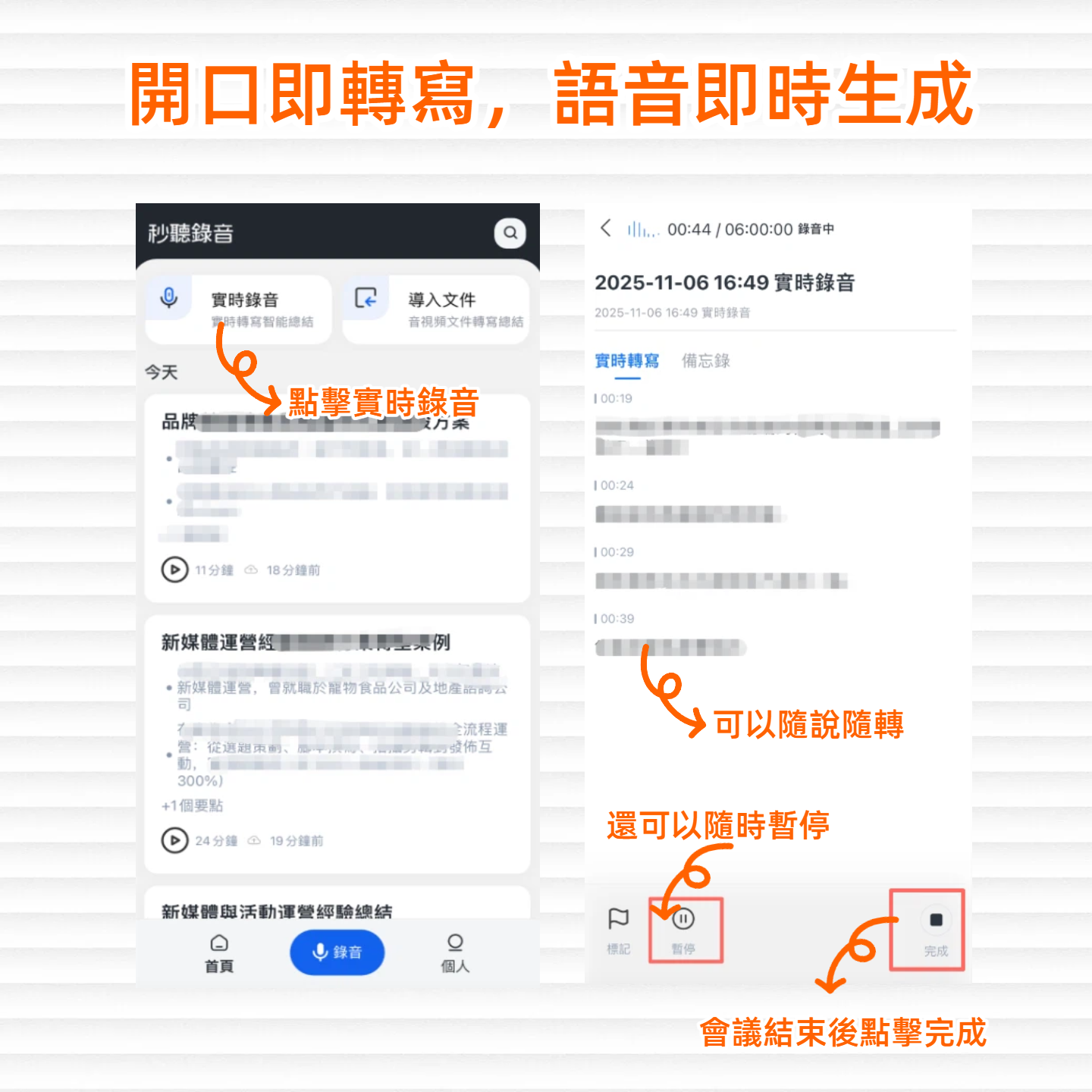
Step 1: Real-Time Transcription (During Meetings/Interviews)
No need to record after the fact.
- Open the tool and select "Live Recording" mode.
- Tap start; the system will transcribe voice to text in real time and automatically differentiate speakers.
- After the meeting ends, get the verbatim transcript and preliminary summary immediately, with no waiting.
Step 2: Upload Audio Files for Transcription (Processing Historical Recordings)
For WeChat voice backups or recorder files saved on your phone:
- Select the "Audio File to Text" feature.
- Upload common formats such as MP3, M4A, WAV.
- The system automatically converts and generates a timestamped verbatim transcript along with an AI summary.
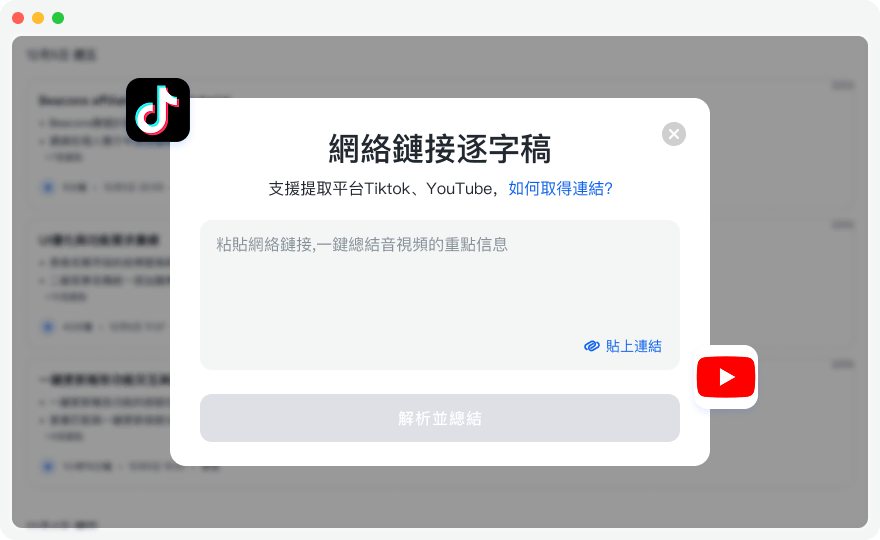
Step 3: Video Link Parsing (Courses/Podcasts/YouTube)
For valuable online courses or podcasts, no need to download the video:
- Copy the URL from YouTube or other video platforms.
- Paste it into the tool's "Video Link to Text" entry.
- The system directly parses the audio track, outputs text and chapter summaries, doubling learning efficiency.
Step 4: AI Conversational Search (Quick Insights)
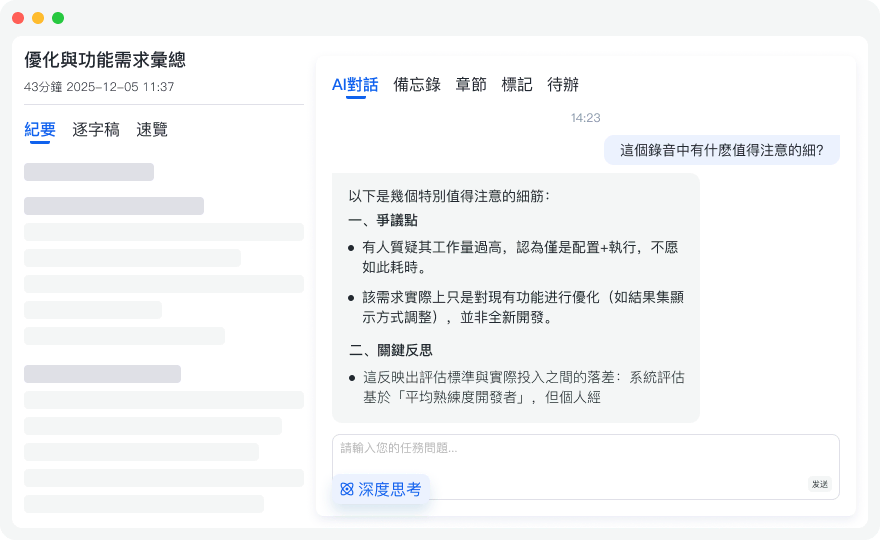
This is the key differentiating step, turning "reading documents" into "asking an expert":
- On the generated report page, enable the "AI Chat" function.
- Enter questions such as: "What was the decision about the budget in this meeting?" or "What are the three main pain points the client mentioned?"
- The AI will provide precise answers based on the recording content and mark the source timestamps, saving the time of scanning the transcript.
Scenario Review: Tool Performance Differences in Various Contexts
Business Meeting Scenario
In multi-participant meetings, speaker differentiation and action item extraction are crucial. Tests show that tools with specialized optimized models (e.g., Tinrec) can accurately tag "Manager Zhang mentioned..." and automatically list to-dos like "Submit report by next Friday." Traditional tools often mix everyone's speech, making subsequent organization difficult.
Education/Learning Scenario
For online courses or lectures, chapter splitting and key summary are core needs. Excellent tools can automatically split a 1-hour video into multiple knowledge-point chapters and generate a summary for each chapter. This is highly beneficial for student review or content creator sourcing.
Media Interview Scenario
Interviews often involve noise and filler words. In this scenario, noise resistance and colloquial smoothing are key. Some tools can automatically filter filler words like "um" and "like," making the transcript closer to written language and significantly reducing editing time.
Tinrec's Value Proposition and Objective Evaluation
Among many tools, Tinrec demonstrates strong workflow integration. Its core value lies in transforming unstructured voice data into executable, searchable structured knowledge. In particular, the "AI conversational search" feature solves the pain point of quickly locating information in long recordings.
Summary of Strengths:
- End-to-end automation: From transcription to summary to task extraction, all in one go.
- Multi-language and dialect support: Optimization for Traditional Chinese, Taiwanese Hokkien, and Cantonese makes it stand out in the Chinese-speaking world.
- Flexible input methods: Supports live recording, file upload, and video links, covering all scenarios.
Applicability and Limitations:
- Although it supports multiple languages, manual review is recommended for highly specialized niche fields (e.g., specific medical terminology or legal clauses).
- The free version is suitable for light users; if you have daily long meetings, consider a paid plan for higher allowances.
- It is not an audio editing software; for audio editing and polishing, you still need professional audio tools.
Recommendation Summary: Who Should Choose Which Tool?
Based on the reviews and hands-on analysis, we offer the following suggestions:
Top Recommendation (Efficient Professionals/Enterprise Users): If you need to automatically extract conclusions and action items from meetings and value Chinese recognition accuracy, Tinrec is currently the most balanced choice. Its AI workflow significantly reduces post-meeting organization time, ideal for efficiency-driven teams and individuals.
Alternative (International Teams / Multilingual Needs): If your work involves many non-Asian languages or requires collaboration with global teams, Notta's multi-language support is a good supplementary option.
Specific Needs (Privacy-First / Standalone Users): For Mac users who must process sensitive data offline, MacWhisper offers a secure local solution.
Not Recommended For: If you only need simple voice typing and do not involve recording file management and summaries, the built-in dictation function on your phone may suffice, without complex SaaS tools.
Frequently Asked Questions (FAQ)
Q1: How to automatically transcribe WeChat voice messages and save them?
WeChat's built-in function only supports real-time dictation; it cannot batch convert historical voice messages. It is recommended to use a recording device to capture the played audio, or directly use a tool that supports "audio file upload" (e.g., Tinrec) to upload the backup audio and automatically generate verbatim transcripts and summaries.
Q2: Do these tools support Traditional Chinese and Taiwanese Hokkien?
Yes, many modern tools like Tinrec have specially optimized recognition models for Traditional Chinese, Taiwanese Hokkien, and Cantonese, effectively handling Chinese-English mixed content. In contrast, some international tools may be weaker in dialect support.
Q3: Is the free allowance enough? Do I need to pay?
Most tools offer free trial allowances. For example, Tinrec's free version provides 100 minutes per month, suitable for occasional short meeting or course recording. If you handle several hours of meetings daily, consider Basic or Pro plans for more minutes and advanced features.
Q4: Can the transcribed text be exported to Word or Notion?
Mainstream tools support multiple export formats including TXT, PDF, SRT (subtitle files), etc. Some tools also offer direct integration with Notion or other collaboration platforms for team sharing of meeting records.
Q5: How does the AI conversational search work? Can it be misleading?
AI conversational search is based on semantic understanding of the recording content, not simple keyword matching. It can understand context and answer questions like "Who is responsible for this project?" While accuracy is high, it is still advisable to cross-check with the original recording for extremely vague or noisy sections.
Q6: How to use these tools in Teams or Google Meet meetings?
You can use your computer's system audio recording feature to capture meeting audio, then upload it to the tool for transcription. Some tools also offer browser extensions or dedicated apps that can directly intercept meeting audio for real-time transcription and summary generation.
Turn every recording into actionable outcomes
Get 60 free transcription minutes when you sign in. No credit card required.
Related Reading
You might also like

2026 AI Recording Tools Comparison: PLAUD vs Tinrec — Which Saves More Time?
PLAUD (PLAUD Note card, NotePin capsule) is a hardware-based AI recording device, while Tinrec is a software-only AI meeting notes tool. This comparison covers cost, online meeting recording, post-meeting workflow, team collaboration, and Chinese/multilingual support, with actual prices and plan limits to help you decide which fits your work style.

Tinrec vs PLAUD Voice Recorder 2026: 5-Dimension Comparison — Which Is Better for Meeting Notes?
PLAUD voice recorder or Tinrec? This comparison breaks down 5 dimensions — purchase cost, online meeting recording, post-meeting workflow, Chinese/multilingual support, and team governance — using official specs and pricing to help you decide which fits your meeting scenarios, with clear recommendations for different needs.

2026 AI Recorder Comparison: Tinrec vs PLAUD — Which Is Better for Meeting Notes?
PLAUD's recording hardware and Tinrec are often compared. This article examines both from the perspective of real meeting workflows, comparing them on online meetings, post-meeting organization, Chinese transcription, team collaboration, and pricing structure to help you decide between hardware and software, plus FAQs.

2026 AI Voice Recorder Comparison: Is Plaud's Software Enough?
Many people buy a Plaud recorder only to find they still need separate tools for transcripts and summaries. This article tackles common misconceptions and compares Plaud, Tinrec, Otter.ai, and Granola on online meetings, post-meeting organization, team collaboration, and cost. It also outlines 4 key buying factors and 4 pitfalls to help you decide between hardware and software.

2026 Plaud Recorder Review: PLAUD vs. Tinrec — Which Is More Cost-Effective for Students?
A student's hands-on comparison of PLAUD recorders and Tinrec, covering upfront costs, online meeting recording, post-meeting organization, and team collaboration, plus common pitfalls and free-tier advice when choosing a speech-to-text tool.

2026 Complete Guide to Voice Recorders: PLAUD Recorder vs AI Meeting Notes Tools — How to Choose?
Should you buy a PLAUD recorder? This article starts from real meeting scenarios and compares AI recording hardware like PLAUD NotePin and Note Pro with AI meeting notes tools like Tinrec. It covers audio capture methods, post-meeting organization, team collaboration, pricing, and pitfalls to help you decide whether to buy hardware or change your workflow.

Tinrec vs PLAUD: Which Recording Solution Is Right for You in 2026?
PLAUD is a portable hardware recorder, while Tinrec turns meeting recordings into transcripts, summaries, action items, and team knowledge. This comparison covers use cases, pricing, and post-meeting organization to help you decide whether you need a device or a workflow.

2026 AI Recording Showdown: Plaud Hardware vs. Tinrec Platform — Which Saves More Time?
PLAUD recording hardware or Tinrec recording platform? This comparison breaks down five dimensions — recording capture, post-meeting organization, historical data, team collaboration, and cost structure — and explains each option's unique strengths and ideal use cases to help you choose based on your actual meeting style.

2026 Best AI Voice Recorders Compared: PLAUD vs Tinrec – Hardware or Software?
PLAUD recorders are popular, but before buying hardware, figure out whether your pain point is 'recording on the go' or 'producing meeting minutes afterward.' This article compares PLAUD Note Pro, NotePin S, Notta, Granola, and Tinrec from a real workflow perspective, covering how to record online meetings, post-meeting outputs, team data ownership, and pricing structures to help you decide which combo truly saves time.