
Turn recordings into transcripts and summaries in minutes
Upload audio or video for multilingual transcription, AI notes, and action items
How to quickly convert voice information into editable text has become a must-learn skill for professionals to boost efficiency. Especially for users of Cantonese, given the dialect's complexity and the common mix of Chinese and English, finding an accurate Cantonese speech-to-text tool is often more challenging than for Mandarin. Recently, AI recording devices like Plaud.ai have attracted widespread attention, but beyond hardware recorders, pure software solutions like TinRec are also changing how we work with their flexibility.
Technical Challenges and Breakthroughs in Cantonese Speech to Text
For a long time, Cantonese speech recognition has faced two major pain points: the difference between spoken and written forms (e.g., "gam" vs. "this way"), and the common mix of Chinese and English in Hong Kong workplaces. Early recognition engines often struggled to handle these details accurately, requiring heavy manual correction of transcripts.
However, with the development of large language models (LLMs), a new generation of AI tools can not only understand Cantonese but also grasp context, automatically correct grammar, and even convert spoken language into written form. This means speech-to-text is no longer just dictation but has gained the intelligence to understand and summarize.
Hardware Recording Pen Innovation: Plaud.ai's Advantages and Limitations
Among many solutions, Plaud.ai made a name with its ultra-thin hardware design (Plaud Note). This device is marketed as an "AI recording pen that sticks to the back of your phone," using MagSafe magnetic attachment to solve the pain point of iPhone users struggling to record calls. Its core advantage lies in physical convenience: using vibration conduction sensors (VCS), it can clearly record phone calls, making it highly attractive for those who frequently take phone meetings or interviews.
Plaud.ai Key Highlights:
- Hardware Integration: Physical button for one-touch recording, no need to open an app.
- Call Recording: Specifically addresses iOS call recording limitations.
- AI Processing: After recording, uploads to the cloud via the app for transcription and summarization using models like ChatGPT.
However, hardware solutions also have limitations. Users need to carry an extra device, and if the recording file doesn't come from that hardware (e.g., a Zoom meeting recording on a laptop or a file from someone else), the workflow becomes cumbersome. Also, the upfront cost of hardware is a consideration.
Stop organizing recordings by hand
Upload audio or video and automatically get a transcript, summary, and action items
Rise of the Software Ecosystem: TinRec's Versatile Applications
Compared to Plaud.ai's hardware-first approach, pure software solutions offer another flexible option. Take TinRec as an example—these tools break free from hardware constraints, focusing instead on post-processing and multi-scenario applications. For users who don't want to carry extra gear or mainly handle digital files (like MP3, MP4), TinRec provides a more direct efficient path.
TinRec's design philosophy is "full format compatibility" and "deep AI applications." It's not just a recording tool but a powerful audio processing hub.
TinRec Core Features:
- MP3 to Text and Multi-Format Support: Users can directly upload existing audio files (e.g., old recordings from a voice recorder, podcast audio), and the system quickly converts them into accurate text, with specially optimized recognition for Cantonese.
- Call Recording to Text: Even without external hardware, TinRec offers strong call recording transcription capabilities, suitable for quickly transcribing files from phone or VoIP software.
- YouTube Subtitle Generation: This is a unique and practical feature of TinRec. For content creators, simply paste a video link or upload audio to automatically generate subtitles with timestamps, greatly reducing post-production time.
From Meeting Minutes to Video Content: Real-World Use Cases of AI Meeting Summary
Whether using Plaud.ai or TinRec, the true value of modern AI tools lies in "post-processing." Traditional word-for-word transcripts are complete but time-consuming to read. Both tools offer "AI meeting summary" and "AI meeting minutes" features, but with slightly different focuses.
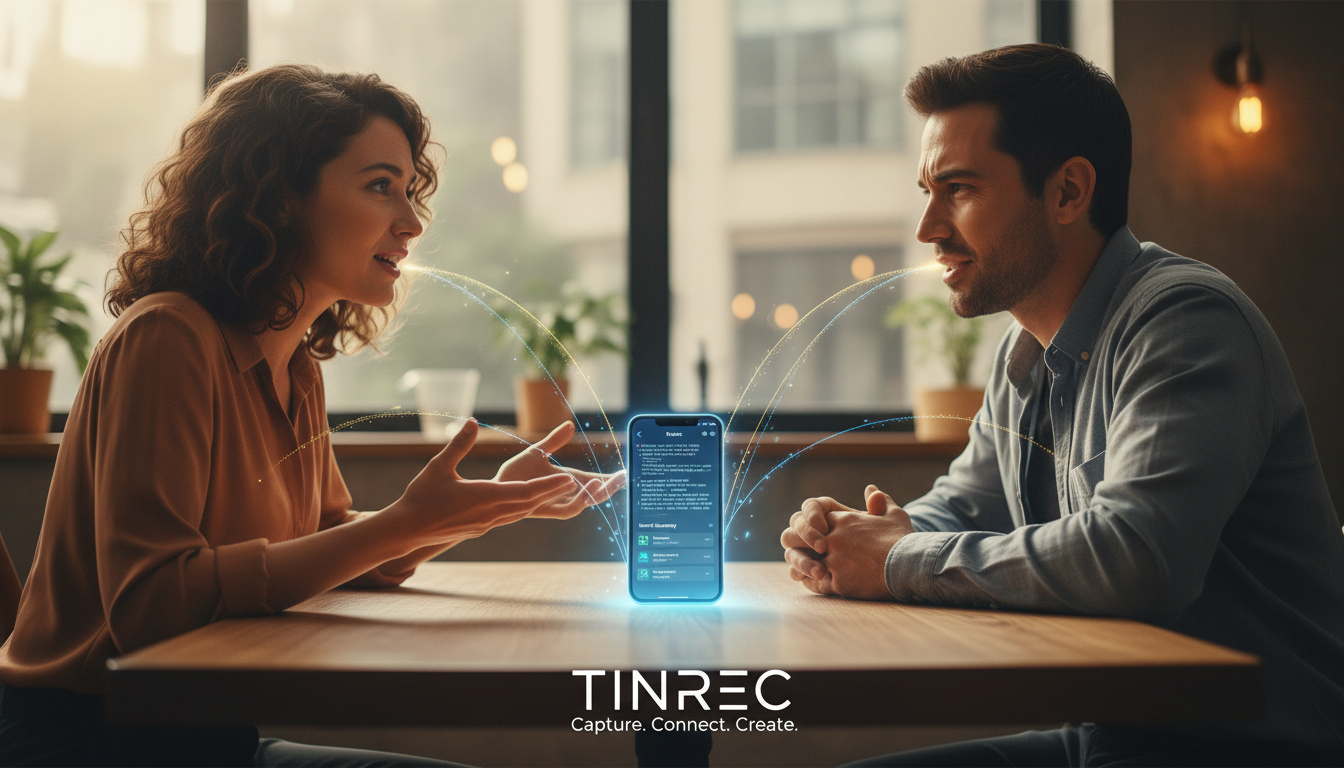
In the Plaud.ai ecosystem, the summary feature mainly serves content recorded on its hardware, ideal for quickly reviewing a just-ended phone call or in-person meeting. In TinRec's application, the AI summary shows stronger compatibility. Users can upload a two-hour Zoom meeting recording (MP3 or MP4) to TinRec; the AI not only generates a verbatim transcript but also automatically extracts key decision points, to-do lists, and topic summaries.
This "AI meeting summary" capability is crucial for cross-department collaboration. It filters out small talk and digressions, precisely locking in core information. Especially when processing Cantonese meetings, the AI automatically converts colloquial discussions into formal written summaries, ready for email reports.
Comprehensive Review: How to Choose the Right Tool for You?
When choosing a Cantonese speech-to-text tool, the key is to clarify your workflow:
- If you are a "field" worker: Often take calls on the go, conduct face-to-face interviews, and don't mind carrying extra accessories—Plaud.ai's hardware recording pen offers excellent real-time capture.
- If you are a "digital" worker or creator: Your work involves heavy file processing (e.g., organizing past recordings, creating video subtitles), remote video meeting records, or you want efficient transcription without buying new hardware—TinRec offers higher cost-effectiveness and flexibility.
TinRec's advantage lies in its breadth as a comprehensive platform, from MP3 to text to YouTube subtitle generation, covering multiple needs from input to output. Through its official website (https://tinrec.com/), users can experience an AI productivity revolution without hardware constraints.
In summary, Cantonese speech-to-text technology is now mature. Whether you choose Plaud.ai's hardware integration or TinRec's software ecosystem, making good use of AI meeting minutes and transcription tools will completely change how you record and manage information, freeing your brain from memory tasks to focus on more valuable thinking.
Turn every recording into actionable outcomes
Get 60 free transcription minutes when you sign in. No credit card required.
Related Reading
You might also like
How to Use AI for Meeting Minutes in 2026: 5 Steps from Recording to Team Data
For mid-level managers juggling a dozen meetings a week and still stuck writing up minutes afterward, this guide breaks down how to use AI for meeting minutes in 5 steps: recording, transcription, summary and chapters, action item extraction, and team knowledge retention. It also reviews 7 AI meeting minutes tools, their positioning, pricing, and best-fit scenarios, so you can pick the right one for your team.

What Are Meeting Minutes in 2026? 4 Steps from Recording to Complete Minutes
What do meeting minutes mean? How do they differ from meeting records? This article first uses 4 steps to explain how to turn a meeting recording into trackable meeting minutes, then compares Tinrec and Otter.ai across 5 dimensions—Chinese-language meetings, recording methods, post-meeting outputs, team governance, and pricing—to help you decide which approach to use.

2026 Comparison of 6 Meeting Minutes Tools: Which Format Produces Actionable Records Fastest?
How to write meeting minutes that won't get rejected? This article breaks down the 5 core fields and writing principles of meeting minutes, and compares the format support, free quotas, and pricing of 6 tools—Tinrec, Otter.ai, Fireflies.ai, Notta, Granola, and TurboScribe—to help you choose the best record-keeping solution for your team.

Best AI Meeting Collaboration Platforms 2026: 6 Tools with Auto Summaries & Team Knowledge Capture
From bot-free recording and post-meeting summaries to team knowledge retention, here are 6 AI meeting collaboration solutions, with Tinrec as the primary example, to help you quickly choose the right tool for your needs.

How to Use Live Transcription in 2026: 5 Steps from Recording to AI Meeting Notes
In 2026, live transcription tools compete not just on transcription speed but on post-meeting organization and team collaboration. This article breaks down the live transcription workflow in 5 steps, tests Tinrec's bot-free recording, AI summaries, action item extraction, and AI Q&A, and compares Otter.ai, Notta, and Granola for different use cases—helping Hong Kong office workers cut overtime and leave work earlier.

2026 Comparison of 4 Smart Meeting Collaboration Platforms: From Free to Team Plans
A tutorial-style side-by-side comparison of Tinrec, Otter.ai, Notta, and Granola—covering meeting recording, transcripts, summaries, action items, AI Q&A, team seats, and pricing—to help you decide which fits your meeting workflow.

How to Choose Smart Meeting Collaboration Tools in 2026: A Complete 5-Step Evaluation Guide
Use 5 steps to build evaluation criteria for smart meeting collaboration: from meeting scenarios, capture methods, post-meeting workflows, team governance to total cost of ownership. Using Tinrec as an example, learn how to validate with a real meeting and choose the right tool within budget.

2026 Smart Meeting Collaboration Tool Comparison: From Recording to Action Items, Which One Really Handles Post-Meeting Work?
Starting from the common misconception of 'putting the entire budget into the meeting moment,' this article breaks down how to choose a smart meeting collaboration toolbox: how meetings are captured, what can be done after transcription, where data ultimately resides, and how team roles and seats are allocated. It compares Tinrec, built-in platform transcription, Otter.ai, and PLAUD recording hardware, with a pitfall guide and scenario-based selection advice.

2026 Review of 5 Smart Meeting Collaboration Platforms: Tinrec vs Otter.ai – Which Should Chinese-Speaking Teams Choose?
Starting from the three most common pitfalls when choosing a meeting tool, this hands-on comparison examines Tinrec and Otter.ai across six dimensions: meeting capture, Chinese transcription, post-meeting output, audio retention, team governance, and pricing. It helps you decide how to choose a smart meeting collaboration platform and whether the free version is sufficient.