
Turn recordings into transcripts and summaries in minutes
Upload audio or video for multilingual transcription, AI notes, and action items
In the age of information overload, we encounter a flood of audio content daily—whether it's a one-hour educational podcast, a weekly team meeting, or a spur-of-the-moment voice memo. But audio has a big drawback: low information density and difficulty in searching.
Have you ever had to re-listen to an entire episode just to find a single quote? Or struggled to keep up with taking notes while listening, ending up with fragmented scribbles?
This article benchmarks 6 popular AI speech-to-text tools in 2026, comparing free tiers, accuracy, and AI summarization capabilities. Quick verdict:
- Best for Taiwanese/Hokkien recognition: Yating Transcript.
- Best for team collaboration and comments: Vocol.
- Best for podcast organization, AI Q&A, and knowledge management: Tinrec (Instant Audio Notes).
- Best for students on a budget: inFin.
Why Do You Need an AI Voice Note Tool?
Traditional voice recorders or simple speech-to-text tools only produce walls of text—you still need to spend ages reading and organizing. The new generation of AI tools in 2025 solve three core pain points:
- Time-consuming re-listening: AI processes an hour of audio in minutes, marking key timestamps so you don't have to listen from start to finish.
- Difficulty taking notes: Automatically identifies speakers and generates summaries, eliminating the need to scribble frantically.
- No follow-up after meetings: Many recordings are never reopened. AI extracts action items to ensure decisions are executed.
In-Depth Review of 6 Popular AI Transcription Tools in 2026
Based on market buzz and hands-on testing, we selected 6 distinctive tools: Vocol for team collaboration, Yating for localization, and Tinrec with its unique AI chat feature.
Feature and Spec Comparison Table
| Tool | Core Focus | Free/Trial Quota | Key Features | Best For |
|---|---|---|---|---|
| Tinrec (Instant Audio Notes) | All-in-one AI note assistant | 100 min/month | AI chat Q&A, podcast link import, multi-format export | Study notes, meeting minutes, content curation |
| Vocol.ai | Team collaboration & meetings | 200 min | Integrates with Google Meet/Teams, multi-user commenting | Enterprise teams, remote meetings |
| Yating Transcript | Taiwanese localized speech | 300 min | Excellent Taiwanese/Mandarin recognition, supports live recording | Interviewing elders, local content creation |
| cSubtitle | Video subtitle generation | 3 min trial | Auto punctuation & formatting, no registration required | Short video creators, subtitle making |
| Litok | Cross-language translation | 1 month trial | Fast translation, great for foreign language contexts | International meetings, travel |
| inFin | Free basic tool | Unlimited | Completely free, works offline | Students, budget-conscious users |
Commentary on Established Tools
- Vocol: Ideal for internal company use, especially its voice collaboration feature that lets you tag colleagues on transcripts like in Google Docs. Integrates well with Teams and Meet.
- Yating Transcript: A top choice for Taiwanese users, particularly when recordings include Hokkien or heavy Taiwanese accents. Its recognition is hard to beat, but summary depth is basic.
- inFin: Though the interface is simple and mainly supports Simplified Chinese, it's a generous "unlimited recording" option for students who want to pay nothing and don't need high accuracy.
Stop organizing recordings by hand
Upload audio or video and automatically get a transcript, summary, and action items
However, if you're after a complete workflow from recording to knowledge management—especially for podcasts or long lectures—Tinrec offers a novel interactive experience.
Tinrec Deep Dive: More Than Transcription—Talk to Your Audio
Among the many tools, Tinrec (Instant Audio Notes) carves a different path. It doesn't just convert speech to text; it emphasizes "understanding" and "action." For podcast learners and frequent meeting attendees, it solves the biggest pain point: organization.
1. Exclusive AI Chat Q&A: Turn Recordings into Your Knowledge Base
Most tools give you a transcript and you still have to Ctrl+F for keywords. But if the speaker uses imprecise terms, you'll miss them. Tinrec's AI Chat Q&A lets you ask questions directly.
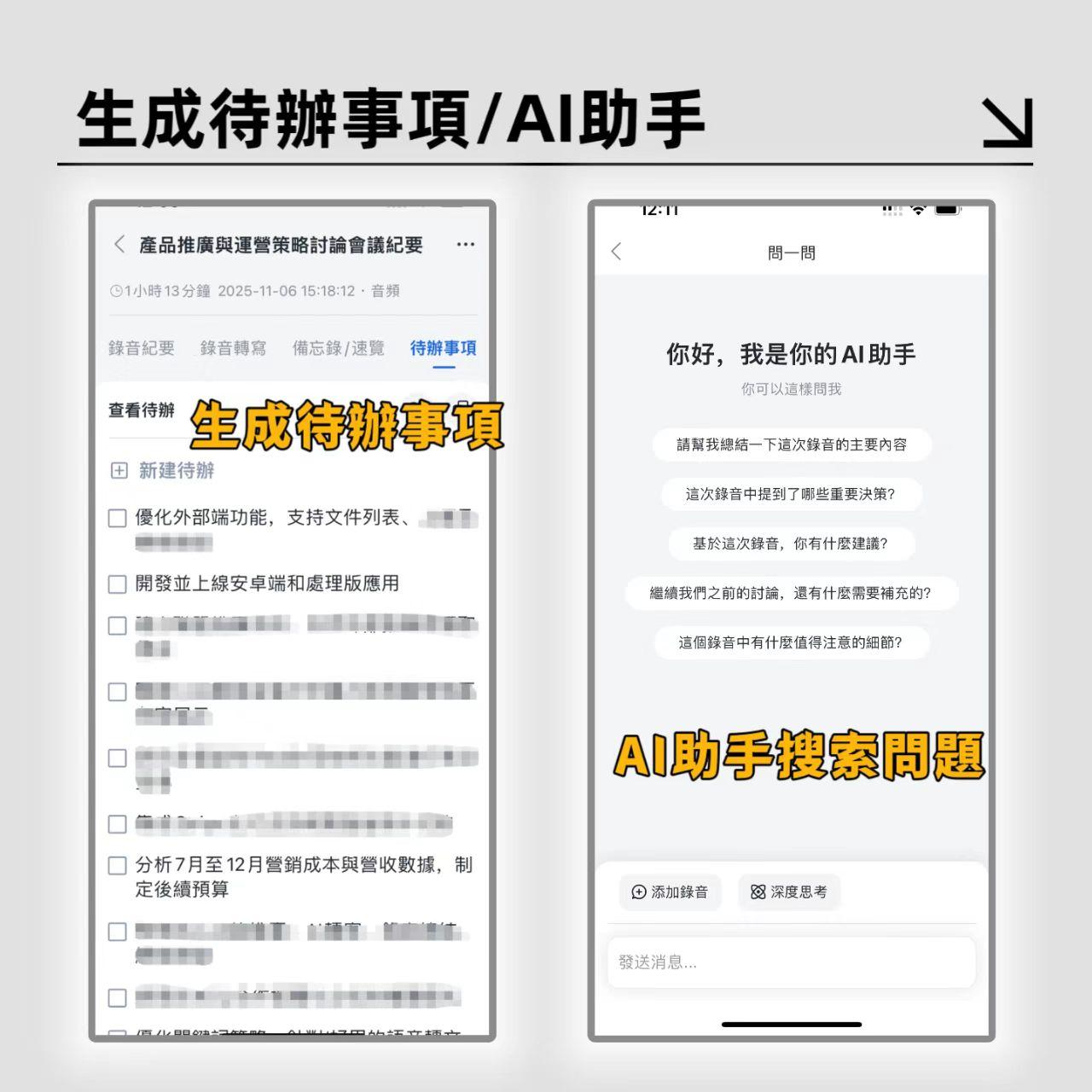
For example:
- "What are the three tips about sleep quality mentioned in this podcast?"
- "What is the exact marketing budget mentioned in the meeting?"
The AI answers based on the recording content—a huge efficiency boost for 2-hour interviews or lectures.
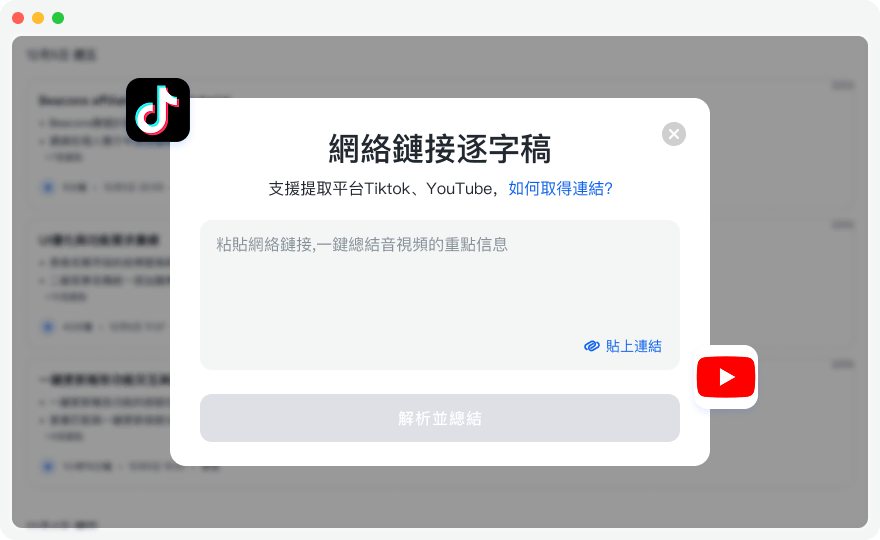
2. One-Click Podcast & YouTube Link-to-Notes
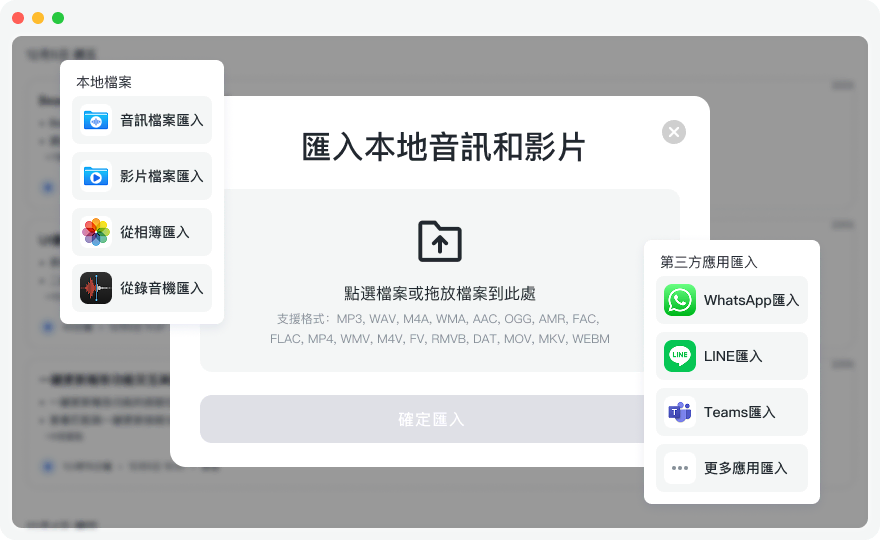
A favorite among content creators and learners. No need to download MP3s; Tinrec accepts podcast/video links directly and automatically transcribes and generates summaries in the cloud. Listen on your commute, and have notes ready by the time you arrive at work.
3. Automated Meeting Minutes & Action Items
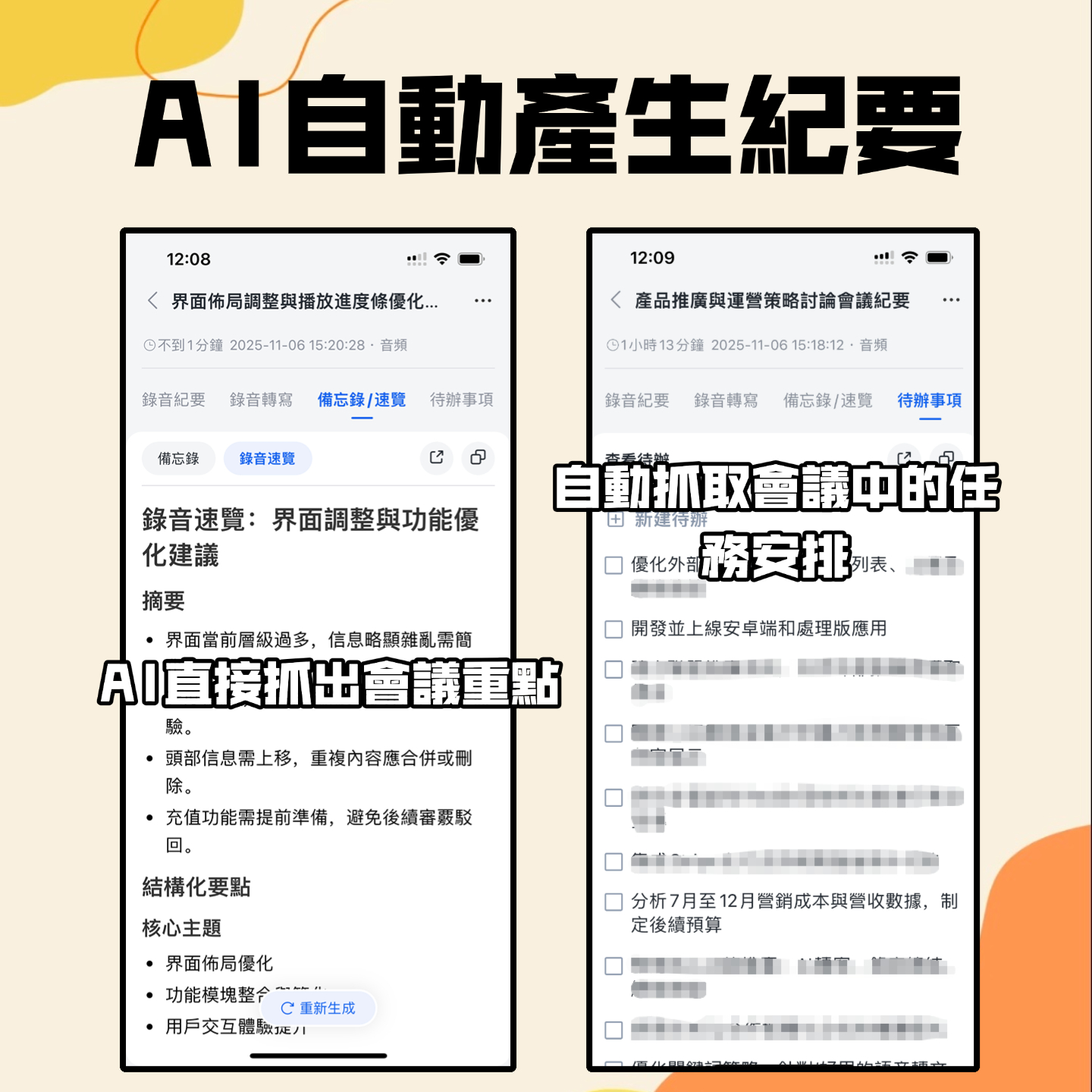
For workplace meetings, Tinrec not only provides a transcript but also identifies speakers, extracts "meeting conclusions," and lists "action items." This saves 30 minutes of note-taking after each meeting, ensuring every discussion leads to follow-up.
Practical Tutorial: How to Quickly Summarize a Podcast with AI

Below is a walkthrough for turning a 60-minute podcast into study notes using Tinrec (the process works with most import-compatible AI tools):
Step 1: Get the content link or recording Find the URL of a YouTube video or podcast episode. For live meetings or interviews, use the mobile app's live recording with real-time transcription feature.
Step 2: Import and transcribe Open Tinrec's web or app, choose "Import audio/video" or paste the link. Tinrec supports 10+ languages including Chinese, English, Japanese, Korean. Select the correct language for better accuracy.
Step 3: AI analysis Wait for transcription (typically 1/10th of the audio length). Once done, you'll see:
- Timeline transcript: Click text to jump to the corresponding audio.
- AI summary: Structured key points auto-generated.
- Speaker diarization: Clear identification of different speakers.
Step 4: Chat with AI and export Use the chat panel on the right: "Summarize the speaker's specific steps for time management." After verifying, use multi-format export to save as Word, PDF, or Markdown, then store in Notion or Obsidian.
Frequently Asked Questions
Q1: How accurate are these AI transcription tools?
Current tools like Vocol, Yating, and Tinrec achieve over 90% accuracy in clear environments. Accuracy is mainly affected by background noise, overlapping speech, or poor mic quality. With good audio, Tinrec's AI even corrects awkward phrasing.
Q2: Can I transcribe iPhone phone calls?
Due to iOS privacy restrictions, apps cannot directly record phone calls. Use speakerphone and record with another device (iPad or computer) via Tinrec, or import a call recording if you have third-party hardware.
Q3: Can I process old recordings in bulk?
Yes. Tinrec supports batch audio file upload for transcription. Upload past meeting or lecture recordings to build a searchable personal knowledge base.
Q4: Is the free version enough?
For occasional students or individuals, inFin (fully free) or Tinrec's free tier (100 min/month) typically handle 1-2 lectures/meetings. Heavy users (journalists, secretaries, grad students) should consider a paid subscription (e.g., Tinrec Pro ~$8.25/month) for more minutes and faster processing with better AI analysis.
Q5: Do these tools handle mixed Chinese and English?
Yating Transcript excels at mixed Taiwanese+Mandarin. Tinrec and Vocol perform well in Chinese+English business meetings, accurately recognizing proper nouns.
Q6: Is cloud upload safe?
Check privacy policies. Reputable paid software uses encrypted transmission and storage. Tinrec emphasizes user data privacy; recordings and transcripts are for personal use only and never shared publicly.
Turn every recording into actionable outcomes
Get 60 free transcription minutes when you sign in. No credit card required.
Related Reading
You might also like

2026 Hands-On Comparison of 3 AI Recording Tools: Plaud Audio to Text, Why Tinrec Is Better for Teams
This article compares Plaud recording hardware with Tinrec AI meeting notes tool, explains how to handle Plaud audio files, and analyzes Tinrec's advantages in transcription, summarization, and team collaboration. It's ideal for readers seeking efficient recording and organizing solutions.

2026 AI Voice Recorder Comparison: Tinrec vs Plaud Note – Costs and Features Fully Analyzed
This article compares Tinrec and Plaud Note in terms of costs, hardware expenses, online meeting recording, historical audio organization, team collaboration, and AI post-processing capabilities to help you decide which is better for users in the U.S.

Tinrec vs Plaud Note in 2026: A 5-Dimension Comparison for Hong Kong Professionals
Thinking about buying a Plaud voice recorder? This article compares Tinrec and Plaud Note across five dimensions—cost, online meetings, post-transcription processing, team collaboration, and language support—to help you choose the best AI recording solution for Hong Kong office workers.

2026 Hands-On Test: 3 AI Recording Tools Compared—Is Tinrec's Free Plan More Practical Than Buying a Plaud Recorder?
Want to use AI recording tools to organize meetings and interviews but torn over whether to buy a Plaud recorder? This hands-on comparison tests hardware recorders, phone recording apps, and Tinrec's meeting notes tool to show which one suits office workers best.

2026 AI Recording Tool Buying Guide: PLAUD vs Tinrec Hands-On Recommendations
Still deciding between a PLAUD recorder and a software solution? This article compares hardware recording with Tinrec's AI meeting tool in real meeting, interview, and team collaboration scenarios to help you find the truly time-saving choice.

2026 Notion Alternatives: 5 Steps to Take Meeting Minutes with Tinrec
Still using Notion for meeting minutes? This article starts from real pain points, compares Tinrec and Notion for meeting notes, and provides a 5-step tutorial on how to use Tinrec to record online meetings without bots, auto-generate summaries and action items, turning meetings into searchable, collaborative team knowledge.

How to Take Meeting Minutes in 2026: 5 Steps to Replace Notion Free with Tinrec
Notion's free plan has trial limits for meeting notes. Switch to Tinrec for bot-free recording, AI summaries, to-dos, and team collaboration. Complete efficient meeting minutes in 5 steps.

What Does "Meeting Minutes" Mean? A Guide to Writing Meeting Minutes in English
Searching for "meeting minutes 中文" usually means you want to know how to say and write meeting minutes in English. This article covers the correct usage of "meeting minutes," common sections in meeting minutes, useful phrases, and introduces tools like Tinrec that can help you create meeting minutes quickly, saving you from overtime work.

Notion AI vs Tinrec in 2026: A 5-Dimension Comparison to Choose Your Meeting Notes Tool
Notion AI meeting notes may seem convenient, but limitations like the free plan, browser audio capture, and transcript retention could trip you up. This article outlines 5 common limitations of Notion AI and compares 7 meeting notes tools including Tinrec, Otter, Fireflies, Notta, TurboScribe, and Granola to help you find the best AI meeting assistant.