

Turn recordings into transcripts and summaries in minutes
Upload audio or video for multilingual transcription, AI notes, and action items
Why Are People Looking for Notta Alternatives?
Notta is often the first speech-to-text tool people discover. It features an intuitive interface and broad multilingual support, especially its real-time transcription and meeting notes feature, which has saved many workers a lot of time. But as use cases increase—you may start encountering some common frustrations: the free quota feels restrictive, you need to process more than just meetings (like online videos), and you still have to manually review everything to find key points. If you're experiencing this, Tinrec might be the solution you're looking for.
Tinrec vs Notta: What’s Different in Core Experience?
1. Language Support: Which Handles Chinese Better
For Chinese speakers, the real test is accurately handling mixed Chinese-English sentences, verbal fillers, and even Taiwanese Hokkien phrases. Notta supports multiple languages, but its Chinese tuning leans toward a general model. Tinrec, on the other hand, focuses on Chinese content as a core feature, with finer tuning for common spoken Chinese, technical terms, and multi-speaker conversations from live meetings to online videos. If most of your work is in Chinese, this difference becomes more noticeable in the usability of transcripts and summaries.
2. Input Sources: Not Just Meetings
Notta excels in meeting scenarios—recording, real-time transcription, and meeting link integration work well. But if you also need to process course recordings, YouTube video key points, podcast interview transcripts, or old audio files on your phone, Tinrec covers more ground. It consolidates “live recording, audio file upload, and online video link” into one workflow, so you don't need to switch tools for different sources.
3. AI Features: Transcription Is Just the Start
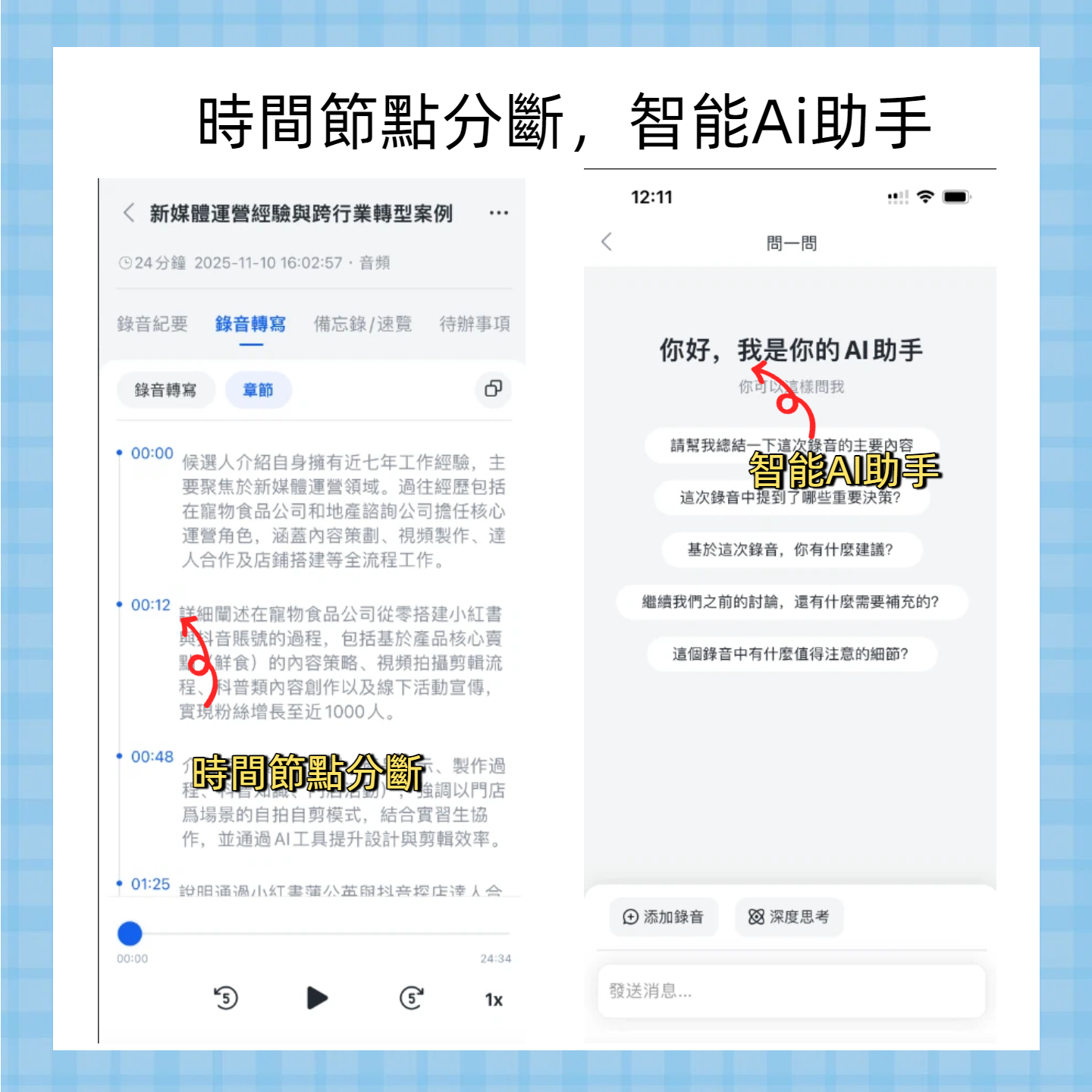
Notta provides a transcript, translation, and summary. Tinrec focuses on “post-transcription.” After a meeting, you can ask “What’s the conclusion?” or “Who is responsible for which tasks?” Upload a lecture recording, and AI segments it and creates a mind map. Paste a YouTube link, and you not only get a transcript but also structured key points. It's not just turning audio into text—it's making the content searchable, queryable, and further processable.
4. Output and Reuse
Notta allows exporting transcripts, subtitles, and summaries, which is sufficient for general document processing. But Tinrec goes further: you can export results to Notion, Google Docs, OneNote, or Dropbox, or even use its built-in Agent to generate meeting reports, tables, or documents directly on the platform. If you need to turn recordings into formal deliverables, you don't need another AI tool.
5. Free Plan Friendliness
Notta’s free plan offers 120 minutes per month, which works for light meeting use. But if you need to process a 40-minute lecture plus a couple of 20-minute interviews, the quota runs out fast. Tinrec’s free plan also offers basic transcription minutes, but importantly, it doesn't limit you to live recordings—you can upload files and analyze online videos in the free version, letting you test the tool in more realistic scenarios.
Stop organizing recordings by hand
Upload audio or video and automatically get a transcript, summary, and action items

Tinrec Core Features at a Glance
- Real-Time Audio-to-Text: Open Tinrec and start transcription with less than 1 second latency. During meetings, you can follow along with the text and mark key points. When the meeting ends, the transcript is ready.
- AI Conversational Query: After recording, simply ask “What are the key exam points from this lecture?” or “Who raised an objection in the meeting?” AI finds the answers from the entire content, so you don't have to scroll through everything.
- Online Video Transcription: Copy a public video link from YouTube, Bilibili, or Xiaohongshu. Tinrec converts the audio to text and generates summaries and segmented highlights—perfect for online courses or content creation.
- Automatic Action Item Extraction: Meetings often leave a list of action items. Tinrec automatically identifies “who needs to do what” and compiles a clear to-do list, which you can export to a calendar or project tool.
Real-World Use Cases
Meeting Notes: Start real-time recording before a meeting. Tinrec transcribes synchronously, and you can mark important sections. After the meeting, ask AI for “meeting conclusion and action items,” and within three minutes you can share organized notes with your team.
Classes & Learning: Upload lecture audio files or online course videos. They are automatically segmented into chapter notes. You can ask “What is the key theory in chapter 2?” without scrubbing through the timeline.
Interviews & Research: Convert interview recordings to transcripts, then use AI queries to extract interviewee viewpoints. Have Tinrec organize these into an analysis report, turning research material into citable text.
Content Creation: Want to turn a podcast or YouTube video into a blog post? Paste the link, transcribe, use the summary to capture core paragraphs, copy to an editor, tweak, and you have a post.
Key Points to Consider When Choosing a Transcription Tool
- Language & Content Type: If your content is mainly Chinese, including colloquialisms, Chinese-English mixing, or Hokkien, prioritize tools with deeper Chinese tuning. Tinrec's effort in this area will give you a more accurate transcription than general models.
- Beyond Live Recording: Check if the tool handles all your audio files and video links. One tool for meetings, courses, and online videos greatly reduces management overhead.
- Post-Transcription Features: A plain transcript requires you to reread to find key points. If the tool can auto-summarize, segment chapters, extract action items, and let you ask questions, the long-term time savings are huge.
- Cross-Device Sync: You might record on your phone, review transcripts on your computer, and study on a tablet. Choose a tool that supports iOS, Android, and web with real-time sync to avoid file transfer headaches.
- Free Plan Isn't Just About Minutes: Many free plans restrict input sources or features. Opt for a plan that lets you test core features (like file upload and video analysis) to truly evaluate if the tool fits your needs.
Summary: Is Tinrec Worth Trying?
If you're looking for a tool that not only converts audio to text but also helps you organize, query, and reuse that content—Tinrec is one of the few on the market that integrates live recording, file transcription, and online video parsing in one workspace, with a particular focus on Chinese content. The free plan lets you experience the core workflow. Test it with your own meetings, lectures, or online videos. In just a few minutes, you'll know if it's the right fit.
Turn every recording into actionable outcomes
Get 60 free transcription minutes when you sign in. No credit card required.
Related Reading
You might also like

iPhone Call Recording in 2026: Do You Still Need Tinrec? 3 Reasons to Convince You
iPhone's built-in call recording in iOS 18.1 is handy, but organizing recordings still takes time. This article shows how Tinrec turns call recordings into searchable notes, summaries, and to-dos to boost learning and work efficiency.

2026 Hands-On Comparison of 4 Computer Recording Tools: More Than Just Recording, They Help You Organize Key Points
Struggling to organize your computer recordings after capturing them? This test of 4 computer recording tools — from free options to AI-powered organization — helps you find the most suitable solution.

2026 Complete Guide to AI Meeting Minutes: Auto-Generated Transcripts and Action Items to Double Meeting Efficiency
Still wasting time on meeting minutes? This article shows how to use AI recording tools to auto-generate transcripts, summaries, and action items, with hands-on comparisons of Tinrec, Notta, Otter.ai and more to help you pick the best solution.

2026 iPhone Screen Recording with Audio: 2 Methods Compared — Is the Built-in Feature Good Enough?
Can iPhone screen recording capture audio? This hands-on comparison tests the built-in screen recorder against two third-party apps, showing how to record system sounds and ambient sound, and explains the common causes of no-audio issues and how to fix them.

2026 Hands-On Comparison of 2 PC Screen Recording Audio Fixes: Tinrec vs. QuickTime Player – Which One Saves You Effortlessly?
Silent screen recordings are a common headache. This article compares Tinrec, an AI recording and media organizer, with Mac's built-in QuickTime Player across four dimensions—recording capabilities, post-processing, cross-platform support, and pricing—to help you find the best audio-video sync solution.

2026 Free Speech-to-Text Tools Compared: 4 Apps Reviewed
Is it legal to record conversations? There are legal restrictions, but the bigger challenge is managing your recordings. We tested 4 speech-to-text tools, compared their free plans, and shared practical insights to help you choose the right one without wasting time.
Where Are iPhone Voice Recordings in 2026? 5-Step Guide and a Better Alternative
Can't find your iPhone recordings? This article walks you through 5 steps to record, export, and share with Voice Memos, and offers an in-depth comparison with the AI tool Tinrec to show why Tinrec is a more complete audio/video organization solution for most users.

2026 AI Meeting Notes Tools: How to Choose Between Tinrec and Otter.ai in 5 Steps
There are many AI meeting notes tools on the market, so how do you choose between Tinrec and Otter.ai? This article compares the two across five key dimensions—Chinese speech recognition, audio/video source support, AI organizational capabilities, pricing plans, and cross-platform experience—and uses hands-on testing to help you quickly see the differences and find the best fit for users in Taiwan.

2026 Web Recording Tools Comparison: Which One Organizes Online Audio More Efficiently?
Want to record audio from web meetings, courses, or videos? This article compares Tinrec and Otter.ai in real-world tests, covering online video transcription, AI summaries, Chinese support, and pricing, to help users in Taiwan find the best web recording tool for organizing online audio.