
Turn recordings into transcripts and summaries in minutes
Upload audio or video for multilingual transcription, AI notes, and action items
Recently, I recorded an entire online course session using Google Meet.
But after the class, looking at the two-hour video, I really didn't want to watch it from start to finish just to take notes.
This made me think—many readers often ask me, "Esor, after recording a Google Meet, is there a quick way to extract key points and action items?"
So I started testing different tools, from built-in features to third-party services, to find the best solution for typical knowledge workers.
This article is my complete guide to Google Meet meeting notes—not just transcription, but turning meeting content into actionable data.
Why Do You Need Google Meet Meeting Notes?
If you just save a meeting recording, it remains a "watch and forget" file.
But if you convert it to text, it becomes a searchable, summarizable, queryable database.
Especially in the growing remote work environment, using meeting note tools can save you hours of playback and manual note-taking.
Below, I introduce the 4 methods I tested, from most comprehensive to simplest, so you can choose based on your needs.
Method 1: Tinrec — The Most Complete AI Recording Assistant
I first tried several plain transcription services, but they all felt lacking.
Then I used Tinrec and realized that "what happens after transcription" is the key.
Tinrec doesn't just convert Google Meet audio into verbatim text.
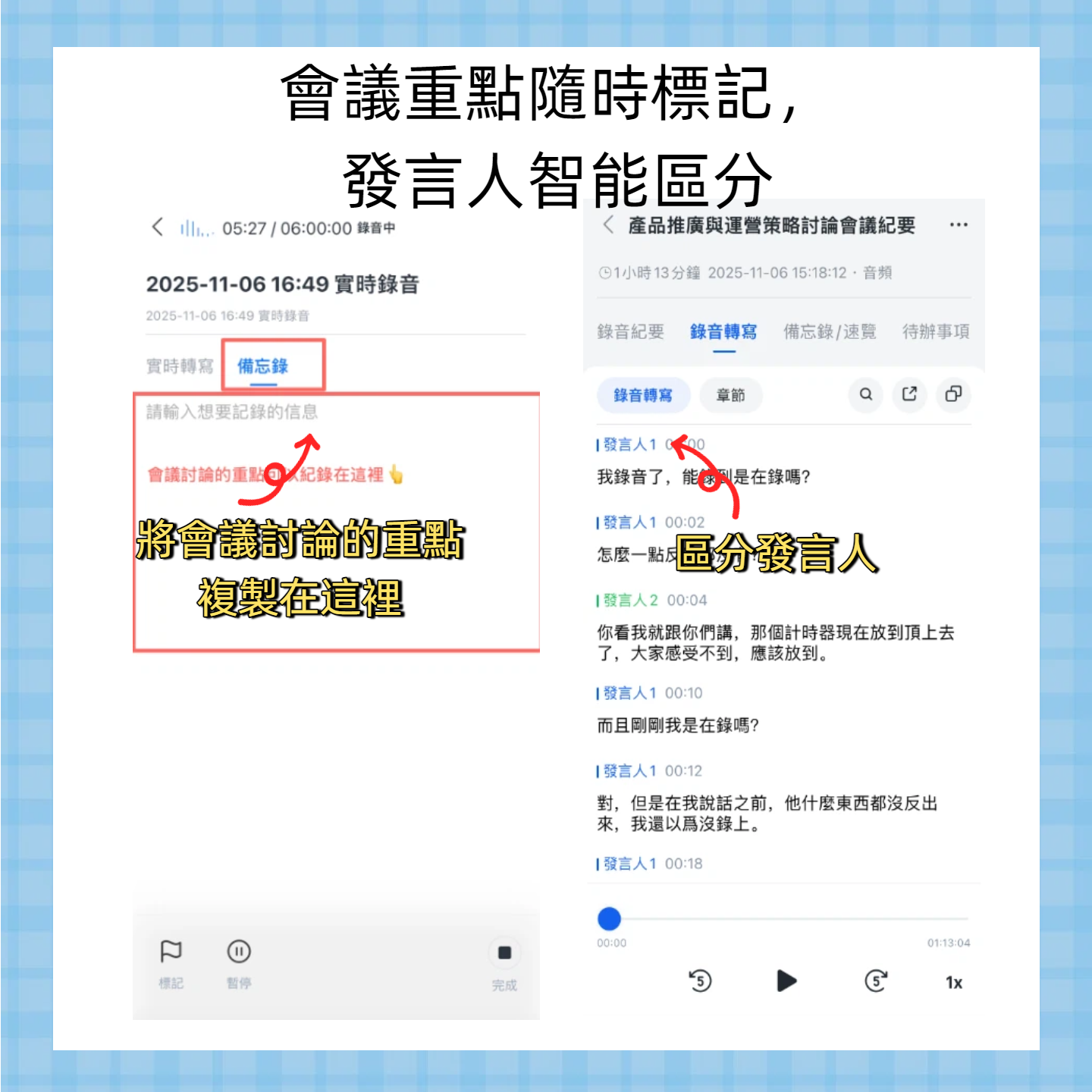
It also automatically generates summaries, chapters, action items, and even lets you use AI chat to directly ask questions about the recording.
For example, I had a meeting recording and simply asked Tinrec, "Please list three key points discussed and each person's action items."
It not only listed the points but also clearly indicated who needed to do what. Finally, I could export to Notion or Google Docs with one click.
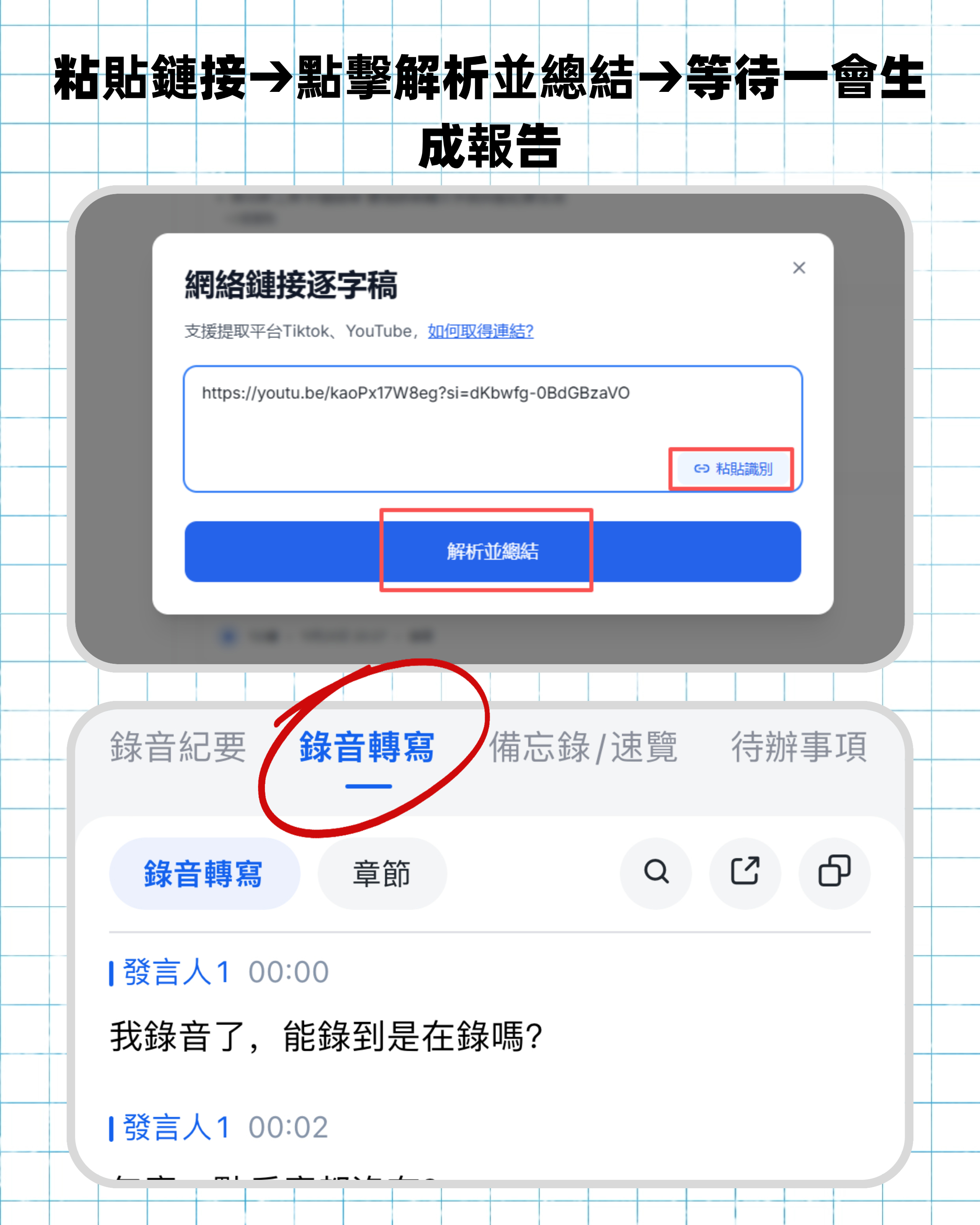
What I love most is that Tinrec handles not just Google Meet recordings but also supports pasting YouTube, Bilibili, and other online video links, or uploading local audio and video files.
This way, whether it's a meeting, course, interview, or public online video, I can manage everything in one workflow.
The free plan includes basic transcription minutes, suitable for occasional use.
If you have weekly meetings or courses to process, the Pro plan is more cost-effective and offers higher transcription limits and AI Q&A features.
Who it's for: If you want to turn meeting content into truly "searchable, queryable, exportable" data rather than a static transcript, Tinrec is the most complete choice.
Prompt template: You can directly input in Tinrec's AI chat: "Based on this recording, please extract: 1. Three core conclusions 2. Two risks to track 3. Action items for each participant."
Method 2: Otter.ai — AI Meeting Notes Tool Focused on Online Meetings
Otter.ai is the go-to for many English meeting users. It automatically joins Google Meet, Zoom, and other meetings, offering real-time transcription and speaker labeling.
Stop organizing recordings by hand
Upload audio or video and automatically get a transcript, summary, and action items
Its strength lies in "invisible recording"—you don't need to manually start; it appears on its own.
However, if your work involves not just meetings but also courses, interviews, or online videos, Otter's scope is more limited, and Chinese transcription isn't as smooth as English.
The free plan offers 300 minutes per month, and the Pro plan (annual) costs about $8.33/month with 1,200 minutes.
Who it's for: If your work scenario is almost entirely English online meetings and you need automatic recording and post-meeting collaboration, Otter is worth a try.
Method 3: Notta — Multi-Language Transcription and Meeting Notes
Notta is quite similar to Tinrec—both support real-time recording, file transcription, and multi-language recognition.
But from my experience, Notta leans more toward "transcription itself" with well-integrated translation, while Tinrec focuses more on "thinking after transcription," like AI chat queries and action item extraction, which feel more robust.
Notta's free plan gives 120 minutes per month; the Pro plan (annual) is about $8.17/month with 1,800 minutes.
Who it's for: If you need simultaneous meeting transcription and subtitle creation, and you care about multi-language translation, Notta is a sufficient option.
Method 4: Google Meet Built-in Recording and Transcription — Free but Basic
Google Meet can record, and if you have certain Google Workspace versions, you can get auto-captions after recording.
But limitations are clear: captions are English-only, and there's no automatic summary, chapters, or action items, let alone search or Q&A afterward.
If you just need a simple video archive, this is enough.
But if you want to turn meetings into actionable data, you'll likely need a more professional tool.
Who it's for: Those with zero budget who only need to preserve the meeting without further processing.
How to Choose Among So Many Options?
Personally, I differentiate like this:
- Want the most complete AI features (transcription + AI chat queries + auto minutes) → Tinrec (the only one with all these features)
- Need Cantonese + Mandarin bilingual transcription, or care about Chinese text quality → Tinrec (supports multiple languages, most detailed for Chinese scenarios)
- Need to switch between phone and computer usage → Tinrec (iOS + Android + web version)
- Almost exclusively attend English meetings and don't want manual operation → Otter.ai (auto-joins, great English experience)
- Care about transcription + translation, balanced meeting and subtitle needs → Notta
- Zero budget and only occasional recording → Google Meet built-in (basic retention)
3 Things to Know Before Using Google Meet Meeting Notes
Recording quality determines transcription quality
Regardless of the tool, if the Google Meet audio has poor microphone pickup, echo, or overlapping voices, transcription quality will suffer. I recommend using a headset microphone during meetings or asking participants to speak one at a time.AI summaries still need your review
Tools like Tinrec produce useful summaries and action items, but occasionally they miss subtle cues or unstated conclusions. I usually skim the key points and add my own notes where necessary.Check privacy and permissions
If you're sending meeting recordings to a third-party tool, confirm company policy and inform participants. Tinrec has a clear privacy policy, and I ensure data is used only for my personal knowledge base.
Summary
Google Meet recordings shouldn't just be "archives."
With AI tools like Tinrec, you can turn them into searchable, queryable, actionable data.
If you want to try it out, start with this checklist:
- Download Tinrec (iOS, Android, or web version)
- Import a Google Meet recording, or paste the meeting recording link
- Test the AI summary and chat query features to experience the efficiency of "not having to watch from start to finish"
Test gradually, and you'll master this method over time.
Turn every recording into actionable outcomes
Get 60 free transcription minutes when you sign in. No credit card required.
Related Reading
You might also like
2026 Mac Recording-to-Text App Comparison: Which AI Meeting Notes Really Save Time?
Apple's built-in Voice Memos makes recording easy, but it can't transcribe audio. This article hands-on tests Tinrec, Otter.ai, and Notta, covering accuracy, AI summaries, cross-platform support, and free plans, to help you find the best fit for meetings, classes, and interview notes.
iPhone Voice-to-Text Test in 2026: Built-in Dictation vs. Apps Compared, This AI Q&A App Made Note-Taking 3x Faster
A college senior tested iPhone voice-to-text methods, from built-in dictation to third-party apps. See how Tinrec’s free plan saved 3 hours of note-taking time per week, plus a pitfall guide and student-focused buying advice.

iPhone 17 Screen Recording Free Options in 2026: 5 Tools Reviewed
How to screen record on iPhone 17? This article covers built-in screen recording, Dual Capture tips, and recommends tools like Tinrec to transcribe audio from recordings, from free to paid options.

Best AI Meeting Recorder Tools in 2026: Automatic Summaries, Action Items, and Multi-Source Organization
Looking for an AI meeting note tool but not sure where to start? This article reviews 6 top solutions—from automatic summaries and action items to cross-platform collaboration—and shows you how to save up to 80% of your meeting note time with the right tool.
2026 Free AI Meeting Notes Tools Buyer's Guide: 2 Hands-On Reviews and Practical Tips
Don't want to spend money on hardware but still want to use AI to organize meeting recordings? I actually compared Tinrec, a pure software tool that provides instant recording, with Plaud Note, which integrates hardware. From free plans, recording sources, post-processing capabilities, to cross-platform flexibility, this guide helps you find the best free AI meeting notes solution for your needs.
iPhone Call Recording in 2026: Do You Still Need Tinrec? 3 Reasons to Convince You
iPhone's built-in call recording in iOS 18.1 is handy, but organizing recordings still takes time. This article shows how Tinrec turns call recordings into searchable notes, summaries, and to-dos to boost learning and work efficiency.

2026 Hands-On Comparison of 4 Computer Recording Tools: More Than Just Recording, They Help You Organize Key Points
Struggling to organize your computer recordings after capturing them? This test of 4 computer recording tools — from free options to AI-powered organization — helps you find the most suitable solution.

2026 Complete Guide to AI Meeting Minutes: Auto-Generated Transcripts and Action Items to Double Meeting Efficiency
Still wasting time on meeting minutes? This article shows how to use AI recording tools to auto-generate transcripts, summaries, and action items, with hands-on comparisons of Tinrec, Notta, Otter.ai and more to help you pick the best solution.

2026 iPhone Screen Recording with Audio: 2 Methods Compared — Is the Built-in Feature Good Enough?
Can iPhone screen recording capture audio? This hands-on comparison tests the built-in screen recorder against two third-party apps, showing how to record system sounds and ambient sound, and explains the common causes of no-audio issues and how to fix them.