

Turn recordings into transcripts and summaries in minutes
Upload audio or video for multilingual transcription, AI notes, and action items
Why Look for an Alternative to Google Meet Recording?
Google Meet's built-in recording is convenient but has limitations—you need a Google account, only certain plans can use it, and the recorded file is saved directly to the cloud, making it hard to edit or organize later.
For many users, after a business meeting or online class, recording is just the first step. The real hassle is turning the recording into usable meeting notes or transcripts. If you also don't want to log into multiple accounts just to record, and wish you could directly convert recordings to text and find key points, Tinrec is worth checking out.
Tinrec vs Google Meet Built-In Recording: Core Differences
Cross-Platform Recording Flexibility
Whether you're joining Google Meet on a computer, phone, or tablet, you can simply open Tinrec to record system audio without any platform permissions—unlike built-in recording which requires the host to enable it. In practice, even as a guest, you can independently save the full audio.
Transcription and Organization
Google Meet's built-in recording gives you an audio file, leaving you to organize it yourself. Tinrec instantly transcribes the recording into text and automatically generates a summary, action items, and chapter breaks. In internal tests with a 15-minute meeting, Tinrec started transcribing in about 3 seconds, and by the time the meeting ended, the text record was ready.
Language Support and Localization
Meetings often mix English and Chinese, sometimes even Taiwanese. Tinrec's Chinese recognition is specifically tuned for mixed-language environments, extracting keywords more accurately than most general-purpose engines that are primarily English-oriented. Google Meet's transcription currently focuses on English, with Chinese accuracy varying greatly depending on accents.
Output and Further Use
Built-in recording only saves as an audio file, but Tinrec lets you export the organized content as TXT, PDF, Markdown, or even sync directly to Notion or Google Docs. If you need to generate a formal meeting report, Tinrec's AI can do it in one click—no need to start from scratch.
Key Features of Tinrec
Real-Time Speech-to-Text
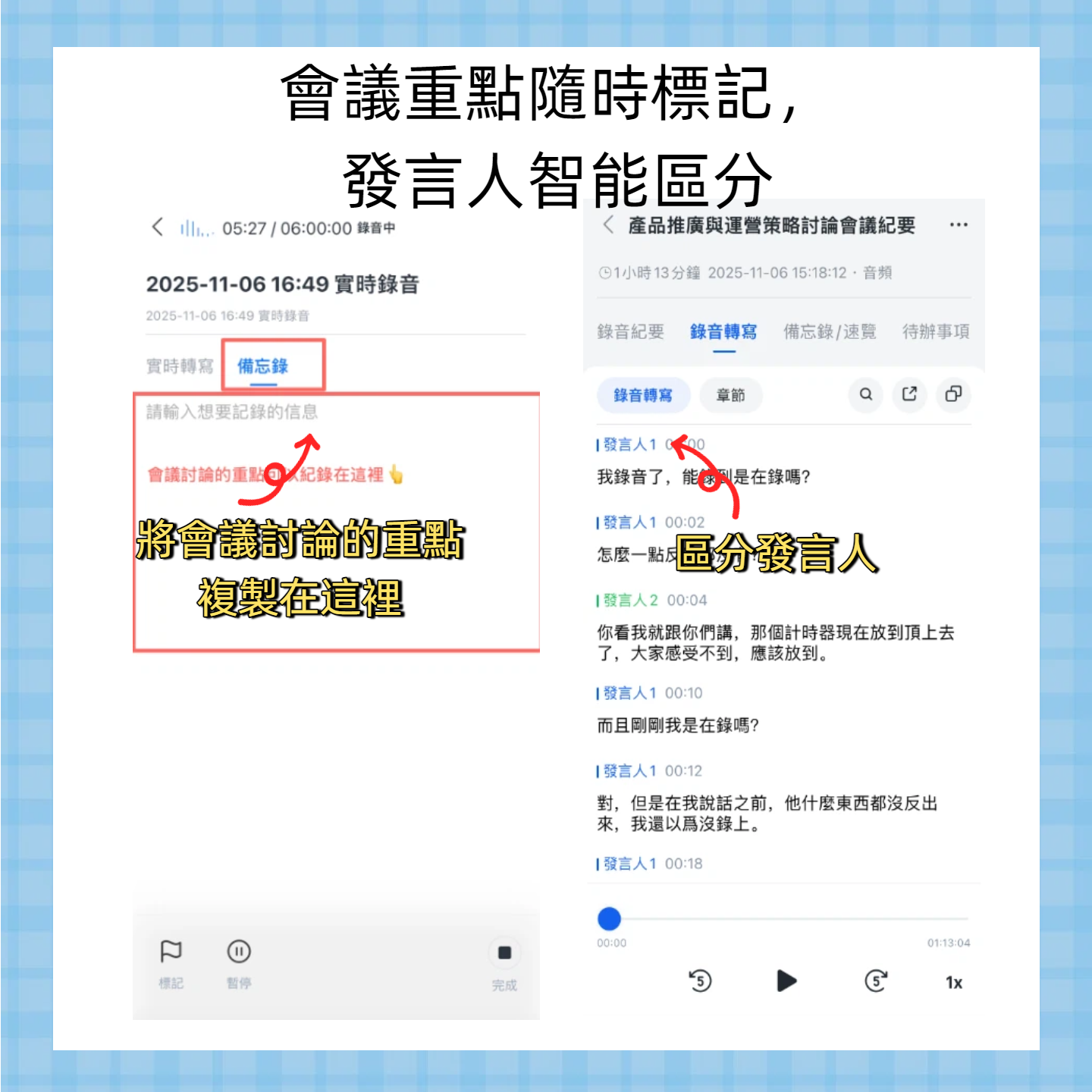
Text appears synchronously as you record, with less than 1 second delay. During a meeting, you can listen and read along to ensure you catch every point; by the time the meeting ends, the transcript is complete.
AI Chat Query
This is my personal favorite. After recording a one-hour meeting, simply ask Tinrec—"What was the conclusion?" "Who is responsible for what?"—and it answers based on semantic understanding, saving you from manually scrolling through 30 pages of transcript.
Online Video Parsing
If you want to review a class or meeting but only have a YouTube link, Tinrec can extract the audio and transcribe it directly from the URL. This is especially useful for organizing online courses or podcasts.
Automatic Task Extraction
Tinrec automatically identifies action items from the discussion, like "Manager Chen needs to send the contract by Friday," so you don't have to jot them down while listening.
Stop organizing recordings by hand
Upload audio or video and automatically get a transcript, summary, and action items
Multiple Export Formats
Organized content can be exported as TXT, PDF, Word, or pushed directly to Notion or Google Docs, keeping your existing workflow uninterrupted.
Real-World Use Cases
Online Meeting Minutes
When joining Google Meet, Zoom, or Teams, whether you're the host or participant, open Tinrec to record the session. You get the transcript, summary, and action items immediately, reducing miscommunication within the team.
Class and Lecture Notes
Students or lifelong learners can watch a live text transcription while listening to an online class, highlighting key points on the spot. After class, use AI Q&A to review—more comprehensive than handwritten notes.
Interview and Research Organization
Journalists or researchers can upload audio files to Tinrec, which transcribes them into timestamped transcripts and extract core viewpoints, making it easy to find quotable passages.
Personal Knowledge Management
Accumulated meeting recordings and course audio become a searchable, queryable database through Tinrec. No more "I think we discussed this but can't find it."
What to Look for When Choosing a Speech-to-Text Tool
Cross-Platform Support
Ensure the tool works on all your devices. Tinrec offers iOS, Android, and web versions with account sync, so switching devices doesn't require re-recording.
Chinese Recognition Quality
Most international tools have average Chinese support. Tinrec is optimized for Traditional Chinese and mixed Chinese-English scenarios, delivering significantly more useful summaries and action items in typical meeting environments.
Beyond Transcription
Some tools only provide transcripts. Tinrec goes further with AI summaries, query capabilities, and report generation—you get actionable data, not just text.
Pricing and Usage Limits
Tinrec's free plan provides a monthly base transcription quota, suitable for light users. For frequent meetings, consider Pro monthly or annual plans, which still cost less than most similar tools.
Privacy and Permissions
Recording files are stored only on your device and private cloud, encrypted in transit. Tinrec does not require logging into third-party meeting platforms or granting extra permissions, offering peace of mind for privacy-conscious users.
Conclusion: Is Tinrec Worth Trying?
If you need a tool that can record Google Meet meetings without requiring a login, and that directly generates transcripts, summaries, and action items after recording—Tinrec is one of the few options on the market that delivers this entire package. Especially for Chinese users, its localization optimization is something many Western tools currently lack.
Start with the free plan and test it with your own online meetings or course recordings. Experience the real-time transcription and AI organization firsthand before deciding whether to upgrade—this is more direct than any review and best matches your expectation of "no login needed."
Frequently Asked Questions
Q: Can Tinrec directly record Google Meet audio?
A: Yes. Just open Tinrec's recording feature on your device, select "Record system audio," and it will capture the full Google Meet conversation without needing the host's permission.
Q: Do I need to log in to Google to use Tinrec?
A: No. Tinrec works independently. You only need a Tinrec account (or quick sign-up) and it is not tied to any meeting platform.
Q: Is the free plan sufficient?
A: The free plan offers a monthly base transcription quota, suitable for occasional meeting or class recording. For frequent, long recordings, consider a Pro plan for more flexibility.
Q: What languages does Tinrec support?
A: It supports over 14 languages, including Traditional/Simplified Chinese, English, Cantonese, Japanese, etc. Chinese recognition is specifically optimized for mixed Chinese-English scenarios.
Q: Where are the recordings stored? Are they secure?
A: Files are stored on your device and private cloud, encrypted during transfer. Tinrec does not use the recordings for any other purpose, and no third party can access them.
Q: Can I record other meeting software besides Google Meet?
A: Yes. Tinrec can record any meeting that outputs audio through your device, including Zoom, Teams, Webex, etc. It also supports uploading audio/video files or pasting public video links for transcription.
Turn every recording into actionable outcomes
Get 60 free transcription minutes when you sign in. No credit card required.
Related Reading
You might also like

Best iPhone Recording Apps in 2026: 3 Tested, and This One Is Best for Chinese Users
Wondering how to record audio on your iPhone? This article tests three recording tools (iPhone's built-in Voice Memos, PLAUD Note, and Tinrec), comparing recording quality, organization features, and price, and ultimately recommends the best AI recording and organization tool for Chinese users.

2026 Tested: 4 Best Audio-to-Text Tools Compared – Which One Really Turns Recordings into Usable Data?
Transcribing audio isn't just about getting a verbatim transcript—it's about turning content into searchable, summarizable data. This article tests four tools and offers a methodology for choosing and using them, so your recordings truly work for you.

Tinrec vs Yating Transcript 2026: 5-Dimension Comparison for Audio Transcription
Want to turn recordings into transcripts but can't decide between Tinrec and Yating Transcript? This article compares them across 5 key dimensions—transcription accuracy, AI organization features, input sources, free plans, and cross-platform support—to help you find the best free AI transcription tool for your needs.

Best LINE Voice-to-Text Tools: 2026 Hands-On Test of 2 Apps, One Does More Than Transcribe
When LINE voice messages can't be played back, converting them to text is the best solution. From a productivity consultant's perspective, this article compares Notta and Tinrec through hands-on testing, analyzing input sources, AI summarization, Chinese-language scenarios, and downstream applications to help you find the best way to organize LINE voice messages and other recordings.

2026 AI Transcription Tools Compared: Which One Does More Than Just Convert Speech to Text?
Yating Transcription focuses on localized transcription but lacks in organization. This article compares Yating Transcription and Tinrec in AI summarization, action item extraction, and knowledge organization to help you find a transcription tool that truly saves work time.

2026 Voice-to-Text Tool Comparison: Yating vs Tinrec — Which Saves You More Time After Export?
Struggling with Yating transcript export and post-export organization? This article fully compares Yating and Tinrec, covering export formats, AI post-processing, cross-platform experience, privacy, and pricing, to help you find the best voice-to-text solution.

Does Google AI Studio Support Chinese in 2026? 5-Step Guide to Switching to Tinrec for Recording Transcription
Google AI Studio's interface is in English, but its models support Chinese. If you need a more complete Chinese audio/video organization tool, Tinrec (秒聽錄音) is better suited for meetings, learning, and creative scenarios. This article provides a full tutorial on how to use Tinrec to turn recordings into usable knowledge.

How Long Can iPhone Voice Memos Record in 2026? 3 Steps to Extend Recording and Organize with AI
iPhone Voice Memos has no strict time limit, but long recordings are constrained by storage and battery life. The bigger headache is what to do after recording. This article shares tips to extend recording time and shows you how to use Tinrec to turn recordings into searchable, summarizable, exportable data in 3 steps, solving the pain of re-listening.

2026 Speech-to-Text Tool Buying Guide: 5 Hands-On Reviews and Recommendations
Is Yating Transcriber really from Taiwan? The answer is yes—it was developed entirely by a Taiwanese team. This article tests 5 mainstream tools, from Tinrec, Yating Transcriber, and Otter to Notta and TurboScribe, using data and real-world scenarios to help you find the best speech-to-text solution.