

Turn recordings into transcripts and summaries in minutes
Upload audio or video for multilingual transcription, AI notes, and action items
Two Hours in a Meeting, Another Two to Write It Up? You Need More Than Just a Meeting Link
After every online meeting, do you also struggle: even though you attended the whole thing, trying to find "who said what" or "what was the last decision" feels like searching for a needle in a haystack?
Worse still, if the meeting contains important training, interviews, or client conversations, relying solely on the platform's built-in recording is not enough—you still need extra time to transcribe and summarize key points.
If you've been there, this article is for you. I've tested 4 tools hands-on: from the well-known Google Meet, to meeting-focused Otter.ai, transcription tool Notta, and Tinrec, which I now use daily. Let's find the right solution for you.
Before Choosing an Online Meeting & Recording Tool, Understand These 4 Key Points
Many people think, "Google Meet works for meetings, why would I need another tool?" The key is whether your need is just to "meet" or to "turn meeting content into usable data." These 4 points directly impact your post-meeting efficiency.
1. Transcription & Summarization: More Than Just a Word-for-Word Transcript Built-in transcription usually gives you a plain text file with no breaks or highlights. A truly useful tool auto-generates summaries, action items, and even lets you ask AI "what was the budget number discussed in the last meeting?" instead of manually searching through a 30-minute recording.
2. Cross-Platform & Input Sources: Not All Recordings Come from Meeting Links You might need to process classroom recordings, interview audio files, or YouTube videos. If the tool only works with a single meeting platform, you're out of luck.
3. Chinese & Mixed-Language Accuracy: The Real Test for Taiwan Users Many overseas tools excel in English but stumble with Taiwanese accents or Chinglish. Before buying, test with your own recordings—don't just trust the 98% accuracy claim on the website.
4. Free Plan Limits: Can Your Usage Frequency Justify a Paid Plan? Budgets are tight, so knowing what the free version offers matters. Some tools are generous with free minutes but feature-limited; others offer AI summaries for free but with very few minutes. Choose based on your meeting frequency.
Tinrec: Our Top Pick After Testing—Turn Recordings into Actionable Knowledge
Tinrec is an AI recording and audio/video summarization tool supporting multiple input sources. It covers not only meetings but also classes, interviews, online videos, and historical files. Available on iOS, Android, and web, no extra hardware needed.
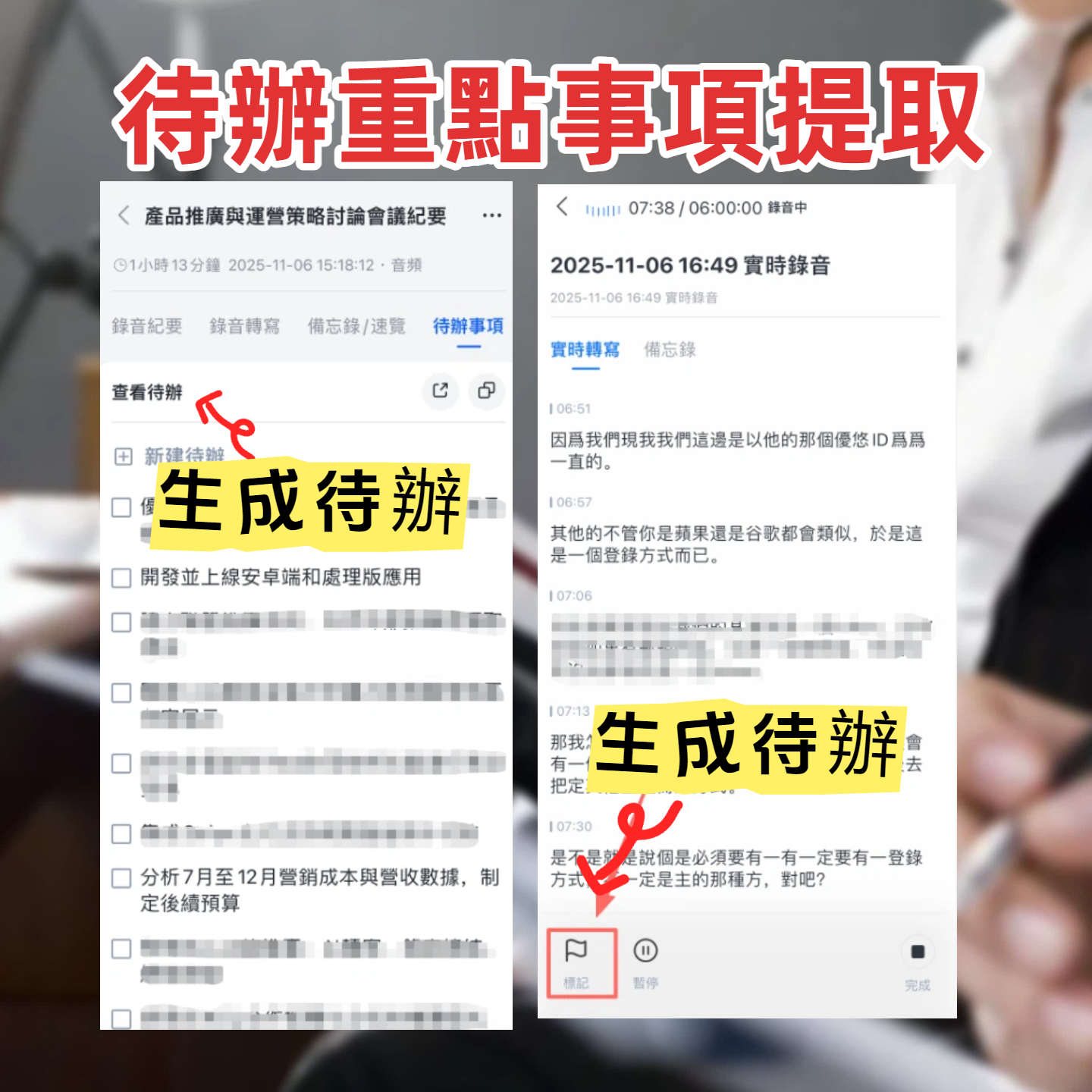
1. Beyond Meetings: Turn Any Audio/Video into Text & Key Points
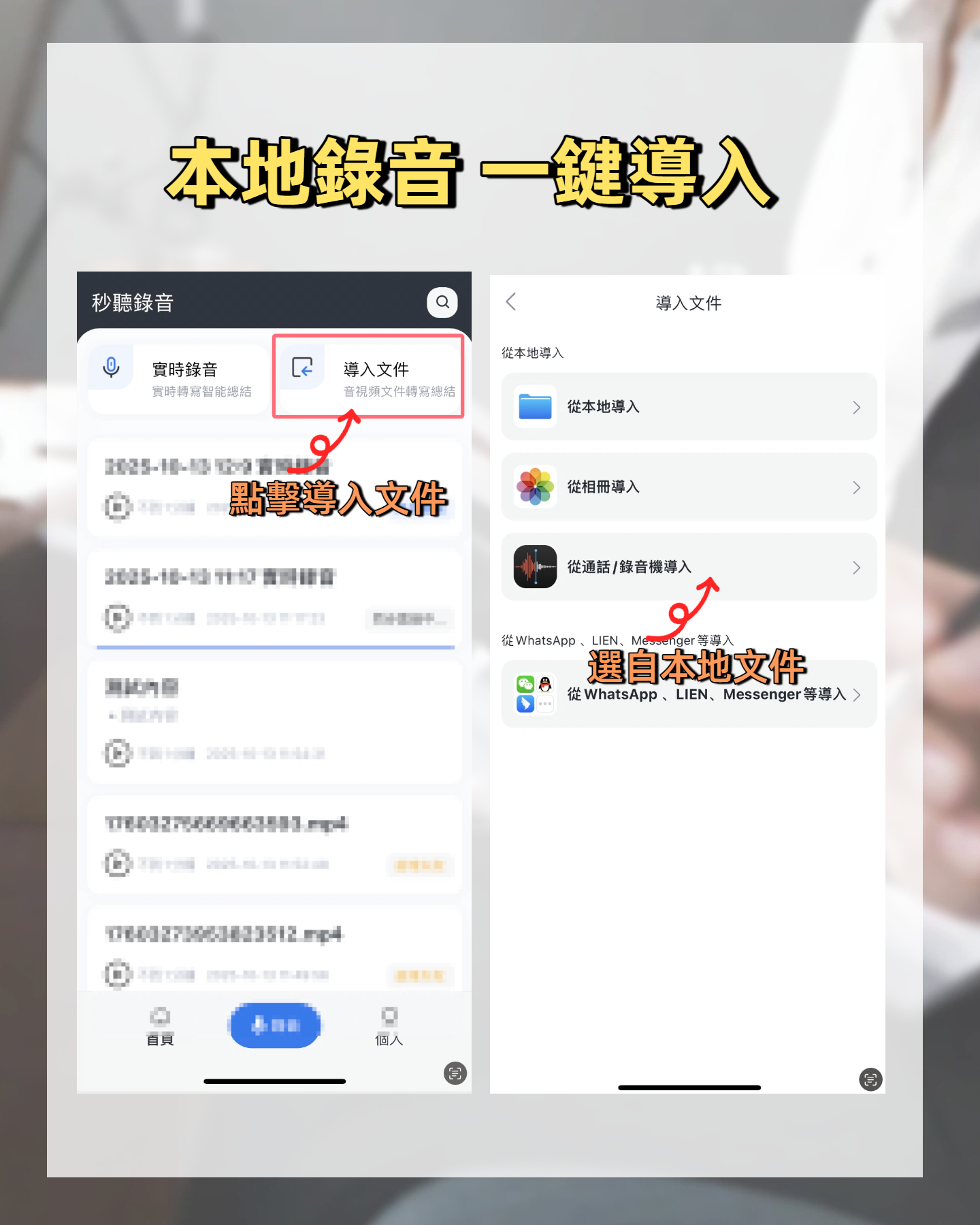
Open Tinrec: you can record and transcribe in real time, upload old audio or video files, or even paste a YouTube or TikTok link—it will generate a transcript.
But the real value comes after transcription. AI auto-generates summaries, chapter markers, and action items: who is responsible for what and the deadline—all clear. No manual work needed.
2. Ask AI Questions: Turn Historical Recordings into a Searchable Knowledge Base
This is my favorite feature. After recording, you can ask Tinrec: "Who proposed the new marketing budget in the last project meeting?" It doesn't just keyword search—it understands semantics and gives you the answer directly. Among tools in this price range, virtually no competitor offers this. It's incredibly useful for people who attend multiple meetings a week.
Stop organizing recordings by hand
Upload audio or video and automatically get a transcript, summary, and action items
3. Test Data: Reliable Accuracy for Chinese Meetings
We tested with a 5-minute Chinese meeting recording (with mild office background noise). Tinrec's word error rate was about 5.2%. Key statements and action items were captured almost without omission. Not perfect, but more than sufficient for general meeting notes.
Pros:
- Most diverse input sources: live recording, files, web links.
- Complete AI summarization and Q&A—not just a transcript.
- Multiple export formats, syncable to Notion, Google Docs, etc.
Honest Limitations: The free plan offers only basic transcription minutes (currently about 100 minutes per month). If you have meetings daily, it may not be enough and you'll need the Pro plan. But for most office workers with 2-3 meetings per week, the free trial is more than sufficient.
Who Is It For? If you want to turn meetings, classes, or interviews into a searchable, Q&A-ready knowledge base, and you often switch between phone and computer, Tinrec is currently the most complete option on the market.
Other Options Besides Tinrec
Google Meet: Best for Free Meetings, but Nearly Zero Summarization
Many ask "What is Google Meet?" It's Google's online meeting tool. With a Google account, you can host meetings for free, up to 100 participants, with built-in live captions and background noise cancellation.
But its limitations are clear: live captions aren't saved as transcripts, they vanish after the meeting. No AI summaries or action items. To review meeting points, you have to manually watch the recording.
Best for: those who just want a quick meeting with no need for post-meeting notes. But if you need to turn meeting content into reviewable data, you'll need a companion tool like Tinrec.
Otter.ai: Best for English Meetings, but Chinese Still a Hurdle
Otter.ai is a well-known AI meeting note-taker. The free plan offers 300 minutes per month, generous for light users. English transcription accuracy is excellent, with speaker identification and meeting summaries.
However, Chinese recognition is mediocre. It struggles with Taiwanese expressions and mixed Chinese-English content, with error rates noticeably higher than Tinrec. Also, Otter's core experience revolves around online meeting platforms; handling local audio files or web videos is less flexible.
Best for: those who primarily hold English meetings and rarely need to process Chinese or external audio files.
Notta: Feature-Rich, but Check Pricing and Minutes Carefully
Notta is the closest competitor to Tinrec, supporting multi-platform transcription, meeting notes, and translation. Free plan: 120 minutes per month; paid plans offer substantial minutes.
However, Notta's AI Q&A is more basic. After recording, it's harder to follow up with questions like you can with Tinrec. Also, its web video transcription support is inconsistent; occasional incomplete captions during tests.
Best for: users who need massive transcription minutes and heavy translation. But if you value AI conversational querying and a more intuitive workflow, Tinrec feels smoother.
Pitfall Guide: 3 Common Mistakes When Choosing Recording & Summarization Tools
Pitfall 1: Thinking Built-in Platform Transcription Is Enough Google Meet or Teams live captions look convenient, but the content isn't saved, there are no summaries, and you can't compare across meetings. If you need to manage meeting data, you need a dedicated tool.
Pitfall 2: Trusting Official Accuracy Claims Many tools claim 98% accuracy, but those tests are done in quiet labs. Your actual meeting environment has keyboard clicks, discussions—accuracy drops. Always test with your own recordings for free before committing.
Pitfall 3: Ignoring Post-Meeting Summarization and Export Needs Getting a transcript is just the first step. Can it auto-summarize? Can you share with colleagues? Can you export to Notion or Google Docs? That's where time is saved. Tinrec's AI Q&A and action item extraction turn the tool from "record" into "action."
Summary: Which One Should You Choose?
Back to the original question: If you just need a quick team meeting, Google Meet is fine. But if you want every meeting, class, or interview to automatically become a searchable, reusable knowledge asset, you need more than a meeting link—you need a complete workflow.
Recommendations by Use Case:
- Just want free meetings, don't care about notes → Google Meet (most basic)
- Heavy English meetings needing team collaboration → Otter.ai (but weak in Chinese)
- Need massive transcription minutes and translation → Notta (but less AI interaction)
- One-stop for meetings, classes, video processing, plus AI Q&A → Tinrec (most comprehensive)
Honestly, for most Taiwan users encountering Chinese meetings, mixed languages, and the need to process web videos or old recordings, Tinrec feels the smoothest. Download the free version and try—100 minutes per month are enough for 2-3 meetings to gauge its effectiveness. Upgrade only if you find it useful, no need to pay upfront.
Turn every recording into actionable outcomes
Get 60 free transcription minutes when you sign in. No credit card required.
Related Reading
You might also like
Best No-Install Google Meet Recording Tools: Hands-on Test of 4 Options in 2026, This One Is the Easiest
No need to install an app to record Google Meet meetings. This article tests 4 solutions: Tinrec, Otter.ai, Fireflies.ai, and Google Meet's built-in features, comparing functionality, Chinese language support, and convenience to help you find the best no-install meeting recording tool.

How to Use Google Meet Companion Mode in 2026? 5 Steps from Recording to AI Summary - Complete Guide
Google Meet Companion Mode helps you focus in meetings, but how do you capture the content? This article uses the Esor methodology to guide you from recording, transcribing, to AI organization in 5 steps, turning meetings into searchable, queryable knowledge assets.

2026 Hands-On Comparison of 3 Google Meet Alternatives: Which Saves the Most Time on Chinese Meeting Minutes?
Downloaded Google Meet but missing meeting notes functionality? This article hands-on tests 3 AI tools, comparing Traditional Chinese recognition, meeting summaries, and action item extraction to help you choose the best alternative.

2026 Comparison of 4 Google Meet Meeting Note Tools: Which AI Summary Really Saves Time?
Spending two hours in a meeting and another two hours writing notes? This article tests 4 Google Meet meeting note tools, from free plans, transcription accuracy to AI summary capabilities, to help you find the most time-saving option.

2026 Hands-On Comparison of 3 Google Meet Alternatives: Efficient Transcription Without a Google Account?
Google Meet is convenient, but without a Google account, transcription needs, or Chinese meeting summaries, it can feel limiting. This article tests Tinrec, Notta, and Otter across dimensions like input sources, Chinese accuracy, AI summaries, and free plans to help you find the best Google Meet alternative.

2026 Google Meet Recording Tools Comparison: Which AI Saves the Most Time?
Exhausted from post-meeting notes? We tested 3 AI recording tools—Tinrec, Otter.ai, and Notta—to help you pick the best for Google Meet. Are free plans enough? Which handles Chinese best? Find out here.

2026 Google Meet Guide: Auto-Generate Meeting Notes with AI Summaries & Q&A
Struggling to organize Google Meet transcripts? Learn how Tinrec can instantly transcribe, summarize, extract tasks, and let you ask AI questions to turn every meeting into actionable knowledge.

2026 Real-World Test of 3 Meeting Transcription Tools: Is Google Meet's Built-in Transcription Enough?
How much does Google Meet cost? Can the free version's transcription really help? We tested 3 tools and found Tinrec excels in Cantonese accuracy and AI features. Read this to save time and avoid overtime.

The Ultimate Guide to Google Meet Meeting Notes in 2026: Recording, Transcription, and AI Summarization Tested
Still manually organizing your Google Meet recordings after meetings? This article tests Tinrec and other tools, showing you how to automatically convert meeting content into transcripts, summaries, and action items to boost remote meeting efficiency.