

Turn recordings into transcripts and summaries in minutes
Upload audio or video for multilingual transcription, AI notes, and action items
I have a client who is a manager at a tech company and attends at least four hours of meetings every day.
He told me, "Meetings aren't the hard part; it's the post-meeting minutes and follow-ups that drain you."
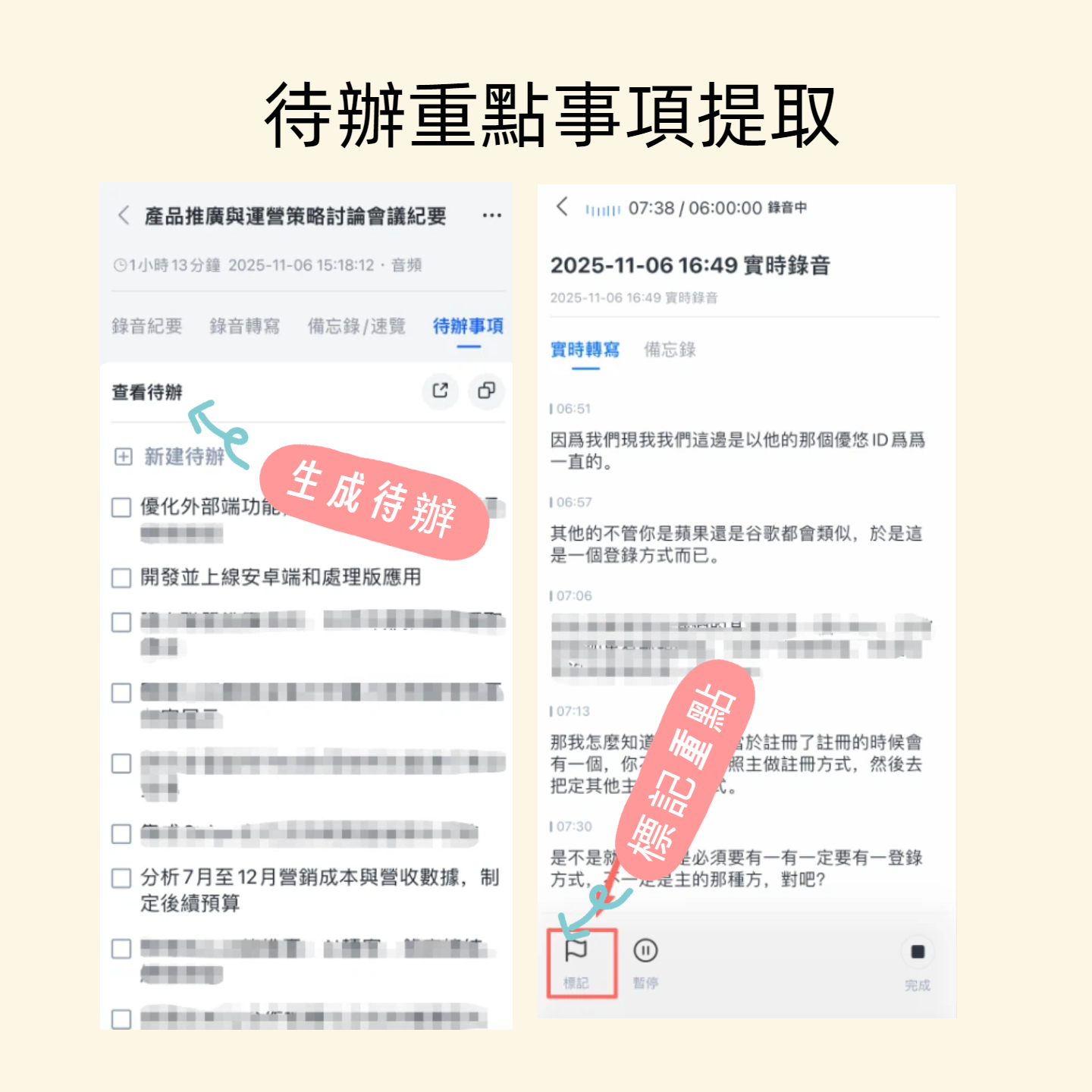
Until I set up an AI office automation workflow for him, using Tinrec to automatically handle recording, transcripts, summaries, and to-do lists. Now he can leave work before 7 PM.
In this article, I'll share this method.
What Can AI Office Automation Do for You?
I've noticed that many people still think of "office automation" as filing documents or auto-replying to emails.
But what really eats up time is information organization.
Especially for meetings, interviews, and client communications—discussions that require high concentration—you have to listen, ask, and take notes simultaneously, and your brain just can't keep up.
Take Tinrec as an example: it turns recordings into a searchable, summarizable, and queryable database, so you don't have to spend time recollecting afterward.
Scenario 1: Meeting ends, summary and to-dos generated instantly
After a two-hour meeting, you used to spend another half hour organizing key points and to-dos.
Now, as soon as the meeting recording is done, Tinrec's AI summary automatically lists discussion topics, conclusions, and action items.
Who needs to do what and by when—crystal clear.
(Screenshot here: Tinrec meeting summary, arrows pointing to summary and to-do list)
Scenario 2: Forgotten discussion details, just ask
Three days after a meeting, you suddenly remember the client mentioned a budget figure.
Instead of listening to the entire recording again, you can simply ask Tinrec: "What was the final budget the client agreed on in this meeting?"
The AI finds the answer from the transcript.
(Screenshot here: Tinrec AI chat query, arrows pointing to the dialog box and reply)
Scenario 3: Past meeting database becomes a knowledge base
Every meeting's recording and summary stay in Tinrec, gradually building a searchable meeting knowledge base.
For the next project, if you need to reference past decisions, a quick keyword search brings them up.
Core Capabilities of AI Office Automation
My definition: office automation isn't about offloading work to AI; it's about offloading the "repetitive organization" tasks.
So a good automation workflow should include these capabilities—Tinrec is designed with this in mind.
Real-time transcription: text appears as you record, not after
You can read the text on the go and catch anything you missed immediately.
Tinrec's real-time transcription has low latency, so during meetings you can confirm key points by looking at the text, without relying on memory.
(Screenshot here: Tinrec real-time audio-to-text, arrow pointing to the live text block)
AI summary: structured organization, not just a paragraph
Most tools condense the transcript into one paragraph, but Tinrec's summary is layered: topics, conclusions, action items, and notes are all separate.
You can instantly see the meeting's focus at a glance.
AI chat query: query the content like a database
After transcription, you can ask Tinrec any question, like "What was the client's reaction to the quote?" or "Who mentioned the budget during the meeting?"
It gives direct answers based on semantic understanding, so you don't have to scan the transcript yourself.
(Screenshot here: Tinrec AI Q&A, arrow pointing to the dialog box)
Action item extraction: discussions become task lists
Action items often pop up during meetings, but if you don't jot them down immediately, they're easy to forget afterward.
Tinrec automatically extracts to-dos from the conversation and can even tag the responsible person.
(Screenshot here: Tinrec action item extraction, arrow pointing to to-do list)
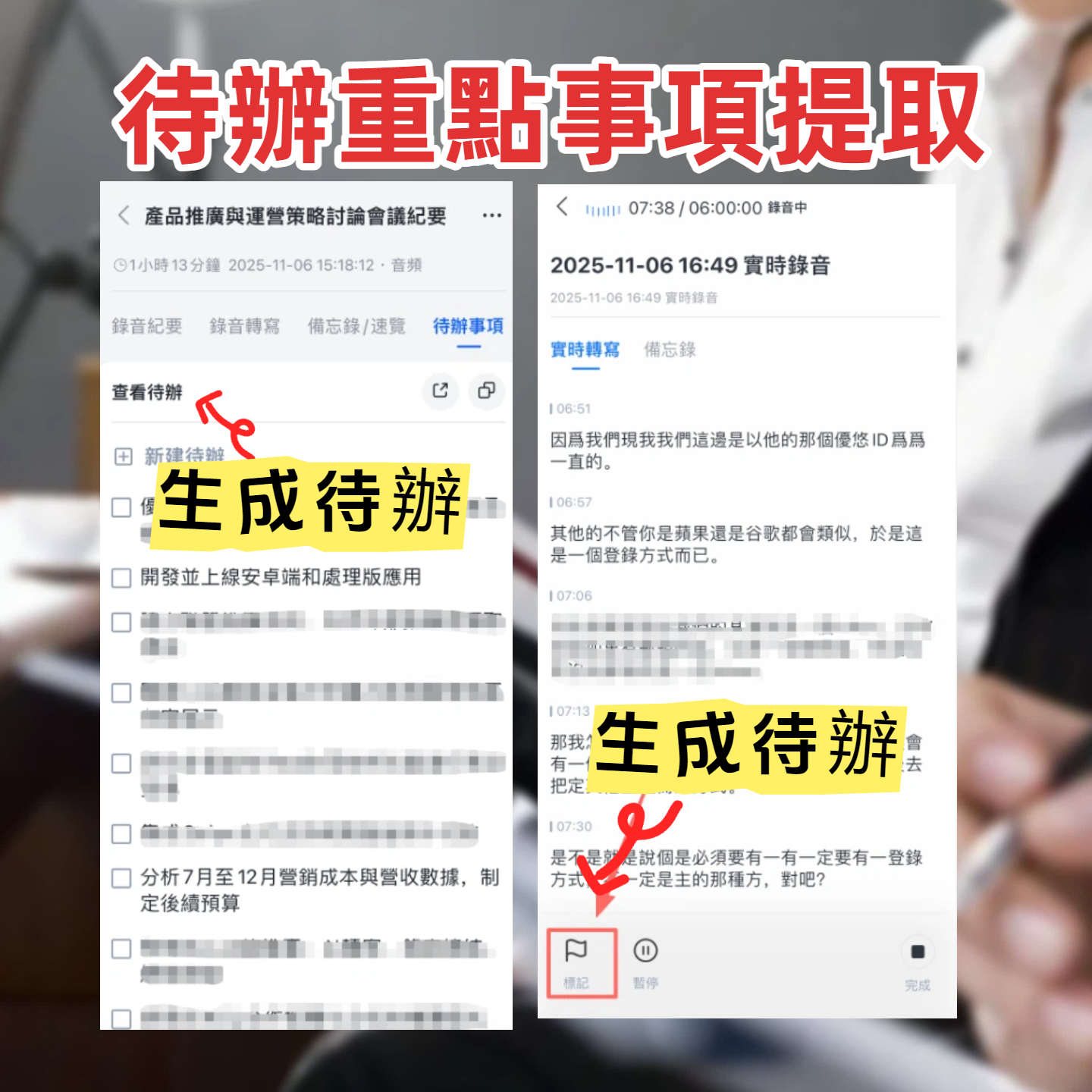
Stop organizing recordings by hand
Upload audio or video and automatically get a transcript, summary, and action items
Multi-source input: not limited to meetings; files and online videos can be processed too
It's not just meeting recordings that need organizing in the office.
Client audio files, competitor videos, online courses—all of these can be dropped into Tinrec for transcription and summarization.
This way, your automation workflow isn't limited to meetings; it becomes the central hub for all audio/video data in the office.
Practical Use Cases
I've implemented this workflow with several teams, and it works well.
Scenario 1: Daily stand-up meetings
The team has a 15-minute daily stand-up. They record it with Tinrec and automatically generate a summary.
Right after the meeting, everyone receives the day's key points and to-dos. No more "I didn't make progress" or "I don't know who's working on that."
Scenario 2: Client needs interviews
After client meetings, we used to spend time writing up notes and sending them for confirmation.
Now, we record with Tinrec and share the summary and action items directly with the client. They say, "You guys are so efficient!"
Scenario 3: Internal project retrospectives
Project retrospectives can be long, and many people only participate in part of them.
Record the entire session with Tinrec; if you need to revisit a section, just search for keywords instead of listening to two hours straight.
Scenario 4: New employee training videos
Paste a training video link into Tinrec, and it automatically generates text notes and a summary.
New hires can quickly grasp the key points without rewatching the whole video.
(Screenshot here: Tinrec online video link parsing, arrow pointing to the link input box)
4 Things to Consider When Choosing an AI Recording & Organization Tool
Not every audio-to-text tool is suitable for office automation.
When I evaluate tools, I pay attention to these four criteria. Tinrec passed these standards before I recommended it to clients.
1. Organization capabilities after transcription
Transcription is just the first step; the key is whether it offers summaries, to-dos, and Q&A.
Some tools only provide a transcript, leaving you to digest it yourself.
Tinrec covers everything from summaries to to-dos to Q&A, so you don't have to do secondary processing.
2. Quality of Chinese content processing
If your meetings are in Chinese, you need a tool optimized for Chinese.
I've tested many tools: some produce transcripts with missing words or awkward phrasing for the same Chinese recording.
Tinrec handles Chinese content consistently well, especially for meetings and courses in Taiwan.
3. Support for multiple input sources
Office data organization isn't limited to live recordings; it also includes audio files, videos, and online meeting recordings.
Tinrec handles live recording, uploaded audio/video files, and pasted online video links, offering great flexibility.
4. Export and output flexibility
The organized results should be usable elsewhere, like exporting to Notion, Google Docs, or downloading as a file.
Tinrec supports multiple export formats, making it easy to integrate into your existing workflow.
(Screenshot here: Tinrec multi-format file export, arrow pointing to export options)
Frequently Asked Questions
Q: Is there a risk of data leakage when using AI to organize meeting minutes?
A: Tinrec encrypts all recordings and data in the cloud; only your account can access them. For important meetings, it's good practice to get consent from participants before recording, just as a general meeting etiquette.
Q: Can the accuracy reach 100%?
A: No, just like human note-takers miss things. In typical meeting environments, Tinrec's transcription quality significantly reduces manual cleanup time. For key details, I prefer to cross-check with the original text to avoid misunderstandings.
Q: Is the free version sufficient?
A: Tinrec's free plan offers a basic monthly quota, good for trying it out. If you have more than two meetings per week, the Pro plan is more suitable, but I recommend starting with the free version to experience the ease of "automation."
Q: Can I use it on both mobile and desktop?
A: Yes, Tinrec supports iOS, Android, and the web version, so you can use it whether you're in a meeting room or at your desk.
(Screenshot here: Tinrec cross-platform support diagram)
Conclusion
AI office automation isn't science fiction; it can be implemented right now in your meetings, interviews, and daily communications.
Tinrec takes over the most time-consuming information organization tasks, letting you focus on more valuable activities—like thinking, decision-making, or leaving work on time.
If you haven't tried it, start with one meeting: record, transcribe, view the summary, and feel the ease of not having to organize it yourself.
Test it step by step, and you'll gradually master this approach.
Quick Start Checklist
- Download Tinrec and sign up for an account.
- Start a live recording at your next meeting.
- After the recording ends, view the AI summary and to-do list.
- Try using the AI Q&A feature to ask about a detail.
- Export the meeting's organized results to your favorite note-taking app.
- After a week, compare the difference between your manual notes and the AI-generated ones.
Turn every recording into actionable outcomes
Get 60 free transcription minutes when you sign in. No credit card required.
Related Reading
You might also like

2026 Comparison of 3 AI Meeting Workflow Tools: Which AI Features Are Most User-Friendly?
Spending hours on meeting notes? We tested 3 popular AI meeting tools—comparing transcription quality, AI features, and pricing—to help you find the perfect fit for your workflow.

2026 Test Comparison of 5 Automatic Meeting Report Generators: Which Free Version Is Best?
Tired of spending hours organizing meeting notes? This article tests 5 popular AI automatic meeting report tools, comparing free limits, cross-platform support, and AI summary accuracy to help you find the best solution.
The Best Meeting Minutes Automation Software of 2026: Auto Summaries & Action Items
Struggling to organize meeting notes? This article covers the best meeting minutes automation software of 2026, from free to paid plans, helping you quickly generate summaries and action items.

2026 Post-Meeting Automation Tool Buying Guide: 3 Products Tested and Recommendations
Meetings running into overtime, and still need to work late on meeting minutes? This article tests 3 post-meeting automation tools, including Tinrec, Otter.ai, and Notta, comparing accuracy, AI features, cross-platform support, and more, to help you choose the most time-saving solution.

2026 Real-World Test: 3 One-Click Meeting PPT Solutions Compared – From Recording to Slides, Which Actually Saves Half the Time?
Two hours in a meeting, another two hours making slides? This article tests three leading solutions to show you how to turn meeting content directly into presentations with the right tools—no more late nights transcribing.

2026 Meeting Post-Processing AI Free Plans: A Look at Two Options
Convert meeting recordings into text and key points without manual transcription. This article compares the free plans of two popular meeting post-processing AI tools, Tinrec and Otter.ai, from transcription quality, input sources, AI summaries to Chinese support, to help you find the best option.

Tinrec vs Otter.ai 2026: 5-Dimension Showdown – Which Extracts Meeting Action Items Better?
Afraid you'll forget meeting takeaways? Can auto-extraction really work? This article compares Tinrec and Otter.ai across 5 key aspects—action item extraction, Chinese support, AI Q&A—to help you choose the best tool.

Effortless Meeting Notes in 2026? 4 Steps from Recording to AI Summary
No more overtime typing transcripts! We tested Tinrec's instant recording transcription, a 4-step guide to turn meeting recordings into AI summaries, plus an AI chat to find key points. Cantonese recognition is accurate—a must-read for office workers.

2026 Comparison of 4 AI Meeting Note Tools: Which Has the Most Convenient One-Click Export?
Are you always spending too much time organizing meeting notes? This article tests 4 AI meeting note apps, from real-time transcription, AI summaries, one-click export to cross-platform support, to find the solution that truly saves you time.