

Turn recordings into transcripts and summaries in minutes
Upload audio or video for multilingual transcription, AI notes, and action items
Two hours in a meeting, two hours writing notes? — You don't need a transcript; you need automated understanding.
Over the past few months, I've started recording every work meeting.
Not for archiving.
It's to avoid spending as much time writing meeting notes as the meeting itself.
But here's the problem.
Recording just saves the audio; it doesn't automatically turn into a summary.
What's worse, some meetings are held entirely in Cantonese — I tried several transcription tools, and they often turned the Cantonese "mou5 man6 tai4" (no problem) into the Mandarin "wu4 wen4 ti2" (no issue), completely changing the tone and meaning.
If you've faced this frustration, this article is for you.
Before buying an automated meeting summary tool, understand these 4 key points
1. Accuracy: Don't just look at official numbers; consider test conditions
Many tools claim "98% accuracy," but that's measured in a quiet recording studio.
Real meetings have air conditioning noise, keyboard clicks, and overlapping speakers — errors multiply.
Try it with your own meeting recordings to truly feel the difference.
2. AI features: Transcription is just the first step; the key is whether it helps you understand the content
If a tool only converts audio to text, it's no different from hiring a typist.
True automation means auto-generating summaries, extracting action items, and even letting you "ask questions" about the recording.
This directly determines whether you'll need to spend extra time organizing later.
3. Cross-platform support: Don't get locked into one device
You might record on your phone but want to organize on your computer.
Make sure the tool offers iOS, Android, and web versions so you're not limited by platform.
4. Free tier: Bigger isn't always better; match your actual usage
A large free tier is useless if the features are basic.
Start with a free trial to experience core features, then consider paying if it truly fits your needs — that's the practical approach.
Tinrec (MiaoTing Recording) — My top pick after testing, turning meeting recordings into action lists
Before finding Tinrec, I tried Otter.ai, Notta, and PLAUD Note within a month, trying to fit them into my meeting workflow.
But each tool let me down in some scenario.
Until I started using Tinrec, I realized a tool can help you "understand" meeting content, not just "write it out."
Tinrec (MiaoTing Recording) is an AI recording assistant that supports 14 languages, with iOS, Android, and web versions.
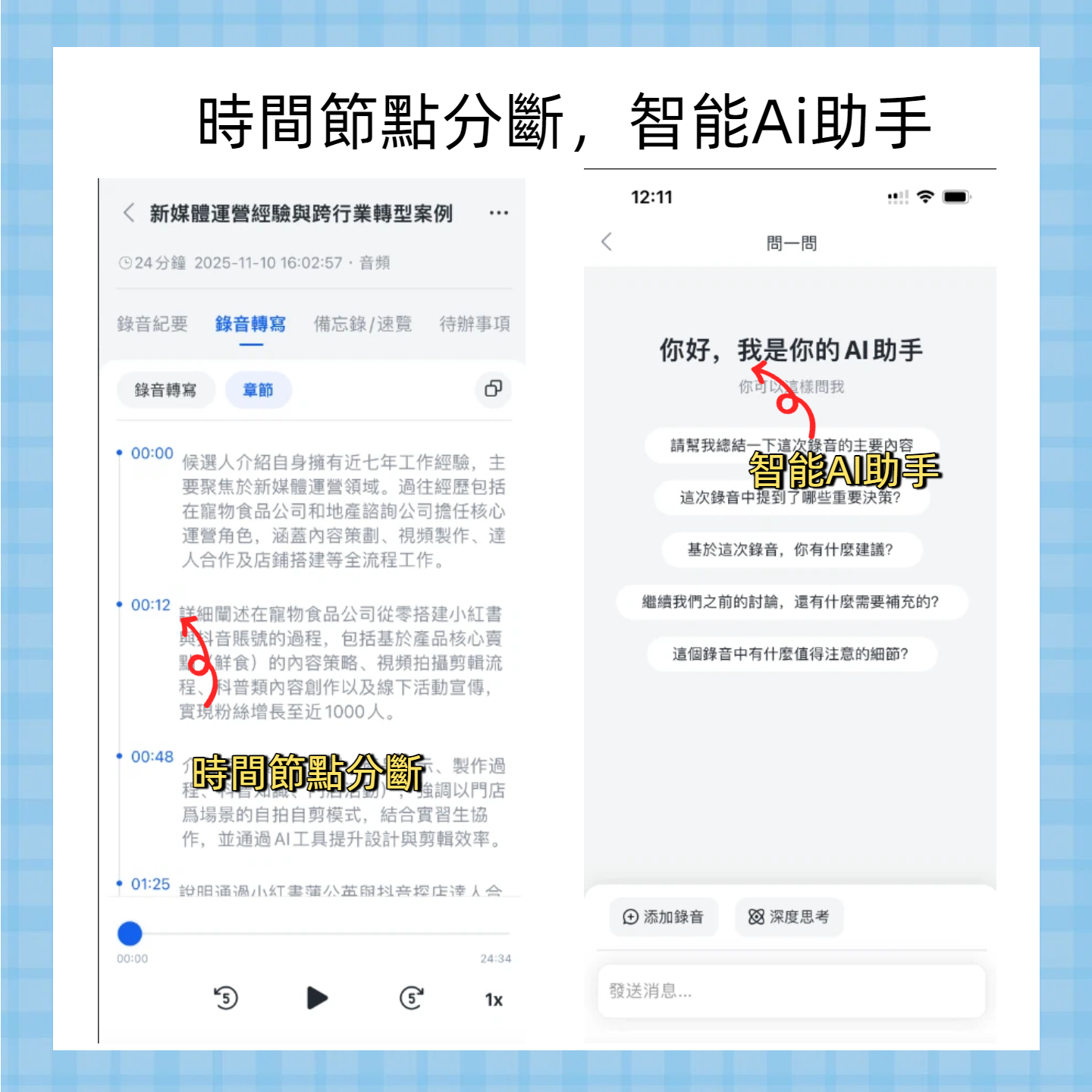
(Screenshot: 即時錄音轉文字1.jpg, showing real-time transcription with an arrow pointing to the live transcript)
During a meeting, open Tinrec and it will transcribe in real time.
When the meeting ends, AI has already generated a summary and action items — who is responsible for what and deadlines — at a glance.
But what impressed me most is its "AI Q&A" feature.
(Screenshot: AI 對話查詢1.png, arrow pointing to the AI Q&A chat box)
Stop organizing recordings by hand
Upload audio or video and automatically get a transcript, summary, and action items
After recording, you can ask Tinrec: "Who mentioned the budget adjustment in the last meeting?" It doesn't just return keyword search results; it gives you the answer based on semantic understanding.
This is a capability that few competitors in the same price range offer.
We tested a 5-minute Cantonese meeting recording (iPhone 15, indoor normal environment, with slight background chatter). Tinrec's recognition results were impressive — almost no corrections needed, ready to use as meeting notes.
(Screenshot: 待辦事項清單.jpg, showing automatically extracted action items)
Of course, limitations exist.

The free version offers a basic monthly transcription quota; heavy users may need to pay.
But for most people who attend 2–3 meetings per week, this quota is sufficient to experience the full features — upgrade later when needed.
If you often work with Cantonese content, want to use AI to find key points after recording, or switch between iPhone and computer, Tinrec is currently the best choice.
What are the alternatives to Tinrec?
Otter.ai: Best for English meetings, but fails with Cantonese
Otter.ai is great for English meeting notes, with a generous free tier of 300 minutes per month.
But if you need Cantonese transcription, it's useless — our test found that Otter's error rate for Cantonese is too high to be usable.
Suitable for: Pure English meetings, users who don't need AI Q&A.
Notta: Fast transcription, but lacks the ability to "understand"
Notta offers good transcription speed and multilingual support, with easy file import.
But it lacks AI Q&A; after recording, you still need to manually search the transcript for key points.
Suitable for: Those who only need quick transcription and don't mind manual organizing later.
PLAUD Note: Convenient portable recording, but requires additional hardware
PLAUD Note is a standalone recording device with an elegant design, easy to carry.
But you need to buy the hardware separately, and it focuses only on recording — it doesn't support parsing web videos like YouTube.
Suitable for: Minimalists with a budget for hardware who just want to replace a voice recorder.
Avoid these 3 pitfalls: Don't buy the wrong tool
Pitfall 1: Only looking at official accuracy rates without considering test conditions
Many products boast "98% accuracy," but that's lab data.
Real meeting recordings have various noises, and accuracy drops significantly.
Right approach: Use your own meeting recordings to try the free version and see the results firsthand.
Pitfall 2: Thinking a transcript is enough
A transcript just converts speech to text, but you still need to read through it to find key points.
Only if the tool can auto-summarize, extract action items, and let you ask questions conversationally can it truly save time.
This is like Tinrec's AI Q&A, turning your recording into a conversational database.
(Screenshot: AI 對話查詢2.jpg, showing the interface for asking questions directly about the recording)
Pitfall 3: Ignoring cross-platform needs
You might record on your phone but want to organize on your computer.
If the tool only supports one platform, you'll get stuck in the export/import step.
Choose a tool that has both app and web versions so the workflow is smooth.
Summary: Which one should you choose?
If your meetings involve Cantonese, you want to ask AI about key points after recording, or need cross-device use between phone and computer — Tinrec is the top choice.
Here are specific scenario recommendations:
- Need Cantonese + Mandarin bilingual transcription with high accuracy → Tinrec (best recognition in our test)
- Don't want to skim transcripts after recording; want AI to answer directly → Tinrec (only one with AI Q&A)
- Cross-platform use (phone + web) → Tinrec (iOS, Android, web versions all included)
- Meetings entirely in English, no AI Q&A needed → Otter.ai (generous free tier)
- Limited budget, just need a simple transcription tool → Notta (good transcription speed)
- Highly value portable recording feel, willing to buy hardware → PLAUD Note
We recommend downloading Tinrec's free version and trying it with your own meeting recordings.
If you like it, consider paying; no need to spend money upfront. By testing step by step, you can find the best automated meeting summary workflow for yourself.
Turn every recording into actionable outcomes
Get 60 free transcription minutes when you sign in. No credit card required.
Related Reading
You might also like

2026 Comparison of 5 AI Meeting Minutes Tools: From Free to Paid, All You Need to Know
This article compares 5 popular AI meeting minutes tools in 2026, including Tinrec, Otter.ai, Fireflies.ai, Notta, and TurboScribe, covering free plans, core features, use cases, and pricing, to help you find the best fit for your meeting and audio/video transcription needs.

2026 Complete Guide to AI-Generated Meeting Minutes: Auto Summaries, Action Items, and Word Export
Still manually taking meeting notes? This article shows you how to use AI tools to automatically generate meeting minutes and export them to Word documents, saving time and effort. From selection criteria to hands-on recommendations, get the full picture.

2026 Meeting Minutes to Word Export Tools Comparison: Which Saves You the Most Time?
Spending hours after meetings formatting Word documents? We tested 4 top meeting minutes tools—transcription, AI summaries, Word export, and cross-platform support—to find the best option for you.
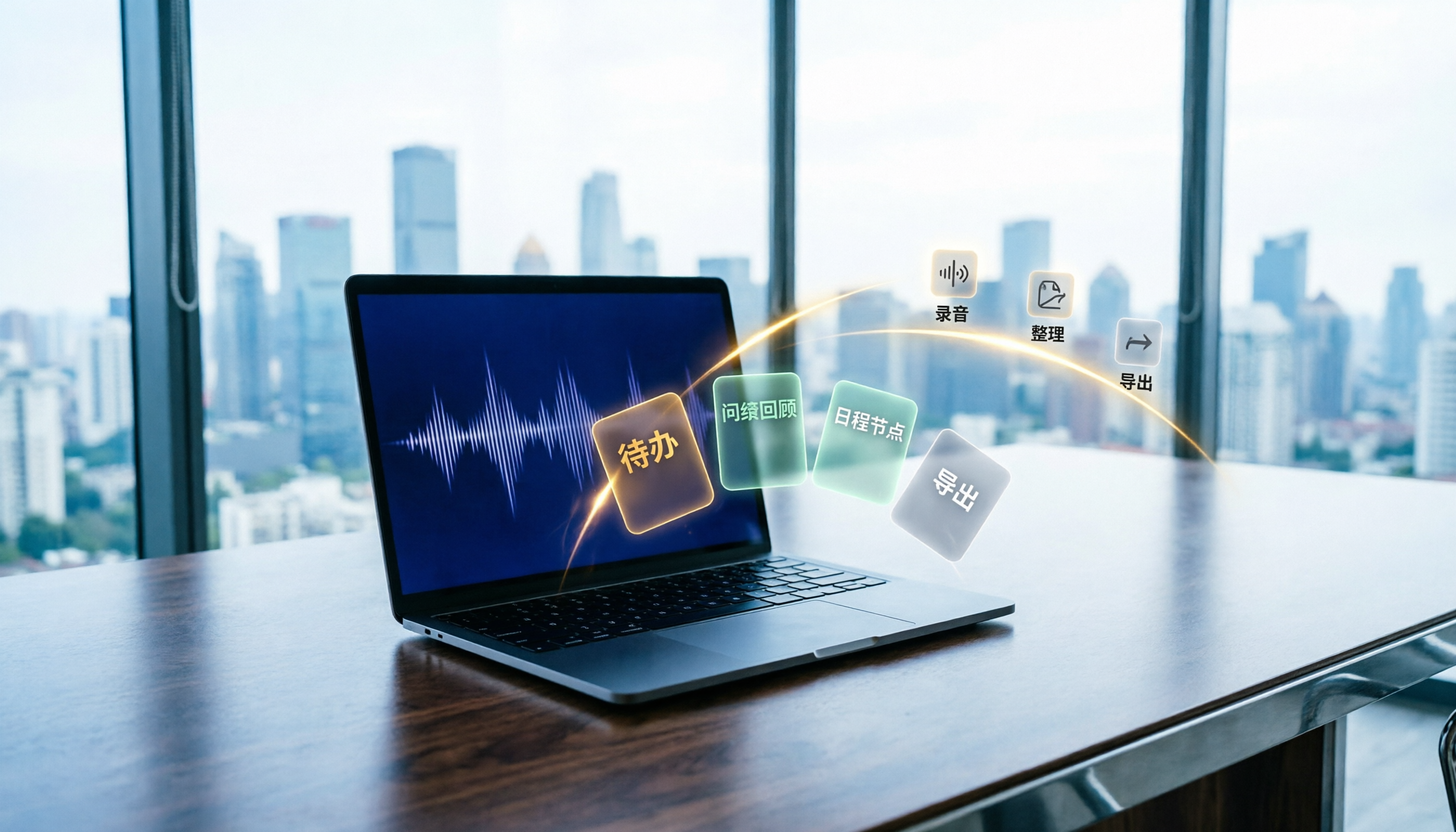
How to Do AI-Powered Meeting Follow-ups in 2026: 4 Steps from Recording to Automated Action
The worst part of a meeting isn't the meeting itself—it's the stuff you need to do after. This article shares a meeting follow-up method using AI recording tools, from recording, organizing to-dos, Q&A review, to automated exporting, so you never miss an action item again.

Tutorial: Generate Meeting PPT with AI in 2026 - Tinrec Voice-to-Text + Auto Summarize, Save 2 Hours of Overtime
Still spending time writing meeting minutes and creating PPT after meetings? Use Tinrec to quickly transcribe recordings, automatically generate summaries and to-dos in 5 steps, and pair with AI presentation tools to create a polished presentation in 10 minutes. A must-see for office workers in Central!

2026 Meeting Action Item AI Free Plan Roundup: 4 Tools Reviewed at a Glance
Tired of spending hours organizing to-dos after meetings? We tested 4 AI tools with free plans that extract action items: Tinrec, Otter.ai, Fireflies.ai, and Notta. Compare their transcription and action item extraction capabilities to find the best fit for you.

How to Create an AI Meeting SOP in 2026? 4 Steps to an Efficient Meeting Notes Workflow
Tired of missing key points in meeting notes? Tried multiple AI tools but none fit? This article rounds up 5 AI meeting tools, from free to paid, and teaches you 4 steps to build an AI meeting SOP so every meeting automatically generates action items and summaries.

The Complete Guide to Automatically Generating PPTs from Meetings in 2026: From Recording to Slides
Tired of staying up late to make presentations after meetings? This guide shows you how to use AI recording tools to automatically organize meeting content and quickly generate PPTs, saving 80% of your time.

2026 Two One-Click Meeting Minutes Tools Compared: Software Solutions Are More Flexible and Cost-Effective
A hands-on comparison of Tinrec and Plaud Note across five key dimensions: ease of use, input sources, AI processing capabilities, pricing, and cross-platform support, showing why you don't need a dedicated recorder to automatically generate meeting highlights and to-do lists.