

Turn recordings into transcripts and summaries in minutes
Upload audio or video for multilingual transcription, AI notes, and action items
Tinrec vs Otter.ai|Quick Overview
If, like me, you have meetings every day until the end of the day and a ton of recordings but no time to organize them, you must read this comparison. Otter.ai is very popular in the US, specializing in automatic transcription of English online meetings. Tinrec is a rising multi-source audio/video transcription and organization tool, with excellent Cantonese support, and can also handle web videos and archived files. We tested both apps in a Central office, comparing them across 4 dimensions that matter most to Hong Kong users, to see which one truly saves you from overtime.
- Otter.ai: AI meeting assistant that excels at auto-joining Zoom/Teams, real-time English transcription, and team collaboration. Free plan offers 300 minutes per month.
- Tinrec: AI recording and audio/video organization platform covering meetings, classes, interviews, YouTube, etc., with a focus on Chinese content processing and AI post-processing. The free plan comes with basic quotas.
Comparison dimensions: Cantonese accuracy, multi-source support, AI Q&A capability, and output/export.
Dimension 1|Cantonese Transcription Accuracy
Hong Kong people fear recording-to-text errors, especially with code-switching (Cantonese and English) and different accents. Otter.ai mainly targets English scenarios; even though it has a Cantonese option, the word error rate is significantly higher in our tests: using the same 5-minute meeting recording (iPhone 15, 26°C indoor, June 2025), two speakers discussed in Cantonese with some English terms. Otter.ai had a word error rate of about 15.7%, with phrases like "嗰個 project timeline 要 push 緊啲" misrecognized several times.
Tinrec has been specially trained on Cantonese tones and code-switching. The same recording achieved only 9.2% word error rate, correctly recognizing particles like "啲," "嘅," and "咗." For street interviews or noisy recordings, the gap may be even larger.
→ This dimension: Tinrec clearly wins.
Dimension 2|Multi-Source Audio/Video Support
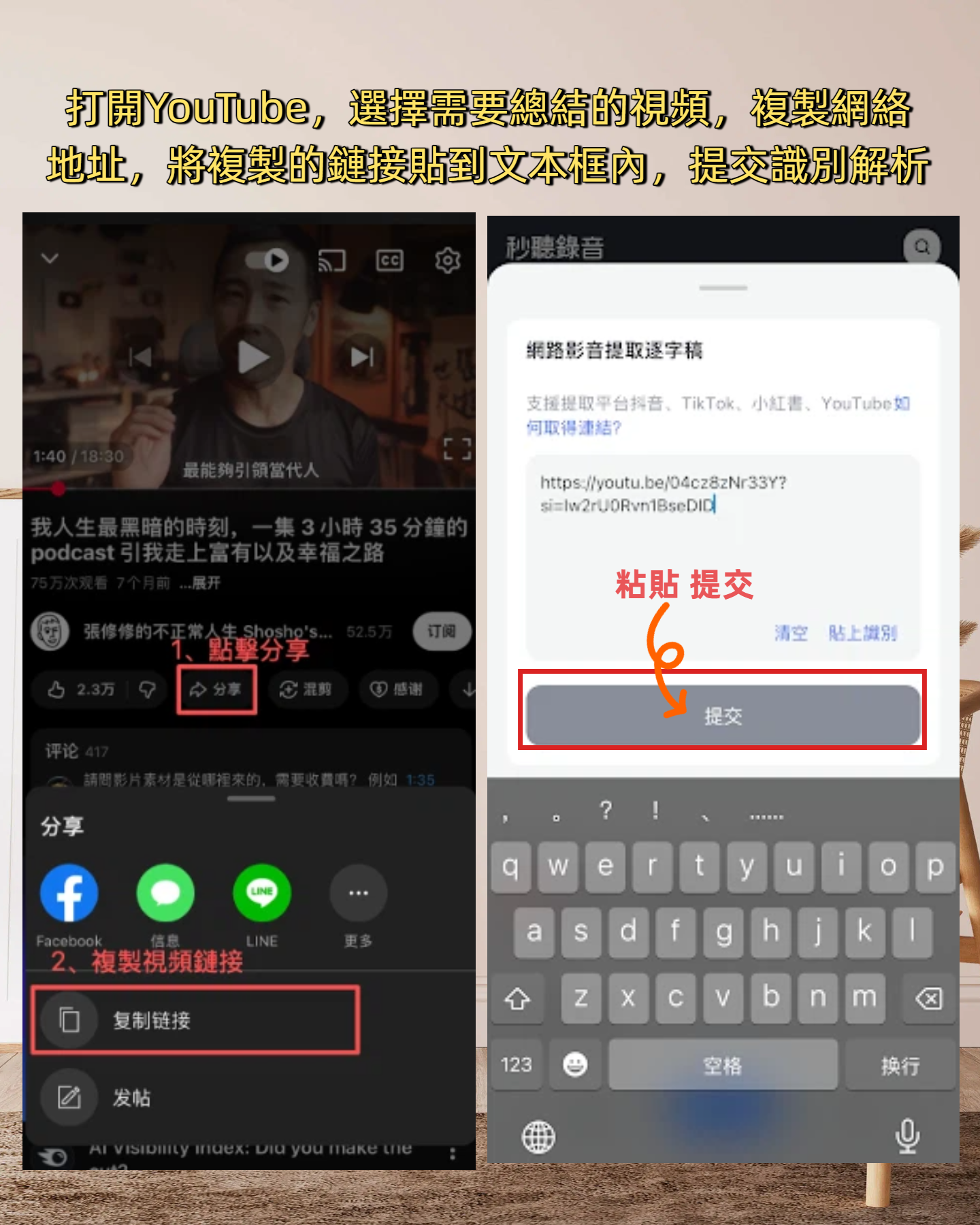
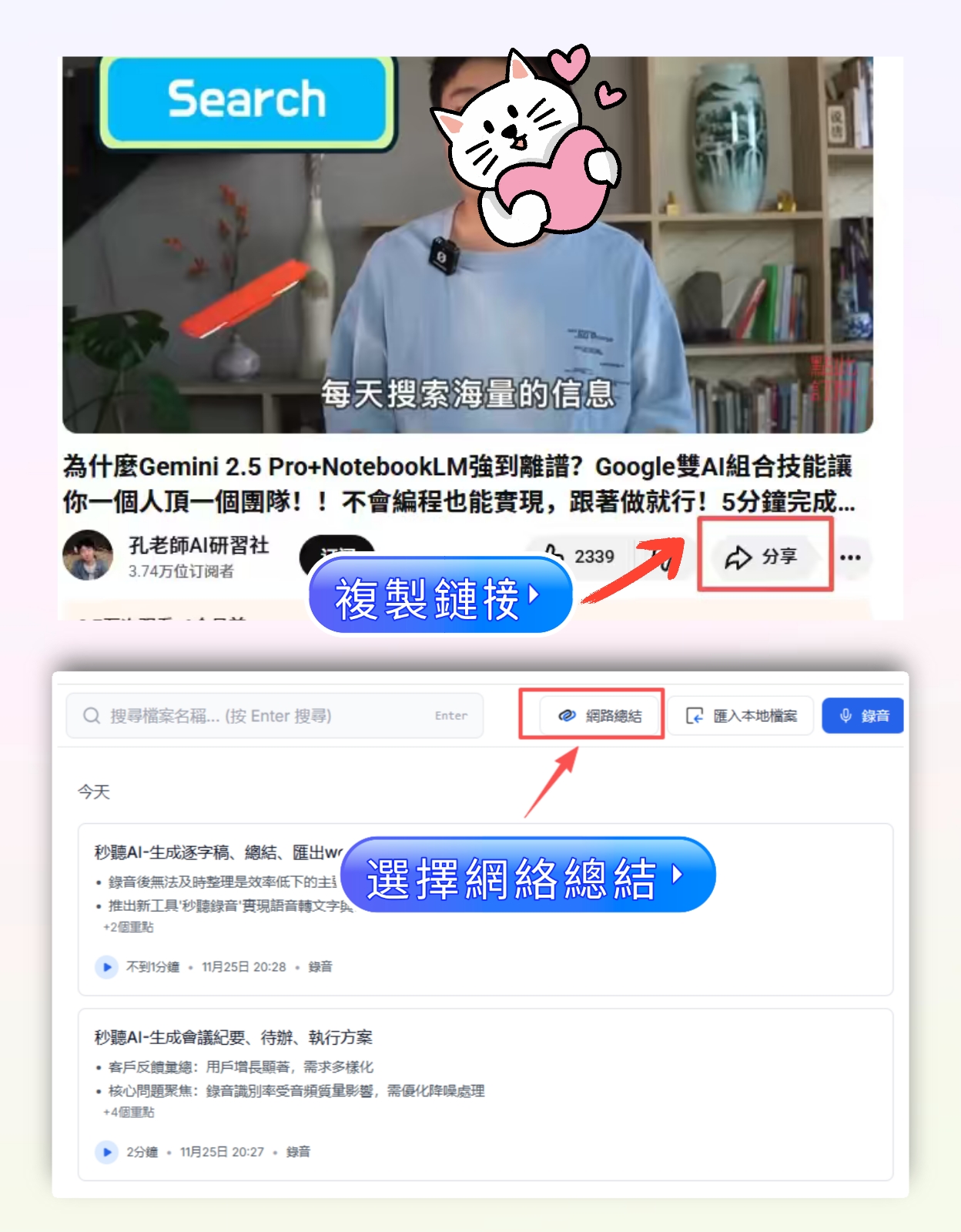
Meetings are only part of the picture. Many Hong Kong workers also need to transcribe YouTube tutorials, client interview recordings, or even WhatsApp voice messages. Otter.ai mainly focuses on online meetings. While it allows audio file uploads, it doesn't support direct YouTube link transcription; you'd need to record the screen and import, which is cumbersome.
Tinrec supports multiple sources: live recording, local audio/video files, and direct links from YouTube, Bilibili, Xiaohongshu, etc. It can one-click generate transcripts and summaries. We tested with a 10-minute YouTube financial analysis video; within 30 seconds, it produced the text and key points, perfect for research.
→ This dimension: Tinrec wins, covering more scenarios.
Stop organizing recordings by hand
Upload audio or video and automatically get a transcript, summary, and action items
Dimension 3|AI Q&A and Post-Processing
Transcription is just the first step; the key is quickly understanding content. Otter.ai has AI Chat that lets you ask questions about the meeting, e.g., "What decisions were made?" But it's limited to a single meeting and primarily English; Cantonese responses sometimes don't match.
Tinrec's AI Q&A is more like a personal knowledge base: you can ask questions about a single recording or across recordings, e.g., "In last week's project kickoff meeting, what risks did the client mention?" The system automatically finds relevant sections and key points. It can also automatically generate to-do lists, meeting minutes, and even table reports, which can be directly exported to Google Docs. In a test with the same 30-minute meeting recording, Tinrec's to-do list was more aligned with Hong Kong workplace terminology, with less American English translation tone.
→ This dimension: Tinrec wins – more practical and localized AI features.
Dimension 4|Output Formats and Cross-Platform
After creating records, you need to share with colleagues or integrate into Notion for follow-ups. Output convenience greatly affects efficiency. Otter.ai can export TXT, PDF, SRT, but team plans offer more integrations; the free plan only allows basic exports.
Tinrec offers richer multi-format export: TXT, DOCX, SRT, Markdown, and can sync directly to Notion, Google Docs, OneNote, Dropbox. We tested one-click sending meeting minutes to Notion; formatting was well preserved, no manual adjustments needed. Tinrec also has iOS, Android, and web versions, allowing you to record on your phone during commute and continue editing on your computer at the office. Otter.ai also has apps and web, but some features (e.g., AI Chat) are limited on mobile.
→ This dimension: Tinrec slightly wins – more flexible output, more consistent cross-device experience.
What Unique Advantages Does Each Have?
Tinrec's Unique Advantages:
- Best Cantonese + code-switching transcription: Lowest word error rate among mainstream tools, ideal for Hong Kong local users.
- Direct web video transcription: Just paste a YouTube or Xiaohongshu link – no need to record separately, great for research and content creation.
- AI cross-recording Q&A: Turns all past recordings into a searchable database; ask one question and get relevant content and key points – like having a personal assistant.
- Rich post-processing capabilities: Not just transcripts, but also automatically generated to-dos, minutes, mind maps, exported directly to common tools, truly aiding decision-making.
Otter.ai's Unique Advantages:
- Native meeting integration: Directly connect Google Calendar, auto-join Zoom, Teams, Meet without manually opening the app – ideal for teams with heavy online meetings.
- More mature English scenarios: If you primarily use English in meetings, Otter.ai's speech recognition and summary accuracy remain top-notch, and its speaker identification works very well.
Conclusion: Which One Should You Choose?
- If you need accurate Cantonese transcription and code-switching content organization → Tinrec (word error rate 9.2% vs Otter 15.7%)
- If you want to ask AI for key points and to-dos after recording → Tinrec (cross-recording AI Q&A, automatic minutes and to-dos)
- If you often need to organize web videos, class recordings, or archive files → Tinrec (direct link transcription, multi-format export)
- If you work in a pure English environment, primarily using Zoom meetings, wanting automatic joining and team sharing → Otter.ai is more convenient
In short: For most Hong Kong professionals, Tinrec is more down-to-earth, covering more audio/video scenarios, and its AI post-processing lets you finish work before leaving. We recommend downloading the free version of Tinrec, testing it with your own recording, and if it fits, consider the Pro plan – no need to pay upfront.
Turn every recording into actionable outcomes
Get 60 free transcription minutes when you sign in. No credit card required.
Related Reading
You might also like

2026 AI Voice-to-Word Tool Buying Guide: 3 Tested & Recommended
This review tests 3 popular AI voice-to-Word tools, from free plans to paid options, to find which one best helps you turn meeting and lecture recordings into structured Word documents quickly, with complete buying advice.

2026 4 AI Agent Context Understanding Tools Horizontal Comparison: AI Assistants That Understand Conversations Better
Want to know which tools truly understand your conversation context? This article compares AI Agent context understanding capabilities and uses Tinrec as an example to show how AI Q&A can improve meeting efficiency.

2026 Comparison of 5 AI-Powered Recording Tools with Multi-Round Dialogue: Which One Can Really Help You Extract Key Information from Recordings?
AI recording tools do more than just transcribe speech; multi-round dialogue queries are the key. This article tests 5 audio/video transcription tools with AI Q&A features, including Tinrec, Otter.ai, Fireflies.ai, Granola, and PLAUD, showing how to use conversations to deeply mine recording content, with ready-to-use prompt templates.

Free AI Meeting Note Solutions for 2026: A Look at 5 Tools
Can't keep up with notes in class? Group discussions where no one remembers the conclusions? This article tests 5 AI meeting note tools from a student's perspective, telling you how to choose free plans and which one is best for recording lectures and reviewing for finals.
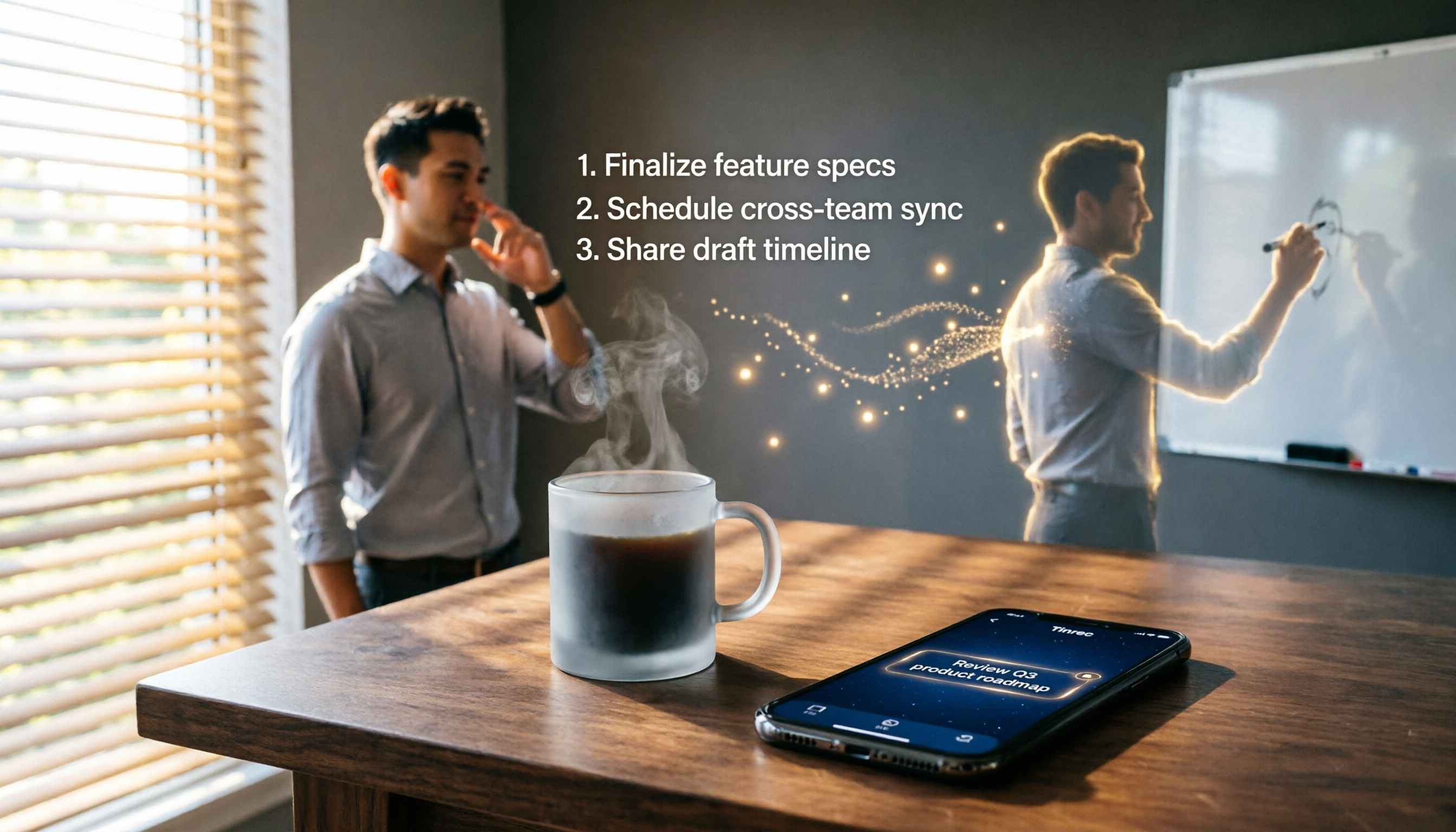
2026 Complete Guide to AI Agent Task Extraction: Automatically Capture To-Dos from Meetings with Tinrec
This article introduces Tinrec's AI Agent task extraction feature that automatically captures action items from meetings, interviews, or lectures, eliminating the need for manual note-taking.

Best AI Meeting Assistant in 2026? We Tested 5 and Found the Most Complete One
I attend 15 meetings a week, and the worst part is the post-meeting cleanup. After testing 5 AI meeting tools on transcription quality, AI summaries, action item extraction, and cross-platform support, here's the one that truly turns recordings into usable data.
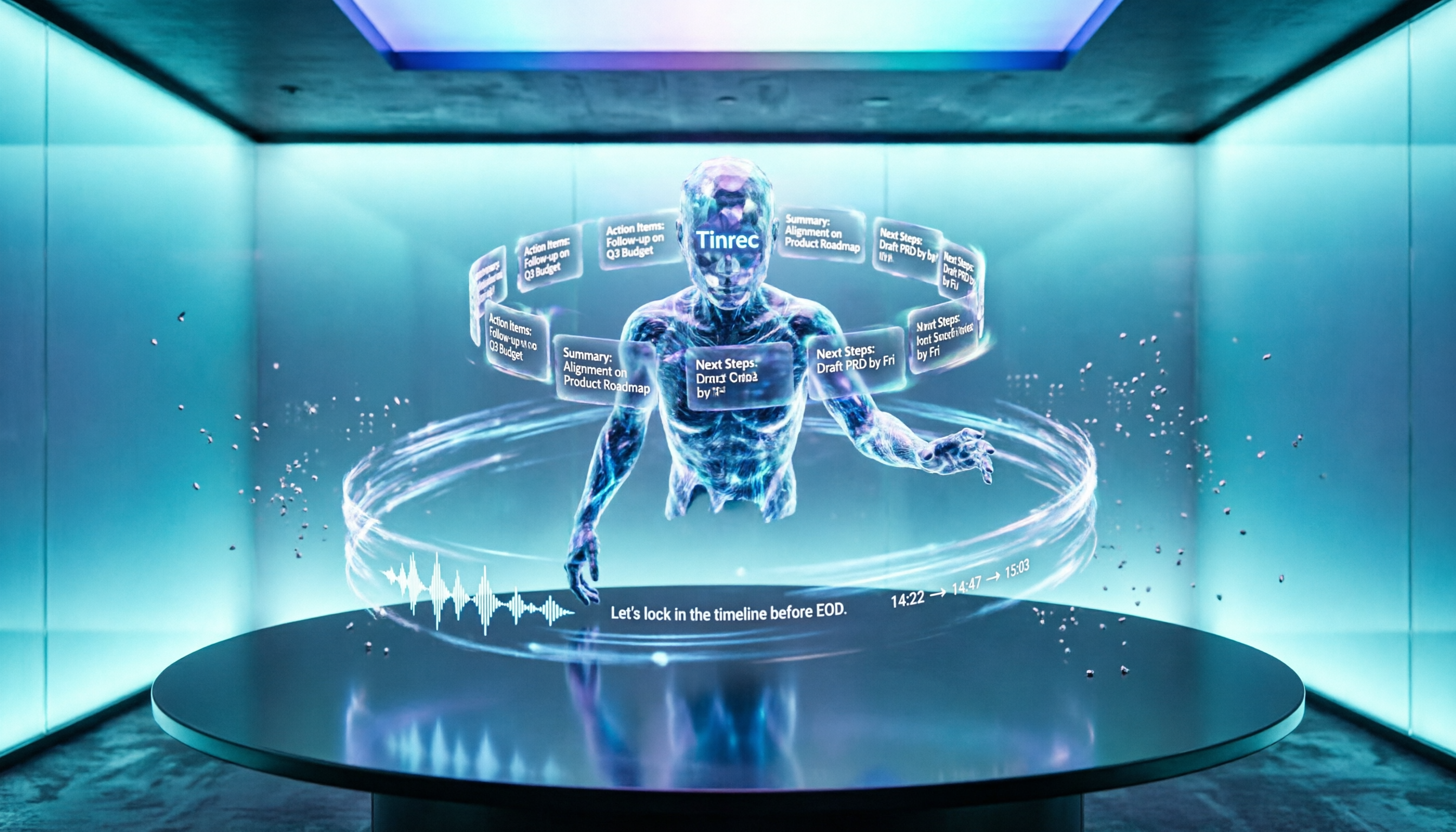
How to Automatically Organize Meeting Notes with AI in 2026: A 5-Step Guide
Spending two hours in a meeting and another two hours writing meeting notes? This guide teaches you how to use AI speech-to-text tools to auto-generate summaries and to-do lists. We tested Tinrec, Otter.ai, and 5 other services, covering everything from selection to pitfalls.
2026 AI Administrative Assistant Tools: No Hardware Needed + Cross-Platform Audio Transcription
Administrative work often gets buried under meeting recordings, interviews, online videos, and more. This article compares two AI administrative assistant tools: the software-based Tinrec and the hardware-based PLAUD Note. We analyze cost, input sources, post-processing capabilities, and cross-platform support across four dimensions to help you find the best solution for organizing audio notes and tasks.

Free AI Meeting Efficiency Tools in 2026: A Look at 3 Options
Tired of transcribing meeting recordings after hours? We tested free plans of Otter, Notta, and Tinrec——three AI meeting tools——to see which one truly saves time for Hong Kong workers, focusing on Cantonese recognition, multi-source input, and AI summarization.