
Turn recordings into transcripts and summaries in minutes
Upload audio or video for multilingual transcription, AI notes, and action items
2026 Comparison of 3 AI Agent Recording Tools: Which One Turns Audio into Action Items?
I've been organizing client interview recordings from the past six months. Dozens of hours of audio—just listening through takes several days. What's worse, after listening I still have to manually summarize, list action items, and write meeting notes. I suddenly realized that having a transcript is no longer enough—I need someone to directly extract action items from the recording, organize them into meeting minutes, and even generate reports. So I decided to find an AI Agent tool that truly "organizes" recordings.
I first tried a tool that focuses on AI meeting notes. It does automatically generate a summary, but the summary was just a paragraph—no structured to-do list, and I couldn't ask it later "What budget did the client mention last time?" Then I tried another transcription tool; the transcript was accurate, but after transcription, all the content just sat there—I still had to read line by line and organize myself. Until a friend recommended Tinrec, I realized that the end point of AI recording organization is not a transcript, but actionable data.
With Tinrec, I uploaded a 90-minute interview recording. I not only got a transcript and AI summary but also used the built-in Agent feature to generate meeting minutes, action items, and key conclusions with one click. I could even ask questions about the recording like asking an assistant: "What pain points did the client repeatedly mention in this interview?" It automatically organized them for me.
So, this article is not just about features—it's about sharing with you how to use AI Agent to turn recordings into actionable knowledge. I'm not comparing feature specs; instead, I'm using my personal experience with Tinrec as an example to show you what AI recording organization can achieve and how you should choose such tools.
What can AI Agent recording organization do for you?
Many people think speech-to-text is the end goal, but for me, it's just the starting point. The true power of AI Agent recording organization lies in not just converting audio to text, but understanding the content, organizing key points, and even generating the work documents I need.
Scenario 1: Get meeting minutes 5 minutes after a meeting ends
After a two-hour meeting, what I dreaded most was the post-meeting organization—relistening to the recording, summarizing conclusions, and assigning tasks. Now with Tinrec, when the meeting ends, it not only provides the transcript but also generates a structured meeting minutes document with topics, discussion points, resolutions, and assignments—clear and organized.
(Screenshot: Tinrec meeting minutes summary interface showing AI-generated meeting topic, conclusions, and action items)
Scenario 2: Instantly extract key insights after an interview
When conducting user interviews, I record the entire session. Previously, it took two or three hours to relisten and take notes. Now I upload the recording to Tinrec and not only get the transcript but can also ask AI questions like "What was the main user feedback on pricing in this interview?" It finds relevant passages from the entire recording with timestamps.
(Screenshot: AI dialogue query interface showing the question and answer with source)
Scenario 3: Turn classroom recordings into study notes
Many students ask me how to organize lecture recordings. My approach is to use Tinrec to transcribe in real time, then use its chapter splitting feature to divide an hour-long content into three sections, and ask it to generate key summaries for each section. This way, reviewing is like reading ready-made notes without having to listen from start to finish.
(Screenshot: Chapter splitting interface showing section summaries)
Scenario 4: Convert online videos into text materials
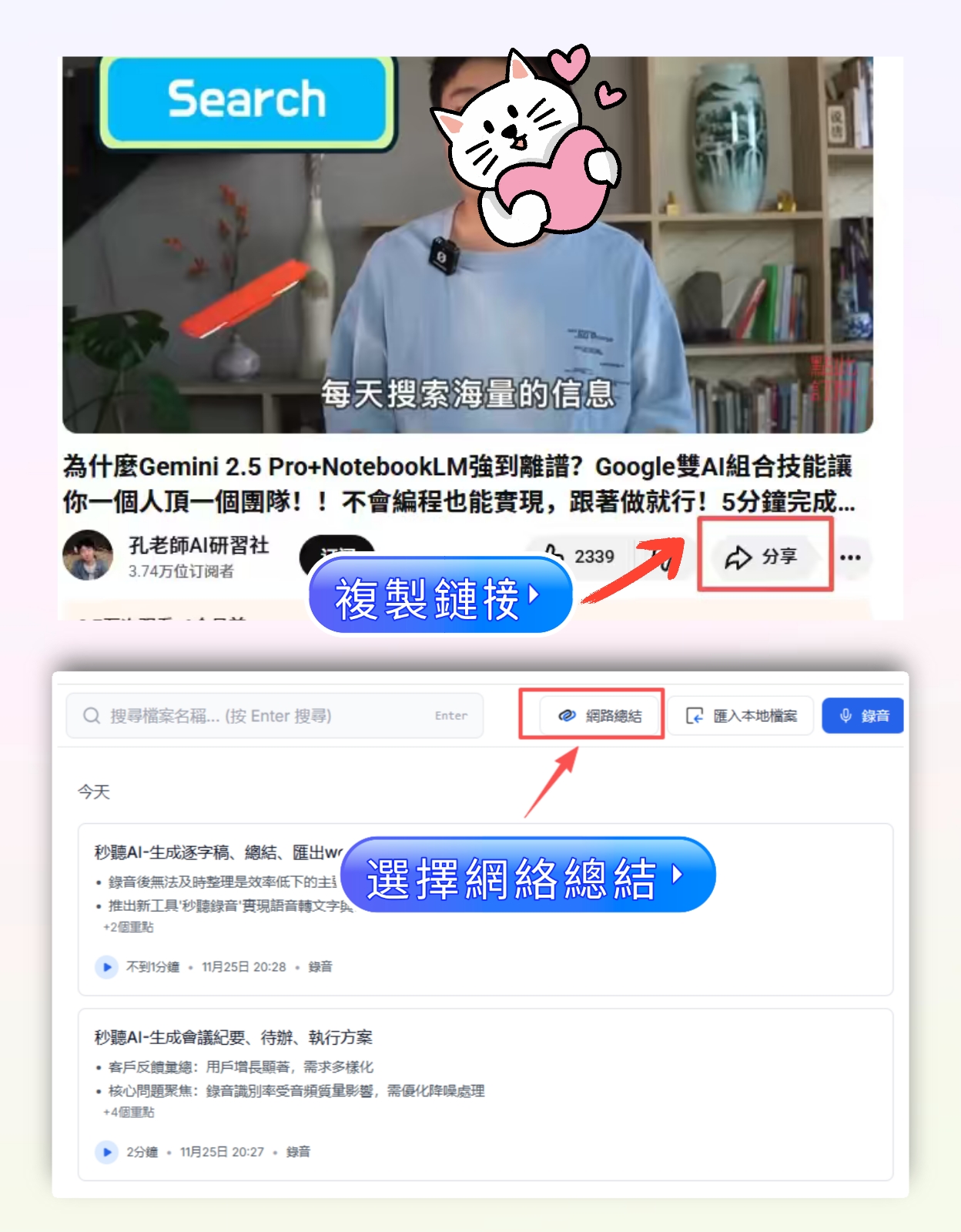
Not just recordings—when I find good interviews or talks on YouTube, I paste the link into Tinrec, let it automatically fetch the audio, transcribe it, and organize it into quotable material. This is much faster than watching and typing.
(Screenshot: Online video link parsing interface)
You see, AI Agent recording organization doesn't just give you a transcript—it turns recordings into usable data. Next, I'll use Tinrec's features as an example to show you the core capabilities of such tools.
What are the core capabilities of AI Agent recording organization?
After using Tinrec for a while, I found its Agent post-processing capabilities can be broken down into these key capabilities. Each is not a feature spec pulled from thin air, but a process I repeatedly use in real work.
1. Conversational organization after transcription
This is the feature I use most. After transcription, I can directly give commands in Tinrec's chat box, just like talking to an assistant.
For example, I might enter:
"Based on this recording, list all the dates, names, and key numbers mentioned."
In seconds, the AI organizes a clean list.
(Screenshot: AI Q&A interface showing extracted dates, names, and key numbers)
This isn't simple keyword search—it's semantic understanding. Even if the exact words aren't in the recording, the AI can pull relevant concepts.
Stop organizing recordings by hand
Upload audio or video and automatically get a transcript, summary, and action items
2. Automatic generation of structured summaries and to-dos
Typical tools give a condensed paragraph, but Tinrec's summary is structured: meeting topic, discussion points, conclusions, action items. Especially for action items, it automatically assigns owners and deadlines, so I can copy directly into my project management system.
(Screenshot: To-do list showing owners and deadlines)
Moreover, this to-do list isn't one-way; I can continue to adjust it: "Break down item 3 into two subtasks and add priorities." It follows.
3. One-click generation of deliverables: meeting minutes, reports, tables
Tinrec has an "Agent Post-Processing" feature that can generate more complex documents from recording content. For example, I often use this command:
"Based on the above meeting recording, generate a formal meeting minutes document including topics, attendees, discussion content, resolutions, and action plan, presented in a table."
It really produces a neatly formatted table that I can tweak before sending to the team.
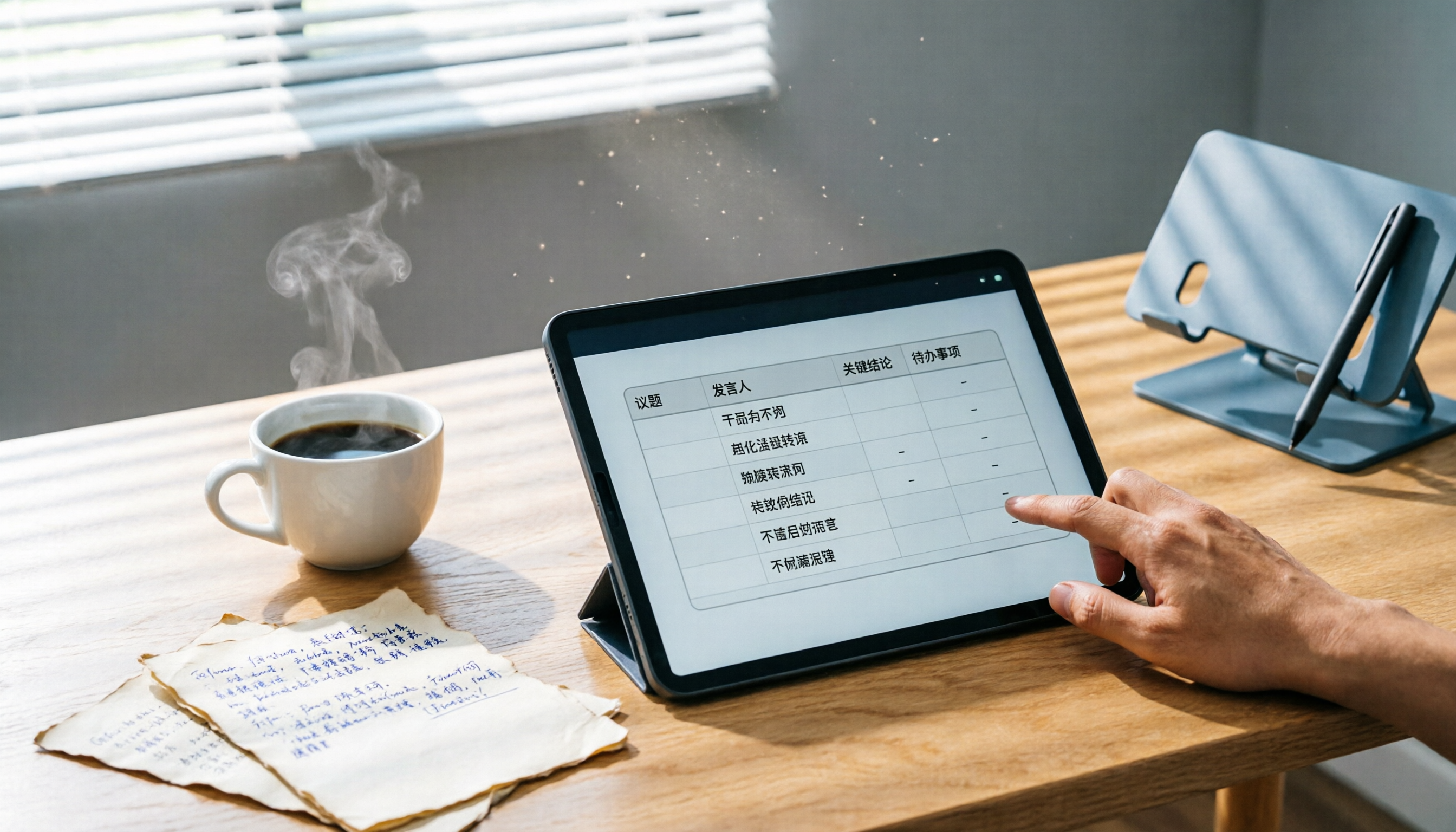
(Screenshot: Generated meeting minutes table)
This has completely changed my recording organization workflow: Previously "recording → listen → manual write-up"; now "recording → transcribe → command → deliverable."
4. Support for multiple input sources, unified organization
Another thing that impressed me is that Tinrec can not only record new audio but also integrate existing audio/video files and even online videos. I have old client recording files and saved YouTube talks—all can be processed with the same workflow. This makes my personal knowledge base very systematic.
(Screenshot: Import local recording file interface)
5. Seamless cross-platform continuation
I might record on my phone during meetings, upload files on desktop via web, and check results on mobile when on the go. Tinrec has iOS, Android, and web versions—my data syncs without any file transfer hassle.
(Screenshot: Multi-platform support illustration)
Practical application scenarios
Now that you understand the core capabilities, you might want to see how I use Tinrec's AI Agent to organize recordings in different situations.
Work meetings: from discussion to action list
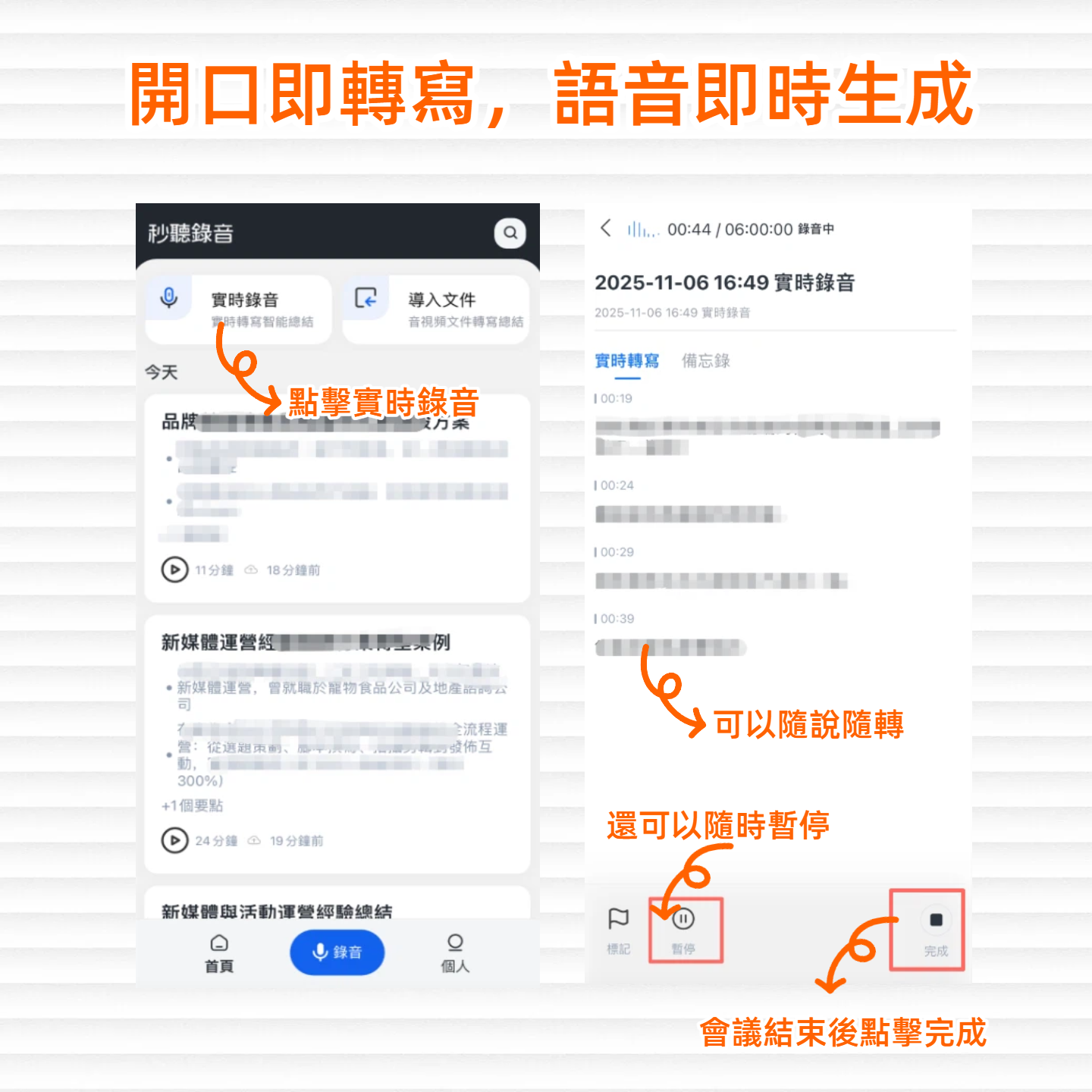
During weekly team meetings, I open Tinrec to record in real time. When the meeting ends, I use the Agent feature to generate "This week's meeting minutes and to-dos" and share in the group. Team members say they no longer wait for meeting notes because results are ready immediately.
(Screenshot: Meeting minutes generated from live recording)
Classroom learning: from audio to study notes
When taking online courses, I record the entire class, use Tinrec to transcribe it, then use the chapter feature to split into sections. Then I command each section: "Summarize the core knowledge points and list three key takeaways." This gives me a personalized study note.
(Screenshot: Notes generated for a specific section after chapter splitting)
User interviews: from recording to insight report
During user interviews, I transcribe first, then ask via dialogue: "What are the interviewee's top three needs?" "How many times did they mention competitors?" Finally, I ask the Agent to generate a "User Interview Key Findings Report." This is much faster than manual organization and less likely to miss important points.
(Screenshot: AI dialogue query showing answers about needs)
Content creation: from online video to article material
Sometimes I write articles critiquing YouTube videos. Previously, I had to watch and pause to type. Now, I paste the video link into Tinrec, it automatically transcribes, and I ask it to "List the ten key points mentioned and provide original paragraphs." With a little polish, I have usable material.
(Screenshot: Key points extracted from online video transcription)
4 things to look for when choosing an AI Agent recording tool
There are more and more tools like this on the market. How to choose? I've developed my own criteria that you can reference.
1. Not just transcription, but true "organization"
Many tools tout transcription accuracy, but I've found transcription is just the first step. What really saves time is the ability to automatically generate summaries, to-dos, and continue with conversational organization. Tinrec does this well—its Agent post-processing can produce almost any document format I need.
2. Support for multiple content sources
Your recordings don't always come from the same place. Sometimes live recordings, sometimes old files, sometimes online videos. Make sure the tool you choose can handle these sources. Tinrec supports live recording, file uploads, and web links—very convenient for me.
3. Conversational AI that understands context
Some tools' AI only does keyword matching, but what really works is AI like Tinrec's that understands the semantics of the entire recording, answers complex questions, and can rewrite or summarize based on content. When trying, ask it a question that requires contextual understanding and see the result.
4. Output formats compatible with your workflow
The ultimate goal of recording organization is to use it elsewhere. Tinrec can export multiple formats, including plain text, PDF, Word, and sync directly to Notion, Google Docs, etc. This saves me from copying and pasting.
Frequently Asked Questions
Q: Will AI Agent recording organization make mistakes? A: Yes, but it significantly reduces manual organization time. I treat the AI output as a draft and verify important parts against the original. Tinrec's conversational query feature allows me to check original passages anytime—very convenient.
Q: Is the free version sufficient to try AI organization features? A: Tinrec's free version includes basic credits to experience the full functionality. I started with the free plan and only upgraded to Pro because of my weekly meetings.
Q: How is this different from typical meeting bots? A: Meeting bots mainly join online meetings automatically and generate summaries. But Tinrec isn't just for meetings—I can organize classroom recordings and videos too. Its Agent post-processing can generate more complex documents, not just meeting minutes.
Q: Do I need to prepare complex commands? A: Starting with the default summary feature is enough. For advanced use, you can refer to the command templates I provided above and adjust gradually.
Conclusion: Make recordings your knowledge asset
AI recording organization isn't magic, but it has changed my workflow. Recordings used to be dead data; now they become an interactive knowledge base that produces reports. If you handle more than three meetings or interviews per week, I suggest you try this approach.
You can start with Tinrec's free plan, which includes monthly basic credits. Try a full organization workflow—record a meeting, then ask it to generate minutes. You'll likely be surprised at how easy recording organization can be.
Quick Start Checklist
- Download Tinrec (iOS / Android / Web)
- Record your first meeting or class
- After recording, view AI summary and to-dos
- In the chat box, enter: "Summarize the meeting into a three-section meeting minutes"
- Export to Notion or Google Docs to continue using
- Gradually try uploading old files or online video links
Take it step by step, and you too can turn recordings into actionable intelligence.
Turn every recording into actionable outcomes
Get 60 free transcription minutes when you sign in. No credit card required.
Related Reading
You might also like

2026 Tinrec vs Notta: A 5-Dimension Showdown – Which One Boosts Chinese Meeting Efficiency?
Struggling to keep up with meeting notes? This article compares two major AI meeting efficiency tools, Tinrec and Notta, across five dimensions: core features, Chinese language support, post-processing, pricing, and real-world applications. Find out which tool best boosts your meeting productivity.

Tutorial: AI Agent Structured Output in 2026 – Generate Meeting Minutes and To-Do Lists Automatically with Tinrec
Still manually compiling meeting notes and to-do lists? This article introduces AI Agent structured output, using Tinrec voice recording as an example to show you how to generate meeting minutes, action items, tables, and other deliverables with one click, saving you time.

2026 AI Meeting Assistant Comparison: Tinrec, Otter.ai, Fireflies.ai, Notta – Which Saves You the Most Effort?
The most time-consuming part of meetings isn't the meeting itself, but the post-meeting cleanup—organizing notes and extracting action items. This article tests four AI meeting efficiency tools: Tinrec, Otter.ai, Fireflies.ai, and Notta, comparing transcription accuracy, AI summaries, cross-platform support, and more. Find out which free version is sufficient and how to avoid common pitfalls when choosing.
A Complete Guide to AI Agent Step-by-Step Processing in 2026: Features, Use Cases, and Tool Selection
A curated list of 5 AI Agent tools to help you process recordings, videos, and meetings step by step—from transcription to summaries—with selection recommendations.

2026 Comparison of 3 AI Smart Transcription Tools: Meeting Recordings & Online Videos Converted to Actionable Lists
A mid-level manager tests Otter.ai, Notta, and Tinrec—three AI transcription tools—from meeting minutes and online video transcription to AI chat queries. Find out which is best for busy professionals.
2026 Review of 3 AI Voice-to-Excel Tools: Which One Auto-Generates Meeting Data Tables?
Need to turn meeting recordings into Excel reports? We tested Tinrec, Notta, and Otter.ai to see which truly saves time by directly producing structured data.

Which AI Agent Auto-Delivery Tool is Best? 2026 Hands-On Review of 3 Top Picks: Tinrec Generates Reports in One Click
A senior college student tests 3 AI tools to automatically turn recordings, meetings, and online videos into organized reports and to-do lists, saving all-nighters.

2026 Hands-On Comparison of 2 AI Recording and Summarization Tools: Which One Produces the Best Meeting Notes for PPT?
When making a PPT, the most time-consuming part is often not the layout, but converting meeting recordings, lectures, or interview content into structured key points. This article compares Tinrec and Otter.ai across five dimensions to see which AI recording tool is better for Chinese-speaking users to quickly organize presentation-ready material.

2026 Comparison of 3 AI Agent Document Generation Tools: From Recording to Document in One Click
Tired of spending hours transcribing meeting recordings, lectures, or interviews? AI Agent document generation technology can automatically turn audio into meeting minutes, reports, to-do lists, and more. Tinrec's Agent post-processing feature lets you generate documents in various formats on demand. This article compares three mainstream solutions to help you choose the most time-saving option.