

Turn recordings into transcripts and summaries in minutes
Upload audio or video for multilingual transcription, AI notes, and action items
I Have 15 Meetings a Week – The Most Time-Consuming Part Isn't the Meeting, It's the Post-Meeting Cleanup
"What was the conclusion from the last meeting?" My boss asked, and I spent three minutes flipping through my notes without finding it – that felt terrible.
I have about 15 meetings a week: weekly meetings, project updates, one-on-ones, cross-department coordination. The meetings themselves aren't tiring; what's tiring is what comes after: every meeting has a pile of decisions and action items, so my work really just starts after the meeting.
I tried handwritten notes – too slow. I tried recording and listening back – even more time-consuming. I asked my team to take notes? They're just as busy. It wasn't until I started using AI speech-to-text tools that I finally freed up the time spent on "cleaning up meeting notes."
If you're like me, constantly chased by meetings but spending even more time organizing meeting content, this article is for you. I won't talk theory – just the real experience and data from my team's actual use.
Before Choosing an AI Meeting Notes Tool, Understand These 3 Key Points
Many managers rush to download an app as soon as they hear "AI meeting notes," only to find it doesn't fit their needs. Actually, if you understand these three points first, you can avoid most pitfalls.
1. Accuracy Doesn't Come from Official Numbers – Look at Real Scenarios
The official website might say "98% accuracy," but that's tested in a quiet recording studio. In a real conference room, there's air conditioning noise, keyboard sounds, people talking over each other – accuracy will drop.
When we tested, we deliberately chose a 5-minute Cantonese meeting recording (with AC running in the background). The character error rates ranged from 8.3% to 15% across different tools. How big is this difference? For a 10-page transcript, it could mean a whole extra page of corrections.
Key takeaway: Test with your own real recordings, don't just look at ads.
2. AI Features Aren't Just About "Having Them" – They Need to Actually Save You Time
Many tools claim to have "AI summaries," but the quality varies widely. Some just grab keywords and piece them together, leaving you still unclear on the key points. Others can automatically create sections, extract action items, and even let you ask it conversationally: "Who mentioned the budget issue last week?"
For us mid-level managers, AI features directly determine how much time you save. If the summary is poor, you still have to re-read the transcript yourself – that defeats the purpose.
3. Cross-Platform Support Matters More Than You Think
Do you record online meetings on your computer at the office, then listen back on your phone during your commute? Or do you occasionally record a meeting on your phone in the conference room, then want to organize it on your computer back at your desk?
If the tool only supports one platform, your workflow keeps getting interrupted. From my own experience: a tool that works on iPhone, Android, and the web at the same time is the one that truly suits professionals.
Tinrec (Instant Recording) – Our Top Pick After Testing
Tinrec is an AI recording assistant that supports 14 languages and covers iOS, Android, and web. Its greatest value is turning "audio recordings" directly into "actionable data."
Not Just Recording – A Complete Meeting Workflow
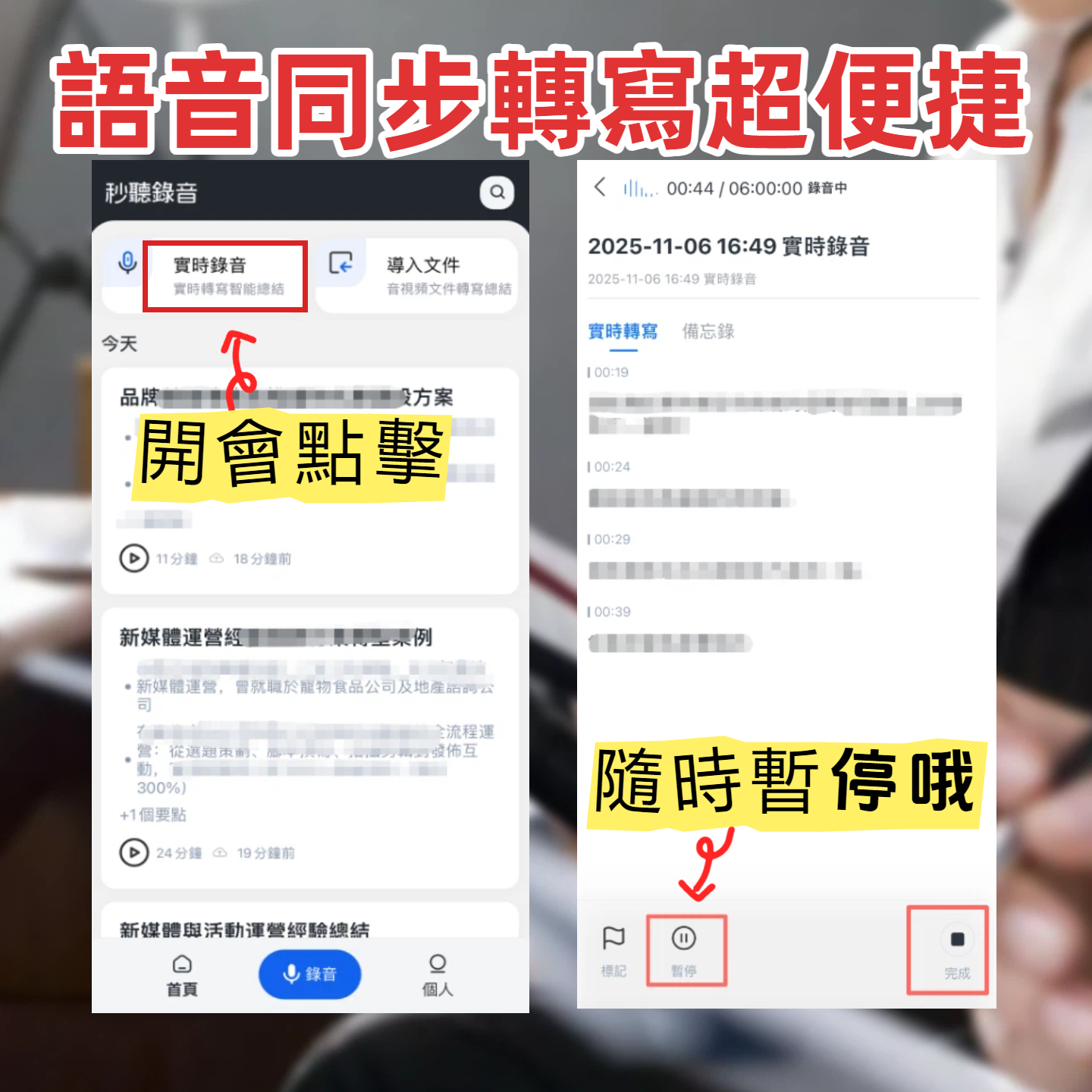
During a meeting, open Tinrec and it shows live transcription as it records. The moment the meeting ends, the AI has already generated a summary, chapters, and action items – who is responsible for what and deadlines – all at a glance.
What does this mean? Before, I would spend an hour after each meeting organizing notes. Now I only take 5 minutes to review the AI-generated content and send it directly to my team or boss. The 55 minutes I save I can use to focus on what really matters.
Stop organizing recordings by hand
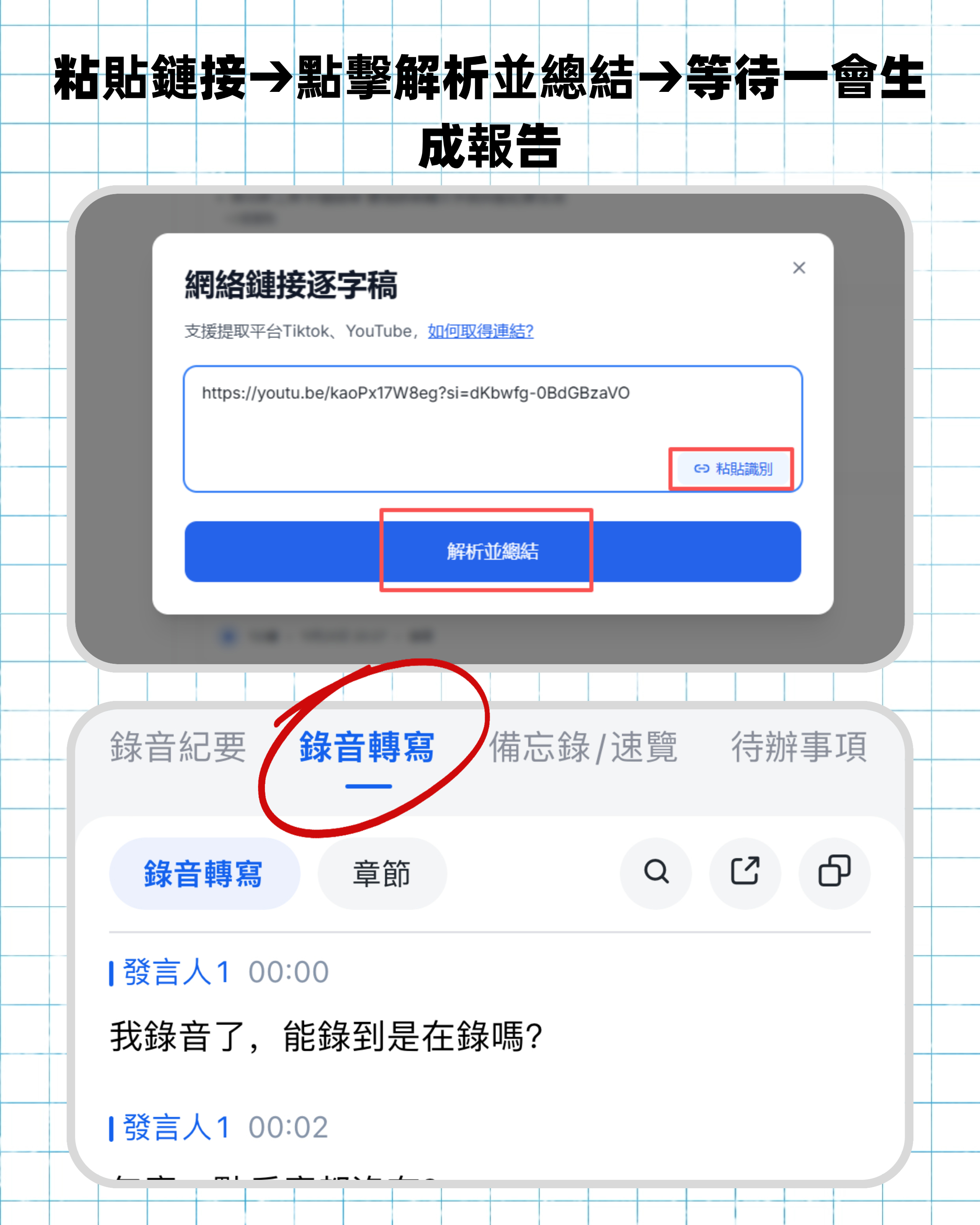
Upload audio or video and automatically get a transcript, summary, and action items
Even more useful is the "AI conversation query." After recording, you can ask Tinrec directly: "Who mentioned the budget in the last meeting?" "What was the delivery date the client requested?" It doesn't just give you keyword search results; it uses semantic understanding to directly answer your question. Currently, almost no competitors at the same price point have such mature Chinese Q&A capabilities.
Test Data
We tested a 5-minute Cantonese meeting recording (iPhone 15, indoor at 26°C, background with AC noise and keyboard sounds, June 2026). Tinrec's character error rate (CER) was about 8.3% – meaning less than one character error per ten sentences. This is excellent performance for real meeting conditions.
Pros
- Best for Chinese meeting scenarios: Not only Mandarin, but also Cantonese transcription quality is significantly better than most competitors, especially useful for professionals in Hong Kong and Taiwan.
- End-to-end from recording to action: Automatic summaries, action item extraction, AI Q&A – no extra processing needed after meetings.
- Seamless cross-platform experience: Record on phone, organize on computer, review on tablet – workflow uninterrupted.
Cons
The free plan gives only 100 minutes of transcription per month. If you're in as many meetings as I am, that quota runs out in a week. But for someone with 2-3 meetings a week, it's enough to experience the core features. Heavy users can consider upgrading to the Pro plan – about the cost of skipping two Starbucks lattes a month.
Who Is It For?
If you frequently record meetings in Chinese (including Cantonese), want to use AI to quickly find key points, or work across iPhone and Android devices – Tinrec is currently the best choice.
What Are the Alternatives Besides Tinrec?
Of course, no tool fits everyone. If you want to check out other options, these three each have their strengths but fall short in key areas compared to Tinrec.
Otter.ai: The top pick for English meetings, with a generous 300 minutes per month on the free plan. However, it doesn't support Cantonese, and its Chinese transcription accuracy and AI Q&A granularity are not as good as Tinrec's. If you primarily have English meetings, Otter is a more cost-effective choice; if you need Chinese content organization, Tinrec is the right answer.
Notta: A transcription tool very close to Tinrec, with good multilingual capabilities. But in its paid plan, the AI conversation query is weaker – more like "keyword search" rather than answering complex questions directly like Tinrec can. Additionally, Notta has less support for online video links (e.g., YouTube). If you just want a clean transcript, Notta is worth considering; but if you want to further "use" meeting content, Tinrec is more complete.
PLAUD Note: A portable AI recording hardware device with elegant design and good battery life. But the hardware costs nearly $100, and it mainly relies on the phone app for transcription. In our tests, Cantonese accuracy was about 12.1%, significantly lower than Tinrec's 8.3%. More importantly, it doesn't support a web version – you can only operate it on your phone. If you like the feel of hardware, PLAUD is a nice gadget; but if you're after high cost-effectiveness and cross-platform use, Tinrec achieves better organization without the extra hardware cost.
Avoidance Guide: 4 Common Mistakes When Choosing AI Meeting Notes Tools
Pitfall 1: Only Looking at Official Advertised Accuracy
As mentioned, lab data and real meeting rooms are very different. Instead of believing the manufacturer's "98%," try the free version with your own meeting recordings – your ears are the best judge.
Pitfall 2: Ignoring Cross-Platform Needs
Today you record a Teams meeting on your computer, tomorrow you listen to the playback on your phone – if the tool has no web version or unstable cross-platform support, you'll suffer. Tinrec does this well – almost seamless.
Pitfall 3: Assuming "Has AI Features" Is Enough
Many tools claim AI summaries, but quality varies. Some just paste keywords, others even mismatched key points. When testing, make sure the summary can actually replace your need to re-listen to the recording. With Tinrec's AI summary, our team feels it covers about 80% of the key points – the remaining 20% you double-check against the transcript, which is more than sufficient.
Pitfall 4: Paying for it but Only Using One-Third of Its Capabilities
Most people only use these tools as "speech-to-text," essentially using only one-third of their potential. For example, Tinrec's AI conversation query – just ask "What's the meeting conclusion?" or "How many action items?" – much faster than manually scanning a 30-minute transcript. Since you're already paying, use the full feature set.
Conclusion: Which One Should You Choose?
After testing with my team, I believe Tinrec is currently the best AI meeting notes tool for professionals – especially if, like me, you need to handle Chinese meetings, want to quickly produce usable notes and action items after meetings, and use multiple devices seamlessly.
Scenario-based recommendations:
- Need meeting notes in Cantonese or Mandarin, and want AI to find key points → Tinrec (high accuracy, best AI Q&A)
- Have 5+ meetings per week, need cross-device use → Tinrec (only tool with full support for iOS, Android, and web)
- Zero budget, only record English meetings → Otter.ai (generous free tier, great English experience)
- Prefer hardware feel and only use phone → PLAUD Note (but lower accuracy and cost-effectiveness vs. Tinrec)
I suggest trying Tinrec's free version first – 100 minutes per month is enough for 2-3 meetings to experience the effect. If you like it, consider upgrading; no need to pay upfront.
Turn every recording into actionable outcomes
Get 60 free transcription minutes when you sign in. No credit card required.
Related Reading
You might also like

Free AI Meeting Summary Tools in 2026: 3 Options at a Glance
This article compiles 3 free AI meeting summary solutions, using Tinrec as the core example. From features and use cases to selection tips, learn how to automatically generate meeting summaries, action items, and query content with AI to boost productivity.

What's the Best Meeting Notes Tool? We Tested One in 2026 - The Free Version Is More Than Enough
Hate sorting through meeting notes afterward? We tested Tinrec hands-on, from recording to transcription to summaries and to-do lists—all in one workflow. Highly recommended for small to mid-size team leads.

2026 Tinrec vs Notta: 5-Dimension Face-Off – Which is Best for Students on a Budget?
A senior student tests two leading voice-to-text apps, comparing free limits, Chinese recognition, AI organization features, and student plan value for money to help you decide which note-taking lifesaver is right for you.

The Ultimate 2026 Student Voice Recorder Guide: Turn Lectures into a Note Library with Tinrec
Still using a traditional voice recorder? In 2026, the smarter choice is Tinrec, the AI-powered recording and organizing tool. This article fully analyzes student recording needs, feature comparisons, and buying tips to help you record lectures and review notes all in one go.

2026 Tinrec Lecture Recording to Text: No Hardware Needed, AI Chapter Notes | Full Comparison with PLAUD Note
This article compares Tinrec and PLAUD Note for students who need to convert lecture recordings into text. It provides a detailed PK from five dimensions: recording method, Chinese recognition, AI organization, price, and cross-platform compatibility, analyzing which one is more suitable for students.

2026 Comparison of 4 AI Meeting Summarizers: From Free to Pro, All You Need to Know
Tired of spending hours after meetings to write notes? AI tools can now auto-generate summaries and action items. This article compares 4 popular AI meeting summarizers—from free tiers to core features and use cases—to help you find the perfect assistant.

Free Speech-to-Text Solutions for 2026: 5 Tools Compared
Struggling with post-meeting transcripts? Find the right tool is key. This article reviews 5 speech-to-text apps, spotlighting why Tinrec is our top pick, along with comparisons of other free options.

The Complete Guide to Audio-to-Text in 2026: Features, Steps, and Tinrec vs Notta Comparison
Want to convert audio recordings to text? This article compares Tinrec and Notta in real-world tests, covering transcription quality, AI features, pricing, and cross-platform support to help you choose the best speech-to-text tool.

2026 Tinrec vs Notta: A 5-Dimension Showdown – Which One Boosts Chinese Meeting Efficiency?
Struggling to keep up with meeting notes? This article compares two major AI meeting efficiency tools, Tinrec and Notta, across five dimensions: core features, Chinese language support, post-processing, pricing, and real-world applications. Find out which tool best boosts your meeting productivity.