

Turn recordings into transcripts and summaries in minutes
Upload audio or video for multilingual transcription, AI notes, and action items
2026 Tinrec vs Notta: 5-Dimension Comparison – Which Is Better for Students in Real-Time Chinese-Japanese Translation?
Last semester, I took a Japanese general education course. The professor spoke really fast, and the slides were a mix of Chinese and Japanese. I often couldn't keep up with handwritten notes, and listening to the recordings after class was confusing. That's when I realized how important it is to have a tool that can translate Chinese-Japanese in real time and help organize the content into key points. I tried both Notta and Tinrec, and this article compares these two apps from a student's perspective based on my actual experience in class, working on projects, and preparing for exams.
Tinrec vs Notta: Quick Overview
Notta is a tool focused on multilingual transcription and translation. I initially got into it because of its advertised translation features. Tinrec, on the other hand, positions itself as an AI recording and audio/video organization workspace, emphasizing not just translation but also turning audio content into usable notes. In the context of real-time Chinese-Japanese translation, both can transcribe and translate on the fly, but their post-processing logic differs significantly.
| Basic Info | Tinrec | Notta |
|---|---|---|
| Free Quota | Basic transcription & translation experience | 120 minutes per month |
| Pricing Plans | Weekly card, Pro monthly, Pro annual | Pro monthly, annual |
| Cross-Platform | iOS, Android, Web | iOS, Android, Web |
| Key Difference | Auto summaries, chapters, tasks, AI Q&A after translation | Focuses on transcription & translation, limited post-organization |
This article will compare them across five dimensions: translation accuracy, content organization, free quota adequacy, platform convenience, and AI add-on features, based on my hands-on experience.
Translation Accuracy: Which One Understands Your Professor's Mixed Chinese and Japanese?
Notta's Japanese transcription is fairly stable, but when it comes to mixed Chinese-Japanese-English classes, it sometimes produces translations that feel overly literal with awkward word order. For instance, when the teacher suddenly switches to Chinese to explain a Japanese grammar point, Notta's translation occasionally forces the Chinese into Japanese, making the whole sentence bizarre.
Tinrec, which emphasizes Chinese content organization, performs more naturally in mixed Chinese-Japanese scenarios, especially in real-time classroom speech. Its translated sentences are closer to the original tone and rarely go off the rails. After a whole semester, when I revisited the transcripts for finals, Tinrec's version was smoother and easier to understand the professor's original meaning.
→ This dimension: Tinrec edges ahead, especially in everyday mixed-language conversations.
Post-Translation Content Organization: Can It Become Notes Directly?
Notta gives you a clean transcript with translated text, but you have to manually sift through and extract key points. For time-strapped students, this is really time-consuming—especially when you realize a week before exams that you haven't organized your recorded notes yet, and you feel like crying.
Stop organizing recordings by hand
Upload audio or video and automatically get a transcript, summary, and action items
Tinrec shines here. After translation, it automatically generates summaries, chapters, and to-do items. A 90-minute class can be turned into a structured outline in seconds, even extracting assignments the professor gave. I now export the organized results directly to Notion, saving tons of time on note-taking. This all-in-one “translation + organization” design is like a superhero for students.
→ This dimension: Tinrec wins by a landslide.
Is the Free Quota Enough? How Long Can a Bubble Tea Budget Last?
Students care most about free tier capabilities. Notta offers 120 minutes per month free. With two Japanese classes a week at under an hour each, I'd run out by mid-month, leaving me to manual note-taking or switching tools for the rest of the month.
Tinrec's free version also has a basic quota, but it adds a “weekly card” option. During midterms and finals, spending a few cups of bubble tea on a short-term unlimited transcription and translation plan is way more flexible than upgrading to Notta's monthly subscription. For short-term cramming, Tinrec's payment flexibility is kinder to a student's wallet.
→ This dimension: Tinrec's flexible plans better match student rhythms.
Cross-Platform and Use Cases: Classrooms, Libraries, Online Videos All in One
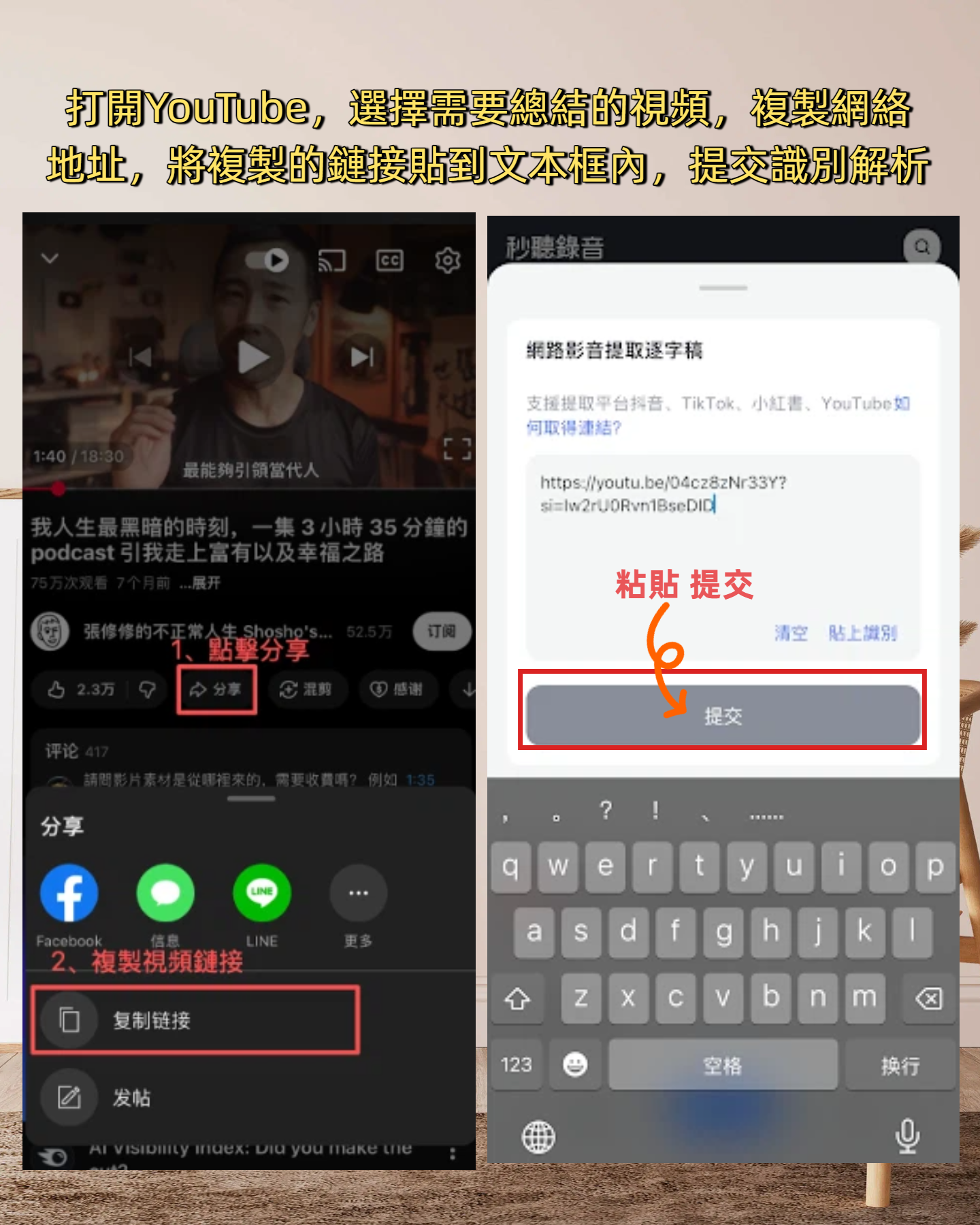
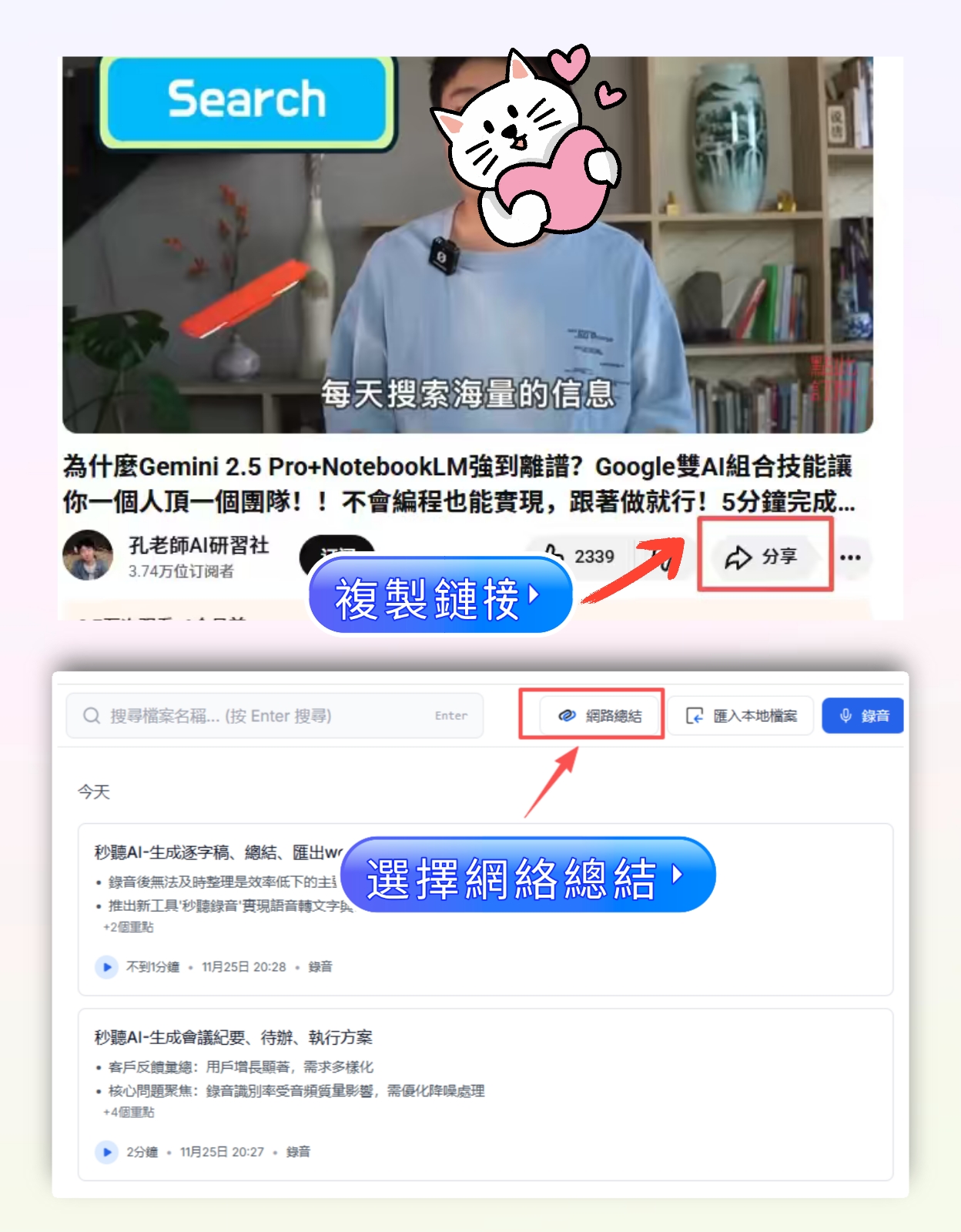
Both tools have mobile apps and web versions, so daily use is similar. But Tinrec has a feature especially useful for students: you can paste a YouTube or online video link, and it will transcribe and translate the content. Last semester, I analyzed a short Japanese video by simply dropping the link into Tinrec, and it gave me a transcript and summary. Notta can also upload files, but you need to download the video first, adding extra steps.
Additionally, Tinrec can import local audio files—like my previous class recordings—and translate and organize them. Notta can do that too, but with Tinrec's follow-up summaries and Q&A, it's a more complete package.
→ This dimension: Tinrec is more flexible in multi-source input and organization.
AI Add-On Features: Beyond Translation – Q&A and Review
Notta has AI features, but they mainly revolve around transcription itself; after translation, there's little further interaction with the content. Tinrec's AI Q&A impressed me: you can ask questions directly about the translated content, like “What key grammar points were covered in this class?” or “What was the group project topic?” Before exams, I used this feature to quickly review without having to listen to the entire recording.
This feature is especially useful for language classes because you can repeatedly ask about things you're unsure of—it's like having a personal AI teaching assistant. Notta doesn't yet offer such deep content interaction.
→ This dimension: Tinrec's AI Q&A is a unique advantage.
What Are Their Unique Strengths?
Tinrec's Strengths
- Auto-generates summaries, chapters, and to-do items after translation for direct note output
- Supports pasting online video links for translation, saving the hassle of file management
- AI Q&A enables deep review of content, great for language learners
- Weekly card plan lets students cram without long-term commitment
Notta's Strengths
- Fast transcription and translation speed, ideal for those who only need raw transcripts
- Has team collaboration features, but less relevant for individual students
Conclusion: Which One Should You Choose?
If you only occasionally want to translate a Japanese audio clip and don't need post-organization, Notta is sufficient. But if you're a student like me who wants to turn classroom recordings and online videos into actionable notes for review, and even ask questions while learning, then Tinrec's real-time Chinese-Japanese translation combined with its organization workflow is the better choice.
• If your class often mixes Chinese and Japanese and you want natural translations → Tinrec
• If you want to get notes and to-do items right after recording → Tinrec
• If you want to use AI Q&A to deepen memory → Tinrec
• If you only need a plain transcript and don't mind organizing yourself → Notta is worth considering
I now use Tinrec's free version plus a weekly card to handle my Japanese class materials. Over a semester, it's saved me tons of time. I recommend downloading the free version first and testing the translation and organization with your own recordings—then decide if the paid plan fits your needs.
Turn every recording into actionable outcomes
Get 60 free transcription minutes when you sign in. No credit card required.
Related Reading
You might also like

2026 Complete Guide to Speech-to-Text: Features, Use Cases, and Tool Selection
As a senior college student, I used speech-to-text tools for an entire semester to organize lecture notes, group discussions, and YouTube study videos. This guide introduces you to Tinrec, from core features to real student scenarios, showing how AI turns audio and video into actionable knowledge.

2026 Free Speech-to-Text Solutions: 2 Tools Compared
A mid-level manager puts two popular free speech-to-text tools—Tinrec and Otter.ai—to the test, comparing Chinese accuracy, free tiers, AI features, and cross-platform support to help you pick the best one for workplace productivity.

2026 Tinrec Voice-to-Text Tutorial: No Hardware Needed, AI Organizes from Multiple Sources
How to choose voice-to-text software? This article compares Tinrec and Plaud Note, from hardware requirements, input sources, AI features to pricing, and tells you why you don't need to buy a voice recorder — your phone can handle meetings, lectures, and online video transcription.

2026 Hands-On Comparison of 5 Cross-Border Meeting Note Apps: Which AI Summary Saves the Most Time?
Dealing with cross-border meetings daily, mixing English, Mandarin, and Cantonese? Still transcribing recordings after meetings? We test 5 transcription apps to see which one can quickly organize multilingual meetings, saving you time and overtime.

2026 Free Chinese-English Real-Time Translation Solutions: 3 Tools Compared
A must-read for professionals: hands-on testing of Chinese-English real-time translation tools. From cross-border meetings to self-study, Tinrec not only translates in real time but also transcribes audio and generates AI summaries, truly solving the pain points of middle managers.

2026 Tinrec vs Otter.ai: 5-Dimension PK – Which Is Better for Chinese Transcription?
Looking for a great speech-to-text app? This article compares Tinrec and Otter.ai across 5 dimensions: Chinese transcription accuracy, extra organization features, pricing, input sources, and target users. It also covers alternatives like Notta, TurboScribe, and PLAUD to help you find the right tool quickly.

How to Choose a Multilingual Speech-to-Text Tool in 2026: A 5-Step Guide
Cross-border team meetings often mix English and Chinese, and a simple English transcription tool fails when it hits Chinese. After using Otter.ai for two years and switching to Tinrec, here's a 5-step guide to choosing the best multilingual speech-to-text solution, covering accuracy, translation, input sources, AI post-processing, and pricing.

2026 Comparison: 3 Transcription Apps Tested – Which AI Summary Actually Saves Time?
We tested three popular voice-to-text apps—Tinrec, Otter.ai, and Notta—comparing language support, cross-platform capabilities, AI summaries, and free plans to help you find the best time-saving tool for Chinese users.

How to Real-Time Translate Chinese and Korean in 2026? A Complete 3-Step Guide
How to do real-time Chinese-Korean translation in 2026? As a manager with 15 meetings a week, I tested 3 steps using Tinrec to handle cross-border meetings, more suitable for professionals than traditional translation apps. Full guide and alternative comparisons.