

Turn recordings into transcripts and summaries in minutes
Upload audio or video for multilingual transcription, AI notes, and action items
I have about 15 meetings a week—team stand-ups, project check-ins, one-on-ones, cross-department syncs. The biggest pain point used to be not the meetings themselves, but what came after: every meeting left a pile of decisions and action items to organize. Lately, many colleagues have asked me: Do you need a Google account to join a Google Meet meeting? The answer is: it depends.
Actually, you don't need a Google account to join a Google Meet meeting—just the meeting link or code is enough. You only need to sign in to a Google account if you want to host a meeting. But whether you're a host or a participant, meeting notes are often more of a headache than the account question. Below, I'll walk you through 4 steps to master meeting notes, while sharing 5 recording-to-text tools my team has tested.
Why You Need a Meeting Recording-to-Text Tool
During a meeting, you're busy discussing and making decisions—it's hard to take detailed notes at the same time. From my own experience, spending 30 minutes after a meeting to organize notes is normal, and that adds up to several hours a week. A recording-to-text tool can turn conversations into transcripts and automatically generate summaries and action items, giving you a structured record right after the meeting ends, instead of a 60-minute audio file.
Option 1: Tinrec (MiaoTing) – The Most Complete AI Recording Assistant
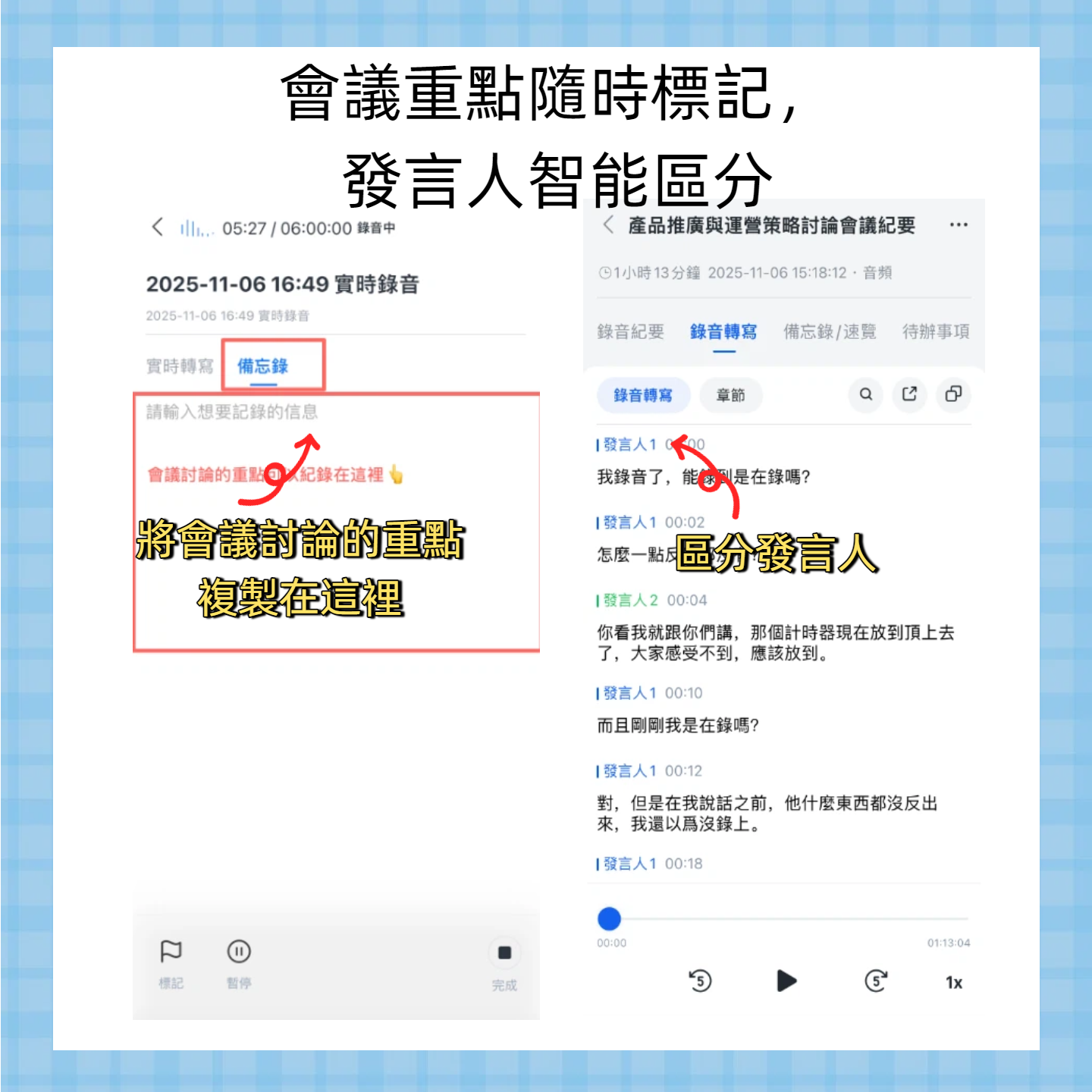
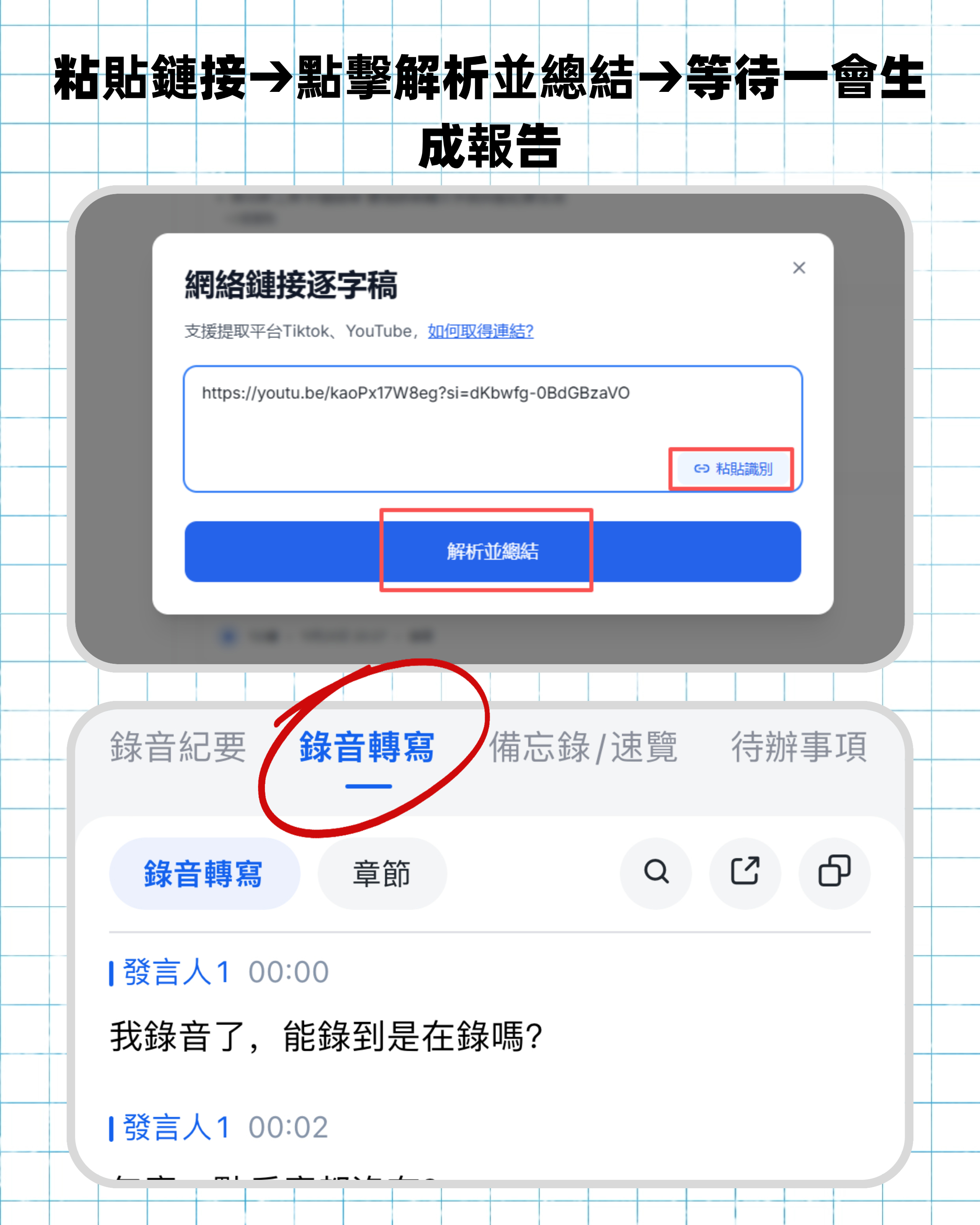
Tinrec is the most comprehensive AI recording and audio/video organization tool I've used so far. It not only supports real-time recording-to-text but also allows uploading local audio or video files, or even pasting links to YouTube or TikTok videos, to generate transcripts and summaries.
For meeting scenarios, its AI summary and action item extraction features are especially useful—after the meeting, it automatically highlights who said what, conclusions, and next steps. You can even "ask" the meeting notes questions, like "What was the budget number discussed in the last meeting?" and it will retrieve the answer from your past recording database.
The free version offers a basic monthly transcription quota, suitable for occasional meetings. If you have meetings every day, the Pro plan (monthly or yearly) costs less than two Starbucks coffees a month, and the monthly cost is lower than Otter or Notta's paid plans.
Best for: Professionals who need to manage multiple audio/video sources (meetings, courses, videos), especially middle managers and project leads.
Option 2: Otter.ai – A Classic Choice for AI Meeting Notes
Otter is well-known in the English meeting notes space, with strengths in automatically joining online meetings, real-time transcription, and speaker identification. The free plan offers 300 minutes per month, which is generous for light users.
However, its Chinese transcription accuracy isn't as high as Tinrec's, and if, like me, your meetings often mix Chinese and English, Otter sometimes ignores Chinese or produces garbled text. The Pro plan costs about $8.33/month (billed annually), offering 1,200 minutes and file uploads, but the interface and customer support are English-focused, not very friendly for Chinese users.
Stop organizing recordings by hand
Upload audio or video and automatically get a transcript, summary, and action items
Best for: Members of cross-border teams with primarily English meetings.
Option 3: Notta – Multilingual Transcription and Subtitling Tool
Notta overlaps with Tinrec in many ways, offering real-time recording, file transcription, and web meeting integration. The free plan provides 120 minutes per month, while the Pro plan at $8.17/month (billed annually) gives 1,800 minutes—more minutes than Tinrec.
However, Notta's strength lies mainly in transcription and subtitle output; its subsequent AI conversational query and "turn recordings into actionable lists" capabilities are not as complete as Tinrec's. If you just need a transcript, Notta is sufficient; but if you want meeting minutes and action items directly, Tinrec is more suitable.
Best for: Content creators who need large volumes of transcription and multilingual subtitles.
Option 4: Fireflies.ai – Automated Meeting Assistant
Fireflies' main selling point is "auto-join meetings." Once you add it to your Google Calendar, it automatically joins Zoom, Google Meet, and Teams meetings to record. The free plan features unlimited transcription (though team storage is limited), which is appealing; the Pro plan costs $10/month (billed annually).
But its Chinese capabilities are mediocre, and the interface is entirely English, making the learning curve a bit steep for Chinese-speaking managers. Also, it's more of a meeting bot—if you also want to handle course recordings or online videos, it's not ideal.
Best for: Teams with established English meeting workflows wanting fully automated recording.
Option 5: TurboScribe – High Value File Transcription Tool
TurboScribe follows a "cheap and generous" approach, focusing on uploading audio/video files for transcription. The free plan allows 3 transcriptions per day (30 minutes per file), while the paid Unlimited plan is about $10/month (billed annually) with almost no limits.
However, it lacks real-time recording and cannot parse online video links directly—it's purely a file-to-text tool. If you already have recorded meeting audio files, TurboScribe can handle them cheaply; but if you need to record during a meeting, it's not helpful at all.
Best for: Budget-conscious individual users who need batch transcription of old recordings.
So Many Options, How Do You Choose?
- Want the most complete AI features (transcription + AI conversational query + auto minutes + action items) → Tinrec (the only one with all these, and best for Chinese)
- Need Cantonese + Mandarin bilingual transcription → Tinrec (supports 14 languages, handles Chinese-English mixed content well)
- Need to switch between phone and computer → Tinrec (iOS + Android + web version)
- Zero budget, only need occasional short meeting transcription → Otter free version (300 min/month) or TurboScribe free version (3 short files/day)
- Only use iPhone and prefer hardware recording → Consider PLAUD Note, but software subscription cost is high and lacks AI conversational query
- Meetings entirely in English and need automated meeting notes → Fireflies.ai (strong auto-join meeting feature)
3 Things to Know Before Using Meeting Recording-to-Text Tools
- Recording quality determines everything: No matter which tool you use, if the meeting room is noisy or the microphone picks up poorly, the transcription will be messy. I recommend using a headset microphone, or at least sitting close to the speaker. Tinrec's AI noise reduction helps to some extent, but don't challenge physics.
- Try the free version first: Every tool offers free credits. Test it with a real meeting to see transcription speed, accuracy, and summary quality. I personally used Tinrec's free version for three meetings to confirm the Chinese summaries were good before subscribing to Pro.
- AI summaries aren't magic—you still need to double-check key points: AI can save you 80% of note-taking time, but for key numbers, names, and decision details, I recommend quickly reviewing the transcript. In Tinrec, I use the "action items" list to do a second check, ensuring nothing assigned by my boss is missed.
Conclusion
Whether or not you need a Google account for Google Meet isn't the real issue. What matters is whether you can get a clean record right after the meeting ends. Since my team fully switched to Tinrec this year, we save about 5 hours per week on meeting organization. If you also want to turn recordings into truly usable material, why not start with the free version—your meetings, your rescue.
Turn every recording into actionable outcomes
Get 60 free transcription minutes when you sign in. No credit card required.
Related Reading
You might also like

2026 Free Speech-to-Text Solutions: 5 Top Picks
This article rounds up 5 free and paid speech-to-text tools for 2026, from fully free options to professional AI workstations, including Tinrec, Otter.ai, Notta, and more. Get an overview of each tool's highlights and selection tips.

2026 Comparison of 2 Transcription Solutions: From WeChat Voice Memos to AI Workbench
A mid-level manager's real-world test: Say goodbye to WeChat voice memos. Use Tinrec to automatically transcribe meetings, courses, interviews, and more into searchable, summarizable, and exportable text.
2026 Complete Guide to Speech-to-Text: Features, Use Cases, and Tool Selection
Still unsure which speech-to-text tool to choose in 2026? This article dives deep into five key dimensions—recording methods, input sources, AI organizing capabilities, cross-platform support, and cost—to compare the pure-software solution Tinrec with the AI recording hardware Plaud Note, helping you find the right fit.

How to Transcribe Voice Recordings on Your Phone in 2026: A Complete 5-Step Guide (Using Tinrec as an Example)
Learn how to convert phone voice recordings to text with Tinrec (Second Listen Audio) in 5 easy steps—from recording and verbatim transcription to AI summaries and to-do lists. Includes a hands-on tutorial, FAQs, and advanced tips.
Tinrec vs Notta 2026: A 5-Dimension Showdown for Cantonese Users
Meetings all day? Looking for a Cantonese-friendly speech-to-text AI? Which one is the lifesaver for Hong Kong office workers? Our reporter tested five key dimensions to save you the hassle.

2026 Tinrec Desktop Audio-to-Text: Chinese Optimized + Cross-Platform AI Organization
Want to convert audio to text on your computer and also need subsequent organization, summaries, or even Q&A? This article compares two desktop audio-to-text tools, Tinrec and Otter.ai, across 5 dimensions including Chinese recognition, supported sources, and AI features, helping you find the best choice for Traditional Chinese users.
![[Tutorial] 2026 Free Recording-to-Text Software: Organize Meeting Minutes with AI Auto-Summarization](https://record-img.tos-accelerate.volces.com/images/2026/07/26/1785076429989611602.png)
[Tutorial] 2026 Free Recording-to-Text Software: Organize Meeting Minutes with AI Auto-Summarization
A mid-level manager tests 5 free recording-to-text solutions, from AI conversational queries to purely free options, helping you choose the best meeting note tool and save 1 hour of paperwork daily.

Free iOS Speech-to-Text Apps in 2026: Two Options Compared
Looking for a speech-to-text app for iPhone without spending money? We tested two free iOS solutions: Tinrec and Otter.ai, comparing Cantonese recognition, AI summarization, and cross-platform support to see which one saves Hong Kong workers the most time.
2026 Free Speech-to-Text Transcription Tools: 4 Options Compared
Hands-on review of 4 free speech-to-text tools: Tinrec, Otter.ai, Notta, and Yating. Compare free plan limits, pros and cons, and find the best option for Chinese speakers.