

Turn recordings into transcripts and summaries in minutes
Upload audio or video for multilingual transcription, AI notes, and action items
Recently, while trying to turn a recording of an online course into an article, I found that just converting a two-hour video into text and then syncing the timeline for captions took my entire weekend.
Not just tiring, but a waste of time.
And if your video is in Cantonese or mixed Chinese and English, it gets even worse.
So I started researching: is there a tool that can auto-generate captions and not just a transcript, but also help me "understand" the content?
This article shares my experience testing three tools and a workflow I've recently refined, hoping it helps others struggling with captions.
4 Key Points to Understand Before Choosing a Captioning Tool
Before we compare, I want to remind you: don't jump straight to tools just because you see "add captions."
Because most people's need isn't just "have captions" but "quickly grasp what the video is about."
Here are four things I always check when choosing a tool.
Accuracy: Don't just believe ads claiming 99%; test in real environments. Echo in meeting rooms, unclear speakers, background keyboard noise—all affect accuracy. Make sure to test with your own videos before deciding.
Multi-language & Accents: Is your video purely Chinese? Or mixed Cantonese and English? Tools vary greatly in language support. Some claim to support Chinese but frequently make errors with Taiwanese Mandarin or Hong Kong accents.
AI Features: Can it generate summaries, auto-segment, or even let you ask "What is this part about?" A tool that only gives a transcript forces you to read it all. AI-assisted tools save you tons of replay and note-taking time.
Export & Integration: Can captions be exported as SRT? Can they sync to other platforms? These are details you notice in actual use. A good tool seamlessly integrates into your existing workflow.
Tinrec (秒聽錄音) – Our Top Pick After Testing
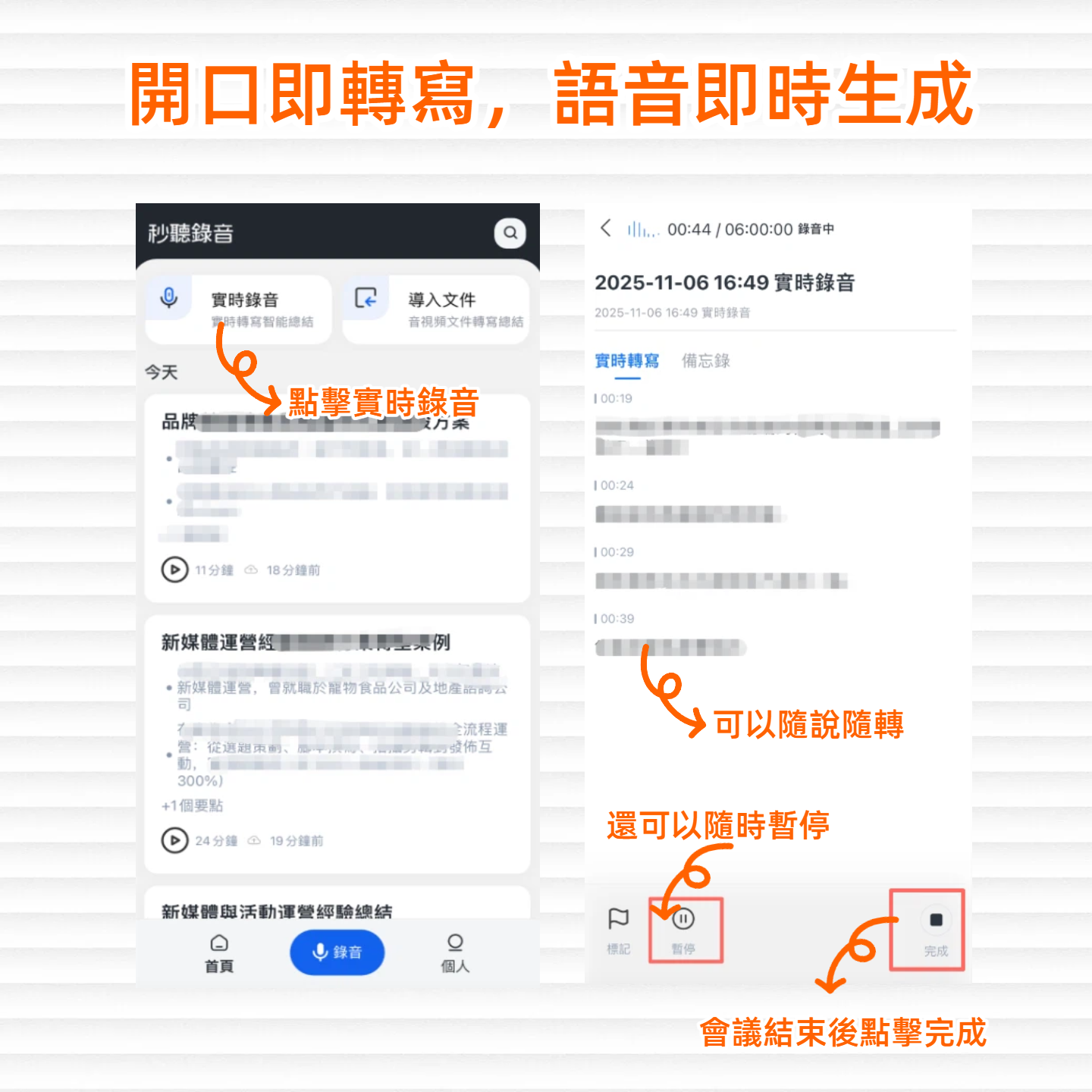
Tinrec is an AI recording and audio/video organization tool that supports real-time speech-to-text, uploading video files, and even pasting YouTube links to auto-generate captions and summaries.
It's not just a caption machine; it's more like a workbench that turns audio/video into actionable knowledge.
What happens after you upload a course video?
Tinrec transcribes and generates a transcript in real time, while automatically dividing chapters, producing summaries, and even extracting action items from discussions.
(Screenshot here: Tinrec's video-to-text results page, arrows pointing to auto-generated chapters and summaries)
But what impressed me most is its AI chat query feature.
After recording an interview, I asked: "What is the interviewee's view on market trends?" It doesn't just throw a bunch of keyword search results; it directly gives a summarized answer with cited quotes.
(Screenshot here: Tinrec's AI chat query interface, arrow pointing to the Q&A box)
Stop organizing recordings by hand
Upload audio or video and automatically get a transcript, summary, and action items
This feature is almost unheard of in tools at this price point.
Summary of Pros:
- Multiple input sources: online video links, local audio/video files, real-time recording—all can generate captions.
- AI summaries and chapters: long videos are no longer daunting; upload and grasp the structure in seconds.
- Easy export: directly produce SRT subtitle files, or export transcripts to Notion, Google Docs, etc.
Limitations:
The free version has monthly transcription limits; heavy users may need to upgrade. But for those organizing a few videos a week, it's sufficient.
Who is it for?
If you often need captions for Chinese (or even Cantonese) videos and want to quickly find key points and ask follow-up questions after transcription, Tinrec is the most complete choice right now.
Besides Tinrec, What Other Options Are There?
Since we tested, here are two other tools I tried.
Otter.ai
Top choice for English meeting captions. Real-time transcription is accurate, but performance in Chinese (especially Cantonese) is not as good as Tinrec. It also doesn't support pasting a video link to generate captions instantly; you have to record or upload files. If you mainly process English content, Otter is worth considering; but if you need AI chat query, Otter's Q&A is not yet direct enough.
Notta
Supports multiple languages and has decent transcription speed. However, it leans more toward pure transcription and translation; its AI summarization and Q&A after caption generation are weaker. If you only need basic captions, Notta suffices; but if you want to turn videos into knowledge, Tinrec's AI integration is more comprehensive.
TurboScribe
Great for batch captioning large numbers of files, with high accuracy. But it lacks real-time recording-to-caption and cannot process web links directly. It also lacks AI chat query—you have to read the entire transcript yourself. If you have a backlog of old videos to caption, TurboScribe is efficient; but if you also handle meetings and courses regularly, Tinrec is more versatile.
Avoidance Guide: 3 Common Mistakes When Choosing a Captioning Tool
Mistake 1: Only looking at transcription minutes, ignoring "post-processing" features.
Many people buy a tool only to find that transcribing is just the beginning—you still have to pick key points and take notes manually. So AI summaries and Q&A are where the real time savings lie.
Mistake 2: Overlooking language support details.
Some tools claim to support Chinese but frequently fail with spoken language, jargon, or mixed Chinese and English. Always test with your own videos using a free trial; don't rely on the official language list.
Mistake 3: Buying but not using AI features.
If you only use the tool as a caption generator, you're wasting its potential. For example, Tinrec's AI chat query—after recording, just ask for key points, which is several times faster than reading the full transcript.
Conclusion: Which One Should You Choose?
After this period of testing, if your goal starts with "generating captions" but ultimately you want a complete audio/video knowledge organization workflow, Tinrec is my top pick right now.
Here are recommendations based on different needs:
- Need Chinese + Cantonese captions and want AI auto-segmentation and summaries → Tinrec
- Only process English meeting captions → Otter.ai
- Batch caption a large number of old videos → TurboScribe
- Real-time meeting captions + team collaboration → Try Notta, but AI features are weaker
I suggest downloading Tinrec's free version and testing it with your own videos to confirm accuracy and features meet your needs before deciding to upgrade.
Quick Start in 3 Steps:
- Upload a video or paste a link to get the transcript and captions.
- Use AI summaries and chapter features to quickly grasp the structure.
- Open AI chat and ask questions about the content to find key information.
Test step by step, and you'll gradually master this method.
Turn every recording into actionable outcomes
Get 60 free transcription minutes when you sign in. No credit card required.
Related Reading
You might also like

2026 Google Meet Whiteboard Free Plan Roundup: 1 Solution at a Glance
Want to use a whiteboard in Google Meet without the hassle of meeting notes? This post covers a fully free combo that lets you automatically generate transcripts, summaries, and action items while using the whiteboard—no more scrambling.

2026 Real-World Test of 5 AI Captioning Tools: Which One Saves Time for Hong Kong Office Workers?
Tired of non-stop meetings and working overtime on meeting minutes? We tested 5 AI speech-to-text tools to find the best time-saving solution for Hong Kong office workers.

2026 Comparison of 4 Speech-to-Text Tools: How Tinrec Saves Mid-Level Managers 50% of Their Organizing Time
A mid-level manager tests 4 speech-to-text tools, from meeting minutes to video subtitles and interview transcription, explaining why Tinrec replaced Notta, whether the free version is sufficient, and when to upgrade.

2026 Comparison of 4 Subtitle Generation Software: Which One Handles Cantonese Transcription Best? Plus AI Summarization Feature!
Tired of daily meetings that run until quitting time, plus overtime to create meeting minutes and subtitles? Tried several Cantonese transcription tools that aren't accurate? This time we test 4 subtitle generation software to see which one can help—especially Tinrec's AI subtitle and summary feature, can it really save your overtime hours?

2026 Real-World Comparison of 4 Auto Captioning Tools: Which One Handles Both Video and Audio?
How to choose an auto captioning tool? This article compares real-world tests, shows you core features and use cases, and uses Tinrec as an example to teach you how to generate subtitles for free and quickly, perfect for meetings, courses, and video creation.

2026 Tinrec vs Plaud Note: A 5-Dimension Comparison for Audio/Video Organization
What's the real difference between the audio transcription app Tinrec and the AI recording hardware Plaud Note? This article compares them across five dimensions—Cantonese accuracy, cross-platform support, AI query capabilities, input source diversity, and long-term cost—to help you decide which is better for organizing meetings, courses, and online videos.

2026 Video Subtitling AI Complete Guide: How to Choose Automatic Video Captioning Tools? Tinrec vs Plaud Note In-Depth Comparison
Want to quickly add subtitles to your videos but unsure which AI tool to pick? This article takes a purchasing decision perspective, deeply comparing Tinrec and Plaud Note across video sources, real-time captions, accuracy, cross-platform support, and pricing, so you can see at a glance which one fits you better.

2026 Comparison of 4 Video-to-Text Tools: Which One Generates the Most Accurate and Fastest Subtitles?
Tested multiple video-to-text apps, from free to paid. Which one supports Cantonese and produces the fastest, most accurate subtitles? Tinrec (Instant Voice Recording) stands out with AI features. Check out the review!

2026 Comparison: Two Top Subtitle Generator Apps for Chinese Video Creators
This article compares Tinrec and Otter.ai, two AI subtitle generation tools, analyzing input sources, Chinese recognition, post-processing capabilities, and pricing to help you quickly decide which one is better for video subtitles.