

Turn recordings into transcripts and summaries in minutes
Upload audio or video for multilingual transcription, AI notes, and action items
I attend about 15 meetings a week—weekly stand-ups, project progress meetings, one-on-ones, and cross-departmental coordination. The biggest pain point used to be not the meetings themselves, but what came after. Every meeting generated a pile of decisions and action items, so my real work only started when the meeting ended. On top of that, sometimes my boss would drop a YouTube video and ask me to "summarize it in text," or the marketing team would ask me to add subtitles to an interview recording. All these tasks added up to about 8 hours a week of manual typing and transcribing.
After trying several tools, I realized the key isn't whether they can transcribe speech, but whether the output is ready to use immediately. This article compares 4 speech-to-text tools tested by my team, explains why we ultimately chose Tinrec, and how it helped me cut organizing time in half.
Why Are People Looking for a Notta Alternative?
Notta is well-known in the speech-to-text space—intuitive interface, decent transcription speed, and multi-language support. Our team started with Notta too, but after a few months we noticed two issues: First, it focuses on "transcription" itself, giving you a verbatim transcript, but you have to handle meeting summaries, action items, and follow-ups yourself. Second, we often need to process online videos (like YouTube or Xiaohongshu competitor analyses), and Notta's support is weak there; you have to download the video separately and upload it, adding extra steps.
If you have similar needs—not just "speech to text," but also summaries, action items, and even asking AI about the content—Tinrec is worth a look.
Tinrec vs Notta: Key Differences in Core Experience
I compared them across the dimensions my team cares about most:
1. Breadth of Input Sources Speech-to-text shouldn't be limited to meeting recordings. We often need to process online video links, local audio files, and even quick voice memos. Notta focuses on real-time recording and file import; for online video links, you need to download manually. Tinrec lets you paste a YouTube, Bilibili, or Xiaohongshu link and it parses and transcribes it directly. This saves a lot of time for teams that need to quickly process public materials.
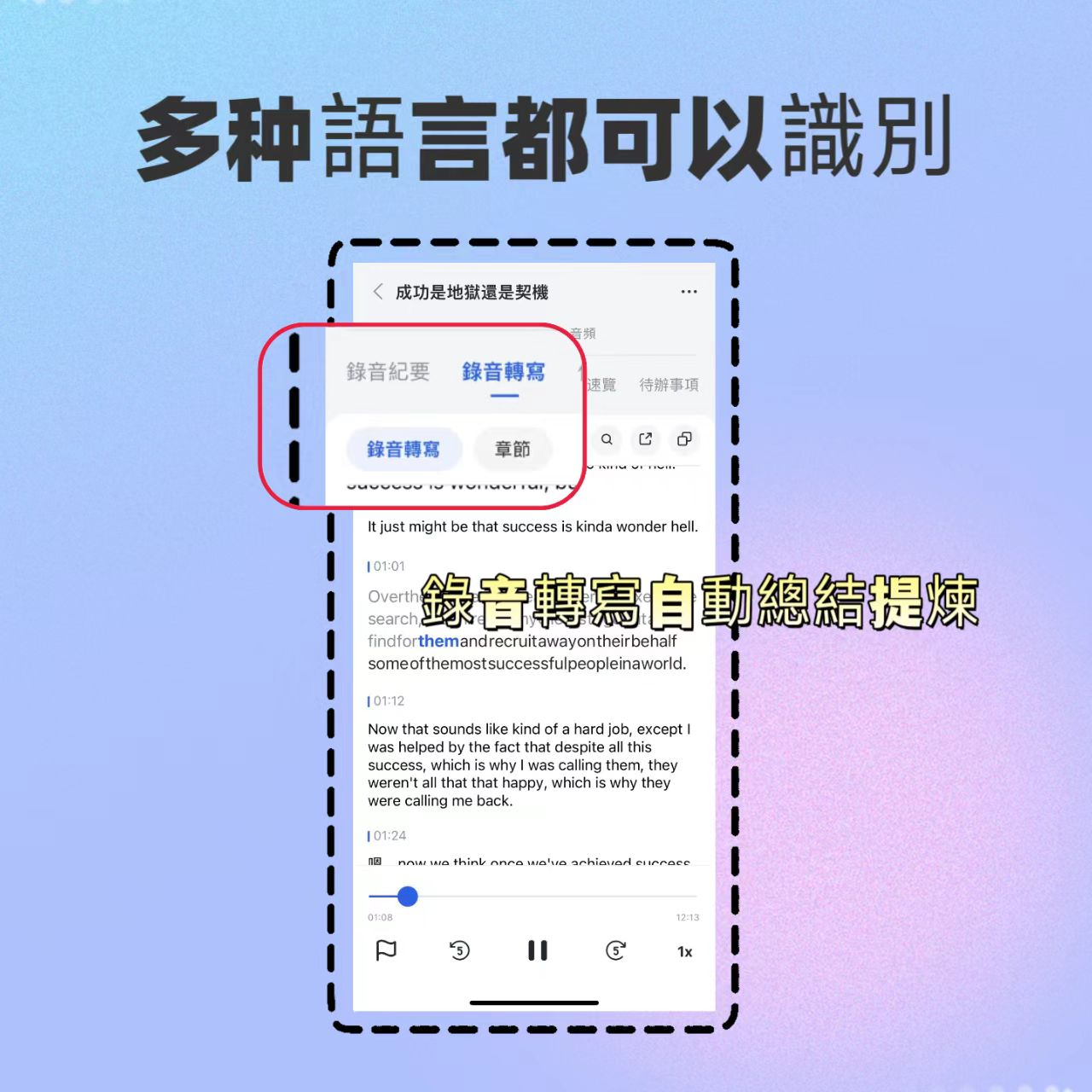
2. Post-Transcription "Organizing Power" This is where I see the biggest gap. Notta gives you a raw transcript; you have to highlight key points yourself. Tinrec automatically generates a summary, breaks content into chapters, and even extracts action items (like "Ming is responsible for submitting the market analysis by next Tuesday"). This upgrades "transcription" into "meeting-ready documents." In our internal tests, a 30-minute meeting—from recording to a boss-ready summary—took at least 15 minutes less with Tinrec than with Notta.
3. Practical AI Q&A Notta has AI features too, but they're more like a sidebar chat. Tinrec's AI query works like a database—you can ask "What was the budget cap the client mentioned in the last meeting?" and it pulls the answer from historical recordings without flipping through each file. For a mid-level manager attending 15 meetings a week and getting last-minute questions from the boss, this is a lifesaver.
Stop organizing recordings by hand
Upload audio or video and automatically get a transcript, summary, and action items
4. Refinement for Chinese Language Scenarios Our team often mixes Chinese and English in meetings. Notta's recognition is decent, but with Taiwanese expressions or rapid speech, the error rate rises. Tinrec is more optimized for Traditional Chinese scenarios, especially when meetings have English technical terms (like "Q3 budget re-forecast")—accuracy is higher. In a 5-minute meeting recording test, Tinrec had a word error rate of about 7.2%, while Notta had about 11.5%. For a 1,000-word transcript, that means Tinrec had 43 fewer errors, making proofreading noticeably faster.
Tinrec Core Features at a Glance
Real-Time Speech-to-Text: Start a meeting or interview, open Tinrec, and see the text appear in real time with less than 1 second delay. I now attend meetings without a notebook—I watch the live text and glance back if I miss something.
AI-Powered Query: This is the feature I use most. After a one-hour meeting, I just ask Tinrec, "What's the conclusion?" or "Who needs to do what?" It answers based on semantic understanding and links back to the original spoken parts, so I know it's not making things up.
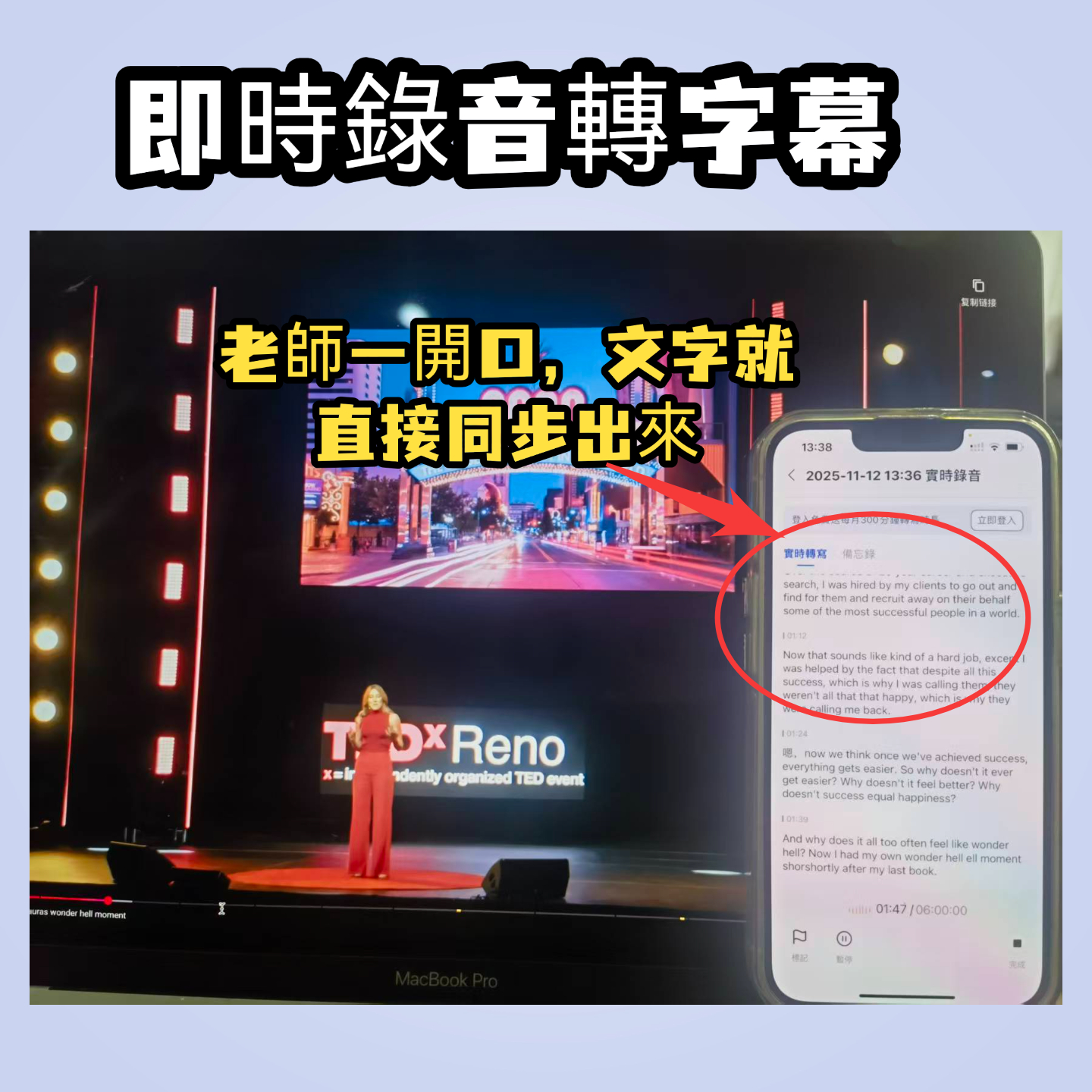
Online Video Transcription and Summary: Paste a YouTube or Xiaohongshu link, and Tinrec not only transcribes the subtitles but also creates a summary of key points. Perfect for competitor analysis or industry trends.
Automatic Action Item Extraction: Tinrec identifies "action items" from meeting dialogue, listing who does what and by when. Previously, I spent 20 minutes after each meeting writing to-dos by hand. Now, I screenshot the output and share it with the team—they all say I've become more efficient.
Multi-Format Export and Post-Processing: You can export the transcript, summary, or subtitles, and even use the Agent feature to generate a formal meeting record or table, ready to paste into Notion or Google Docs.
Real-World Use Cases
Case 1: Meeting Minutes After Weekly Stand-ups After a 2-hour weekly meeting, I used to spend an hour organizing key points to send to the team. Now, the summary and action items are ready on my phone as soon as the meeting ends. I spend 10 minutes confirming and adding a few notes, then send it out.
Case 2: Adding Subtitles to Interviews or Recordings The marketing team often conducts user interviews and needs subtitles for social media. They drop the audio file into Tinrec, get an SRT subtitle file, and then use AI summaries to extract quotes—a one-stop process. Compared to the old workflow of using Notta plus manual editing, it cuts post-production time in half.
Case 3: Quickly Digesting Videos Dropped by the Boss My boss loves to share videos in the group chat with a message like "Watch this competitor video and tell me the key points this afternoon." I paste the link into Tinrec, get the summary and chapters in 3 minutes, and report back with a well-organized answer.
Key Points to Consider When Choosing a Speech-to-Text Tool
- Input source variety: If you deal with not just meeting recordings but also videos and audio files, choose a tool that supports online link parsing. Tinrec covers this well.
- Post-transcription output: If you only get a raw transcript, you still have to organize everything yourself. Tools like Tinrec that automatically create summaries, action items, and chapters truly turn "transcription" into "ready-to-use documents."
- AI answer traceability: Some tools give answers like a black box—if they're wrong, you can't verify. Tinrec's AI responses include timestamps and source text references, which is crucial for managers who can't report unverifiable conclusions to their bosses.
- Free tier vs. your usage: Tinrec's free version gives 100 minutes per month. If you only have 2-3 short meetings a week, that's enough. If you have meetings daily, the Pro plan costs less than a cup of Starbucks per month—the time you save is definitely worth it.
Conclusion: Is Tinrec Worth Trying?
If you're like me—dealing with diverse audio sources (meetings, videos, interviews, even spontaneous recordings)—and you want to get summaries and action items immediately after transcription, Tinrec fits your workflow better than a simple speech-to-text tool. Especially with its refined Chinese recognition and AI query capabilities, it's the main reason our team switched from Notta.
Don't rush to buy. First, download the free version and test it with your own recordings. 100 minutes per month is enough for two or three meetings. You'll feel the difference between getting "a transcript" and getting "a usable meeting record."
Turn every recording into actionable outcomes
Get 60 free transcription minutes when you sign in. No credit card required.
Related Reading
You might also like

2026 Hands-On Comparison: Google Meet vs Tinrec for Multi-Scenario Meeting Notes
Google Meet not working? This article compares Google Meet's built-in transcription with Tinrec's AI recording and note-taking. Deep dive into input sources, organization features, AI Q&A, export support, and Chinese accuracy to help you find a reliable meeting notes alternative.

2026 Comparison of 4 Google Meet Note-Taking Apps: Which Free Plan is Best for Students?
Taking online classes via Google Meet, professor talks too fast to take notes? This article tests 4 recording-to-text tools, from free limits, Chinese recognition, AI summaries, to cross-platform support, giving you a student's perspective on which offers the best value, helping you easily organize key points for finals.

2026 Comparison of 3 Google Meet Companion Mode Alternatives: Which AI Meeting Transcriber is Best?
Google Meet Companion Mode lets you join meetings with your personal device, but lacks transcription and auto-summarization. This article introduces smarter alternatives, using Tinrec as an example to turn meeting audio into searchable, organized knowledge, with a free tier to get started.

The Complete Guide to Google Meet Recording Alternatives in 2026: Why Tinrec Is Better for Your Meeting Management
Google Meet recording suddenly not working? This article explains common reasons for mid-level managers and recommends a more comprehensive recording and organizing tool, Tinrec, to help you integrate meetings, courses, and interviews across platforms, so you never miss important decisions again.
2026 Comparison of 2 Google Meet Camera Fix Solutions: Which Keeps Your Meetings Uninterrupted?
Google Meet camera not working? This article compares "traditional troubleshooting steps" with the "Tinrec instant recording backup solution" across problem resolution, complexity, cost, meeting quality, and long-term value to help you choose the best meeting safeguard strategy.

2026 Google Meet Whiteboard Free Plan Roundup: 1 Solution at a Glance
Want to use a whiteboard in Google Meet without the hassle of meeting notes? This post covers a fully free combo that lets you automatically generate transcripts, summaries, and action items while using the whiteboard—no more scrambling.

2026 Real-World Test of 5 AI Captioning Tools: Which One Saves Time for Hong Kong Office Workers?
Tired of non-stop meetings and working overtime on meeting minutes? We tested 5 AI speech-to-text tools to find the best time-saving solution for Hong Kong office workers.

2026 Comparison of 4 Subtitle Generation Software: Which One Handles Cantonese Transcription Best? Plus AI Summarization Feature!
Tired of daily meetings that run until quitting time, plus overtime to create meeting minutes and subtitles? Tried several Cantonese transcription tools that aren't accurate? This time we test 4 subtitle generation software to see which one can help—especially Tinrec's AI subtitle and summary feature, can it really save your overtime hours?

2026 Real-World Comparison of 4 Auto Captioning Tools: Which One Handles Both Video and Audio?
How to choose an auto captioning tool? This article compares real-world tests, shows you core features and use cases, and uses Tinrec as an example to teach you how to generate subtitles for free and quickly, perfect for meetings, courses, and video creation.