

Turn recordings into transcripts and summaries in minutes
Upload audio or video for multilingual transcription, AI notes, and action items
What Can Google Meet Whiteboard Do for You?
Honestly, Google Meet's built-in whiteboard (Jamboard or the new whiteboard) is really great for meetings that need drawing, brainstorming, or flowchart discussions. It's like an infinite digital whiteboard where everyone can write, draw, and post sticky notes in real time.
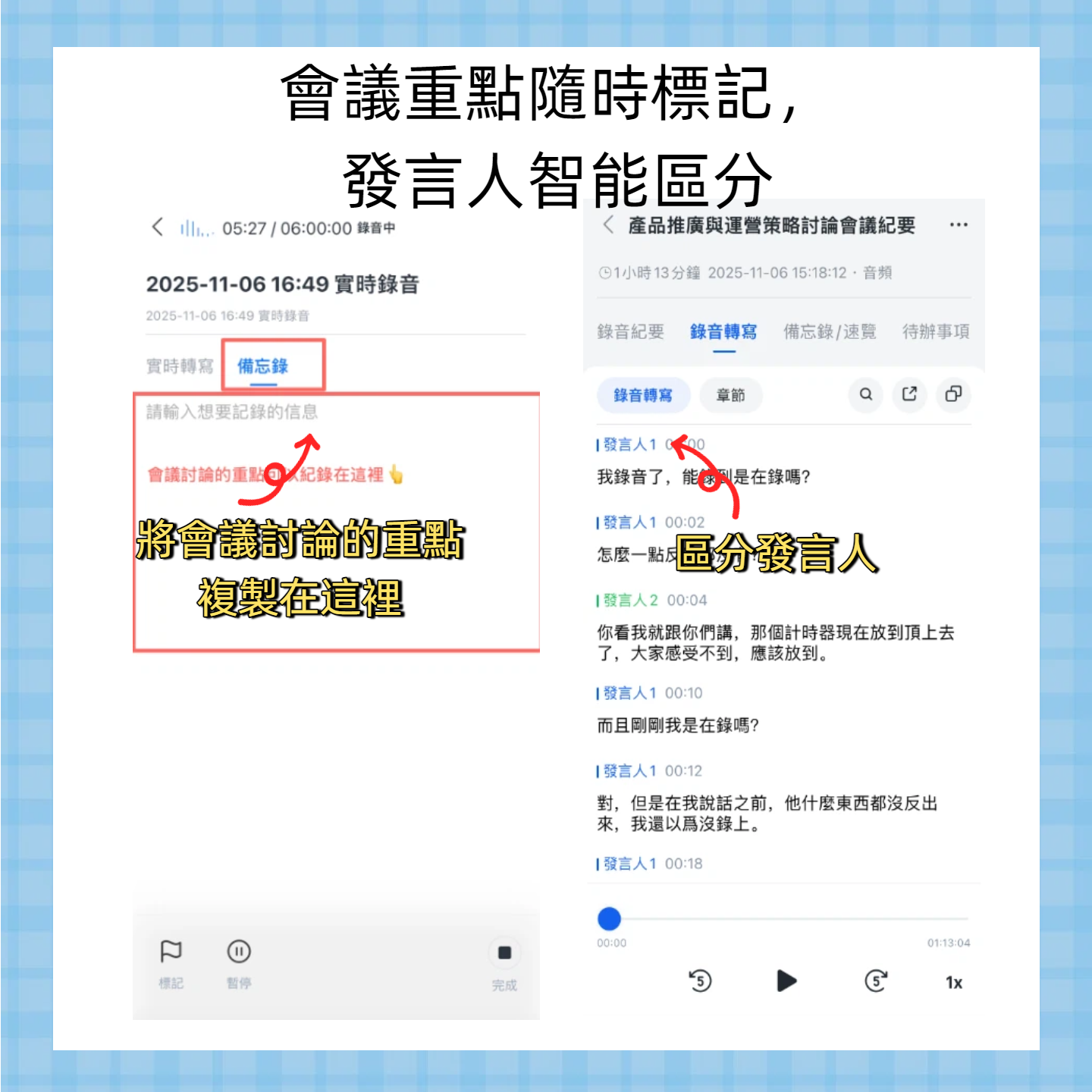
However, the biggest hassle with whiteboard discussions is that once the meeting ends, the canvas disappears. Even if you take screenshots, it's hard to reconstruct the discussion flow. Especially when people are talking over each other—who said what and what the final conclusion was often requires extra time to recall after the meeting.
Take Tinrec, for example. It's an AI recording and audio/video organization tool that can record the audio of your whiteboard meeting, transcribe it in real time, and automatically generate summaries and action items. You can even use AI Q&A later to recall discussion details. So, if you use Google Meet whiteboard for drawing and Tinrec for recording—both free tools—they perfectly fill the gap in meeting notes.
Scenario 1: Brainstorming meetings with instant transcripts
Everyone posts ideas on the whiteboard while discussing, and Tinrec transcribes all speech in the background. After the meeting, you have a complete conversation record without having to rely on memory.
Scenario 2: Flowchart discussions with meeting minutes
Your team draws a flowchart on the whiteboard, and Tinrec simultaneously generates a summary and action items—who is responsible for what and next steps are crystal clear.
Scenario 3: Remote teaching whiteboard sessions turned into notes
Teachers solve problems on the whiteboard while students listen. Tinrec not only transcribes but also splits the recording into chapters, turning the lecture into structured notes that make review a breeze.
What Are the Core Capabilities of Google Meet Whiteboard?
Google Meet whiteboard itself is free, with basic features like pen, shapes, text boxes, sticky notes, and image import. The new version also includes timelines and collaboration alerts. But today we're looking not just at the whiteboard alone, but the combination of "whiteboard + recording."
Capability 1: Real-time collaboration and visual discussions
The whiteboard allows everyone to draw and write simultaneously, breaking the limits of text chat—great for divergent thinking. However, visualization lacks text context, which is where Tinrec's real-time transcription comes in—transcription delay is less than a second, so even if you draw while talking, it aligns with the timeline.
Capability 2: AI summaries and action item extraction
Instead of just condensing the recording into one paragraph, Tinrec structures it: meeting topic, discussion conclusions, action items, and assignees, all listed separately. Paired with the whiteboard's visual record, you can quickly cross-reference who said what and what they drew.
Capability 3: Post-meeting AI Q&A
After transcription, you can directly ask Tinrec: "What was step three of that flowchart?" or "What budget number did the client mention?" It answers based on semantic understanding, so you don't have to go back and manually search the recording.
Stop organizing recordings by hand
Upload audio or video and automatically get a transcript, summary, and action items
Capability 4: Cross-device and multi-source input
Google Meet whiteboard is available on web and mobile; Tinrec also has iOS, Android, and web versions. You can start a whiteboard meeting on your computer and record with your phone, or record system audio directly on your computer—very flexible.
Practical Use Cases
Scenario 1: Product design discussion
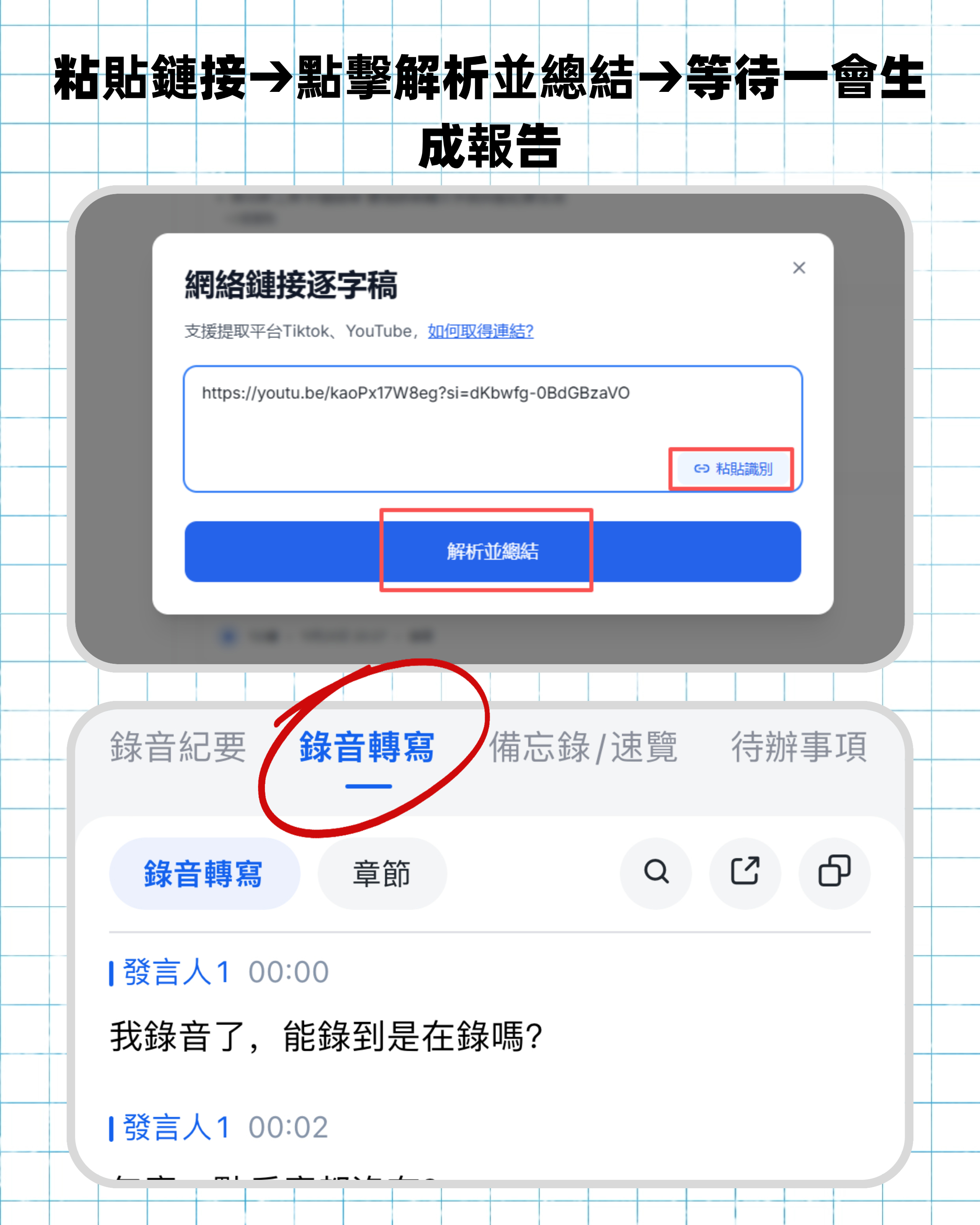
You and your designer discuss a new interface on Google Meet whiteboard while using Tinrec to record all conversations. After the meeting, you get a time-stamped transcript and a summary listing agreed changes, which you can paste directly into a task management tool.
Scenario 2: Agile sprint planning
The team arranges tasks and estimates hours on the whiteboard, moving sticky notes while talking. Tinrec's action item extraction automatically captures "who needs to complete what" and highlights the timelines mentioned during the meeting, saving you from creating a separate document.
Scenario 3: Online class interaction
A teacher demonstrates problem-solving on the whiteboard while students ask questions. After class, the teacher shares Tinrec's chapter notes and transcript with students for review. Tinrec also supports exporting to PDF or Word, which can be uploaded directly to the course platform.
Scenario 4: Client presentations and requirements interviews
You draw a service flow on the whiteboard while listening to client needs. Tinrec not only records the conversation but also marks key points mentioned by the client. After the meeting, send a summary email to the client for confirmation—professional and time-saving.
3 Things to Consider When Choosing a Whiteboard Meeting Recording Tool
- Recording completeness: The whiteboard visuals are important, but the audio context is key. Some tools only capture screenshots without dialogue. Tinrec's real-time transcription preserves every word, so nothing is missed.
- Post-meeting organization: It's not enough to just record—can you quickly find key points? Tinrec's AI Q&A lets you search like asking an assistant, much more efficient than manually listening to the recording.
- Cost and cross-platform support: Google Meet whiteboard is free, and Tinrec's free plan includes basic transcription minutes each month. So you can experience a complete whiteboard meeting recording workflow at zero cost, and it works on both mobile and desktop.
Frequently Asked Questions
Q: Is Google Meet's whiteboard truly free?
A: Yes, as long as you have a Google account, you can enable the whiteboard in any Google Meet meeting for free, with no limits on the number of boards or time.
Q: Do I need to install anything to record a Google Meet meeting with Tinrec?
A: Tinrec has a web version, iOS app, and Android app. You can record system audio directly from the web version on your computer, or record ambient sound with your phone—no additional hardware or plugins needed.
Q: Is the free version of Tinrec sufficient?
A: The free plan includes a basic monthly transcription quota. If you have 2-3 whiteboard meetings a month, it's usually enough. For more minutes, you can consider the weekly card or Pro plan.
Q: Does audio quality affect transcription accuracy?
A: Yes, but typical online meeting audio is clear, and Tinrec performs well with clear audio. If there's background noise or multiple people talking at once, it's recommended to use AI Q&A afterward to verify key points.
Q: Can I record only the whiteboard discussion part, not the entire meeting?
A: Yes, Tinrec supports pausing and resuming recording on the fly. You can start recording only during the whiteboard discussion and pause at other times, keeping the file concise.
Summary
Google Meet whiteboard is already a great free visual collaboration tool, but with an AI recording assistant, it transforms from "draw and forget" to "discussion with a trace." If you frequently hold remote meetings—especially those requiring drawing or divergent thinking—try pairing Tinrec with Google Meet whiteboard. Both are free, and after a few meetings a month, you'll feel the ease of "meeting ends, records automatically generated."
Turn every recording into actionable outcomes
Get 60 free transcription minutes when you sign in. No credit card required.
Related Reading
You might also like

2026 Real-World Test of 5 AI Captioning Tools: Which One Saves Time for Hong Kong Office Workers?
Tired of non-stop meetings and working overtime on meeting minutes? We tested 5 AI speech-to-text tools to find the best time-saving solution for Hong Kong office workers.

2026 Comparison of 4 Speech-to-Text Tools: How Tinrec Saves Mid-Level Managers 50% of Their Organizing Time
A mid-level manager tests 4 speech-to-text tools, from meeting minutes to video subtitles and interview transcription, explaining why Tinrec replaced Notta, whether the free version is sufficient, and when to upgrade.

2026 Comparison of 4 Subtitle Generation Software: Which One Handles Cantonese Transcription Best? Plus AI Summarization Feature!
Tired of daily meetings that run until quitting time, plus overtime to create meeting minutes and subtitles? Tried several Cantonese transcription tools that aren't accurate? This time we test 4 subtitle generation software to see which one can help—especially Tinrec's AI subtitle and summary feature, can it really save your overtime hours?
2026 Real-World Comparison of 4 Auto Captioning Tools: Which One Handles Both Video and Audio?
How to choose an auto captioning tool? This article compares real-world tests, shows you core features and use cases, and uses Tinrec as an example to teach you how to generate subtitles for free and quickly, perfect for meetings, courses, and video creation.

Which Auto-Captioning Tool is Best? 2026 Review of 3 Tools, This One Has the Most Complete AI Features
We tested three auto-captioning tools, evaluating Chinese accuracy, AI features, and export convenience to find which ones really save you time. Top pick: Tinrec, because it not only transcribes but also lets you ask AI questions and generate summaries.

2026 Tinrec vs Plaud Note: A 5-Dimension Comparison for Audio/Video Organization
What's the real difference between the audio transcription app Tinrec and the AI recording hardware Plaud Note? This article compares them across five dimensions—Cantonese accuracy, cross-platform support, AI query capabilities, input source diversity, and long-term cost—to help you decide which is better for organizing meetings, courses, and online videos.

2026 Video Subtitling AI Complete Guide: How to Choose Automatic Video Captioning Tools? Tinrec vs Plaud Note In-Depth Comparison
Want to quickly add subtitles to your videos but unsure which AI tool to pick? This article takes a purchasing decision perspective, deeply comparing Tinrec and Plaud Note across video sources, real-time captions, accuracy, cross-platform support, and pricing, so you can see at a glance which one fits you better.

2026 Comparison of 4 Video-to-Text Tools: Which One Generates the Most Accurate and Fastest Subtitles?
Tested multiple video-to-text apps, from free to paid. Which one supports Cantonese and produces the fastest, most accurate subtitles? Tinrec (Instant Voice Recording) stands out with AI features. Check out the review!

2026 Comparison: Two Top Subtitle Generator Apps for Chinese Video Creators
This article compares Tinrec and Otter.ai, two AI subtitle generation tools, analyzing input sources, Chinese recognition, post-processing capabilities, and pricing to help you quickly decide which one is better for video subtitles.