

Turn recordings into transcripts and summaries in minutes
Upload audio or video for multilingual transcription, AI notes, and action items
Why You Need a Google Meet Attendance List
You've probably been there: after an online meeting, your manager asks, "Who attended?" and you can only remember a few faces. According to surveys, remote workers attend over 10 video meetings per week on average, making it nearly impossible to track everyone manually. This article covers several quick ways to get a Google Meet attendance list, from free to paid, so you never have to rely on memory again.
Method 1: Tinrec (Voice Transcription) — AI Transcription to Automatically Organize Attendance Info
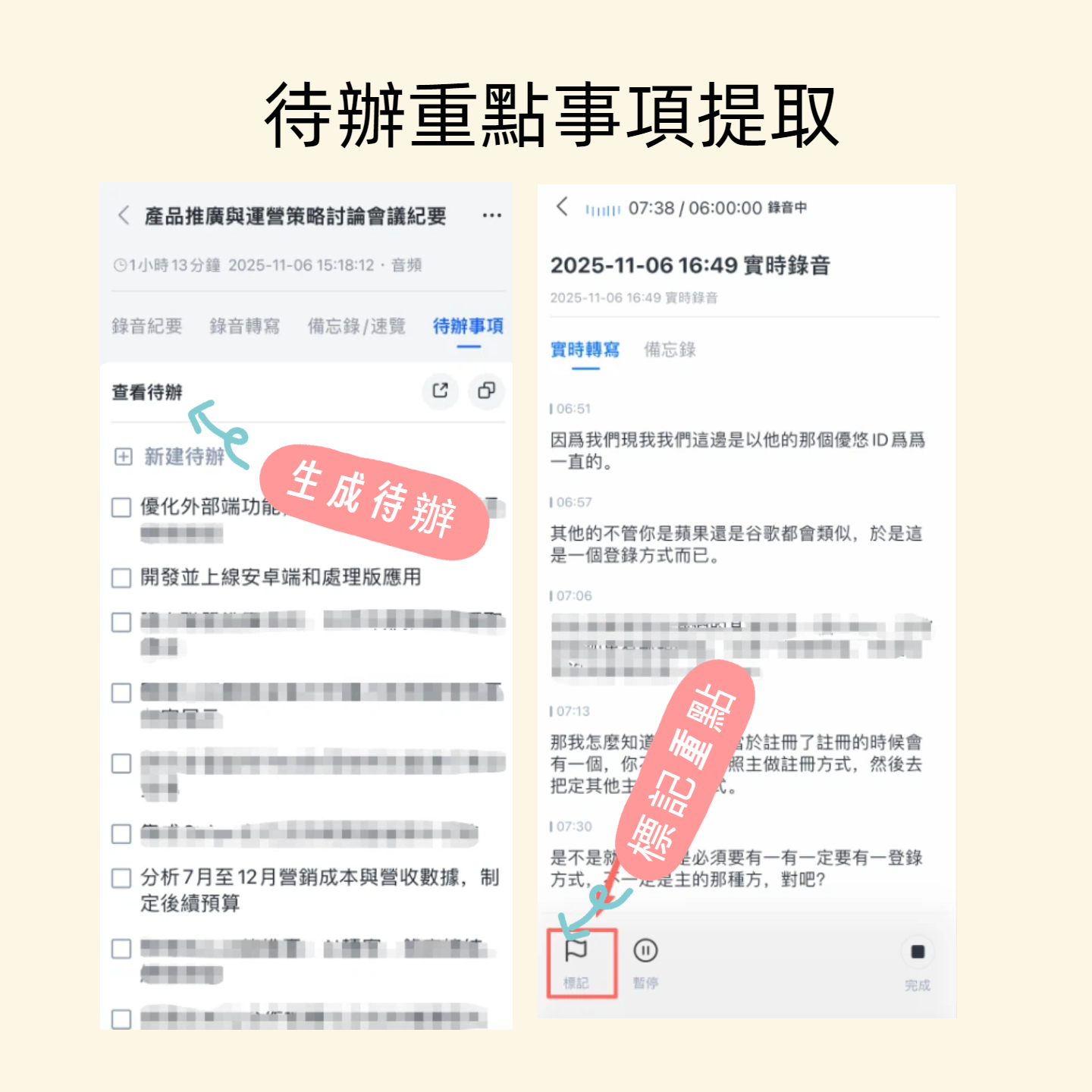
Tinrec is an AI-powered audio/video transcription tool that supports live recording, file uploads, and online video URLs. While not a dedicated attendance tracker, its transcription and AI query features let you quickly identify who spoke during the meeting, indirectly confirming attendance.
Key Highlights
- Real-time transcription with speaker recognition: Records and transcribes during the meeting, tagging different speakers. Review the transcript afterward to see who contributed.
- AI conversation to check attendance: Ask "Who attended this meeting?" and the AI lists speakers based on the transcript — easy to cross-reference.
- Goes beyond attendance: meeting summaries and action items: After transcription, it auto-generates summaries and to-do lists, handling both attendance and meeting notes in one go.
- Cross-platform support: Available on iOS, Android, and web. Record directly from your computer during Google Meet without extra hardware.
Pricing
- Free plan: Monthly base transcription quota, good for trying live recording and file import.
- Weekly plan: Ideal for short-term intensive meetings (e.g., sprints or events).
- Pro Monthly: Higher quota, suitable for professionals with multiple meetings per week.
- Pro Annual: Cheaper per month, best for long-term use.
Who It's For
If you want more than just an attendance list — including automated meeting notes, tasks, and AI-driven post-meeting search — Tinrec is a comprehensive choice.
Method 2: Google Meet Built-in Attendance Tracking
Google Meet has a built-in attendance report feature that requires no installation. However, it's only available for certain Google Workspace editions (Business Standard, Plus, Enterprise, etc.), not for personal accounts or the free tier.
Key Highlights
- Automatic attendance logging: Tracks when participants join and leave in the background.
- Downloadable report after the meeting: Hosts can download a CSV file from Google Calendar or Meet, containing names, emails, and timestamps.
Pricing
Stop organizing recordings by hand
Upload audio or video and automatically get a transcript, summary, and action items
Requires a paid Google Workspace subscription, starting from Business Standard at around US$12 per user/month. Free Gmail accounts don't have this feature.
Who It's For
If your company already uses Google Workspace and you only need basic attendance lists, this is the most straightforward method.
Method 3: Third-Party Chrome Extensions
For personal accounts or an even simpler way to get attendance lists, try Chrome extensions. These tools typically pop up at the end of a meeting, listing participants with an export button.
Key Highlights
- One-click export of attendees: After installation, click the extension icon during a meeting to export participant lists as CSV or plain text.
- Some tools track entry/exit times: Extensions like "Attendance for Google Meet" monitor join/leave times continuously.
Pricing
Most extensions offer a free basic version; advanced features like automatic tracking and history require a paid subscription, with annual fees around US$15–30.
Who It's For
If you don't have many meetings and just want a quick snapshot of current attendees, the free version is sufficient.
So Many Options — How to Choose?
- Want the most comprehensive meeting package (attendance + notes + tasks)? → Tinrec. It helps you cross-check attendance and follow up on meeting details later.
- Your company already uses Google Workspace; just need a download? → Use the built-in feature — easiest.
- Only occasionally need to know who's in a meeting, no record keeping? → Install a free Chrome extension — fastest.
- Need a record of what was said and who said it? → Tinrec is the only tool here that combines transcription, speaker differentiation, and AI Q&A.
- Limited budget, few meetings? → Try Tinrec's free plan first; it includes a monthly quota for several meetings.
3 Things to Know Before Using Google Meet Attendance Lists
- Privacy reminder: Before using any third-party tool (including Tinrec) for recording or tracking attendance, inform all participants and comply with data privacy regulations.
- Accuracy may vary: If someone keeps their mic off and doesn't speak, Tinrec or extensions can't detect them via voice. In that case, rely on manual roll call or Google Calendar RSVPs.
- Don't keep only one copy: Save attendance lists along with meeting notes (e.g., Tinrec transcripts) for efficient future reference.
Summary
Getting a Google Meet attendance list is easy — from built-in features to Chrome extensions. But if you also want meeting content organized and AI-powered search for who said what, Tinrec is the more complete option. Start with the free plan and transcribe a few meetings to experience automated organization.
FAQ
Q: Can I use Google Meet attendance reports with a personal Gmail account? A: No, this is a paid Workspace feature; personal accounts don't support it.
Q: Can Tinrec really tell who attended? A: Tinrec doesn't directly grab Meet's participant list; instead, it transcribes audio and distinguishes speakers. You can confirm attendees via the transcript or by asking the AI.
Q: Are free Chrome extensions safe? A: Check reviews and required permissions before installing. Choose extensions with many users and frequent updates to avoid data leaks.
Q: Is Tinrec useful if no one speaks during the meeting? A: Without voice content, transcription isn't possible. In that case, manual recording or other tracking tools are needed.
Q: How long can Tinrec's free plan record? A: The free plan has a fixed monthly transcription quota; check the official site for exact minutes, which is generally enough for a few meetings.
Q: Can the built-in attendance CSV be automatically sent to participants? A: No, but you can manually download and forward it via email.
Turn every recording into actionable outcomes
Get 60 free transcription minutes when you sign in. No credit card required.
Related Reading
You might also like

5 Free Multilingual Meeting Transcription Tools Compared: Which Handles Chinese Meetings and AI Summaries Best?
How do you choose a free multilingual meeting transcription tool? This article examines five key criteria: language support, free quota, post-meeting organization, recording method, and data ownership. Using Tinrec's actual workflow, it demonstrates real-time transcription, live translation, AI summaries, action item extraction, and team spaces to help you decide if the free version is enough and what limitations to know upfront.

Best Multilingual Meeting Transcription Tools in 2026: We Tested 2, and This One Handles Mixed Chinese Better
How to choose a multilingual meeting transcription tool? This article starts with common misconceptions and compares Tinrec and Otter.ai across 5 key dimensions: mixed Chinese-multilingual recognition, bot-free recording, post-meeting AI Q&A, team collaboration, and pricing, helping you find the right meeting transcription solution for cross-language teams.

5 Free Multilingual Meeting Transcription Apps Compared: Which Handles Mixed Chinese-English Best?
Tired of sorting through mixed Chinese-English meetings? We compare free multilingual meeting transcription apps on free quotas, language support, post-meeting organization, and team management. Using Tinrec as an example, we explain the limits of free plans and where they shine.

Best Multilingual Meeting Transcription Tools in 2026: We Tested 4, and This One Handles Chinese Meetings Best
The real work begins after a cross-language meeting ends. Based on real meeting scenarios, this article covers 4 key factors for choosing a multilingual meeting transcription tool. After testing 4 tools, we explain why Tinrec is the smoothest for Chinese and mixed Chinese-English meetings, bilingual transcript viewing online, post-meeting AI Q&A, and team data retention, while honestly listing each tool's free tier, limitations, and best use cases.

2026 Multilingual AI Meeting Recorder Comparison: Which Is Most Reliable for Mixed Chinese-English Meetings?
The hardest part of a multilingual meeting isn't understanding it—it's the post-meeting cleanup. This article compares four AI meeting recorder tools—Tinrec, Notta, Otter.ai, and Granola—based on hands-on testing, breaking down language switching, recording methods, post-meeting output, and team management. It also covers common pitfalls and scenario-based recommendations to help you find the right fit for your meeting style.

6 Multilingual AI Meeting Transcription Tools Tested: Which Saves the Most Time for Chinese Meetings?
A mid-level manager who runs over a dozen meetings a week tested 6 multilingual online meeting transcription tools, comparing transcription, real-time translation, post-meeting organization, and team knowledge retention. Includes pricing and ideal use cases for Tinrec, Otter.ai, Notta, Granola, TurboScribe, and PLAUD, plus 4 key considerations before buying.

2026 Multilingual Meeting Transcription Software Comparison: Tinrec vs Otter.ai — Which Is Better for Chinese-English Code-Switching Meetings Across 5 Key Dimensions?
How do you choose multilingual meeting transcription software? This article addresses common misconceptions and compares Tinrec and Otter.ai across five dimensions: Chinese and Chinese-English code-switching recognition, meeting capture methods, input sources, post-meeting outputs, and team governance. It also covers free and paid plans to help you decide which tool best fits your meeting style.

6 Multilingual AI Meeting Recorders Tested for 2026: How to Choose for Chinese, Translation, and Team Collaboration
A roundup of 6 AI tools that handle multilingual meeting notes, covering Chinese recognition, real-time translation, post-meeting organization, and team collaboration. Free and paid plans are laid out clearly, and Tinrec's differences in bot-free recording and team data retention are explained.

2026 Multilingual Meeting Transcription AI Comparison: Tinrec vs Otter.ai vs Notta for Chinese and Real-Time Translation
Multilingual meeting transcription AI tools are growing, but Chinese recognition, real-time translation, bot-free recording, and team collaboration are key. This hands-on comparison tests Tinrec and Otter.ai, with Notta as a reference, analyzing multilingual support, meeting capture, post-meeting organization, team collaboration, and pricing to help you decide which is better for Chinese and multilingual meetings.