
Turn recordings into transcripts and summaries in minutes
Upload audio or video for multilingual transcription, AI notes, and action items
Recently, I received a letter from a reader in New York, saying that his company is evaluating cost-cutting measures on Google Meet Workspace, but is unsure if they can find a meeting recording tool that works just as well. Later, I realized this isn't a one-person concern.
Why Are People Looking for Google Meet Alternatives?
Google Meet is a familiar video conferencing tool for many teams, especially in the US, where many companies rely on Google Workspace integration for daily communication. But those who have actually dealt with meeting notes know that a meeting platform alone isn't enough—the post-meeting notes, tasks, and key summaries are often what take the most time.
Especially when companies start reviewing costs and looking for more budget-friendly options beyond Google Meet's paid plans, they often find that a simple meeting platform may not solve the need to "digitize and reuse meeting content." You might want a tool that not only records meetings but also handles course recordings, client interviews, and even online videos—and that's where many people start looking for Google Meet alternatives.
If you have similar concerns, you might want to check out Tinrec.
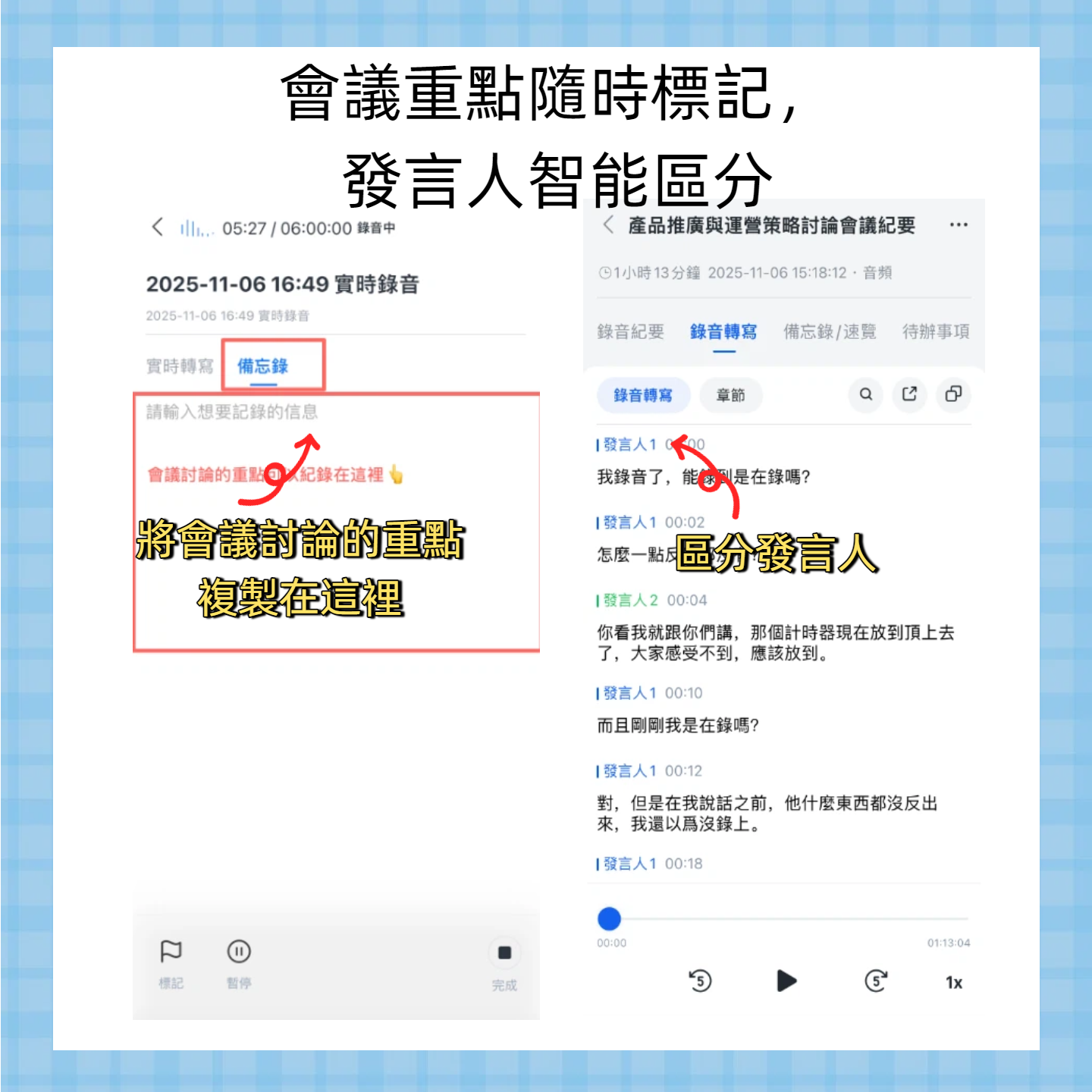
(Screenshot: Real-time recording to text 1, arrow pointing to live transcription area)
Tinrec vs Google Meet: What's the Core Difference?
To judge whether a recording and meeting organization tool is valuable, the key isn't how many features it has, but whether it truly integrates into your workflow and reduces the burden of manual post-meeting organization. Here's a comparison from four practical dimensions that matter most.
Language Support & Localization
Google Meet offers live captions, mainly supporting English and some languages, but many users report room for improvement in recognition of Chinese and Cantonese. In contrast, Tinrec natively supports 14 languages, with special optimization for Cantonese's nine tones—a tangible difference in accuracy for Cantonese speakers in Hong Kong and the US.
Cross-Platform & Cross-Scenario Coverage
Google Meet's strength is in meetings; once you leave the meeting room, you need other tools to organize courses, interviews, or videos. Tinrec, on the other hand, natively includes multiple input methods: live recording, uploading audio/video files, and pasting links to online videos from platforms like YouTube. It works on iOS, Android, and web. This means you can take your Google Meet recordings, download them, and upload to Tinrec to turn them into structured data.
AI Smart Organization Depth
Google Meet provides meeting notes and some summaries in Workspace versions, but Tinrec goes further after transcription: it automatically splits into chapters, extracts action items, and allows AI chat to query the recording content—"What was the conclusion of this meeting?" "Who is responsible for which project?" These queries can be answered within 30 seconds after the meeting, without re-listening to an hour of audio.
Output & Subsequent Use
Google Meet's meeting notes mostly stay within Google's ecosystem, while Tinrec supports multiple export formats (text, PDF, subtitles, etc.) and syncs to Notion, Google Docs, Dropbox, and other tools you already use. More importantly, Tinrec's Agent post-processing can generate a complete meeting report or table based on the recording, turning it into deliverable material.
(Screenshot: AI chat query 1, arrow pointing to question input box and answer)
Tinrec's Core Features at a Glance
Now that we've compared, you may want a fuller picture of what Tinrec can do for you. I've broken it into five core capabilities, each addressing real work scenarios.
Stop organizing recordings by hand
Upload audio or video and automatically get a transcript, summary, and action items
Real-time Recording to Text: Open Tinrec, and as you record, text appears with less than one second delay. During a Google Meet meeting, you can follow along with the text to confirm key points, and as soon as the meeting ends, the transcript is ready.
(Screenshot: Real-time recording to text 2, arrow pointing to text syncing and highlighting features)
Audio/Video File to Text: Upload meeting recordings, interview audio from your phone, or even old mp4 files, and they'll be transcribed. I found this especially useful when sorting through old client interviews that had piled up—finally able to quickly search for key content.
Online Video Link Parsing: Paste a public video URL from YouTube, Bilibili, Xiaohongshu, or TikTok, and Tinrec not only transcribes it but also auto-summarizes and splits into chapters. This is very helpful for content research or learning.
AI Summary & Action Item Extraction: Tinrec automatically extracts key points from long recordings, organizes them into chapters, and highlights action items. After a meeting, you no longer need to manually write "John needs to submit the report by Friday"—Tinrec lists the to-do list for you.
AI Chat Query: This is the feature I use most. After recording a one-hour meeting, I just ask Tinrec: "What was the conclusion of the meeting?" "What was the result of the budget discussion?" It answers based on semantic understanding, without manually flipping through 30 pages of transcript.
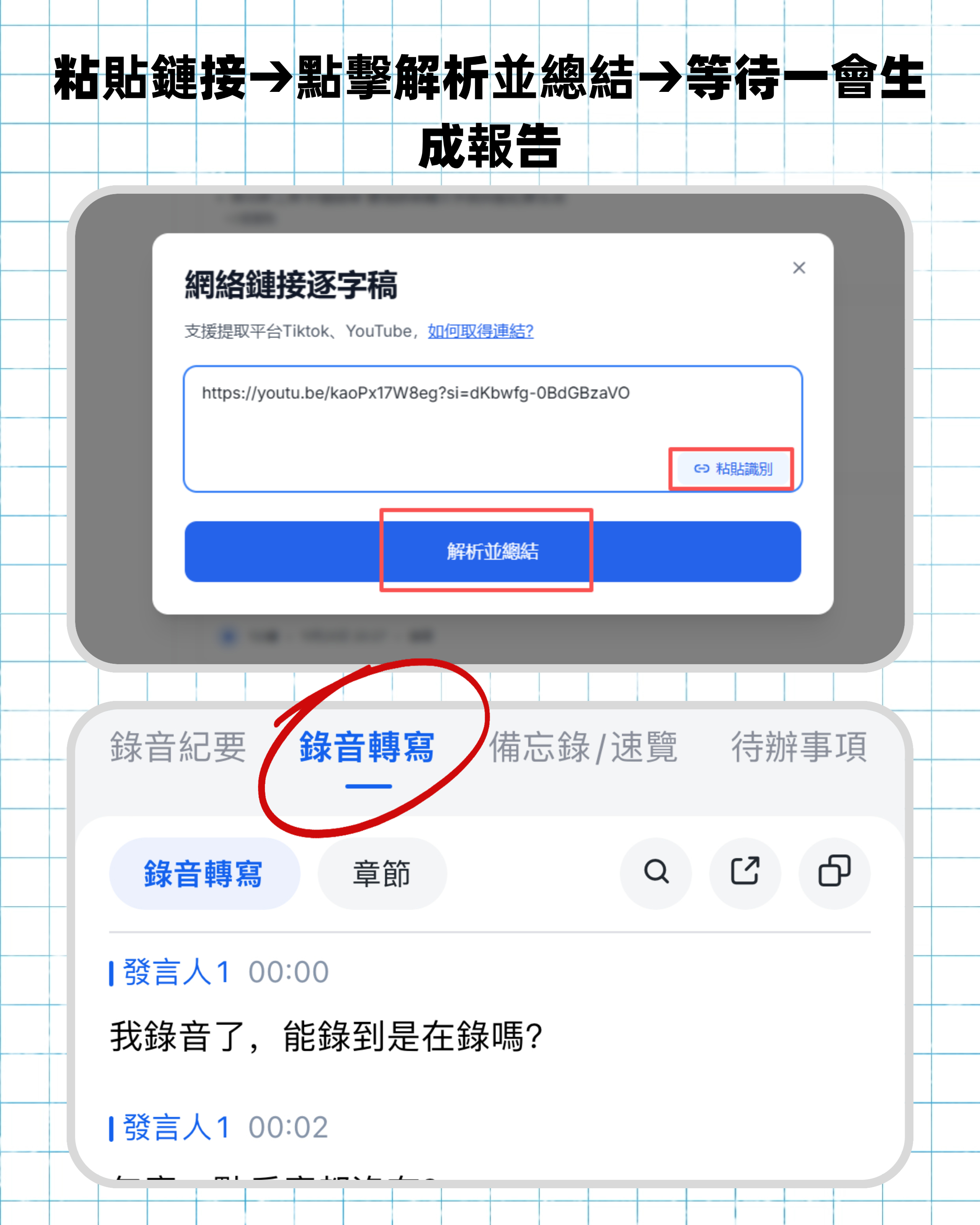
(Screenshot: Online video link parsing, arrow pointing to link input box and parsing result)
Practical Use Cases
No matter how good the tool, it comes down to real life. Here are the scenarios where Tinrec saved me the most effort.
Meeting Notes: Drop a Google Meet recording into Tinrec, and within minutes you get a summary and action items. I once set this up for a startup team, and they no longer spent three hours a week organizing meeting notes.
Online Courses & Lectures: The web version of Tinrec can record and transcribe in real time while you play a course. After class, ask AI: "What are the key points of this lesson?" Review efficiency skyrockets.
Interviews & Research: For user interviews or journalism, Tinrec's transcription and highlight features let me quickly find key quotes and organize thoughts smoothly.
Personal Knowledge Base: I dump all my meetings, inspiration recordings, and book club audio into Tinrec. Over time, it becomes a searchable, queryable private database. I consider this the most valuable use.
(Screenshot: Supporting iOS, Android, and web, arrow pointing to multi-platform icons)
Things to Consider When Choosing a Transcription Tool
Beyond Google Meet alternatives, if you're evaluating such tools, here are five points to help decide if it's right for you.
Check Language Support: If you often deal with mixed Chinese-English, Cantonese, or other non-English content, choose a tool that natively supports and continuously tunes these languages. Tinrec's localization for Chinese and Cantonese is particularly deep among similar products.
Consider Cross-Platform Flexibility: Some tools are only on mobile or only on web, but Tinrec syncs across iOS, Android, and Web. Plus, it supports file uploads and link pasting, giving you much more flexibility.
Evaluate AI Depth: A transcript alone isn't enough; look for auto-summarization, chapter splitting, and action item extraction. Tinrec's AI processing is one-stop—you get usable material right after the meeting.
Free Trial Credit: Tinrec's free plan offers basic transcription credit each month, letting you test with real meeting recordings. That's more direct than reading countless reviews.
Export & Integration: A good tool should fit into your existing workflow. Tinrec supports multiple export formats and can sync directly to Notion, Google Docs, etc., which is especially important for team collaboration.
Summary: Is Tinrec Worth Trying?
If you're looking for a tool that goes beyond meeting notes and turns various audio/video content into usable knowledge, Tinrec is an ideal choice. It not only covers courses, interviews, and online videos that Google Meet can't handle, but also uses AI to shift the habit of "record and forget," making recordings truly searchable, queryable, and reusable assets.
Especially for US users, switching to Tinrec has no geographical limitations, and support for Traditional Chinese and Cantonese is a bonus. I recommend starting with the free plan—you get basic transcription credit each month to test with your own recordings. Try it step by step, and you'll gradually master this method.
Quick start checklist:
- Download Tinrec on your phone or computer, sign up for a free account
- Record a Google Meet meeting, or upload an existing recording
- Check the transcription, try AI summary and action item features
- Ask AI chat: "What was the resolution of this meeting?"
- Export the summarized notes to Notion or Google Docs
- Make this your standard post-meeting routine
That's it—you'll find organizing recordings is no longer a chore.
Turn every recording into actionable outcomes
Get 60 free transcription minutes when you sign in. No credit card required.
Related Reading
You might also like

2026 Test: 3 Meeting Minutes Templates Compared — DOC Downloads vs AI Auto-Generation, Which Saves More Time?
Still searching for meeting minutes template DOC downloads? This article tests 3 ways to create meeting minutes, including traditional templates, built-in platform tools, and AI tool Tinrec, showing you how to auto-generate structured meeting notes with AI and export to DOC format, saving 60% of your time.

2026 Meeting Minutes Tool Buying Guide: 4 Tools Tested and Recommended
Looking for a 'meeting minutes template Word'? What you actually need is an AI meeting minutes tool. We tested 4 popular options, and Tinrec is the top choice for Chinese meetings, helping you save time and avoid overtime.

Tinrec vs Granola 2026: 5-Dimension Hands-On Comparison - Which Is Better for Chinese Meeting Notes?
Tinrec and Granola both offer bot-free meeting recording, but Tinrec supports file import, audio retention, Chinese optimization, and team collaboration, making it a better fit for Taiwanese users who need complete meeting data management.

2026 Review: 5 AI Meeting Recorder Tools Compared – Which One Truly Generates Usable Meeting Minutes?
A hands-on comparison of AI meeting recorder tools in 2026, with Tinrec as the main focus, analyzing the key capabilities for automatically generating meeting minutes and helping you choose the right tool to save time.

2026 Hands-On Comparison of 3 AI Meeting Recorders: Which Free Version Is Most Useful?
We tested Tinrec, Otter.ai, and Notta—three AI meeting recorders—comparing free allowances, Cantonese transcription, AI summaries, and cross-platform support to help you pick the most time-saving option without spending a dime.

2026 Vocol Free Usage Guide: AI Transcription & Auto-Summary Tested vs Tinrec
Searching for Vocol free usage? This hands-on comparison shows you the differences between Vocol and Tinrec in free quotas, online meeting recording, transcription summaries, AI Q&A, and team collaboration, helping you decide which workflow suits you best.

3 Ways to Generate Meeting Minutes PDF in 2026: Which One Turns Meetings into Documents Directly?
Still searching for an editable meeting minutes template PDF? This article compares 3 approaches and explains why letting AI generate meeting minutes first, then exporting to PDF, saves more time, using Tinrec as an example to demonstrate the complete workflow.
2026 Test: Tinrec AI vs Word Templates for Meeting Minutes – Which Saves More Time?
Word meeting minutes templates are a popular choice, but manual entry is time-consuming and prone to missing key points. This comparison of Tinrec AI tool and Word templates covers recording, summarization, task tracking, and team collaboration to help you find a truly time-saving solution.

4 Best Meeting Note Tools in 2026: From Free to Paid, Explained
Tired of copying meeting minutes templates? This article compares 4 popular meeting note tools, showing you how to choose the best AI meeting assistant from free to paid options, and how to write, record, and organize with ease.