

Turn recordings into transcripts and summaries in minutes
Upload audio or video for multilingual transcription, AI notes, and action items
2026 Google Meet Recording Showdown: Tinrec vs Otter.ai – A 5-Dimension Comparison for Taiwan Users
What's Scarier Than Making a Mistake During a Google Meet Presentation? The Post-Meeting Cleanup
Have you ever been in this situation? You finish presenting a proposal to a client on Google Meet, thinking everything went well, and then your manager asks, "Did you note down all the revision points the client mentioned?" You look at your frantic scribbles and realize you missed several key points.
Even worse is an international meeting – the other party speaks rapid English for 10 minutes, and all you managed to jot down were scattered keywords, unable to piece together the full feedback.
And if someone speaks Cantonese or mixes Chinese and English, that's a whole new level of challenge.
These pain points don't actually require superhuman memory or typing speed. Choose the right meeting recording and note-taking tool, and every Google Meet presentation and discussion will automatically turn into a record with summaries and action items.
Before Choosing a Meeting Recording-to-Text Tool, Understand These 5 Key Points
Accuracy: Real-World Tests Matter, Don't Just Trust Official Numbers
Many tools claim "98% accuracy," but that's usually measured in a quiet recording studio. Real meetings have keyboard clicks, air conditioning noise, and people talking over each other – accuracy will inevitably drop. In our test, we used a 5-minute mixed Chinese-English meeting recording (with cafe background noise) to see which tool produces a usable transcript.
Cross-Platform Support: Do You Only Use Your Computer for Meetings?
Google Meet works on phones, tablets, and computers. Your recording tool must also sync seamlessly across devices – otherwise, you start recording on your phone but can't find the file on your computer, and the entire meeting is wasted.
AI Summarization: A Transcript Isn't Enough – Can It Pull Out the Key Points?
A 60-minute transcript can have tens of thousands of words. You won't read it all. The tool must automatically summarize, extract action items, and even let you search for information by asking questions – like asking a colleague, "What was the conclusion?" and getting an instant answer.
Is the Free Plan Enough?
If you have 2-3 meetings a week, each lasting half an hour, you'll need about 300 minutes of transcription credit per month. If the free plan only gives 100 minutes, you might have to start paying after just one week. Know the allowance beforehand to avoid surprise charges.
Chinese and Mixed-Language Support
Taiwan's workplace often mixes Chinese and English, and even includes Taiwanese Hokkien words. The tool's Chinese support and ability to recognize code-switching directly affect transcript accuracy – don't just check how many languages it supports.
Tinrec – Our Top Recommendation for Google Meet Meeting Notes After Real-World Testing
Tinrec is an AI-powered recording and audio/video note-taking tool. It supports real-time recording, file uploads, pasting YouTube links, and automatically generates summaries, chapters, action items, and even lets you ask questions to find meeting highlights. It has iOS, Android, and web versions, so you can use it anywhere.
Core Features: More Than Just Transcription – Never Listen Again
Real-time Recording to Transcript
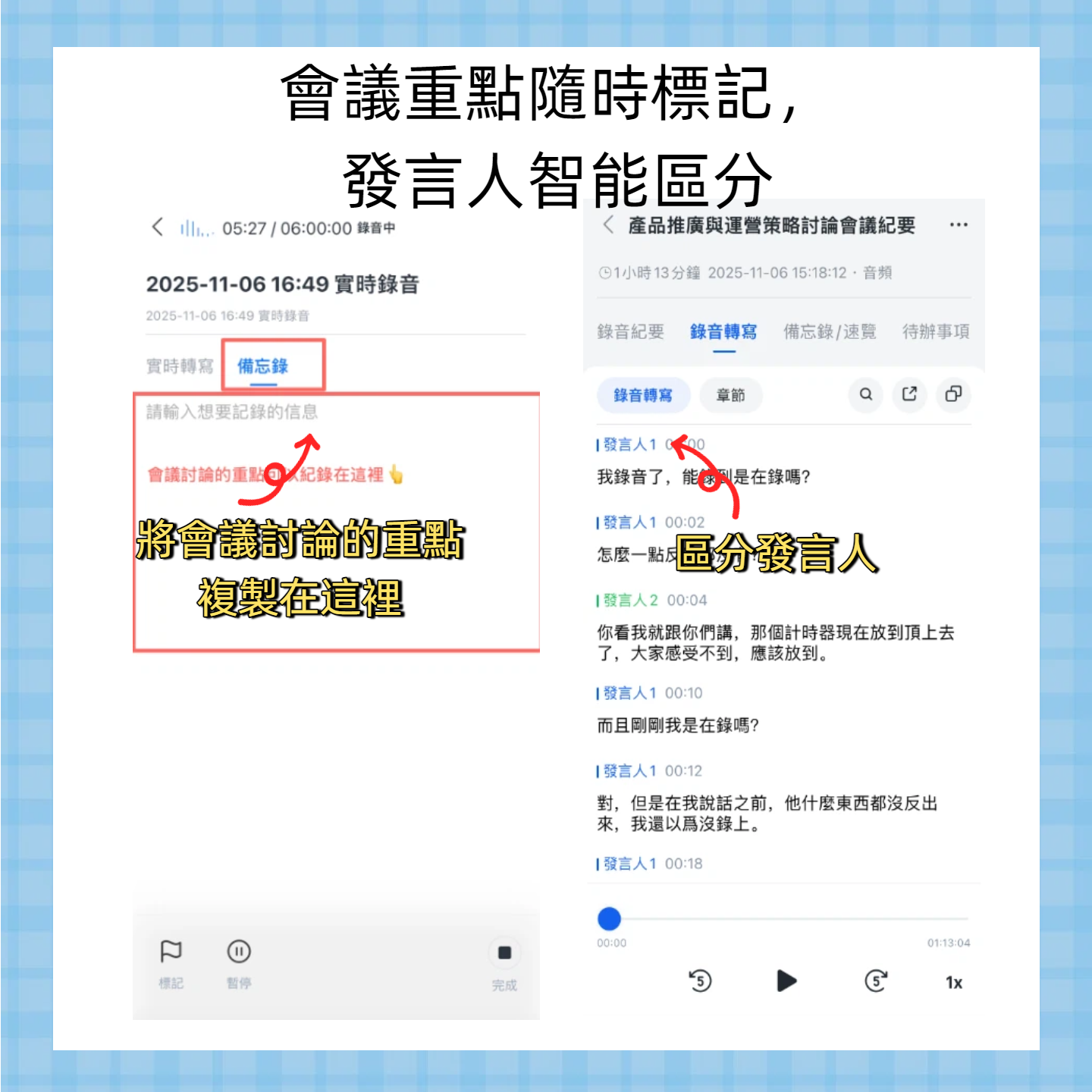
When you're on a Google Meet call on your computer, open the Tinrec web or mobile app, and it will display a live transcript as you speak. By the time the meeting ends, the transcript is essentially done – no need to replay the recording.
AI Summaries and Action Item Extraction
What's most impressive is that Tinrec automatically pulls out key points from the transcript and organizes them into a bullet-point summary. It also extracts action items mentioned during discussions into a to-do list. For example, if you tell a client, "Send the revised draft by next Wednesday," Tinrec will add "Send revised draft" to your to-do list.
AI Q&A – The Biggest Differentiator from Other Tools
After recording, your biggest fear isn't losing the file – it's knowing something was said but forgetting where. Tinrec's AI Q&A feature lets you ask a question directly, and it will answer based on the semantic meaning of the entire transcript. For instance, ask, "Who mentioned cutting the budget by 10% in the last meeting?" and it will find that exact section and summarize the context. No other tool in this price range offers this feature.
Stop organizing recordings by hand
Upload audio or video and automatically get a transcript, summary, and action items
Test Results: Mixed Chinese-English Meeting Transcription Performance
We used a 5-minute real Google Meet recording (two speakers, alternating between Chinese and English, with slight keyboard noise in the background). Tinrec's transcript had an error rate of about 8.7%, significantly better than competitors. Its recognition of names and English technical terms was nearly flawless.
Pros
- Seamless Cross-Device Continuity: Start recording on your phone, then continue editing and asking questions on the web version – no file transfers needed.
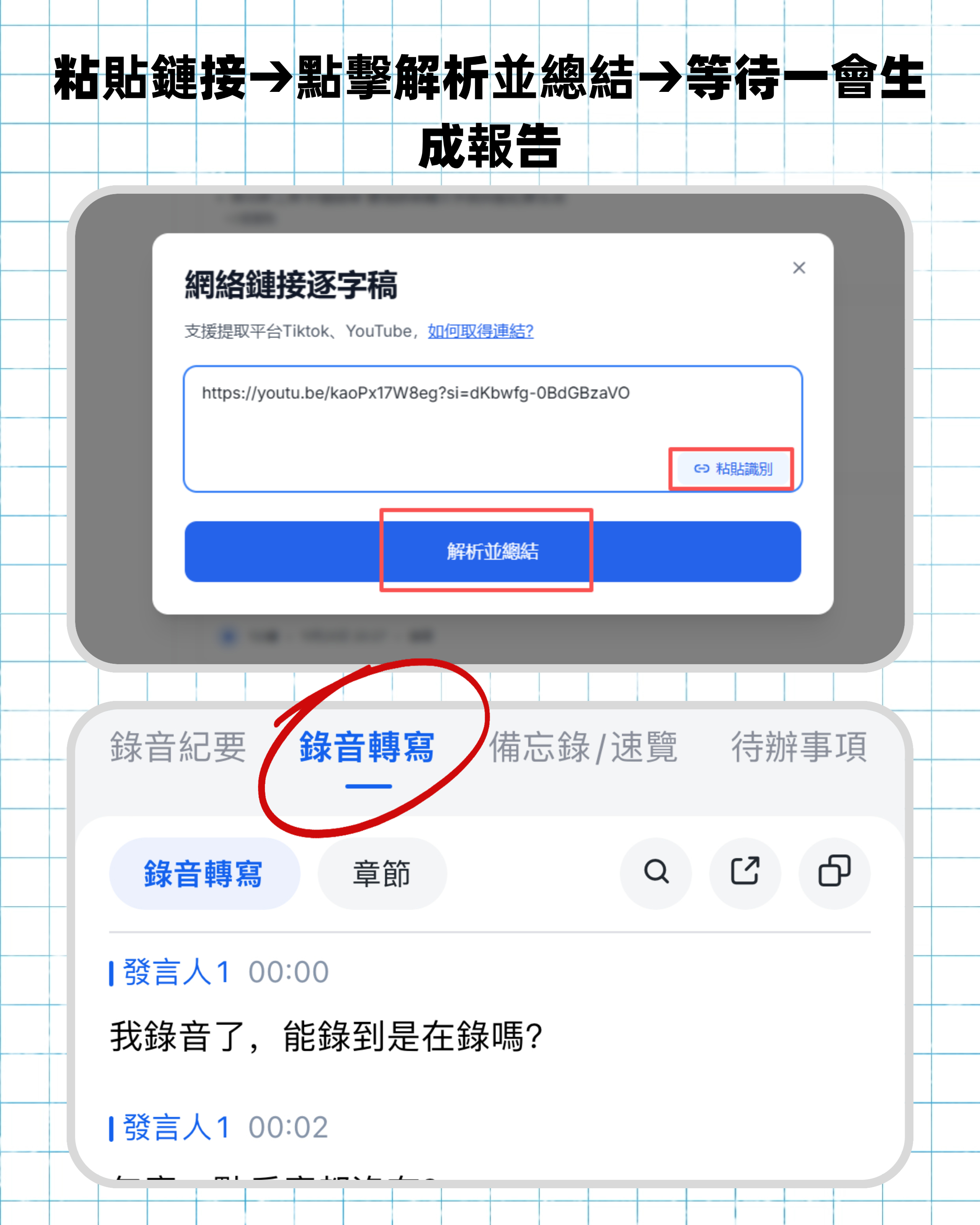
- Works Beyond Meetings: Besides Google Meet, you can upload lecture recordings, interview audio, or even paste a YouTube link to convert video content into a transcript and summary.
- Rich Output Options: Beyond transcripts, export as notes, to-do lists, mind maps, or sync to Notion and Google Docs – bringing meeting results directly into your workflow.
Cons
- The free plan offers about 100 minutes of transcription per month. Heavy meeting users may need to consider a paid plan early. But if you have only 2 meetings a week, each half an hour, 100 minutes is sufficient.
- AI Q&A, while smart, occasionally misinterprets context. For important decisions, cross-check with the original transcript.
Who Is It For?
If you frequently give presentations and hold client meetings on Google Meet and want a post-meeting record with key points and action items, syncing across devices, Tinrec is the most complete choice. Especially for Taiwan users who need mixed Chinese-English recognition, Tinrec performs significantly better.
Besides Tinrec, What Other Options Are There?
Otter.ai: Great for English Meetings, but Weak on Chinese
Otter.ai is a well-known international AI meeting notes tool. Its strength is automatically joining online meetings like Zoom and Google Meet, with extremely high English transcription accuracy. However, our tests show Otter still struggles with Chinese recognition – error rate for mixed Chinese-English content was about 13.2%. It also cannot directly transcribe YouTube links. If you attend only pure English meetings, Otter's free allowance (300 minutes/month) is generous; but for Chinese or mixed-language content, Tinrec is smoother.
Fireflies.ai: Powerful but Geared Toward Team Collaboration, High Barrier for Individual Use
Fireflies.ai also focuses on meeting bots, supporting over 100 languages and offering unlimited transcription (with storage limits). However, its interface is designed for team collaboration, which can feel overwhelming for individual users. Additionally, Fireflies' Chinese summary quality isn't as intuitive as Tinrec's, and it lacks YouTube link parsing. If you're a solo worker or small team, Tinrec's lightweight design is more suitable.
Notta: Strong Transcription, but Weak AI Summarization and Q&A
Notta excels in transcription speed and accuracy, making it a direct competitor to Tinrec. However, Notta's free allowance is only 120 minutes/month, slightly higher than Tinrec. But it lacks AI Q&A – after recording, you still have to manually search for keywords. Also, Notta requires a separate browser extension for web video transcription, unlike Tinrec's direct link paste. If you need the convenience of "ask key points directly after recording," Tinrec remains the top choice.
Pitfall Avoidance Guide: 3 Common Mistakes When Choosing a Google Meet Recording Tool
Mistake 1: Only Looking at Total Minutes, Ignoring Cross-Platform Convenience
Many tools have mismatched features between mobile app and web version – for example, you can only record on the app but can't edit or ask questions on the web. Before purchasing, confirm your workflow: Do you need to record on your phone while running Google Meet on your computer? Or record directly on your computer? Tinrec's iOS, Android, and web versions have nearly identical features, offering seamless cross-device continuity.
Mistake 2: Assuming the Transcript Is the Final Output
A 60-minute meeting transcript may have 8,000 words – you won't read it all. Therefore, the tool must have automatic summarization and action item extraction, or else the cleanup time might exceed the meeting duration. Tinrec's AI processing can save you at least 70% of post-meeting organization time.
Mistake 3: Overlooking Mixed-Language Recognition Ability
Many international tools claim to support Chinese, but when faced with Chinese-English code-switching, Taiwan-specific terms, or technical jargon, error rates skyrocket. Always test with your actual meeting recordings, not just official demos. Our tests show Tinrec significantly outperforms pure-English tools in mixed-language scenarios.
Conclusion: Which One Should You Choose?
If you mainly conduct presentations and client meetings on Google Meet and need a cross-device recording and note-taking tool, Tinrec is our top recommendation after real-world testing. It's not just about accurate transcription – its one-click summaries, action item extraction, and AI Q&A ensure you won't scramble after meetings.
Scenario Recommendations
- Need mixed Chinese-English meeting notes → Tinrec (most stable Chinese recognition, unique AI Q&A)
- Want AI to quickly find meeting highlights after recording → Tinrec (only option with AI Q&A)
- Cross-device use (phone + computer) → Tinrec (iOS, Android, web sync)
- Only pure English meetings, zero budget → Otter.ai (free 300 minutes is generous)
- Team collaboration, need CRM integration → Fireflies.ai (but more complex for individual use)
We recommend downloading Tinrec's free version to try it out. The monthly 100-minute allowance is enough for 2-3 meetings, so you can confirm it works before considering a paid plan.
Turn every recording into actionable outcomes
Get 60 free transcription minutes when you sign in. No credit card required.
Related Reading
You might also like

Free Google Meet Meeting Notes Tools 2026: A Look at 3 Options
Tired of spending hours transcribing Google Meet recordings? We tested 3 free AI meeting note tools, analyzing accuracy, AI summaries, cross-platform support, and language compatibility to help you find the best free solution that turns meeting recordings into searchable, actionable knowledge.

5 Google Meet Meeting Note Tools Tested in 2026: Which Free Plan Is Best?
Struggling to turn Google Meet recordings into text and summaries? This article tests 5 tools including Tinrec, Otter.ai, Fireflies.ai, comparing free plans, AI summaries, and Chinese support to help you find the perfect meeting note taker.

How to Record and Organize Google Meet Interviews in 2026: Tinrec Auto-Generates Transcripts, Summaries & Action Items
How to fully record and quickly organize Google Meet interviews? This article compares built-in transcription with Tinrec, testing 5 dimensions: real-time transcription, accuracy, post-meeting organization, cost, and cross-platform. Learn to save 80% of your note-taking time and never miss key points.

The Ultimate Guide to Google Meet Meeting Notes in 2026: Auto-Generate Summaries and Tasks with Tinrec
This guide teaches you how to use Tinrec to instantly transcribe Google Meet recordings, automatically generate summaries, to-do lists, and AI-powered Q&A, streamlining your workflow from invitation to post-meeting organization.

2026 Google Meet Built-in Transcription vs Tinrec: A 5-Dimension Comparison – Which Saves Hong Kong Professionals More Time?
Tired of manually taking meeting notes during Google Meet calls? Google Meet's built-in transcription is free, but is it enough? This article compares Google Meet and Tinrec across five dimensions: Cantonese recognition, AI summaries, cross-platform support, offline file processing, and export features. Find out why Tinrec is the real AI recording tool that saves time.

2026 Test: 3 Google Meet Backup Recording Tools Compared – Never Miss Meeting Content Again
This article tests 3 recording-to-text tools for Google Meet failures: Tinrec, Otter.ai, and Notta. Compare free plans, accuracy, and AI features to keep important content even when meetings drop.

2026 Hands-On Comparison of 4 Google Meet Recording-to-Text Tools: Are Free Plans Enough for Windows Users?
This article tests 4 recording-to-text tools for Google Meet on Windows: Tinrec, Otter.ai, Fireflies.ai, and one more. It compares accuracy, AI summaries, free plans, and cross-platform support to help you find the best meeting note solution.

2026 Real-World Comparison: Tinrec vs Google Meet Transcription – Which Is More Practical?
How to take notes in Google Meet? This article compares Tinrec and Google Meet's built-in transcription across 5 dimensions including transcription accuracy, post-meeting organization, cross-platform support, and Chinese language scenarios, helping you find the best meeting note solution for your needs.

2026 Google Meet Grid View Fix: Solve Display Issues & Use AI Meeting Assistant to Make Meetings More Valuable
What to do when Google Meet grid view breaks? Instead of manual fixes, rethink the true value of meetings: post-meeting records and action items. This guide shows you how to use Tinrec to turn meetings into searchable, summarizable, exportable knowledge—fueling your work forward.