
Turn recordings into transcripts and summaries in minutes
Upload audio or video for multilingual transcription, AI notes, and action items
Pain Point: You’re Out and About, But Can’t Miss the Meeting
You’re on the subway, walking to a client meeting, or waiting for a connecting flight at the airport when your phone buzzes: an important team meeting in ten minutes. You open Google Meet, and while your colleagues’ faces are clear, the surrounding announcements, wind noise, and shaky camera make it hard to focus and take notes.
Google Meet’s “On-the-Go” mode is designed for exactly this scenario. It doesn’t ask you to tough it out on video; instead, it simplifies the call interface into a “listen-only, key items clear” mobile meeting tool. But once the meeting ends, what about the conclusions and action items discussed?
The key is not just to hear clearly, but to retain and find the information later. This article will guide you from setting up On-the-Go to using AI tools to turn meeting content into reviewable, trackable records—all in one go.
Target Deliverables: Not Just Listen, But Come Away with These Three Things
When attending a meeting on the move, what you really need is:
- A full transcript: To review exactly who said what afterward.
- A summary: To grasp the key points in 30 seconds.
- A to-do list: Who needs to do what by when.
Next, we’ll use Google Meet On-the-Go mode to “listen” to the meeting, then use an AI recording and summarization tool like Tinrec to “save” the meeting, and finally convert the audio into the three items above.
Standard Workflow: From Mobile Meeting to Searchable Meeting Notes
Step 1: Enable Google Meet’s On-the-Go Mode
On-the-Go is a built-in feature in the Google Meet mobile app (iOS/Android). When you’re walking, riding, or moving quickly, the phone’s accelerometer detects motion and prompts you to turn it on.
Manual activation:
- After joining a meeting, tap the “More controls” icon (three dots) at the bottom right.
- Select “On-the-Go” from the menu.
- Your camera will automatically turn off, and the screen will show only four large buttons: Mute, Raise Hand, Audio Device, and End Call.
The interface is deliberately enlarged and hides distracting meeting information, showing only the active speaker and participant count, so you can see the most important controls at a glance while moving.
Step 2: Capture the Recording During the Meeting
In On-the-Go mode, Google Meet itself does not record the meeting. You need to prepare a separate recording method, for example:
- Android screen recorder (recording only system audio).
- iPhone screen recording (ensure microphone is off to record system audio).
- Another device or voice recorder to capture external speaker audio.
Some worry that recording on a subway will be noisy. In practice, most phones’ internal recording captures call audio directly and doesn’t pick up much ambient noise. If you use an external microphone, we recommend using noise-canceling earphones for cleaner audio quality.
Step 3: Upload the Recording to an AI Tool to Auto-Generate Transcript, Summary, and To-Dos
After the meeting, open your preferred AI recording summarization tool (here we’ll use Tinrec as an example):
- Upload the audio file you just recorded.
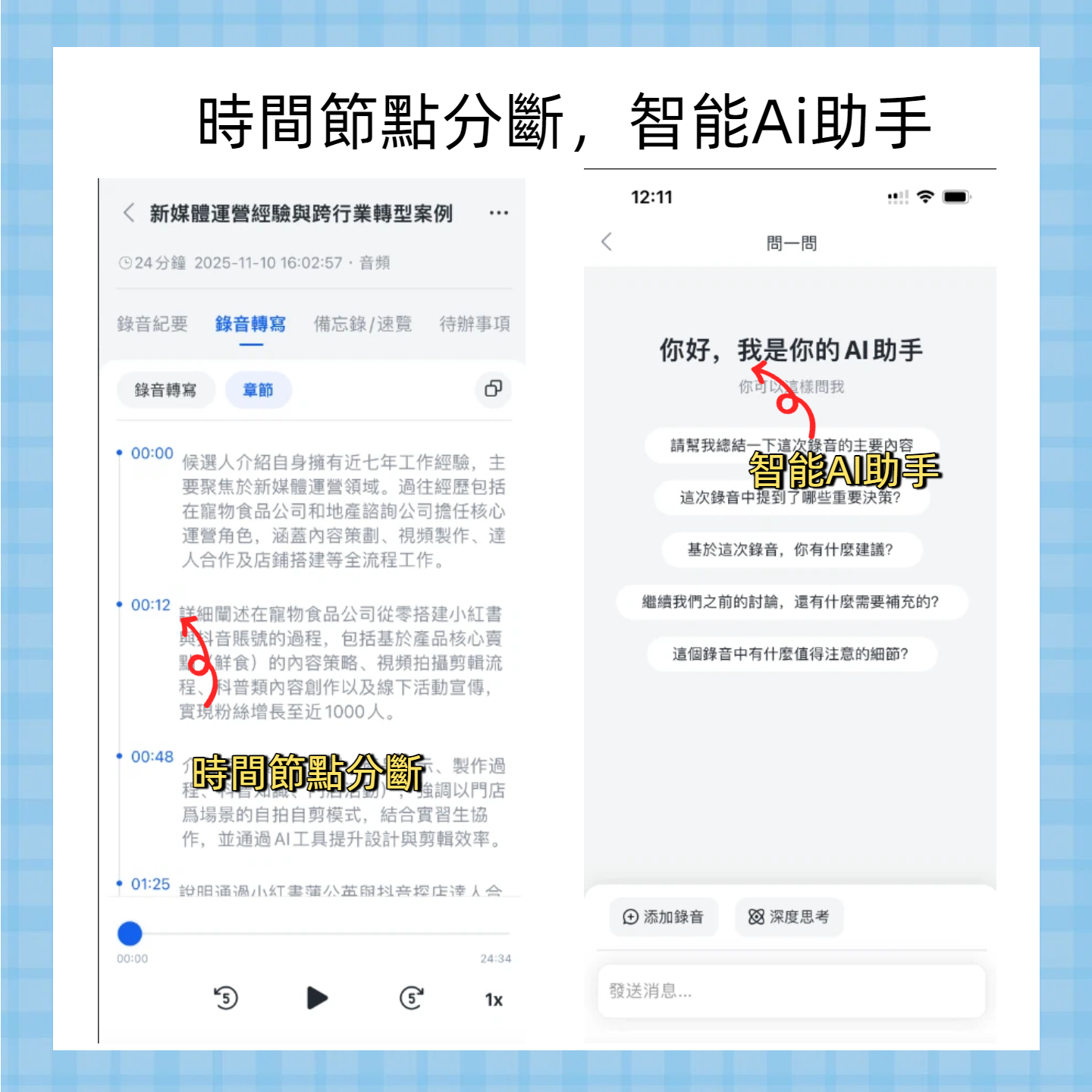
- Tinrec will automatically transcribe the audio and generate an AI summary with chapter segmentation.
- If the meeting covered action items, it will automatically extract a to-do list.
This step saves you from manually transcribing or listening to a two-hour recording from start to finish. After transcription, you can search by keywords—like client names or project codes—and even extract task-oriented phrases like “follow up” or “by this Friday.”
Step 4: Review the Summary, Check To-Dos, and Export to Colleagues

When the AI summary appears, don’t just blindly copy and paste. In practice, the safest approach is:
Stop organizing recordings by hand
Upload audio or video and automatically get a transcript, summary, and action items
- Quickly scan the summary to confirm it captures the meeting’s main points.
- Open the to-do list, cross-reference with relevant sections in the transcript, and verify names and deadlines are correct.
- Finally, export the results as Markdown, TXT, or PDF, and drop them into your team’s Notion, Google Docs, or Slack.
The entire process—from “meeting on the subway” to “meeting notes in the team folder”—takes less than ten minutes.
Tool Capability Checklist: You Need a Recording Assistant That Can “Organize”
| Capability | Google Meet On-the-Go | Tinrec (or other AI summarization tool) |
|---|---|---|
| Optimized interface for movement | ✅ Large buttons, camera off | ❌ Not responsible for meeting interface |
| Automatic motion detection | ✅ Suggests enabling, can toggle | ❌ |
| Bandwidth saving | ✅ Audio only, low data usage | ❌ Not a meeting tool |
| Generate transcript | ❌ | ✅ |
| AI summary | ❌ | ✅ Long meeting summary with chapters |
| To-do extraction | ❌ | ✅ Auto-extracts action list |
| Post-meeting dialogue search | ❌ | ✅ Keyword search, AI Q&A |
| Export and share | ❌ | ✅ Multiple formats, cross-platform |
Tinrec Application Example: From Audio to Action List in Seconds
Suppose you had a 40-minute product progress meeting. In On-the-Go mode, you could only focus on listening, and some parts were a bit messy. After the meeting, you get an m4a audio file and upload it to Tinrec:
- 0:45 seconds: Transcript generated, with a “Summary” tab appearing.
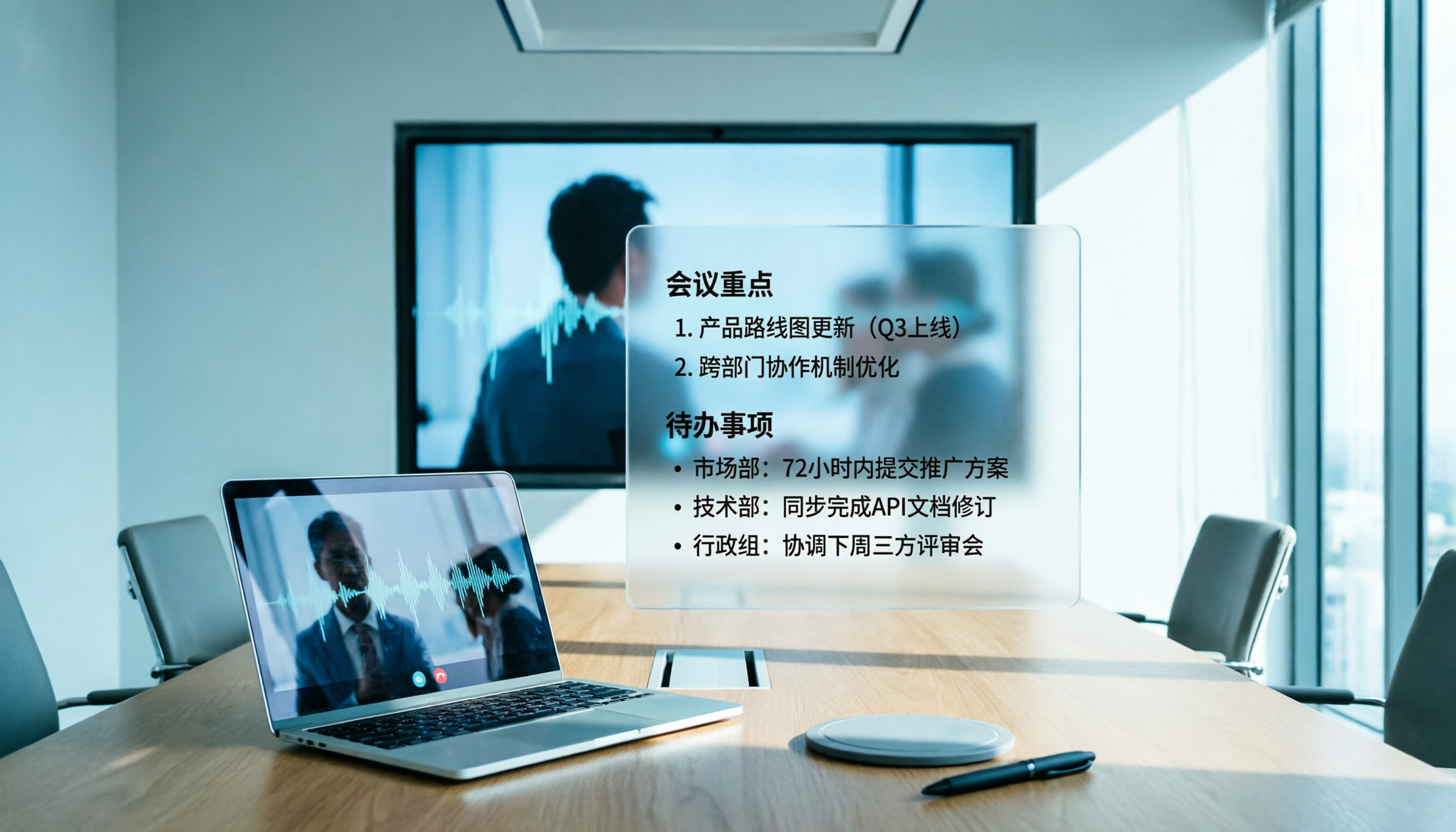
- Summary: “The discussion covered three core module timelines. The ‘payment integration’ is delayed to next Wednesday due to a third-party API issue; the engineering team needs to provide an alternative solution by Friday. The design team has completed UI adjustments pending QA verification.”
- To-dos: Automatically lists three items, including owner and estimated completion date.
You click on the “Payment alternative” to-do, and the auto-location feature jumps you to that part of the recording to confirm it hasn’t misinterpreted the speaker. Then one-click export to text, paste into Jira or Slack channel—no need for extra note-taking.
Frequently Asked Questions: 5 Common Questions About On-the-Go and Recording
1. Can others see my video in On-the-Go mode? No. Once you switch to On-the-Go, your camera is forcibly turned off. Others will only see your profile picture or name initials.
2. Are there legal issues with using the phone’s internal recording? If the meeting was announced as “recording in progress” or is a regular internal company meeting, it’s usually fine. For cross-organization client meetings, it’s strongly recommended to get verbal consent first.
3. How accurate is the transcription? With Tinrec, under clear recording conditions and predominantly Chinese, accuracy can reach about 98% (actual results depend on noise and speaker accents). Compared to standard phone voice input, it handles multiple speakers and technical terms better.
4. Can I do real-time transcription without recording? Yes. Some tools support real-time recording-to-text, but running both Meet and a recording app while moving drains battery faster. For important meetings, many people prefer to record first and transcribe later to avoid missing content due to app switching.
5. What about privacy and data security? For cloud transcription, always choose tools with clear privacy policies and encrypted transmission. Tinrec has an account system; only you can see the transcribed content unless you actively share it.
Final Advice: Mobile Meetings Aren’t a Compromise—They’re a Different Way to Focus
If you frequently attend meetings on the go, consider this mobile work kit:
- Solo workers: Keep Google Meet On-the-Go always on, pair with phone internal recording, and use Tinrec’s free tier for single meeting transcription afterward.
- Business professionals: Use screen recording with noise-canceling earphones, and an AI recording summarization tool to permanently store all meeting notes for cross-meeting search.
- Content teams: Treat interview recordings from On-the-Go mode as raw material, feed them into Tinrec to get transcripts, then extract quotable insights and soundbites.
The key is that being away from your desk doesn’t mean sacrificing meeting completeness and follow-up. Treat mobile meetings as “audio-only participation” and let AI handle the organization. That’s how you achieve true mobile work—not a downgrade.
References
Turn every recording into actionable outcomes
Get 60 free transcription minutes when you sign in. No credit card required.
Related Reading
You might also like

Which Auto-Captioning Tool is Best? 2026 Review of 3 Tools, This One Has the Most Complete AI Features
We tested three auto-captioning tools, evaluating Chinese accuracy, AI features, and export convenience to find which ones really save you time. Top pick: Tinrec, because it not only transcribes but also lets you ask AI questions and generate summaries.

2026 Tinrec vs Plaud Note: A 5-Dimension Comparison for Audio/Video Organization
What's the real difference between the audio transcription app Tinrec and the AI recording hardware Plaud Note? This article compares them across five dimensions—Cantonese accuracy, cross-platform support, AI query capabilities, input source diversity, and long-term cost—to help you decide which is better for organizing meetings, courses, and online videos.

2026 Video Subtitling AI Complete Guide: How to Choose Automatic Video Captioning Tools? Tinrec vs Plaud Note In-Depth Comparison
Want to quickly add subtitles to your videos but unsure which AI tool to pick? This article takes a purchasing decision perspective, deeply comparing Tinrec and Plaud Note across video sources, real-time captions, accuracy, cross-platform support, and pricing, so you can see at a glance which one fits you better.
2026 Comparison of 4 Video-to-Text Tools: Which One Generates the Most Accurate and Fastest Subtitles?
Tested multiple video-to-text apps, from free to paid. Which one supports Cantonese and produces the fastest, most accurate subtitles? Tinrec (Instant Voice Recording) stands out with AI features. Check out the review!

2026 Comparison: Two Top Subtitle Generator Apps for Chinese Video Creators
This article compares Tinrec and Otter.ai, two AI subtitle generation tools, analyzing input sources, Chinese recognition, post-processing capabilities, and pricing to help you quickly decide which one is better for video subtitles.

How to Start a New Google Meet and Turn Recordings into Reusable Content: From Link Creation to AI Summary Export
This hands-on tutorial walks you through quickly creating a new Google Meet from Gmail, Google Calendar, or meet.google.com, and shows you how to use Tinrec to convert meeting recordings into transcripts, summaries, and action items—turning every discussion into searchable, organizable text assets.

2026 Comparison of 3 Google Meet Recording and Transcription Tools: Which Free Plan for Windows Users Is Best?
Using Google Meet on Windows has no built-in recording feature, making meeting notes cumbersome. This article tests 3 recording and transcription tools, showing how to pair them with PWA for efficiency and find the best free plan for Chinese users.
4 Google Meet Transcription Tools Compared in 2026: Which AI Summary Saves You the Most Time?
Struggling to record Google Meet meetings on your TV? This article tests Tinrec, Otter.ai, Notta, and Yating transcript, comparing cross-platform support, Chinese accuracy, and AI summarization to help you find the best meeting recording tool.

2026 Comparison of 4 Auto Video Captioning Tools: Which Free Plan Is Most Useful?
Tested multiple auto video captioning tools, analyzed free version limitations and real-world experience, and recommend the best solution for Taiwan users that supports Chinese and has sufficient free quota.