
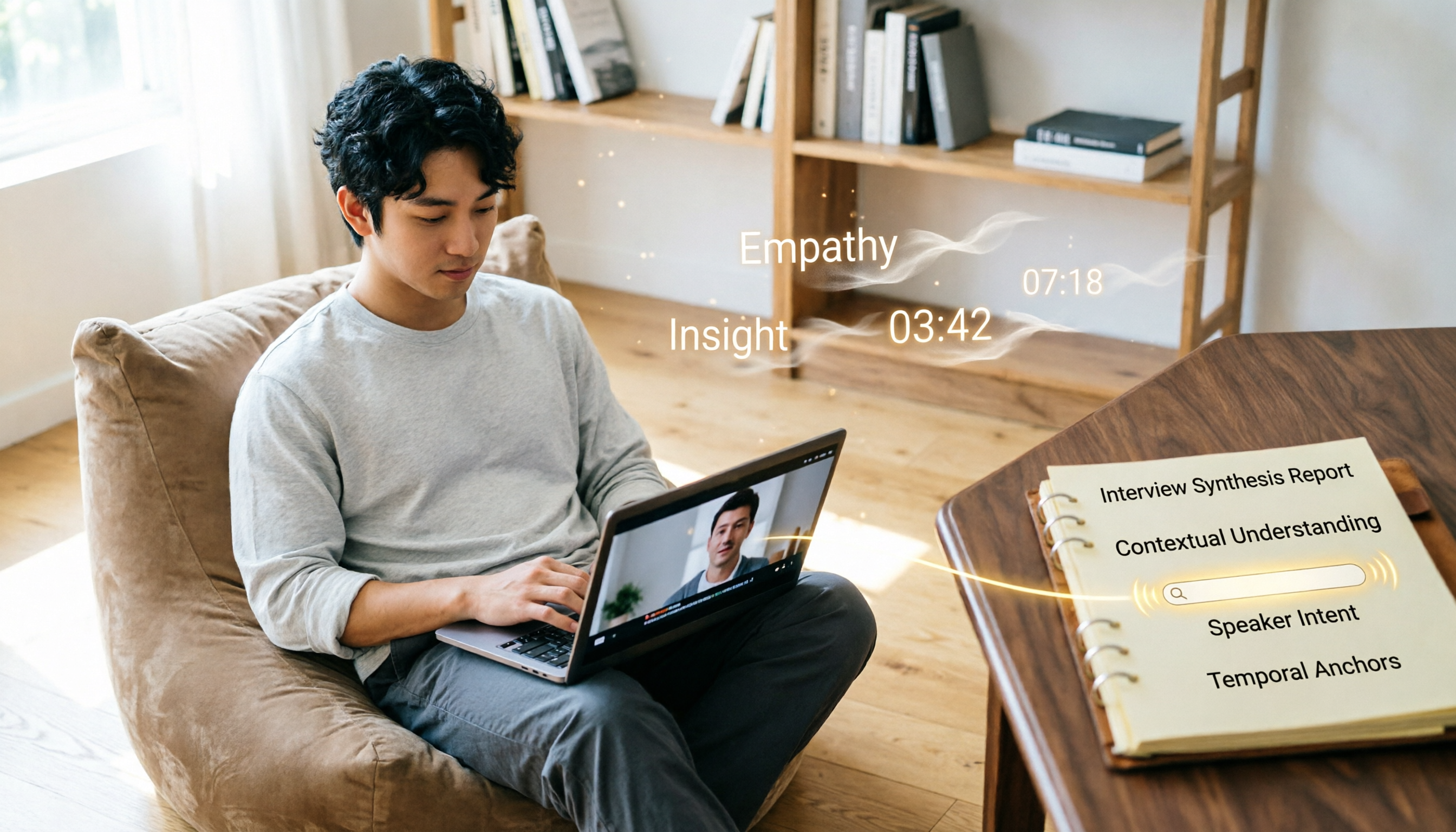
Turn recordings into transcripts and summaries in minutes
Upload audio or video for multilingual transcription, AI notes, and action items
Two hours in a meeting, two more hours taking notes? You don't need another tool, you need a solution.
You watch a 40-minute YouTube tutorial, try to note the key points, but end up pausing constantly and scrambling.
Or you recorded an online meeting, and later you need to find one decision from that two-hour video—so you fast-forward through the whole thing.
And if you usually watch on your phone, making notes simultaneously is even harder—the screen is only so big.
These scenarios all point to the same need: How can you automatically turn video content into text notes that you can search, organize, and ask questions about?
Before Choosing a Video Note Tool, Understand These 4 Key Points
Don't rush to download an app. First, think about what you actually need.
Are the input sources broad enough? Some tools only accept YouTube links and won't handle local videos or audio recordings. If you need to work with meeting recordings or interview material, you'll be stuck.
After transcription, can the AI help you organize? Getting a raw transcript isn't enough. If the tool can automatically generate summaries, chapters, action items, and even let you find key points by asking questions, that's what actually saves time.
Cross-platform support and export options? Where do your notes finally live? If you usually archive in Notion, Google Docs, or a cloud drive, the tool should export directly instead of forcing you to copy and paste.
Is the free tier enough? Free plans are usually just a taste. But if you only process a video or two per week, the free version may be plenty. If you have heavy usage, then consider whether the paid plans are reasonable.
Tinrec (Instant Transcription) — Our Top Pick After Testing
Tinrec is an AI recording and audio/video organization tool. It goes beyond meetings and is great for online videos, courses, interviews, and personal notes.
Virtually no input blind spots Besides real-time recording transcription, you can upload local MP4 or MOV video files, or paste public video links from YouTube, Bilibili, and more. That's rare among current competitors.
It doesn't just transcribe; it helps you understand the content After generating a transcript, Tinrec automatically creates AI summaries, chapters, and even pulls action items from the discussion. Even better is the AI chat query: after recording a video, you can ask, 'How many social media platforms does this video mention?' It finds the answer semantically, not by simple keyword matching.
The last mile: export Your organized notes can be exported as TXT, Word, or PDF, or synced to Notion, Google Docs, OneNote, and more. No more copying and pasting.
Our hands-on test We tested a 5-minute Chinese educational YouTube video (quiet indoor environment, medium speaking pace). Tinrec's transcript required almost no corrections, and the AI summary accurately caught the 3 core points. While the paid tier unlocks more complete features, the free plan offers a monthly base transcription allowance and includes AI Q&A, so you can try it first.
Stop organizing recordings by hand
Upload audio or video and automatically get a transcript, summary, and action items
Is the free version enough? The free plan includes a monthly base allowance for real-time recording, file uploads, and online video transcription. If you only process videos occasionally, that allowance is plenty. Heavy users can consider weekly, monthly, or yearly plans, which lower the monthly cost.
Who is it for? Anyone who wants to quickly pull key points from videos, meetings, or courses; people who need cross-device use (phone + computer); and those who want to use AI chat to find answers after transcription.
Other Options Besides Tinrec
Reccap: Turns YouTube videos into articles, but YouTube only Reccap specializes in turning YouTube videos into full-length articles, pairing key screenshots with segmented text. If you only watch YouTube, it's sufficient. But note: it doesn't support local video files or live recording, and there's no AI Q&A. If you want to ask questions about the video, Reccap won't help.
NotebookLM: Google's AI note assistant, more of a knowledge base NotebookLM can also handle YouTube videos, audio files, and documents, automatically generating summaries and audio overviews. But it's built around a 'note database' concept, better for building up material over time. It doesn't support real-time recording transcription and lacks rich export options. If you need to process a single video and get it into another tool, Tinrec is more straightforward.
Pitfall Guide: 3 Common Mistakes When Choosing a Video Note Tool
Mistake 1: Only trusting the advertised accuracy Many tools tout '98% accuracy,' but that's measured in a studio environment. With background noise, accents, or multiple speakers, real-world performance will drop. The right approach is to try the free plan with your own videos and gauge actual quality.
Mistake 2: Overlooking input source limits If you often organize local videos or recordings but pick a tool that only supports YouTube URLs, you'll eventually have to find a replacement. First, identify the types of videos you work with most, then check each tool's supported sources.
Mistake 3: Treating the tool as a mere transcript generator If you stop at transcription, you're wasting the tool's organization features. Features like Tinrec's AI summaries, action-item extraction, and chat queries save you tons of manual reviewing time. You'll feel the difference after one use.
Conclusion: Which One Should You Pick?
These three tools serve different purposes:
- If you want to handle YouTube, local videos, and live recordings in one go, with AI helping you find the highlights → Tinrec (broadest input support, most useful AI Q&A)
- If you mainly watch YouTube and want long, illustrated articles → Reccap (but note: no AI Q&A)
- If you want to build a long-term multimedia note database and don't mind staying in the Google ecosystem → NotebookLM
Honestly, unless you have particular reasons, Tinrec offers the most versatility, and its free plan lets you try most features. Start with the free version, process a few videos from the types you usually watch, see how the AI organization and Q&A work, and then decide whether to upgrade.
References
- Online AI speech, video, and audio recording to text – Free trial – cSubtitle
- [AI Notes📚💻] Google NotebookLM supports YouTube videos, URLs, and audio documents, helping you build a note database
- Reccap turns YouTube videos into complete articles you can read quickly! Faster note-taking too – Project Management Life Thoughts
- Turn video into text | Transcribe App & Online Editor
- How to use AI to take notes from YouTube videos - Edimakor
Turn every recording into actionable outcomes
Get 60 free transcription minutes when you sign in. No credit card required.
Related Reading
You might also like

3 Interview Transcription Apps Tested in 2026: Which One Helps Journalists Transcribe Faster?
Journalists often spend hours transcribing interviews. We tested three apps—Tinrec, Yating Transcriber, and Notta—comparing real-time transcription, AI summaries, multi-source support, and export convenience to find the best time-saving interview tool.

2026 Hands-On Comparison of 4 AI Recording Tools for Repurposing: Which One Creates the Most Accurate Presentation Outlines?
How can you turn meeting recordings, lecture audio, and interview content into presentation outlines quickly? This article puts four tools—Tinrec, Notta, Otter.ai, and TurboScribe—through hands-on testing, evaluating everything from transcription quality to AI organization, to help you pick the best AI recording assistant for repurposing.

2026 Comparison of 3 Audio-to-Text Tools: From Real-Time Translation to AI Organization, Which One Is Right for You?
Do you need audio-to-text for meetings, classes, or interviews? We tested three tools, comparing transcription accuracy, AI organization, and real-time translation support to help you find the best fit.
2026 Tested: 3 Smart Noise-Canceling Speech-to-Text Tools Compared for Chinese Meeting Notes – Which Saves More Time?
We tested three AI speech-to-text tools—Tinrec, Otter.ai, and Notta—across noise reduction, Chinese accuracy, AI summaries and Q&A, and cross-platform support, to help you find the best tool for organizing Chinese meetings and audio files.

4 AI Speech Recognition Tools Tested in 2026: Custom Dictionaries Aren’t the Only Answer—AI Q&A Is the Key
Struggling with misheard terminology in professional meetings, medical, or legal recordings? We tested 4 AI speech recognition tools—comparing custom vocabulary features, Chinese recognition accuracy, and AI summarization abilities—to show you which one is actually worth using.

2026 Speech-to-Text App Comparison: Which of 3 Apps Offers the Best Privacy Protection?
Worried about meeting recordings being stolen or cloud data leaks? This article tests and compares three popular speech-to-text tools, covering AES encryption, privacy policies, and real-world experience, to help you choose the most secure voice-to-text app.

2026 Hands-On Comparison of 4 Training Video Summarizers: Which One Saves the Most Time with Chinese Summaries?
After attending online training or watching instructional videos, how can you quickly organize the key points? This article tests 4 video-to-text tools, with Tinrec as the top pick, analyzing each tool's AI summaries, Chinese support, and cross-platform capabilities to help you find the best training video organization solution.

2026 Real-Time Speech-to-Text Tools Compared: Which One Transcribes Most Accurately?
Sitting in meetings, classes, or interviews often leads to hours of manual transcription. We tested 4 real-time speech-to-text tools—comparing live transcription speed, Chinese accuracy, and AI-powered summarization—to help you find the best fit.
2026 Hands-On Comparison of 4 Multi-Speaker Meeting Transcription Tools: Beyond Speaker Separation, Which One Actually Helps You Understand the Meeting?
How do you choose a multi-speaker meeting transcription tool? This hands-on test covers Tinrec, Qmeeting, Vocol.ai, and S‑WAVE — from speaker separation to summary quality and AI Q&A, to help you find the best fit.