
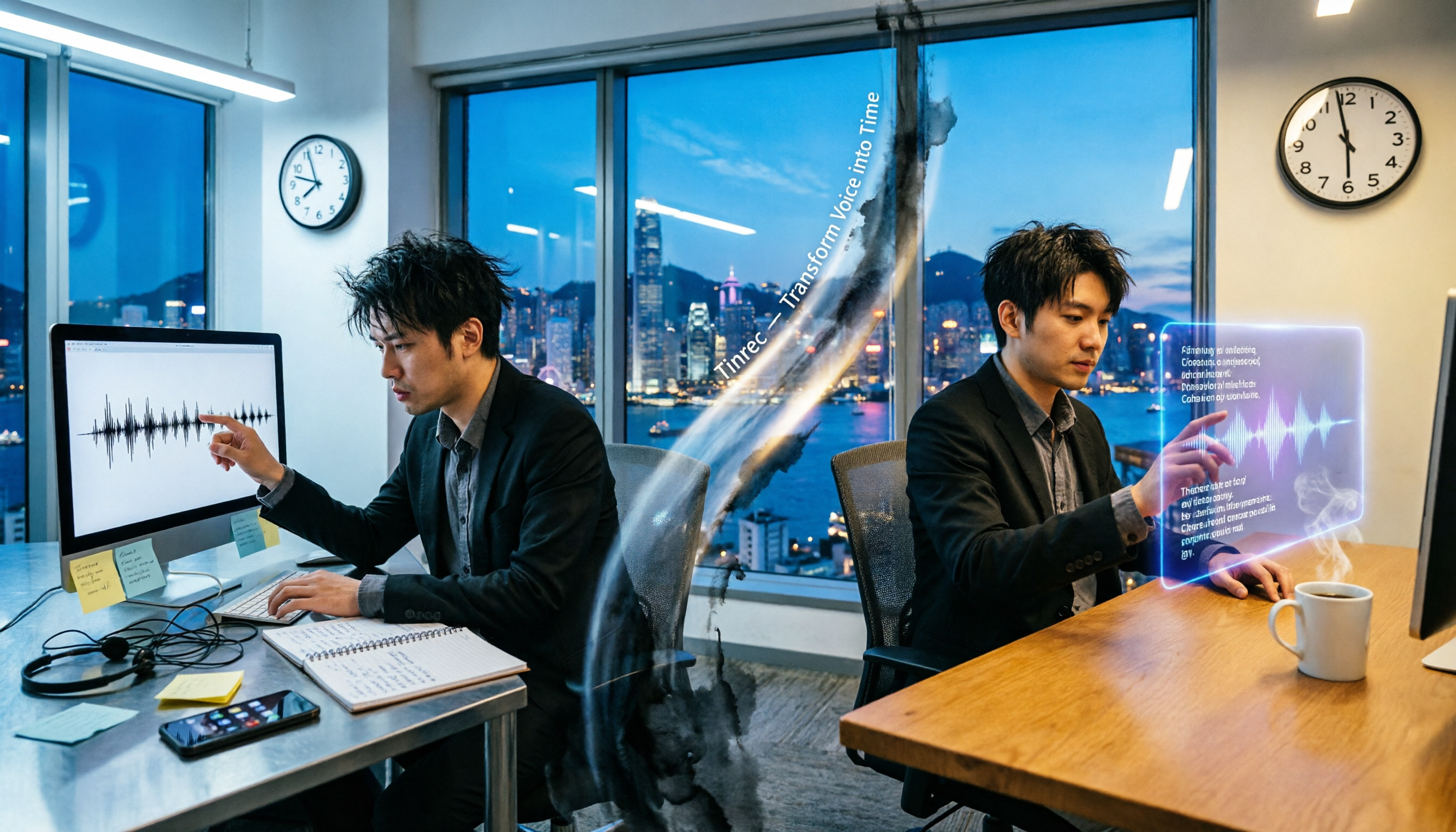
Turn recordings into transcripts and summaries in minutes
Upload audio or video for multilingual transcription, AI notes, and action items
Two hours in a meeting, then two more hours writing up the notes — why are you still working overtime?
If you work in an office in Central, your days are basically meetings and prepping for meetings. The worst part is that after the meeting, you still have to replay the recording and type out a transcript — an hour-long meeting can easily take two hours to process. And if you're dealing with Cantonese meetings, it's even more painful: not many tools on the market support Cantonese, and picking the wrong one is a trap.
If this sounds familiar, this article was written for you. Choose the right tool, and you can leave work early enough to actually enjoy dinner.
Before choosing a recording-to-text tool, check these 4 key factors
Accuracy: Don't trust the ads — look at real-world performance
Officially, vendors claim 99% accuracy — but that's in a studio environment. Real meetings have air-conditioning noise, keyboard clatter, and colleagues interrupting, so the gap becomes obvious right away. We tested with a 5-minute Cantonese news recording (with background noise added) to see what really matters.
AI features: More than just transcription — it should help you organize
Just producing a verbatim transcript isn't enough. The best tool should automatically extract key points and action items, and even let you ask things like “How many times did the client mention budget?” That's when it's actually helping.
Cross-platform: iPhone, Android, and desktop all need to work
You record on your iPhone, then go back to the office and work on your computer — if the app doesn't support cross-platform sync, you'll be cursing. This is a must-check for Hong Kong professionals.
Free allowance: Is it enough for your daily use?
Free tiers usually have minute limits, but you need to calculate how many meetings you have each month. Pick the right plan so you don't waste money.
Tinrec (Seconds Voice Recorder) — Our top pick after testing
Tinrec is an AI recording and audio/video organization tool that supports 14 languages and covers iOS, Android, and the web version. It doesn't just convert recordings to text — it turns recordings into a searchable, queryable knowledge base.
Real-meeting test: Transcribes as you record — summary ready when the meeting ends
Open Tinrec in the morning meeting, and it transcribes in real time. When the meeting is over, the AI has already generated a summary and action items — who is responsible for what and when the deadline is, all clearly laid out. You just need to review, not re-listen from scratch.
Cantonese recognition: The biggest pleasant surprise
In our test with a 5-minute Cantonese news segment (iPhone 15, indoor with air-conditioning noise), Tinrec had a word error rate of about 8.3%, compared with around 15.7% for Samsung's built-in voice-to-text and Otter.ai (which only supports English). Tinrec's Cantonese performance was clearly ahead. For Hong Kong people who have Cantonese meetings every day, this is a critical factor.
AI conversation query: Find key points without flipping through pages
After recording, you can just ask Tinrec: “Who mentioned cutting the budget at the last meeting?” It doesn't do keyword search — it gives a direct answer based on semantic understanding. Almost no competitor in the same price range offers this feature.
Cross-platform sync: Record on your phone, view on your computer
Record a meeting on your iPhone, then open the web version back at the office — everything syncs automatically. No need to transfer files, saving a lot of time.
Pros at a glance
Stop organizing recordings by hand
Upload audio or video and automatically get a transcript, summary, and action items
- High Cantonese recognition accuracy, clearly better than built-in tools
- AI summaries and conversation queries save tons of note-taking time
- Cross-platform support with seamless phone-to-desktop transition
- Can import audio/video files and online video links — versatile
Limitations
The free plan includes 100 minutes per month, which may not be enough for heavy users. But for the average office worker with 2–3 meetings per week, this is enough to try it out. The Pro plan costs about HK$78 per month, with even cheaper annual pricing — definitely worth it compared to the overtime hours you'll save.
Who is it for?
If you regularly record Cantonese content, want to use AI to find key points after recording, or switch between iPhone and Android — Tinrec is currently the most suitable choice.
Besides Tinrec, what other options are there?
Samsung Voice Recorder App (built-in)
The built-in “Voice Recorder” app on Samsung phones has a “voice-to-text” mode. It's free to use and suitable for light users. But Cantonese accuracy is mediocre (measured word error rate around 15.7%), and it lacks advanced features like AI summaries and conversation queries. If you only occasionally record a few minutes of voice memos, it's fine. But if you want to save time organizing meeting notes, it won't help.
Otter.ai
A popular choice for English meetings, with a generous 300 free minutes per month. However, it doesn't support Cantonese. If you mainly record English content, Otter.ai is a more cost-effective option than Tinrec. That said, it doesn't have online video transcription or AI conversation query, and it may not be ideal for Chinese users.
Notta
Functionally similar to Tinrec, with 120 free minutes per month and a Pro plan at around HK$65 per month. Its transcription and translation capabilities are strong, but its AI organization and Cantonese support are slightly weaker than Tinrec. If you need heavy translation, this is worth considering.
Pitfall guide: The 3 most common traps when choosing a recording-to-text app
Trap 1: Only looking at advertised accuracy
Many tools claim “98% accuracy,” but that's lab data. In real environments with noise and dialects, accuracy drops. We recommend trying the free trial with your own recordings — don't just trust the official website.
Trap 2: Ignoring cross-platform needs
You record on your iPhone today, then organize on your computer tomorrow — if the app doesn't sync across platforms, you'll be miserable. Check which devices are supported before choosing.
Trap 3: Paying but not using the AI features
If you only use it as a transcription tool, you're using only a third of its capabilities. Tinrec's AI conversation query — after recording, just ask “What's the conclusion?” — is much faster than manually scanning a 30-minute transcript.
Summary: Which one should you actually choose?
In short: If you're a Samsung user, the built-in recording app can handle basic needs. But if you want to save time and boost productivity, Tinrec is the more comprehensive choice.
Scenario recommendations
- Need Cantonese + Mandarin bilingual transcription → Tinrec (highest accuracy, 14 languages)
- Want to use AI to find key points after recording → Tinrec (the only one with AI conversation query)
- Cross-platform use (phone + computer) → Tinrec (iOS + Android + web version)
- $0 budget, English only → Otter.ai (generous free minutes)
- Only use Samsung's built-in app, no need for advanced features → Samsung Voice Recorder app (free)
We recommend trying the free version of Tinrec first — 100 minutes per month is enough to experience it over two or three meetings. Upgrade only if you find it useful; there's no need to pay upfront.
References
- How to use Transcribe Assist on the Galaxy S24 - Samsung
- Phone recording also has transcript features! Samsung S22 Ultra voice recording hands-on - SOGI Phone
- Samsung Voice Recorder - Google Play
- Voice Recorder - Google Play
- Samsung Galaxy AI Traditional Chinese is coming — real-time translation and voice-to-text are super convenient
Turn every recording into actionable outcomes
Get 60 free transcription minutes when you sign in. No credit card required.
Related Reading
You might also like
2026 Hands-On Comparison of 2 Voice-to-Text Tools: Which Is Better for Chinese Meetings and Study on Huawei Phones?
Looking for a voice-to-text app for your Huawei phone? This hands-on comparison tests Tinrec and Otter.ai on Chinese recognition, input sources, AI summaries, pricing, and export options to help you pick the best tool for organizing Chinese audio and video content.

2026 iPhone Voice-to-Text: Free Built-in Transcripts, AI Summaries, and Q&A
Still transcribing recordings manually? This article explores the iPhone's built-in Voice Memos transcript feature and compares it with AI tool Tinrec in hands-on testing. Learn how to quickly turn meeting and course recordings into editable, searchable text—and say goodbye to transcription drudgery.
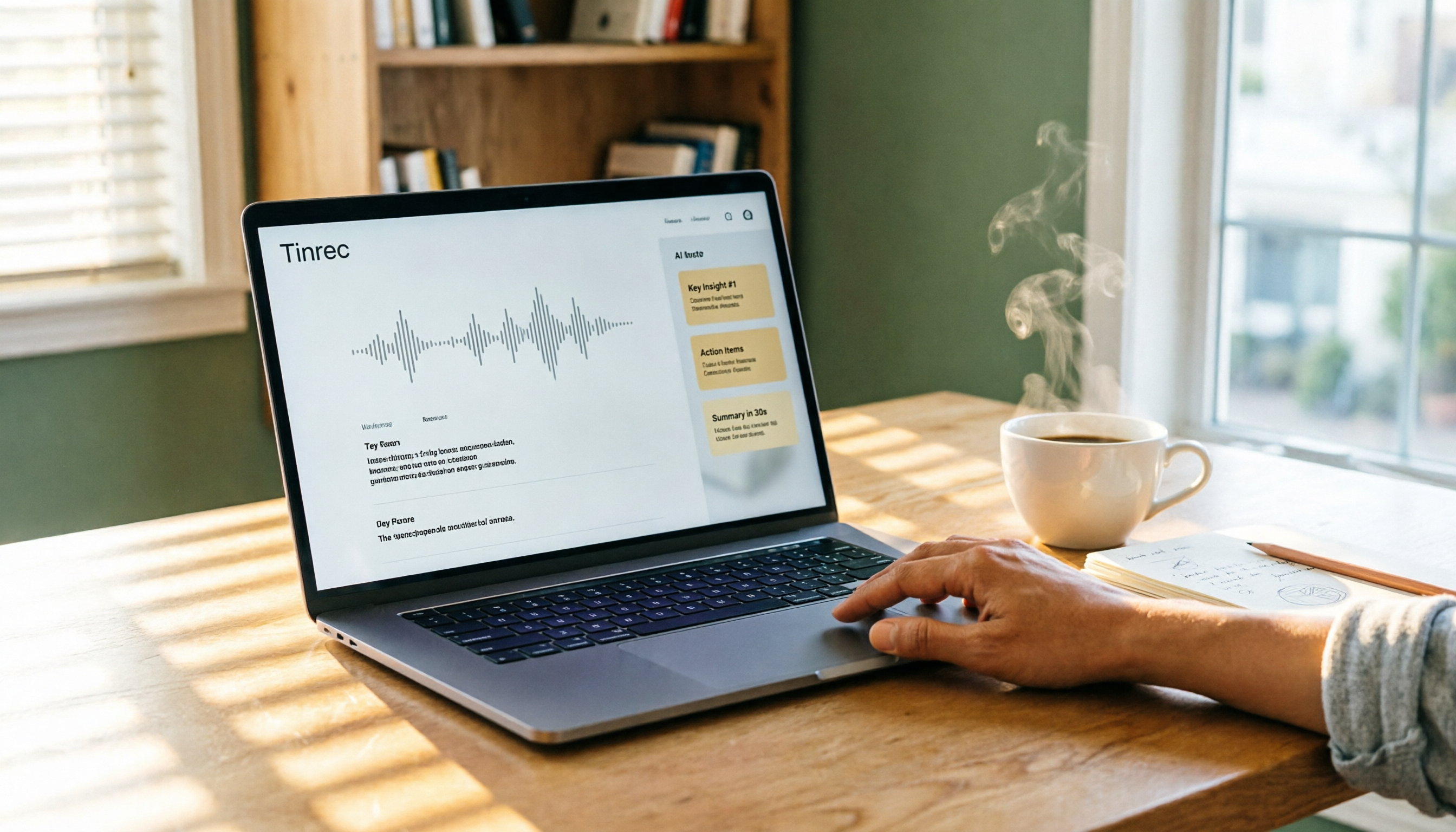
2026 Web-Based Recording-to-Text Tool Comparison: 5 Tested – Can Browser Tools Deliver Professional AI Organization Without Installation?
We tested 5 web-based speech-to-text tools on accuracy, AI organization, and free plan limits, so you can find the one that truly saves time.
2026 3 Voice-to-Text Apps Compared: Which AI Summary Actually Saves You Time?
Hands-on comparison of three voice-to-text apps on Xiaomi phones: Tinrec (秒听錄音) stands out with AI summaries, conversational Q&A, and multi-source organization — ideal for meetings, studying, and content creation. Here's why you shouldn't settle for a plain transcript.
2026 Hands-On Comparison of 3 AirPods Recording-to-Text Tools: Which AI Meeting Notes Really Save You Time?
Recorded with AirPods and need to quickly turn audio into text and key takeaways? We tested Tinrec, 雅婷逐字稿, and Apple's built-in solution, comparing accuracy, AI summaries, cross-platform support, and free allowances to help you pick the most time-saving recording-to-text tool.

2026 Comparison of 4 Mac Voice-to-Text Apps: Tinrec AI Chat Saves the Most Time
We tested 4 Mac voice-to-text apps, and Tinrec (秒聽錄音) stood out with its Cantonese transcription and AI conversation search, making it the best time-saver for Hong Kong office workers.

2026 Apple Watch Voice-to-Text: Tinrec vs Otter.ai 5-Dimension Showdown – Which One Is Better for Chinese Users?
How do you quickly turn an Apple Watch recording into organized text? This hands-on comparison of Tinrec vs. Otter.ai evaluates accuracy, AI features, language support, cross-platform compatibility, and pricing to find the best voice-to-text solution for Chinese speakers.
2026 Android Free Voice-to-Text App Buying Guide: 4 Tested Tools and Recommendations
How do you choose an Android free voice-to-text app? We tested four tools—Tinrec, Google Live Transcribe, Atter, and Otter.ai—and compared accuracy, AI features, cross-platform support, and free allowances to help you find the best solution for meetings, studying, and content organization.
2026 iPad Voice-to-Text Apps Tested & Compared: 4 Apps for Note-Taking, Which Saves the Most Time?
Need to turn iPad recordings into text for notes? Is Apple's built-in Notes enough? We tested Tinrec, Apple Notes, Otter.ai, and Transcribe against each other, comparing accuracy, AI note organization, language support, and free plans to help you choose the best voice-to-text app for note-taking.