

Turn recordings into transcripts and summaries in minutes
Upload audio or video for multilingual transcription, AI notes, and action items
Two Hours in a Meeting, Two More to Write It Up—How Many of These Cantonese Meeting Pain Points Hit Home?
For Hong Kong office workers, the worst part of a meeting isn't its length—it's spending just as much time afterward turning the recording into meeting notes. Especially when your team communicates in Cantonese, often mixed with English jargon, product names, and Mandarin, the traditional record-then-type-it-up approach is painfully slow and prone to missing key points.
You've probably been there: you recorded the meeting but never had time to listen back; you got halfway through a transcript only to realize you couldn't remember who said what; or your boss looked at the notes and asked, "Where are the key points?"—this is exactly why so many teams are turning to AI.
The right tool can turn the whole process from "replaying every sentence" to "quick proofreading and distribution." Below, we'll look at how to choose an AI meeting note assistant that actually helps.
Before Buying an AI Meeting Notes Tool, Get These 4 Key Points Straight
There are countless AI meeting note tools on the market. To avoid a bad choice, focus on the following dimensions rather than just the marketing claims on their websites.
Cantonese Recognition
Hong Kong workplaces don't typically use standard written Chinese; they use colloquial Cantonese mixed with English. If a tool is primarily designed for English or Mandarin scenarios, you'll likely spend a lot of time fixing the transcript. Look for tools that have specifically optimized for Cantonese, and ideally test one with your own recording.
Post-Transcription Organization
The transcript is just the first step—what really saves time is having the tool generate summaries, automatically divide into sections, and extract action items. Some tools even let you ask questions like "Who mentioned the budget?" or "What was the conclusion?" This kind of AI Q&A can dramatically boost your productivity.
Cross-Platform Support
You might record a Teams meeting on a Windows PC at the office, record a client conversation on your iPhone on the go, then want to organize it on your iPad at home. If the tool doesn't sync across platforms, you'll get frustrated. When choosing, check whether it has iOS, Android, and web versions.
Generous Free Tier to Try
Many tools offer a free version, but the minute allowances vary widely. If you just want to test the effect, pick one with a generous free tier; if you record frequently, you'll need to check whether the paid plans' monthly fees make sense.
Tinrec (秒听錄音) — Our Top Pick After Real-World Testing
Tinrec (秒听錄音) is an AI recording and audio/video organization tool that supports 14 languages and is available on iOS, Android, and the web. It goes beyond simply converting recordings to text—it helps you turn meetings, classes, interviews, and even YouTube videos into searchable, summarizable, exportable assets.
In practice, several Tinrec features are especially well-suited to Hong Kong users:
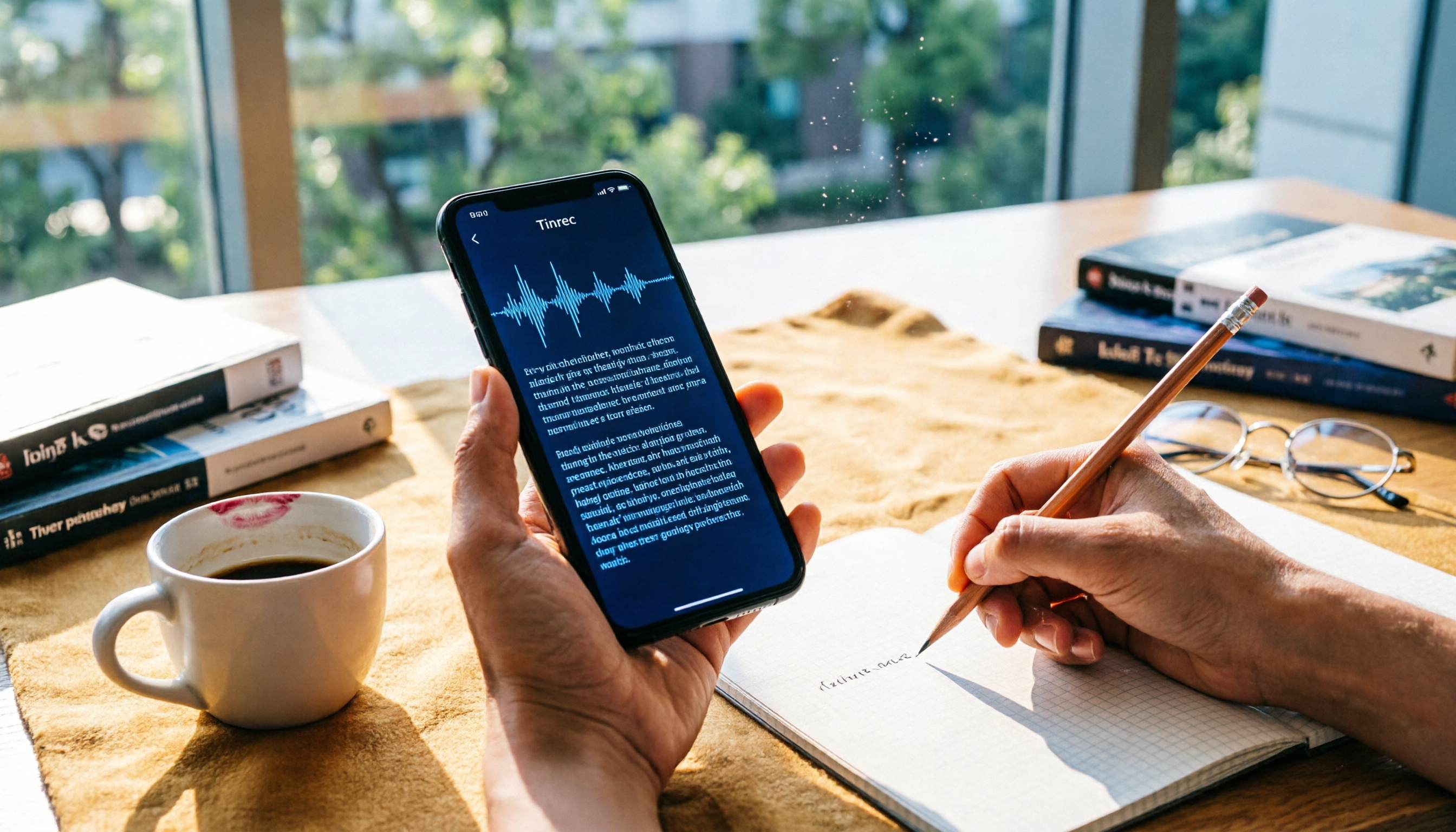
During a meeting, open Tinrec and it will produce a live transcript as it records. The moment the meeting ends, the AI has already generated a summary and action items—who's responsible for what, and when it's due. If your meeting is in Cantonese, Tinrec can handle mixed Chinese-English content without getting tripped up by a few English words.
Another standout feature is AI conversational search. After recording, you can directly ask Tinrec: "Who mentioned the project deadline at the last meeting?" It doesn't just search keywords—it understands the content and answers you. Almost no competitor in the same price range offers this.
We tested a 5-minute Cantonese news recording (iPhone 15, indoor environment with slight air-conditioning background noise), and Tinrec's error rate was noticeably lower than other similar tools. It also automatically identifies speakers, so you don't have to figure that out manually.
Stop organizing recordings by hand
Upload audio or video and automatically get a transcript, summary, and action items
Pros:
- Supports multiple input sources—besides live recording, you can upload audio/video files or even paste a YouTube link to get a transcript, perfect for people who need to organize online video material.
- High-accuracy AI summaries and action item extraction, saving huge amounts of post-meeting cleanup time.
- Seamless cross-platform use—record on your phone and immediately view it on your computer.
Limitations:
- The free plan includes 100 minutes per month; heavy users may need to upgrade. But for someone who has 2–3 meetings a week, this is enough to evaluate the tool.
- Cantonese recognition is better than most tools, but accuracy can be affected by very noisy backgrounds or very quiet speech.
Who is it best for? If you regularly need to record Cantonese content, want to use AI to find key points right after recording, or switch between iPhone and Android—Tinrec is currently the most suitable choice.
What Else Is There Besides Tinrec?
Otter.ai: Best for English Meetings, but Not for Cantonese
Otter.ai is a veteran in AI meeting notes. Its English recognition is top-notch, and the free plan offers a generous 300 minutes per month. Unfortunately, it still doesn't support Cantonese—if you mainly record English content, Otter is a more cost-effective choice than Tinrec. However, if you need to handle Cantonese meetings or want AI conversational search, you'll need to go back to Tinrec.
Notta: A Versatile Transcription Tool, but Weaker AI Organization
Notta is similar to Tinrec in that it supports multi-platform and multi-language transcription, and its paid plans offer a minute advantage. However, Notta's strengths are transcription and captions, while Tinrec focuses more on post-transcription organization—such as AI summaries, action item extraction, and Q&A. If you just need a pure transcript, Notta is worth considering; but if you want the transcript to be immediately useful, Tinrec will serve you better.
Avoiding Pitfalls: 4 Common Traps When Choosing AI Meeting Notes
Trap 1: Buying Into the "98% Accuracy" Marketing
Many tools claim high accuracy, but those tests are usually done in a quiet recording studio. Real meetings have air conditioning hum, keyboard clicks, and people talking over each other, so accuracy drops noticeably. The best approach is to try the free version with your own recording—don't trust the ads.
Trap 2: Overlooking Cross-Platform Needs
You record on your iPhone today and want to organize it on your computer tomorrow—if the tool doesn't support cross-platform sync, you'll have to manually transfer files, which is a hassle. Before choosing, make sure it has an app and a web version.
Trap 3: Paying for the Tool but Only Using the Transcript Feature
If you only use a transcription tool for "recording to text," you're using just a third of its capabilities. Take Tinrec's AI Q&A feature—after recording, ask it "What was the meeting's conclusion?" and it's much faster than scrolling through 30 minutes of transcript yourself.
Trap 4: Assuming All Cantonese Recognition Is the Same
Many tools on the market simply repurpose Mandarin models for Cantonese, and they fall apart when Chinese and English are mixed. Test with the terminology and accents you actually use, and find a tool that truly supports Cantonese.
Conclusion: Which One Should You Choose?
Overall, if your meetings are primarily in Cantonese and you want to save the most time on post-meeting organization, Tinrec is the clear overall winner in this test.
- Need accurate Cantonese + mixed Chinese-English recognition → Tinrec (multilingual support, most comprehensive AI organization)
- Want to use AI to find key points and ask about conclusions right after recording → Tinrec (the only one with AI conversational search)
- Need cross-platform use (phone + computer) → Tinrec (syncs across iOS, Android, and web)
- Only record English meetings and want to save money → Otter.ai (generous free tier, but no Cantonese)
We recommend downloading Tinrec's free version first—100 minutes per month is enough for two or three meetings to see how it works. If you like it, then consider upgrading. No need to pay from the start.
References
- AI Meeting Notes Generator | Meeting Transcription | Smart Meeting Summary | CantoSub
- Meeting Notes AI Cantonese Tool Recommendations: The Secret to Improving Efficiency for Hong Kong People | EasyDailyAI
- No VPN, Common Tools, Cantonese OK, Time-Saving AI Meeting Notes Tutorial, Step-by-Step Demo! - Techapple.com
- MeetingCantonese - Poe
- AI Meeting Records - Get Accurate Transcripts, Summaries & Insights | Subanana
Turn every recording into actionable outcomes
Get 60 free transcription minutes when you sign in. No credit card required.
Related Reading
You might also like

5 Voice-to-Text Tools Compared in 2026: Which Is the Best Letterly Alternative?
Looking for a Letterly alternative? We tested 5 popular voice-to-text services and compared accuracy, AI features, cross-platform support, and free plans to help you find the best fit. Tinrec stands out for Chinese scenarios and post-processing organization, and it's worth a try.

2026 Hands-On Comparison: 3 Whisper AI Speech-to-Text Alternative Apps — Which One Turns Recordings into Truly Usable Data?
After WhisperDesktop stopped being updated, I tried several speech-to-text apps, from local offline solutions to cloud-based AI organization. In the end, I found that the key to a useful tool isn't just accuracy—it's what you can do after the transcription is done. This article uses real-world scenarios to show you which app is best for meetings, learning, and interviews.
2026 Free Speech-to-Text App Comparison: 4 Apps Tested for Students—The Free Version Is All You Need
Based on hands-on student testing, this article compares four free speech-to-text tools—Tinrec, Notta, Yating Transcript, and Google Live Transcribe—analyzing their free quotas, accuracy, and AI features to help you find the best option for recording lectures and organizing notes.

4 Otter.ai Alternatives Compared in 2026: Which Is Most Accurate for Traditional Chinese Speech-to-Text?
Otter.ai doesn't support Traditional Chinese? We tested 4 alternatives and compared accuracy, AI features, pricing, and usability to help you find the best option for Chinese-speaking users.

2026 IG Reels Transcript Tools Compared: 3 Tools Tested — Paste a Link, Which Is Easiest and Most Accurate?
Want to turn Instagram Reels video content into a text transcript? This article tests 3 online tools that can extract text just by pasting a Reels link, comparing free quotas, accuracy, and AI features, and recommends the best solution for Chinese-language users.

Which Japanese Audio-to-Text Tool Is Best? 2026 Hands-On Test of 4 Tools: This One Has the Strongest AI Summarization
We tested VOMO, MyEdit, LexiTranscript, and Tinrec for Japanese speech-to-text, comparing transcription accuracy, AI summarization, cross-platform support, and free plans to help you choose the best option for Japanese meetings, study, and content creation.

2026 Comparison of 5 AI Note-Taking Tools for Zoom Meetings: Beyond Transcripts, Which One Actually Saves You Time?
We tested 5 popular AI meeting note tools — Tinrec, Otter.ai, Notta, and more — from the search results for 'Zoom meeting automatic recording AI.' We evaluated not just accuracy, but also AI summaries, action item extraction, and cross-platform capabilities, to help you find the best tool for generating key points right after a meeting and saving you hours of manual organization.

2026 Speech-to-Text Tool Showdown: Free vs. Paid – 5 Tools Compared at a Glance
Stuck deciding between free and paid speech-to-text apps? We tested Tinrec, Yating, Otter.ai, cSubtitle, and more, comparing accuracy, speed, AI features, and pricing to help you find the best fit.

2026 Tested: 4 Tongyi Tingwu Alternatives Compared—Which Free Plan Is Actually Enough?
Can't use Tongyi Tingwu in Taiwan? This hands-on test helps you find the best replacement. We tested 4 tools, comparing free quotas, Chinese accuracy, and AI summarization. Tinrec comes out on top—it doesn't just transcribe; it generates summaries, to-do lists, and even lets you chat with the AI to find key points.