

Turn recordings into transcripts and summaries in minutes
Upload audio or video for multilingual transcription, AI notes, and action items
You Don't Need Another Otter.ai—You Need a Tool That Actually Understands Traditional Chinese
Two hours in a meeting, then another two hours writing up the minutes—that's a typical day for many professionals in Taiwan. To make things worse, if you use an English-focused speech-to-text tool like Otter.ai for a Traditional Chinese meeting, it often becomes a case of speaking different languages—the transcript is a mess, and you have to re-listen and retype it yourself.
It's not just meetings. Students recording lectures, journalists conducting interviews, YouTubers organizing video scripts—anyone working with Traditional Chinese content faces the same problem: international tools don't support Chinese well, while local tools may lack the features you need.
The truth is, you don't need another AI that only transcribes English—you need a solution built for Traditional Chinese. Below, we tested four tools to help you find the best Otter.ai alternative for Chinese-speaking users.
Before Choosing a Speech-to-Text Tool, Understand These 3 Key Points
1. Chinese recognition ability matters more than official accuracy claims. Many tools claim an “accuracy rate of 98%,” but that's measured in a quiet recording studio with standard English. In a real meeting room—with air conditioners, keyboards, and people talking over each other—accuracy drops significantly. For Taiwanese users, what really matters is Traditional Chinese recognition: can the tool handle code-switching between Chinese and English, Taiwanese (Hokkien) terms, and varying speaking speeds? That's what you should focus on.
2. AI features determine how much time you'll save. If a tool only gives you a transcript, you still have to read through the whole thing to find the key points. A good alternative should automatically generate summaries, extract action items, and even let you ask questions about the recording—just like asking a colleague. These features can cut your review time from two hours to ten minutes.
3. Cross-platform support and export flexibility. You might record on your phone but want to edit on your computer, or you might want to drop the finished meeting notes directly into Google Docs or Notion. Choose a tool that supports multiple devices and export formats so you're not locked into a single platform.
Tinrec (秒聽錄音)—Our Top Pick After Real-World Testing
Tinrec (秒聽錄音) is an AI recording and audio/video organization tool designed specifically for Traditional Chinese users. It supports iOS, Android, and web browsers. Its core positioning is not just “recording to text”—it helps you turn meetings, classes, interviews, and even YouTube videos into searchable, organized, reusable knowledge.
An AI meeting assistant that automatically captures key points. Open Tinrec during a meeting, and it displays a real-time Traditional Chinese transcript while identifying different speakers. The moment the meeting ends, the AI has already generated a summary and action items—who is responsible for what, and when it's due, all at a glance. You no longer need to replay two hours of audio; a five-minute review of the summary gives you the complete picture.
It doesn't just listen—it lets you ask questions. After recording, you can ask Tinrec questions directly—for example, “Who mentioned the budget in the last meeting?” or “What was the client's requested deadline?” It's not just keyword search; it uses semantic understanding to give you direct answers. This AI conversational query feature is almost nonexistent in competitors at this price point.
Comprehensive coverage of Chinese-language scenarios. We tested a 10-minute product meeting recording that mixed Chinese and English with technical jargon. Tinrec quickly produced a highly readable transcript, correctly capturing terms like “Wireframe” and “Sprint.” In addition, it supports uploading audio files, pasting YouTube links for transcription, and even one-click export of organized content to Google Docs or Notion.
Pros:
Stop organizing recordings by hand
Upload audio or video and automatically get a transcript, summary, and action items
- Traditional Chinese recognition significantly outperforms international tools, making it ideal for everyday meetings and study sessions in Taiwan.
- AI conversational query saves hours of re-listening—finding information is as intuitive as asking a colleague.
- Cross-platform support and multi-format export offer great flexibility.
Cons:
- The free plan includes 100 minutes per month; heavy users will need a paid plan. However, for people who have 2–3 meetings per week, it's sufficient.
- Currently, it doesn't support automatic joining of online meetings (such as a Zoom bot); you need to start recording manually.
Who is it for? If you frequently record Traditional Chinese meetings, classes, or interviews, and you want to quickly organize key points—or even ask questions directly about the recording—Tinrec is the most practical choice right now.
What Other Options Are There Besides Tinrec?
Otter.ai: The king of English meetings, but almost useless for Chinese. Otter.ai is a globally renowned AI meeting notes tool. Its free tier of 300 minutes per month is generous, and its real-time transcription and speaker identification are strong. But it doesn't support Traditional Chinese—in our test of a Chinese meeting, the output was almost unreadable. If you predominantly record English content, Otter is a better value than Tinrec; but if you need to work with Chinese, you can skip it.
Notta: Generous minutes but lacks AI conversational query. Notta performs well in transcription and real-time translation. Its Pro plan offers 1,800 minutes per month, which is attractive for heavy users. However, its Chinese recognition is slightly inferior to Tinrec in noisy environments, and it lacks an AI conversational query feature—you can only manually search for keywords, not ask questions directly about the recording. It's suitable for users who need bulk transcription without much AI post-processing.
TurboScribe: Fast batch transcription, but missing the “organizing” part. TurboScribe focuses on uploading long files and quickly converting them to text, which is convenient for people with a large backlog of old recordings. But it emphasizes one-off transcription and lacks post-processing abilities like AI summaries, action-item extraction, and conversational queries. If you just want to convert old recordings to text for storage, TurboScribe is sufficient; but if you want to turn content into actionable knowledge, Tinrec is more complete.
Pitfall Guide: 3 Common Mistakes to Avoid When Choosing a Speech-to-Text Tool
Mistake 1: Focusing only on price and minutes. Many people compare only “free minutes” and “monthly price” when choosing a tool, ignoring their actual needs. If you're recording in Traditional Chinese, a cheap tool that doesn't support Chinese is a waste of money. First check how well the tool supports Chinese, and then look at the minutes.
Mistake 2: Ignoring post-transcription organization features. You buy a speech-to-text tool but only use it for transcripts—that's using only half its value. Features like Tinrec's AI summaries and conversational queries let you shift from passively reading a script to actively querying the data—a tenfold difference in efficiency. Don't spend money on a tool that only produces text.
Mistake 3: Not considering cross-device usage scenarios. You might record on your iPhone and then organize the notes on a Windows PC back at the office. If the tool supports only a single platform, you'll have a miserable experience. Pick a tool that offers both an app and a web version, with cross-device sync, so you don't have to change your workflow to fit the tool.
Summary: Which One Should You Choose?
Overall, if you need a tool that understands Traditional Chinese and helps you organize key points, Tinrec is our top pick after real-world testing. Here are our recommendations for different scenarios:
- Need Traditional Chinese speech-to-text and want AI summaries and conversational queries → Tinrec (the only option that satisfies both requirements)
- Only need bulk transcription of English meetings and don't touch Chinese → Otter.ai (the most complete English ecosystem)
- Need a lot of minutes and don't mind missing AI conversational features → Notta (generous with minutes)
- Have a mountain of old audio files to quickly convert to text → TurboScribe (the best at batch conversion)
We suggest starting with Tinrec's free version. The 100-minute monthly quota is enough for a couple of meetings. If you like it, consider upgrading—there's no need to pay upfront.
References
- 15 Best Otter.ai Alternatives for Accurate Transcription in 2026 • Sonix
- TurboScribe — Unlimited, Accurate Otter.ai Alternative
- Otter.ai Doesn't Support Chinese? 2026 Best Chinese Speech-to-Text and AI Meeting Notes Alternatives – Tinrec Blog
- What Is Otter in Chinese? 2026 AI Speech-to-Text Tool Reviews and Alternatives – Tinrec Blog
- Otter AI Alternatives: 5 Comprehensive Options – MSPoweruser
Turn every recording into actionable outcomes
Get 60 free transcription minutes when you sign in. No credit card required.
Related Reading
You might also like

Which Feishu Meeting Recording-to-Transcript Tool Is Best? 6 Tested in 2026, This One Is the Most Complete
This article tests 6 recording-to-transcript tools (Tinrec, Otter.ai, Notta, Yating Transcript, cSubtitle, inFin), comparing features, pricing, and use cases, and recommends the most all-around solution for Feishu meeting organization.

2026 Tested: 4 WhatsApp Call Recording-to-Text Tools Compared — Tinrec's Chinese Accuracy Surprised Me Most
Need to turn WhatsApp call recordings into text? We tested four tools side by side, covering accuracy, cross-platform support, AI summaries, and free plans to help you find the best fit for your needs. Tinrec impressed us with its multilingual audio organization and Chinese transcription, making it our top pick.
![How to Transcribe & Translate Korean Audio with Tinrec: AI Transcription, Auto-Summary, and Fast Translation Workflow [2026 Guide]](https://record-img.tos-accelerate.volces.com/images/2026/08/03/1785762732307039417.png)
How to Transcribe & Translate Korean Audio with Tinrec: AI Transcription, Auto-Summary, and Fast Translation Workflow [2026 Guide]
Struggling to understand Korean clients in meetings or spending hours transcribing Korean course recordings? This hands-on guide shows how to use Tinrec, a speech-to-text tool, with free translation resources to turn Korean speech into searchable, summarized Chinese notes. We cover what to look for, step-by-step workflow, and common pitfalls to help you choose the right setup.

2026 Granola AI Alternatives Tested and Compared: 4 Tools to Save Time on Chinese Meeting Notes
Struggling with Granola's lackluster Chinese support for meeting notes? We tested four alternative tools for Chinese accuracy, organization features, and pricing to help you find a better AI meeting notes solution for Taiwan-based users.

2026 Hands-On Comparison of 5 Voice Recorder App Alternatives: Free Plans with AI Transcription
Want to replace a voice recorder with your phone? We tested 5 mobile recording apps, comparing recording quality, AI transcription, summary generation, and cross-platform support. We highlight free options like Tinrec that turn meetings and lectures into searchable, organized notes.
5 Voice-to-Text Tools Compared in 2026: Which Is the Best Letterly Alternative?
Looking for a Letterly alternative? We tested 5 popular voice-to-text services and compared accuracy, AI features, cross-platform support, and free plans to help you find the best fit. Tinrec stands out for Chinese scenarios and post-processing organization, and it's worth a try.

2026 Hands-On Comparison: 3 Whisper AI Speech-to-Text Alternative Apps — Which One Turns Recordings into Truly Usable Data?
After WhisperDesktop stopped being updated, I tried several speech-to-text apps, from local offline solutions to cloud-based AI organization. In the end, I found that the key to a useful tool isn't just accuracy—it's what you can do after the transcription is done. This article uses real-world scenarios to show you which app is best for meetings, learning, and interviews.
2026 Free Speech-to-Text App Comparison: 4 Apps Tested for Students—The Free Version Is All You Need
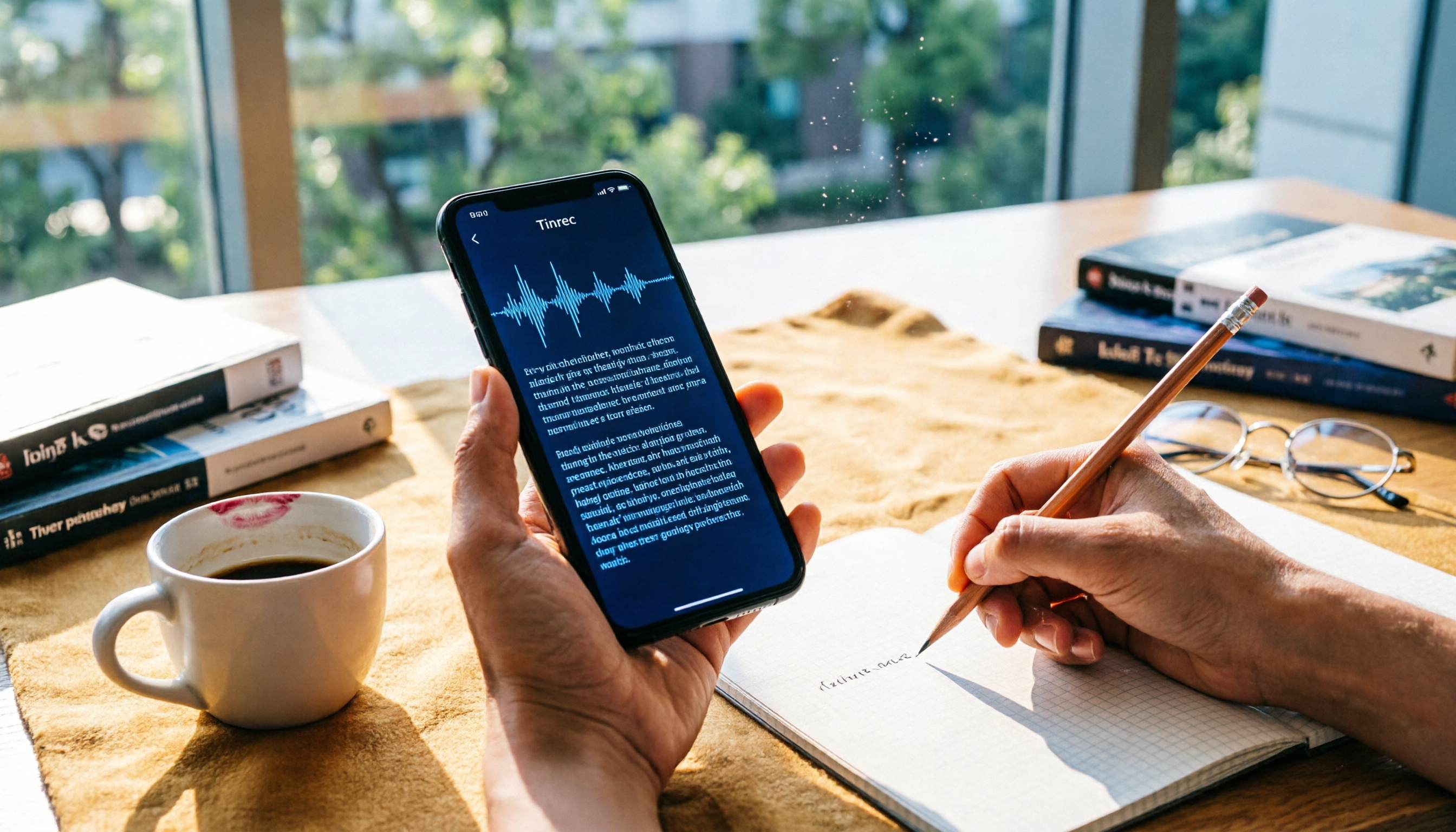
Based on hands-on student testing, this article compares four free speech-to-text tools—Tinrec, Notta, Yating Transcript, and Google Live Transcribe—analyzing their free quotas, accuracy, and AI features to help you find the best option for recording lectures and organizing notes.

2026 IG Reels Transcript Tools Compared: 3 Tools Tested — Paste a Link, Which Is Easiest and Most Accurate?
Want to turn Instagram Reels video content into a text transcript? This article tests 3 online tools that can extract text just by pasting a Reels link, comparing free quotas, accuracy, and AI features, and recommends the best solution for Chinese-language users.