
Turn recordings into transcripts and summaries in minutes
Upload audio or video for multilingual transcription, AI notes, and action items
Facing two-hour meeting recordings or classroom recordings, have you ever experienced the frustration of "recorded but no time to listen" or "spending half an hour just to find one sentence"? Traditional recording methods preserve sound but fail to effectively preserve "information."
This article will evaluate Traditional Chinese recognition accuracy, real-time transcription speed, AI summary capabilities, and free plan allowances to present five types of recording-to-text tool solutions worth considering in 2026. Through practical exercises, you'll learn how to use AI tools to directly convert voice into action lists.
Quick Navigation Conclusion:
- If you only need simple memos: Prioritize using your phone's built-in voice memo app (iOS/Android).
- If you primarily attend online meetings on your computer: Use built-in captioning features in Teams/Google Meet (but post-meeting organization is weak).
- If you need complete meeting minutes and action items: Choose an AI recording app with "comprehension" capabilities (e.g., Tinrec) to significantly reduce organization time.
1. Why You Need "AI Real-Time Speech-to-Text"? Solving Three Pain Points
Before diving into tool recommendations, let's clarify why traditional voice recorders or simple recording apps are no longer sufficient. For professionals and students, audio files have three significant drawbacks:
- Extremely low information density, high review cost: You can scan 500 words per minute in text, but only listen to 180 words per minute in audio. The time cost of reviewing recordings is typically 1:1 with the recording length, making it highly inefficient.
- Lack of structure, hard to capture key points: In hours-long audio, decisions and action items are often scattered across different segments, making manual organization prone to omissions.
- No searchability, knowledge cannot be retained: Traditional audio files are like black boxes; you can't Ctrl+F to search content, often turning recordings into "digital trash" that just takes up storage space.
Therefore, modern recording needs have evolved from "preserving sound" to "extracting information."
2. 2026 Popular Recording-to-Text Tools: Dimensional Comparison
With a plethora of tools available, we selected the most representative solutions for comparison, including native phone features, cloud meeting software, and professional AI recording tools (using Tinrec as an example).
| Criteria | Built-in Recording (iOS/Android) | Online Meeting Software (Teams/Meet) | Professional AI Recording Tool (e.g., Tinrec) | English Transcription Tool (e.g., Otter) |
|---|---|---|---|---|
| Core Purpose | Temporary voice memo | Online meeting caption aid | All-scenario recording notes and knowledge management | English meeting specific |
| Chinese Recognition | Average/Fair | Average | Excellent (supports mixed Mandarin/Cantonese/Taiwanese/English) | Weak/Not supported |
| Real-Time Transcription | Partially supported (varies by model) | Supported (online only) | Supported (real-time output during recording) | Supported |
| AI Summary/Conclusion | None | Basic version | Auto-generates meeting minutes and action items | Supported |
| Post-Recording Query | None | Hard to search | AI conversational query (ask the recording) | Text search |
| Export Formats | Audio only | Caption file (VTT) | Word, PDF, Markdown | TXT, PDF |
| Cost | Free | Included in enterprise plans | Free trial (100 min/month) / Subscription | Subscription |
Selection Recommendation:
Stop organizing recordings by hand
Upload audio or video and automatically get a transcript, summary, and action items
- If you are an iPhone user, iOS built-in Notes app is convenient but lacks robust summary features for long recordings.
- If you need to handle multilingual environments (e.g., meetings mixing Chinese and English) or speaker diarization, professional tools like Tinrec offer better value.
3. Deep Dive: How Tinrec Achieves "From Recording to Action"
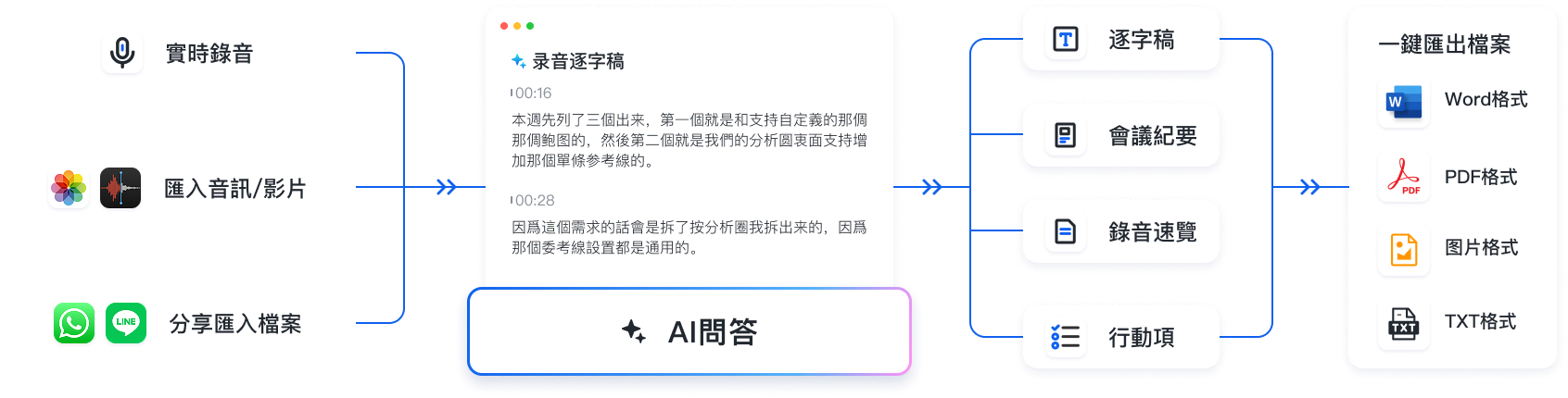
Among the many tools, Tinrec (Instant Voice Recording) has a unique design philosophy. It goes beyond converting voice to text, emphasizing a complete workflow of "Recording → Understanding → Action." Here are its main differences from traditional tools:
1. Multilingual Mixed Recognition and Real-Time Transcription
Unlike many tools that only support a single language, Tinrec supports 10 languages including Chinese, English, Japanese, Korean, Cantonese, and Taiwanese. This is very useful in cross-border meetings or foreign language learning, enabling real-time conversion of conversations into transcripts and reducing language barriers.
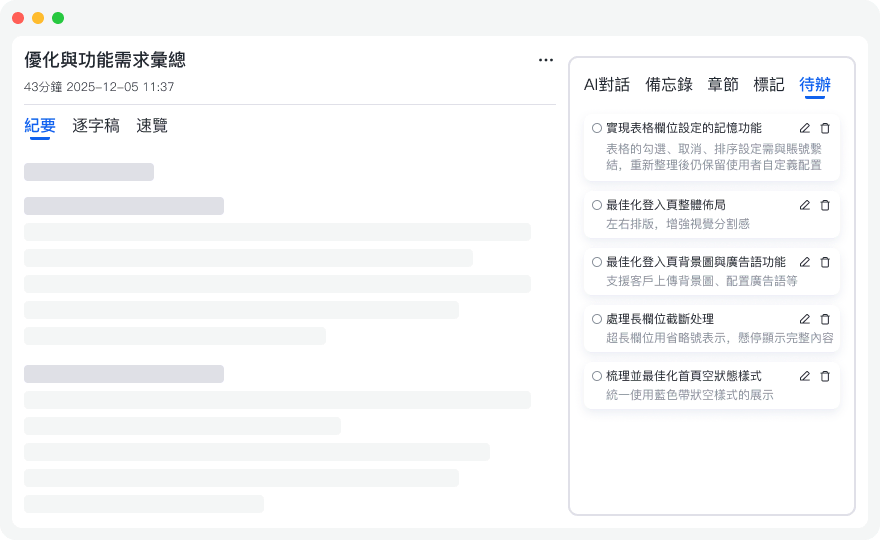
2. Not Just Transcripts, But "Decision Lists"
This is a key feature for many professional users. Tinrec uses AI to analyze the entire recording and automatically extracts:
- Meeting Minutes: Quickly summarize discussion points.
- Action Items: List who should do what by when. This directly saves 30 minutes of post-meeting note organization time.
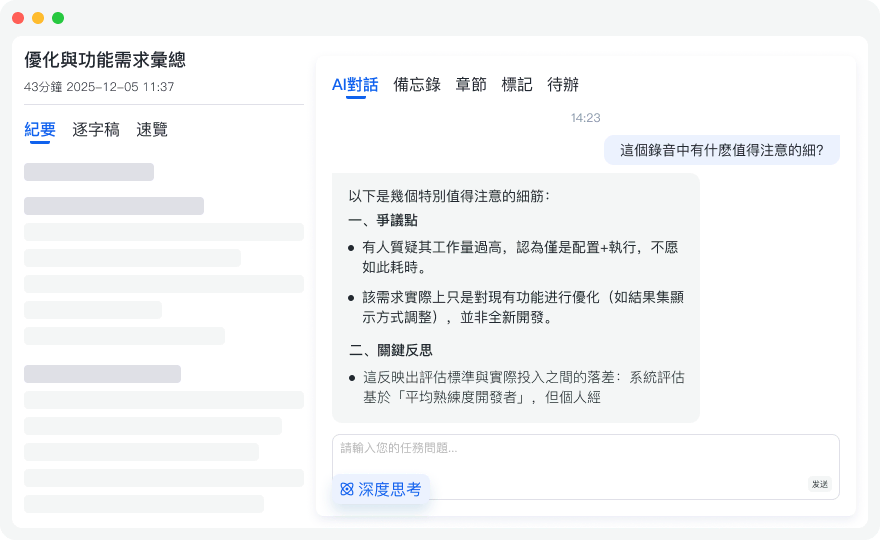
3. AI Conversational Query: Ask the Recording Like Asking a Person
Facing an hour-long interview recording, you don't need to read from start to finish. Tinrec's built-in "AI Conversational Query" feature allows you to ask direct questions, such as "What was the conclusion about the marketing budget in this meeting?" The AI answers based on the recording content, changing how we retrieve information.
4. Hands-On Tutorial: How to Quickly Generate Meeting Notes with a Mobile App
The following demonstrates how to use Tinrec to efficiently process a recording for meetings, lectures, or interviews.
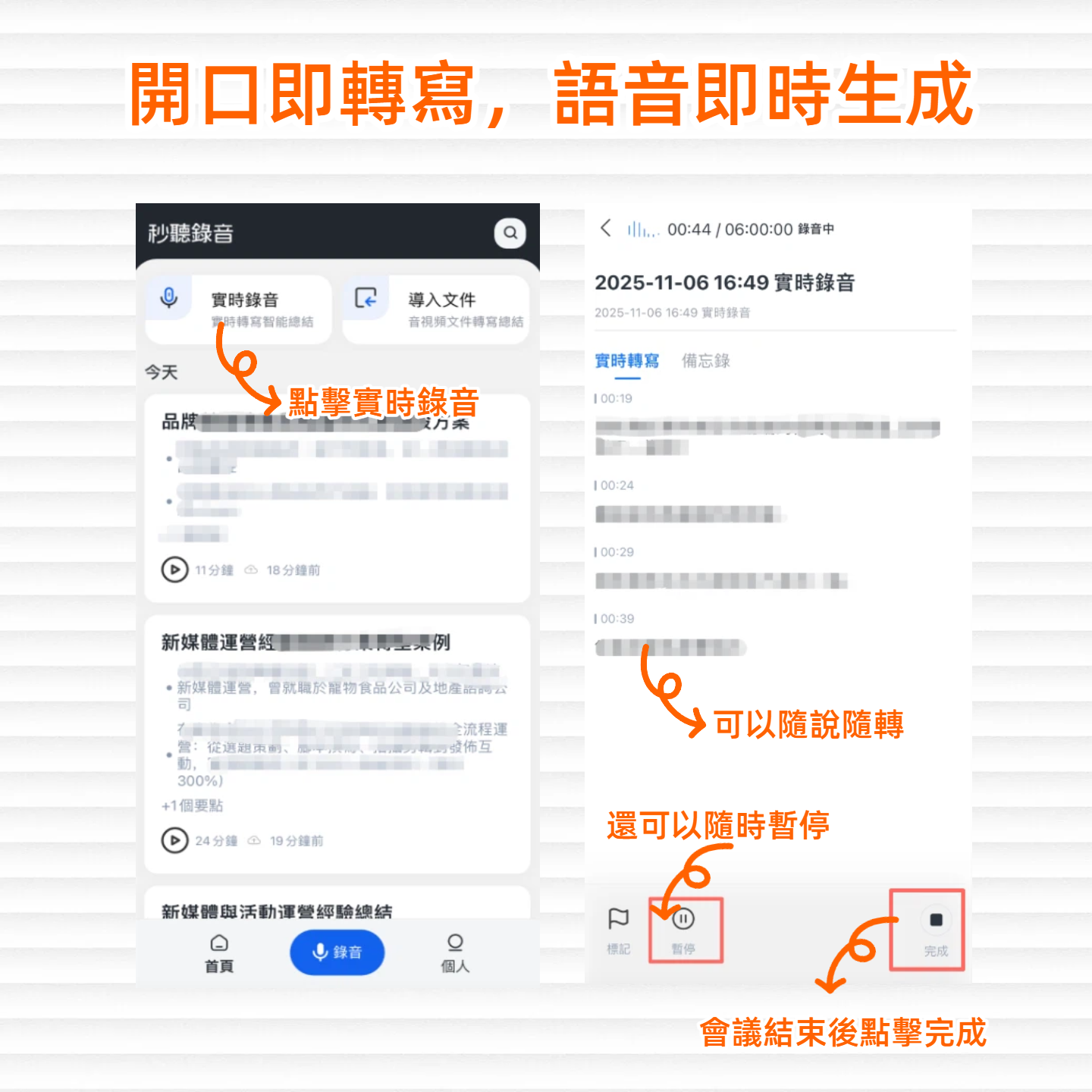
Step 1: Start Real-Time Recording
Open the Tinrec app or web version, and click "Start Recording."
- Tip: Place your phone between speakers for best results. The app displays real-time transcription as you record, so you can monitor progress.
- Entry Point: Record and transcribe in real time
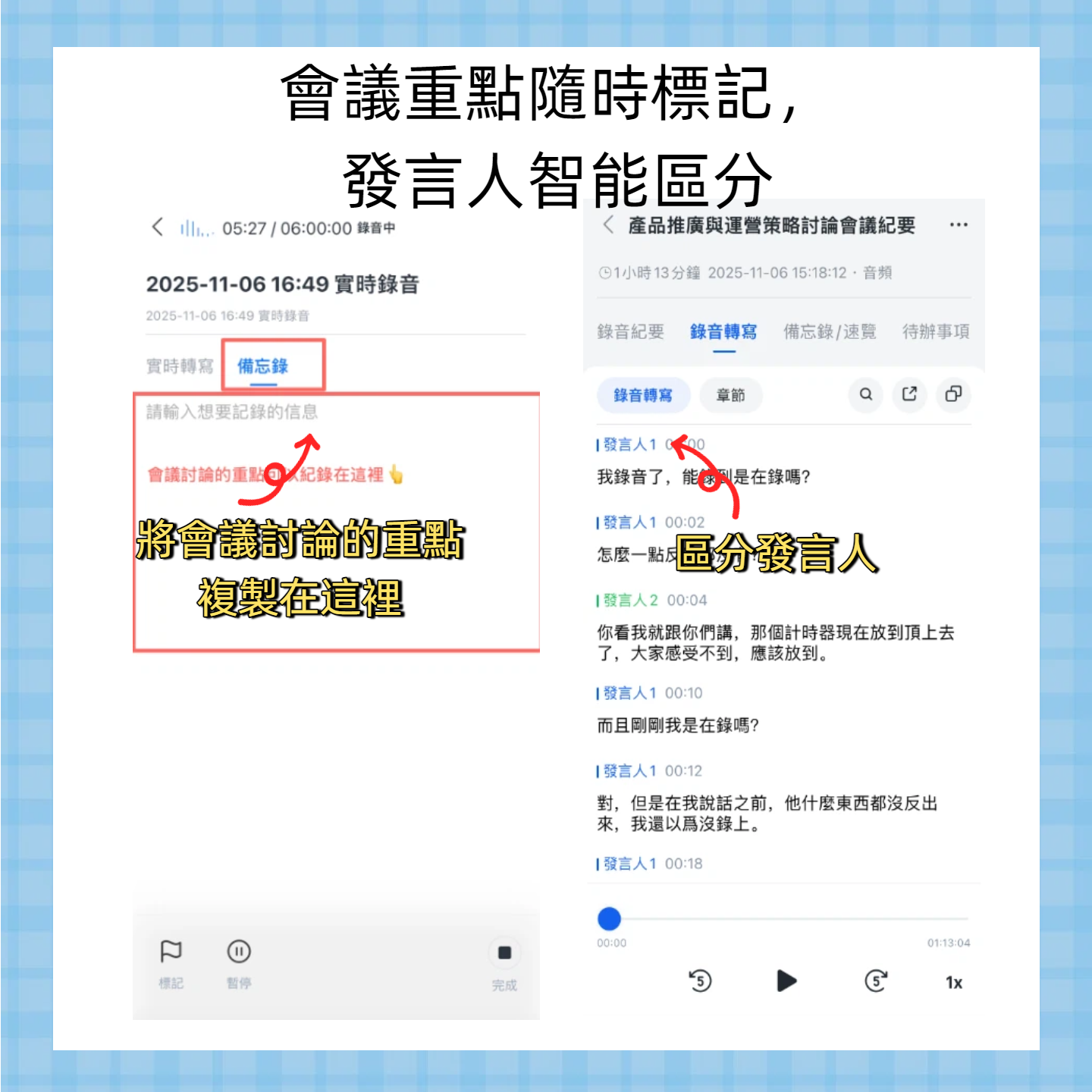
Step 2: Mark Key Points and Diarize Speakers
During recording, if you hear important sections, tap the bookmark button. After recording, the system automatically attempts to distinguish different speakers (Speaker A, Speaker B), and you can manually rename them (e.g., PM, Designer) for clearer transcripts.

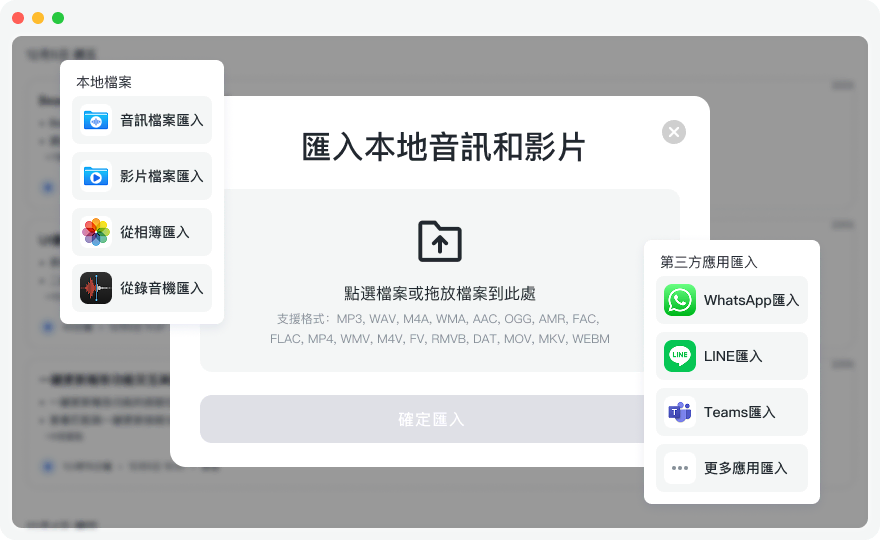
Step 3: Import External Files or Video Links (Optional)
If you already have recorded audio or want to transcribe YouTube/Podcast content, you don't need to re-record with your phone.
- Audio Files: Directly upload mp3/m4a formats.
- Video Links: Paste YouTube or TikTok links, and Tinrec will directly parse and generate summaries.
- Entry Points: Audio file to text | Video link to text
Step 4: Generate Summary and Export
After recording, click the AI analysis button. The system will generate structured notes. Finally, choose to export as Word, PDF, or Markdown format, ready to paste into your work reports.
5. Frequently Asked Questions (FAQ)
Q1: Is Tinrec's free plan sufficient? Tinrec offers 100 minutes of free transcription per month, usually enough for students and individual users who occasionally need to record class highlights or short meetings. For high-frequency business needs, consider Basic or Pro plans.
Q2: Does Tinrec work with iPhone call recording restrictions? Due to iOS privacy policies, most apps cannot directly record phone calls. It is recommended to use speakerphone and open Tinrec to record, or import a call recording file (if obtained through other means) into the app for transcription.
Q3: What affects transcription accuracy? Ambient noise and microphone distance are the biggest factors. Use in a quiet environment and keep the phone close to the speaker. Tinrec's AI includes semantic correction to auto-correct some grammar errors, but clear audio is still key.
Q4: Which languages are supported for transcription? Besides mainstream Chinese (Traditional/Simplified) and English, Tinrec supports Japanese, Korean, German, Cantonese, Taiwanese, and 10 other languages, suitable for multilingual learning or cross-border business.
Q5: Can I directly transcribe a YouTube video? Yes. Use Tinrec's "Podcast/Online Video to Text" feature: just paste the URL without downloading the video, and you'll get a transcript and AI summary, ideal for content creators organizing materials.
Q6: Is my recording data safe? Tinrec uses encrypted transmission to protect your audio data. For enterprise users or sensitive content, after completing transcription and export, manage cloud storage as needed.
Turn every recording into actionable outcomes
Get 60 free transcription minutes when you sign in. No credit card required.
Related Reading
You might also like

4 Best Speech-to-Text Tools in 2026: Free vs Paid Compared for US Users
We tested the most talked-about speech-to-text tools on Dcard and PTT, from free to paid, comparing Tinrec, Yating, Otter.ai, and Notta on features, pricing, and use cases to help you find the time-saving choice.

5 Best Speech-to-Text Tools Tested in 2025: AI Transcripts & Meeting Notes Compared
With countless speech-to-text tools available, this article tests Tinrec, MyEdit, SoundType AI, iPhone Voice Memos, and OpenAI Whisper across three dimensions—Traditional Chinese recognition, recording sources, and post-processing—to help you choose the right one for your needs.
2026 Hands-On Comparison of 4 Speech-to-Text Tools: Why Tinrec Is the Best Alternative for Notta Users?
This article compares speech-to-text tools like Tinrec and Notta, focusing on online meeting recording, AI summarization, and team collaboration, to help you decide which one suits American professionals best.

2026 Hands-On Comparison of 4 Recording-to-Text Apps: The Most Time-Saving Option for Chinese Meeting Notes
After testing multiple recording-to-text apps, Tinrec not only transcribes verbatim but also turns meetings into searchable, collaborative, trackable data. This article covers key buying considerations, hands-on insights, and tips to avoid common pitfalls.

Tinrec vs Otter.ai in 2026: A 4-Dimension Comparison to Find the Best Speech-to-Text Tool for Hong Kong Professionals
Tired of spending hours transcribing meeting recordings? We tested Tinrec and Otter.ai across four key dimensions—Cantonese recognition, bot-free recording, AI summarization, and team collaboration—to help you choose the right tool and save overtime hours.

2026 Hands-On Comparison of 2 Speech-to-Text Tools: Tinrec vs Otter.ai—Which Is More Practical for Bot-Free Meeting Notes and Chinese Summaries?
This article compares Tinrec and Otter.ai, two AI meeting note tools, across five dimensions: meeting capture, Chinese transcription, AI post-processing, team collaboration, and cross-platform support. It also compiles real user feedback from PTT in 2024 to help you choose the best option for Taiwanese office workers.

2026 Tinrec Voice-to-Text Tutorial: Cantonese Support & AI Meeting Minutes
We tested Tinrec (Miao Ting Lu Yin) and show you how to use AI to quickly convert recordings to text, automatically generate meeting minutes and action items, saving hours of manual transcription.

2026 Tinrec Review: A Yating Transcript Alternative with Bot-Free Recording & AI Meeting Minutes
This tutorial explains how to use Tinrec as a replacement for Yating Transcript, enabling bot-free online meeting recording, real-time transcription, and AI-generated meeting minutes—ideal for professionals who need to quickly organize meeting notes.

2026 Hands-On Comparison of 2 Recording-to-Text Tools: Tinrec vs Otter.ai – Which One Should Hong Kong Professionals Choose?
A hands-on comparison of Tinrec and Otter.ai, two recording-to-text tools, across five key dimensions: Cantonese recognition, bot-free meeting recording, AI Q&A, cross-platform use, and team collaboration, to help Hong Kong professionals pick the best option.