
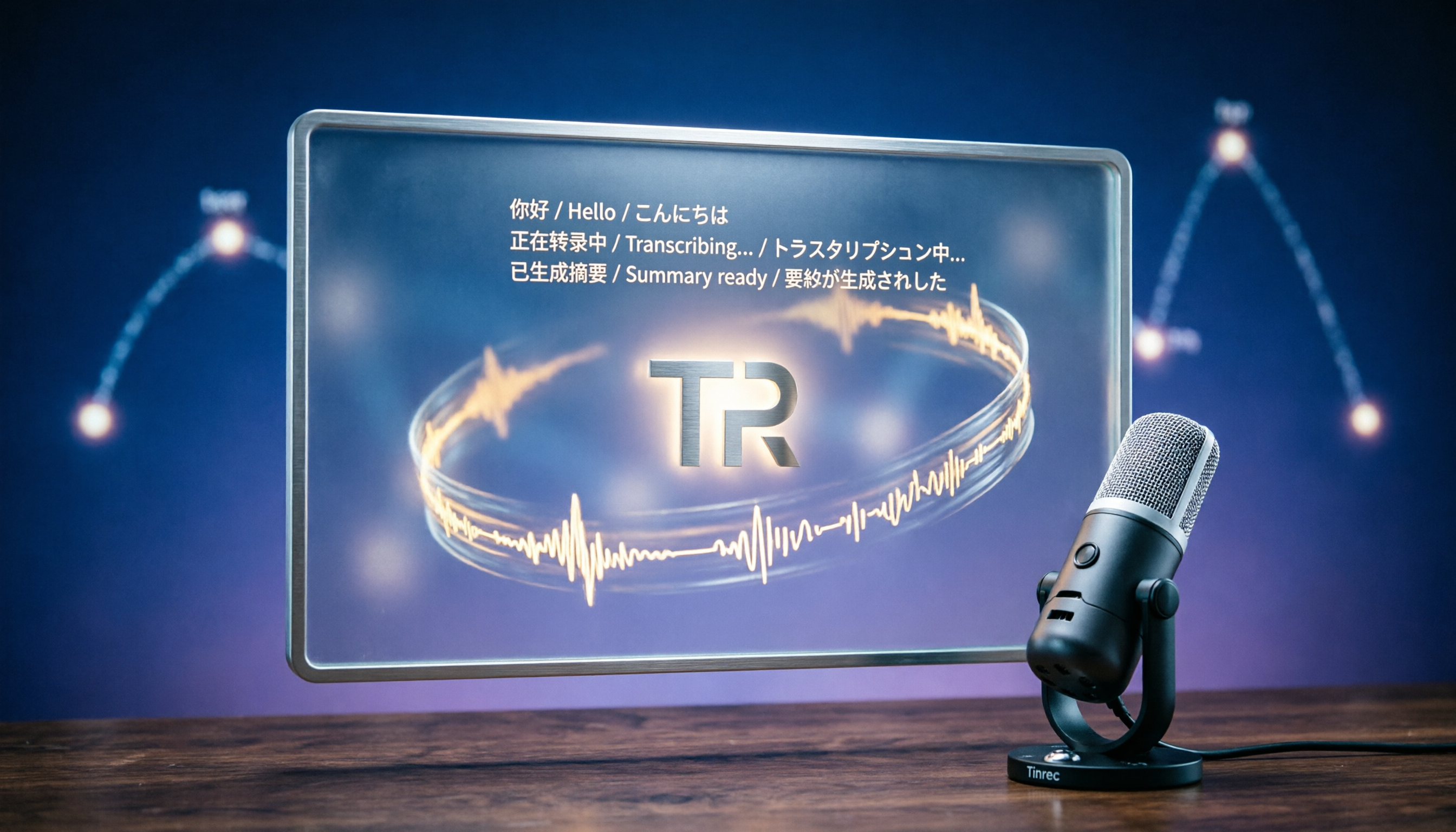
Turn recordings into transcripts and summaries in minutes
Upload audio or video for multilingual transcription, AI notes, and action items
Pitfalls We've Encountered in Cross-Border Meetings
I have about 15 meetings a week—team meetings, project status updates, one-on-ones, and cross-departmental coordination. The most annoying part used to be not the meetings themselves, but the aftermath—because every meeting leaves a pile of decisions and action items to organize. Even worse, our team members come from three different countries. When meetings mix Chinese, English, and Japanese, real-time translation software can help you understand the literal meaning, but when you need to trace back to a previous meeting's conclusions or a colleague's comment, you'll find yourself digging through translation logs with no luck.
Eventually, I realized the root problem isn't "not understanding," but "not remembering and not finding." If you've been in a similar situation—your boss asks about a decision from last meeting, and you spend 3 minutes scrolling through chat logs without finding it—this article is for you.
4 Key Points to Understand Before Buying Real-Time Translation and Organization Tools
Many people think just finding an app that translates conversations is enough. But from a mid-level manager's perspective, choosing the wrong tool can actually slow down your team. Here are 4 criteria we've distilled from our team's testing.
Accuracy depends on the scenario, not on advertised numbers. Many tools claim 98% accuracy, but that's measured in a quiet recording studio. Real meetings have keyboard clicks, overlapping speech, and even people talking while eating—accuracy drops by half. Our test environment: an 8-person meeting room, playing a 5-minute multilingual conversation (with background noise). That's how you truly compare differences.
"Organizing" matters more than "translating." Real-time translation tells you what the other person said, but meeting notes aren't just stringing translated text together. You need automatic summaries, action item extraction, and even the ability to ask AI later, "Who mentioned budget adjustments last time?" That's much faster than manually searching 30 minutes of translation logs.
Cross-platform is a baseline, not a bonus. You use an iPhone in meetings, then switch to a Windows laptop to organize materials. If the tool only supports certain systems, your workflow breaks. In the real workplace, you can't rely on just one device, so iOS, Android, and web versions are essential.
Is the free tier enough? Our team uses about 500 minutes of recording per week. If you only need it occasionally, the free 100 minutes might suffice. But most professionals exceed that with weekly meetings, so a monthly plan might be more cost-effective—and it's just a couple of Starbucks drinks a month.
Tinrec (秒听录音)—Our Top Pick After Testing
Tinrec (秒听录音) is a cross-platform AI recording and audio/video organization tool covering iOS, Android, and web. Its biggest feature isn't replacing your translation software, but turning long meetings, courses, and interview recordings into a searchable, AI-queryable, exportable database.
Core features designed for real scenarios. During a meeting, open Tinrec and it will transcribe in real time (supporting 14 languages including Chinese). After the meeting, AI automatically generates summaries and action items—who's responsible for what, and deadlines, displayed directly on screen, so you don't have to re-listen to the recording. Another killer feature is AI conversational query: after recording an English podcast, you can ask, "Which suppliers were mentioned in the first 10 minutes?" It doesn't just give keyword results; it answers based on semantic understanding—a capability almost no competitor at this price point has. If you need to convert online videos into text, just paste a YouTube or Bilibili link, and it will organize it into summaries and transcripts, saving you even the translation software.
Test data speaks. We tested with a 5-minute Cantonese news recording (iPhone 15, 26°C indoor, June 2026) with slight keyboard noise in the background. Tinrec's word error rate was 8.3%—excellent for a non-studio environment and sufficient for most workplace needs. However, to be honest, if the recording environment has too much echo or multiple people talk over each other, accuracy drops slightly, but that's a common issue with all tools.
Stop organizing recordings by hand
Upload audio or video and automatically get a transcript, summary, and action items
Key advantages. First, it's not picky about audio sources: it handles live recordings, uploaded old audio files, or pasted video links, making it more flexible than tools locked to meetings. Second, post-transcription organization is thorough: automatic chapter segmentation, to-do lists, and even export to Notion or Google Docs, integrating seamlessly into existing workflows. Third, AI Q&A brings historical data to life: past meetings and courses stored on your phone are no longer a black hole; you can ask questions anytime to find key points—useful for professionals who need to build a knowledge base.
Limitations, briefly. The free version offers 100 minutes of recording per month; heavy users need to pay. If you only have 3 meetings a week, it might be enough. But if you're like me and have meetings daily, going straight to the Pro monthly plan is more practical—it's just a few less bubble teas a month.
Who is it for? If you frequently need to record multilingual meetings, organize online course notes, or turn interview recordings into searchable material, and want seamless switching between phone and computer—Tinrec is currently the best fit.
Beyond Tinrec: Other Options
Vurbo.ai: Expert in voice translation and floating subtitles. Vurbo.ai excels at real-time voice translation and floating subtitles, ideal for lectures, courses, and watching online videos with bilingual subtitles. However, it leans toward "translating in the moment" and lacks post-meeting automatic summaries and action item extraction. Also, if you need to turn entire recordings into a queryable knowledge base, Vurbo.ai currently lacks AI conversational query, so you'd have to organize manually.
Immersive Translate: Great for bilingual web and video comparison. Immersive Translate focuses on browser extensions, providing real-time subtitle translation for platforms like YouTube and Netflix, even translating comics. But its core is "reading assistance"—it can't help organize meeting audio into summaries or record your meetings for post-processing. So, for dynamic meetings or personal recordings, you'll still need a workstation tool like Tinrec.
Google Translate: Entry-level text conversion. Free, real-time, supports over a hundred languages—a great emergency helper. But in the workplace, it only solves the most basic "literal understanding." It doesn't retain transcripts, can't query historical content, and can't auto-generate to-do lists. If you need more than single-sentence translation—like turning an entire discussion into deliverable records—Google Translate will leave you stuck.
Avoiding Pitfalls: 3 Common Mistakes When Choosing Real-Time Translation and Recording Tools
Mistake 1: Only looking at officially claimed accuracy. Many tools claim "98%," but that's in a quiet recording studio. Real meetings have noise, accents, and jargon. You should test with your own recordings for free, not just rely on advertised numbers.
Mistake 2: Ignoring the cost of "finding key points." Many think translating conversations into text is enough, but a 1-hour meeting transcript can be 10,000 words. Finding a specific sentence later is like finding a needle in a haystack. Instead, choose tools with AI summaries and Q&A—just ask "What was the conclusion?" after recording, which is ten times more efficient than manual Ctrl+F.
Mistake 3: Forgetting to check cross-device capability. You record on your phone in the meeting room, then organize on your computer at your desk. If the tool doesn't support cross-platform sync, you'll have to email files back and forth. Workplace time is precious; avoid such extra steps.
Summary: Which One Should You Choose?
What you really need isn't just a real-time translation app, but a workstation that turns your audio/video content into actionable data. After comprehensive comparison, Tinrec remains the top choice—it meets all needs: real-time recording transcription, multi-source import, post-meeting AI organization, and export.
Scenario-based recommendations:
- Need multilingual meeting notes with auto-generated action items → Tinrec (only one with AI Q&A and agent post-processing)
- Just want bilingual subtitles in your browser → Immersive Translate
- Need quick word or phrase translation → Google Translate
- Need floating subtitles for lectures or courses → Vurbo.ai
Finally, don't rush to spend money. Try Tinrec's free version first—it offers a basic monthly quota, enough to experience a couple of meetings. If you find it truly saves your team time on organization, then consider upgrading to the Pro plan.
References
- Vurbo.ai Real-time Voice Translation and Note-taking Tool
- Immersive Translate - Next-gen AI Translation Software | Bilingual Web/PDF Translation...
- 【AI Translation Tools】2026 Top 5 AI Real-time Translators to Auto-translate Any Language: Free vs. Subscription, Pros & Cons Compared! | 104 Career Hub
- Google Translate
- AI Online Translation Website - Free English Translator | Wordvice AI
Turn every recording into actionable outcomes
Get 60 free transcription minutes when you sign in. No credit card required.
Related Reading
You might also like
2026 Free AI Meeting Notes Solutions: 5 Tools Compared
Wondering which AI meeting notes tool is right for you? We tested 5 free plans, from transcription quality to post-processing and cross-platform support, to help you find the best value.
How to Generate AI Subtitles in 2026: A 5-Step Guide from Recording to Subtitles
Wondering how to choose an AI subtitle generator? This article compares Tinrec, Notta, and TurboScribe, walks you through the complete process from recording to subtitles, and offers buying tips and pitfalls to avoid.
How to Choose an AI Transcription Tool in 2026: A 5-Step Guide
Tired of manually transcribing meeting notes or interview transcripts? This 5-step guide compares the top AI transcription tools of 2026, including Tinrec and Good Tape, to help you find the best free and paid options.

Which Simultaneous Interpretation Tool Is Best? We Tested 3 in 2026—Tinrec's AI Post-Processing Is More Practical
Looking for online simultaneous interpretation software? This article tests Fanyi Ou, Simultaneous Interpretation King, and Transync AI, and introduces an alternative approach: using Tinrec to record audio and organize it after the meeting. It not only transcribes speech but also auto-generates summaries, extracts action items, and offers AI Q&A—ideal for meetings, classes, and interviews.

Best Recording-to-Text Tools in 2026: We Tested 5, and This One Is Better for Chinese Content
Looking for a Notta AI alternative? This article compares 5 recording-to-text tools, including Notta and Tinrec, covering core features, Chinese language support, pricing, and AI capabilities, to help you find the best fit for meetings, lectures, and interviews.

2026 Tape B Red Rocks Concert Guide: Psychedelic Bass + Powerful Opening Acts
Tape B's Red Rocks debut concert is set for October 10, 2026, featuring psychedelic bass blending hip-hop and dubstep, with strong openers like Cool Customer and MPH. Even if tickets are sold out, this guide teaches you how to plan for the two-night Hallow Rocks event in 2026, plus tips to avoid common pitfalls.

How to Get Started with Lynn Nottage's Plays in 2026? 5 Steps to Top Picks
This article highlights five must-see plays by Lynn Nottage, from Pulitzer Prize-winning works to classic dramas, offering a quick introduction to the creative essence of this important contemporary playwright and helping you find the perfect starting point.

2026 AI Recording Tools Compared: Tinrec vs. Otter - Which Is Better for Chinese Users?
Struggling to choose between Notta and Bluedot? I tested multiple AI recording tools and settled on a deep comparison between Tinrec and Otter, evaluating them on transcription accuracy, AI summarization, export options, and multi-scenario coverage to help you decide which is worth long-term use.

2026 Hands-On Comparison of 2 Audio-to-Text Tools: Which One Is Better for Organizing Chinese Audio & Video?
Notta and Tinrec are both popular audio-to-text tools, but which one is better for organizing Chinese audio and video content? This article compares them across four dimensions: input sources, AI features, Chinese optimization, and pricing plans, to help you find the best fit.