
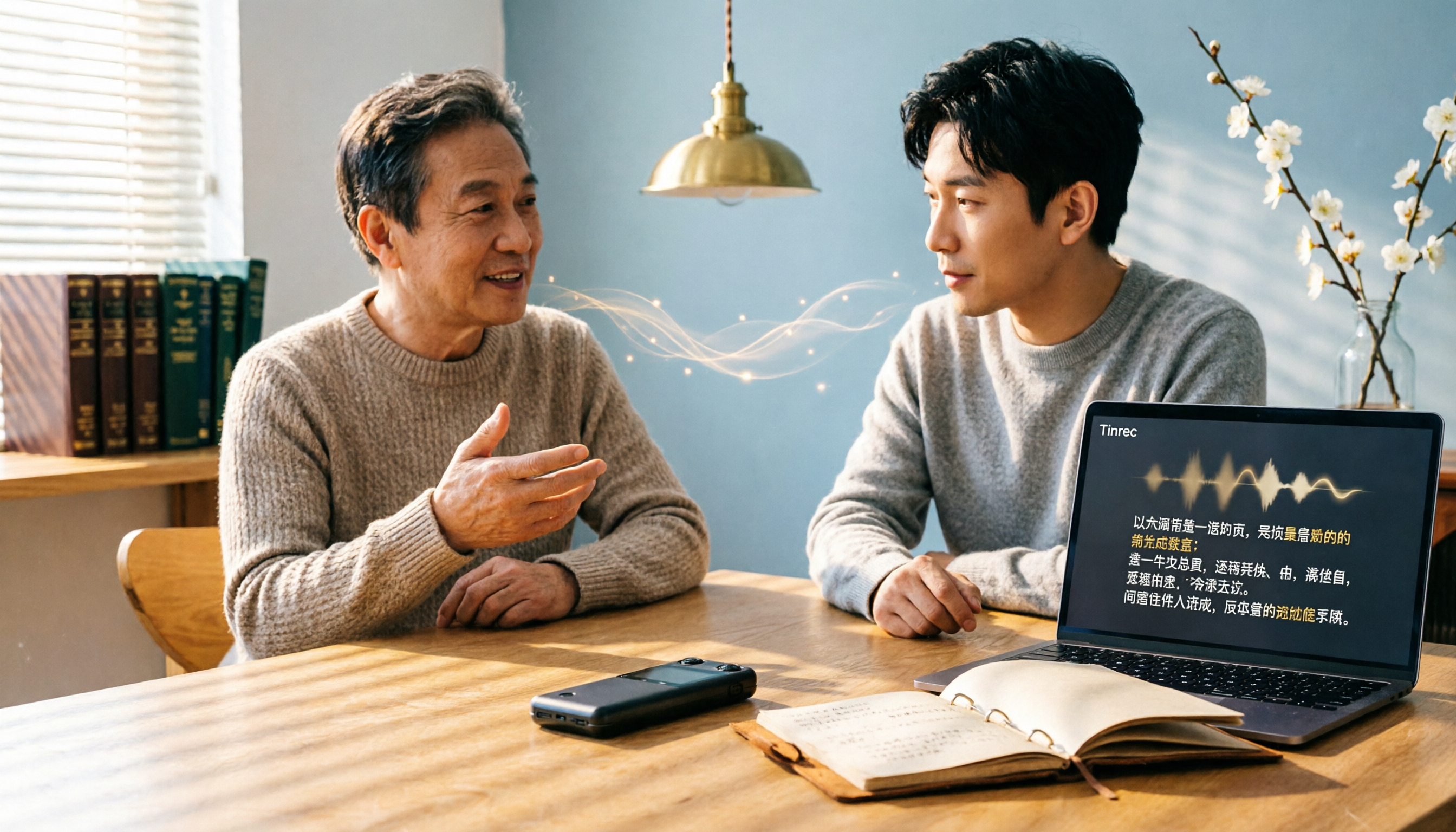
Turn recordings into transcripts and summaries in minutes
Upload audio or video for multilingual transcription, AI notes, and action items
What Can AI Recording-to-Text Do for You?
It's not just about turning audio into text—it's about turning long recordings, meetings, lectures, or interviews into immediately usable material.
Scenario 1: Meeting minutes in 5 minutes after the meeting
Previously, after a two-hour meeting, you might spend another hour summarizing key points. Now, with Tinrec as an example, by the time the meeting ends, AI has already generated summaries, conclusions, and action items—who's responsible for what, deadlines, all at a glance.
Scenario 2: Turning lecture recordings into review notes
Teacher talked for two hours, but you only took notes for the first half? Tinrec not only transcribes verbatim but also automatically splits chapters and highlights key points, so you can review the organized content before exams.
Scenario 3: No more back-and-forth transcription for interviews
For user interviews or journalist interviews, the worst part used to be transcribing. Tinrec supports uploading audio files or directly pasting YouTube links, quickly producing transcripts, and you can use AI Q&A to ask, "What did the interviewee say about pricing?"
Scenario 4: Turning online videos into text material
See a YouTube video perfect for an article but no time to rewatch? Paste the link, and Tinrec gives you the transcript, summary, and subtitles in minutes—ready to use as writing material.
What Are the Core Capabilities of AI Recording-to-Text Tools?
Transcription is just the basics; what matters is what you can do after transcription.
Real-time transcription: Text appears as you record
Not just after recording—Tinrec's real-time transcription has less than 1 second latency, so during meetings or classes, you can watch the text to confirm you haven't missed key points.
AI-structured summaries: Not just a condensed paragraph
Many tools give you a vague summary. Tinrec breaks it down into meeting topic, discussion conclusions, action items, responsible persons, even bullet points—ready to put into a report.
AI conversational query: Ask your recording like a database
After transcription, you can ask Tinrec, "Who mentioned the budget in the meeting?" or "What was the client's feedback on the new feature?" It answers based on semantic understanding, so you don't have to search manually.
Multi-source support: Not just recordings, but online videos too
Besides live recording and file upload, you can paste public video links from YouTube, Bilibili, Xiaohongshu, etc., and Tinrec will transcribe and summarize them.
Post-processing: Bring results into your workflow
Organized content can be exported to Notion, Google Docs, OneNote, or downloaded as Word or PDF—no need to copy-paste manually.
Practical Use Cases
Whether you're an office worker, student, or creator, there's always a scenario where you'll need this.
Meetings: From recording to to-do list
With multiple meetings a week, the fear is forgetting who's responsible for what. Use Tinrec for live recording, get summaries and action items automatically, and paste them into team collaboration tools.
Classes and lectures: Turning audio into review handouts
Record the teacher's explanation in class; Tinrec not only gives you the transcript but also auto-chapters and highlights key points, so you don't have to re-listen to two hours of audio before exams.
Interviews and research: Quickly organizing interview material
For user interviews or field research, each session is one to two hours. Upload the recording, use AI Q&A to quickly find key statements, saving hours of transcription time.
Stop organizing recordings by hand
Upload audio or video and automatically get a transcript, summary, and action items
Content creation: From video to copy
Want to write an article but inspiration comes from a video? Paste the link, let Tinrec transcribe it, then ask AI to generate an outline or social media post—doubling your creative efficiency.
5 Things to Consider When Choosing a Recording-to-Text Tool
There are many tools on the market, from Notta, Otter, to various meeting bots, but you need one that truly fits your situation.
Not just transcription, but organization
Some tools give you a full transcript and stop. Tinrec emphasizes "understanding after transcription": auto-summarization, chapter splitting, action item extraction, and the ability to ask questions. Notta also has summaries, but Tinrec's AI conversational query lets you dig deeper into content.Chinese language experience is key
If you mainly process Chinese content (meetings, lectures, interviews), the quality of summaries and recognition of proper nouns will vary greatly. Tinrec is clearly designed with Chinese users in mind, supporting Traditional Chinese output for meeting minutes and mind maps. In contrast, Notta supports 58 languages, but some deep organization features are most mature in English.Input sources should be broad
If you only have online meetings, a meeting bot might suffice; but if you also have local recordings, YouTube videos, or quick phone recordings, you need a multi-source tool like Tinrec—live recording, file upload, and online video links all work.Free plans should be actually usable
Notta's free plan offers 120 minutes per month, but with a 3-minute limit per recording, making it nearly impossible to test full features. Tinrec provides a basic free allowance, letting you try real-time transcription and online video parsing before deciding to pay.Post-processing and export
Your work shouldn't be locked in the app. Tinrec supports export to Notion, Google Docs, OneNote, and download as Word or PDF, even generating meeting reports or tables directly, making it easy to integrate into your workflow.
FAQ
Q: What's the main difference between Notta and Tinrec?
A: Notta excels in multilingual transcription and translation, making it more of a general-purpose transcription tool. Tinrec emphasizes "organization and use" after transcription, including AI conversational query, online video parsing, and diverse export options, with more complete support for Chinese content. If you mainly handle Chinese meetings, lectures, or interviews, Tinrec will be more convenient.
Q: Is Tinrec's free version sufficient?
A: The free version provides basic transcription allowance, enough to test a few meetings or a lecture recording. If you use it occasionally, the free version is fine; if you have intensive meetings or classes coming up, consider the weekly card or Pro plan.
Q: Does recording quality affect transcription accuracy?
A: Yes. All AI transcription tools are affected by background noise, accents, and multiple people speaking at once. Tinrec performs well with clear audio, but if the environment is too noisy, we recommend using a headset microphone or recording closer to the sound source.
Q: Can I use Tinrec to organize YouTube videos?
A: Yes, just paste the public video link, and you'll get the transcript, summary, and subtitles. However, please comply with platform terms and copyright regulations.
Q: Does Tinrec have a mobile app?
A: Yes, apps are available for iOS and Android, and they automatically sync with the web version, so you can record on the go and organize on your computer at home.
Conclusion
AI recording-to-text is already a tool that can save you a lot of time. If you're looking for a Notta alternative, or simply want a tool better suited for Chinese content that truly turns recordings into knowledge, Tinrec is worth trying. Start with the free version for one meeting or class, and experience the convenience of AI organizing your key points—once you've used it, it's hard to go back to manual transcription.
References
Turn every recording into actionable outcomes
Get 60 free transcription minutes when you sign in. No credit card required.
Related Reading
You might also like

2026 Tested: 4 Best Recording-to-Text Tools for Chinese Meetings & Content Organization
Wondering about Notta AI cost? We tested Tinrec, Notta, Otter, and Fireflies, comparing Chinese accuracy, AI summaries, multi-source support, and free plans to find the best value for your money.

2026 Hands-On Comparison of 4 AI Meeting Recorders: Is Meeting Ink, the Dcard Favorite, Really Worth It?
Many people on Dcard have been discussing Meeting Ink, but choosing an AI meeting recorder isn't just about features. This article takes a 'methodology' approach, using Tinrec as an example to help you build a recording → transcription → summarization workflow, and compares Otter.ai, Notta, and Meeting Ink to help you find the right solution.

Best AI Subtitle Tools in 2026: 4 Tested, This Free One with AI Summarization Is the Best Value
Looking for a free AI subtitle tool? This article tests WayinVideo, cSubtitle, Captune, and Tinrec, comparing accuracy, free quotas, and post-processing features to recommend the best free AI subtitle solution for US users.

2026 Hands-On Test of 4 Speech-to-Text Tools: Which Saves You the Most Time for Chinese Meeting Notes?
We tested Notta, Otter.ai, Tinrec, and other AI speech-to-text tools from a mid-level manager's perspective, analyzing accuracy, AI summaries, and organization efficiency for Chinese meeting notes to help you choose the truly time-saving option.
5 Best Recording-to-Text Apps Compared in 2026: Top Alternatives to Notta
If you're searching for a Notta app alternative, you're likely looking for a recording-to-text tool to organize meetings, lectures, or interviews. This article compares Tinrec, Notta, Otter, TurboScribe, and PLAUD Note across free plans, AI summaries, Chinese accuracy, and multi-source transcription to help you find the best fit.
2026 Free AI Meeting Notes Solutions: 5 Tools Compared
Wondering which AI meeting notes tool is right for you? We tested 5 free plans, from transcription quality to post-processing and cross-platform support, to help you find the best value.
How to Generate AI Subtitles in 2026: A 5-Step Guide from Recording to Subtitles
Wondering how to choose an AI subtitle generator? This article compares Tinrec, Notta, and TurboScribe, walks you through the complete process from recording to subtitles, and offers buying tips and pitfalls to avoid.
How to Choose an AI Transcription Tool in 2026: A 5-Step Guide
Tired of manually transcribing meeting notes or interview transcripts? This 5-step guide compares the top AI transcription tools of 2026, including Tinrec and Good Tape, to help you find the best free and paid options.

Which Simultaneous Interpretation Tool Is Best? We Tested 3 in 2026—Tinrec's AI Post-Processing Is More Practical
Looking for online simultaneous interpretation software? This article tests Fanyi Ou, Simultaneous Interpretation King, and Transync AI, and introduces an alternative approach: using Tinrec to record audio and organize it after the meeting. It not only transcribes speech but also auto-generates summaries, extracts action items, and offers AI Q&A—ideal for meetings, classes, and interviews.