
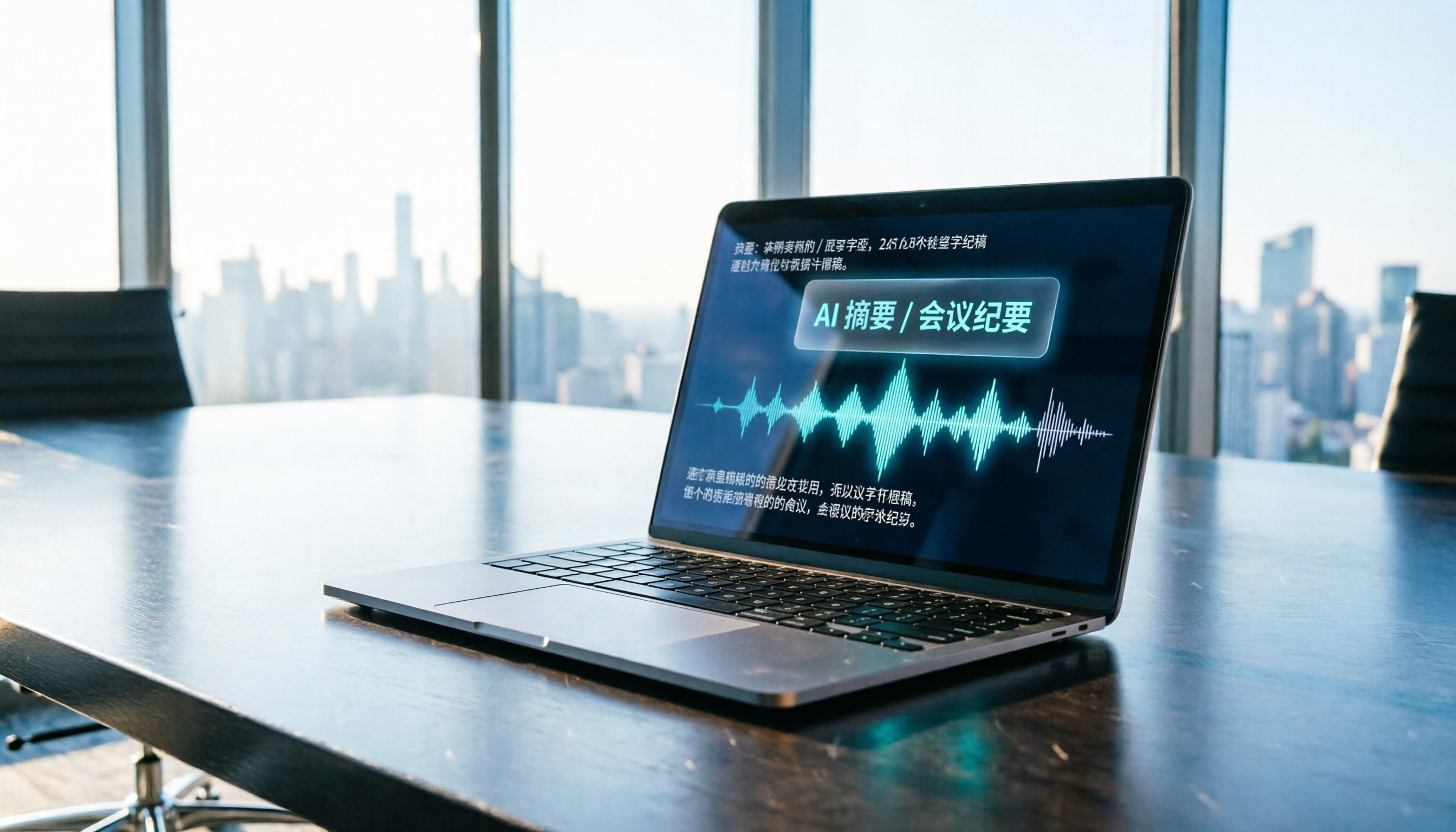
Turn recordings into transcripts and summaries in minutes
Upload audio or video for multilingual transcription, AI notes, and action items
I attend about 15 meetings a week—team meetings, project status updates, one-on-ones, and cross-departmental coordination. The most annoying part used to be not the meetings themselves, but what came after—because every meeting left a pile of decisions and action items to sort out. Then I switched to Tinrec, and now it takes just 5 steps to turn recordings into searchable, organized meeting minutes. This guide walks you through the process.
Before You Start: What You'll Need
- A smartphone (iPhone or Android—Tinrec supports both platforms)
- Download the Tinrec app (free on the App Store or Google Play; registration only requires Google or Apple ID login)
- A recording you want to convert to text (could be a meeting, lecture, or interview recording)
- A stable internet connection (real-time transcription requires internet; if you need offline use, download the language pack in advance)
Step 1: Record the Content You Want to Transcribe
The goal here is to get a clear audio file—it's the foundation for all subsequent steps.
Open Tinrec and tap the record button on the main screen to start recording. Keep your phone close to the speaker—the closer it is, the clearer the audio, and the higher the transcription accuracy. For one-on-one interviews, place the phone between the two people; for group meetings, put it in the center of the table.
Why emphasize recording quality? Because AI transcription accuracy depends on audio quality—even the best transcription engine can't handle blurry audio. Instead of spending time proofreading later, spend an extra 30 seconds positioning the phone during recording.
Once done, you'll see the recording on Tinrec's main screen, with duration and file size displayed.
(Illustration: A person recording in a meeting room, phone placed in the center of the table, surrounded by participants, professional and natural atmosphere)
Step 2: Let AI Generate a Transcript
The goal here is to turn the recording into text—this is the basis for all subsequent analysis.
If you just finished recording, Tinrec will automatically start transcribing; if it's an existing file, tap "Import" to upload an audio or video file. Tinrec supports multiple formats and can also directly paste links to public videos like YouTube or Bilibili for transcription.
After uploading, Tinrec uses AI models for speech recognition, usually completing the transcript within minutes. Once done, you'll see the full text on screen, with timestamps automatically added.
Why use AI transcription instead of doing it yourself? Because an hour of recording takes at least three to four hours to transcribe manually, while Tinrec does it in minutes, freeing you up for more important tasks.
When finished, you'll have a searchable, editable transcript with a timeline for quick navigation.
(Illustration: Phone screen showing a transcript, clear text, office desk background with a cup of coffee)
Step 3: Quickly Proofread the Transcript
The goal here is to correct any words the AI might have misheard, ensuring accuracy.
Open the transcript and skim through it. Errors usually cluster around proper nouns, names, or heavily accented segments. Tinrec's editing feature lets you tap directly on the text to make changes, and you can play the corresponding audio to verify.
Why proofread? Because AI transcription, while powerful, can still make mistakes in noisy environments or when multiple people speak at once. Spending five minutes proofreading prevents embarrassing errors in meeting minutes, so you won't look bad when reporting to your boss.
After proofreading, your transcript becomes a reliable reference document.
(Illustration: A person sitting at a computer, screen showing a transcript, fingers typing corrections, focused expression)
Step 4: Let AI Generate Meeting Minutes
The goal here is to turn the transcript into actionable key points.
Stop organizing recordings by hand
Upload audio or video and automatically get a transcript, summary, and action items
In Tinrec, tap the "AI Summary" or "Chapter Organizer" feature. Tinrec automatically analyzes the transcript, extracting meeting topics, key conclusions, and action items. You can also use the AI Q&A feature to ask questions directly, such as "What decisions were made in this meeting?" or "Who is responsible for what task?"
Why use AI to generate meeting minutes? Because transcripts are too long—your boss won't read them. What you need is a concise version with "conclusions + action items + assignees." Tinrec can pull out 200 words of key points from a 10,000-word transcript, which is exactly what mid-level managers need.
When done, you'll have a structured meeting summary with a title, summary, chapters, and a to-do list.
(Illustration: Laptop screen showing meeting minutes, summary on the left, to-do list on the right, modern office background)
Step 5: Export and Share
The goal here is to bring the organized results into your workflow.
Tinrec supports multiple export formats, including Word, PDF, TXT, subtitle files, and more. It can also sync directly to Notion, Google Docs, OneNote, or Dropbox. You can email the meeting minutes to team members or post them to your company's collaboration platform.
Why export? Because Tinrec is your organizing hub, but the final output needs to fit into your existing work habits. Instead of locking data inside the app, export it to a place where everyone can see it.
After exporting, your meeting records become a shared team asset.
(Illustration: A person clicking the export button on a computer, with multiple cloud service icons displayed, clean and simple design)
FAQ and Troubleshooting
Q: The transcribed text has many errors. What should I do? Usually, the recording environment is too noisy or the distance is too far. Tinrec has built-in smart noise reduction—enable it in settings before recording. If you're using an existing file, you can manually select "High Noise Environment" mode after importing. Most transcription tools on the market don't have this option—they use default settings for all recordings.
Q: My meetings mix Chinese and English. Can Tinrec handle that? Yes. Tinrec is optimized for Chinese content and can also handle mixed Chinese-English conversations. Actual performance may be affected by accents and background noise, but it performs reliably in typical business meeting scenarios.
Q: Is the free version sufficient? If you only have about 3 meetings a week, the free monthly allowance is generally enough. But if you have meetings every day like I do, I recommend upgrading to the Pro version—it costs less than two Starbucks coffees a month.
Q: Are my uploaded recordings secure? Tinrec values data privacy; your files are not used to train models. However, for highly confidential meetings, it's advisable to check your company's policy before uploading.
Advanced Tips: 3 Ways to Double Your Efficiency with Tinrec
- Use AI Q&A to dig out key points directly: Don't read the transcript from start to finish; instead, ask Tinrec directly, "What was the conclusion about the budget in the last meeting?" It will give you the answer like querying a database. This is something most transcript tools can't do.
- Turn online videos into text material: Paste a YouTube or Bilibili link, and Tinrec will generate a transcript and summary. This is useful for tracking competitors or gathering market intelligence; most transcription tools only accept files, not links.
- Use Agent post-processing to auto-generate reports: Tinrec can generate meeting records, tables, or documents directly from the recording content, saving you the hassle of copy-pasting. This feature is rarely seen on the market.
If You Don't Use Tinrec, Here Are Alternatives
- Otter.ai: Its strength is automatic recording of online meetings, but its support for Chinese content and online videos is not as comprehensive as Tinrec's.
- Notta: Good transcription and translation capabilities, but weaker in deep organization features (like AI Q&A or Agent-generated documents).
However, if you need to "turn various audio and video into usable knowledge," Tinrec remains the most convenient choice.
Conclusion
Now that you've learned these 5 steps, you can use Tinrec to convert any recording into a transcript, automatically generate meeting minutes, and even use AI Q&A to find key points directly. Next step: download the free version of Tinrec and try it with one of your own recordings. The monthly free allowance is enough for two or three meetings.
Starting today, your post-meeting time is no longer consumed by organizing notes.
References
- Home | Vocol.ai Voice Collaboration Platform
- Media Library | Vocol.ai Voice Collaboration Platform
- Vocol.ai: Enhancing Voice Collaboration Efficiency with AI, Supporting Multilingual Transcription and Team Collaboration | News | AI Digital Transformation Training Hub | National Taichung University of Science and Technology Extension Education Division
- vocol.ai Voice Collaboration Platform
- Uncovering Insights in Voice: Vocol.ai, an AI Online Voice Collaboration Tool Beyond Standard Transcript Software - INSIDE
Turn every recording into actionable outcomes
Get 60 free transcription minutes when you sign in. No credit card required.
Related Reading
You might also like

5 Best Recording-to-Text Tools Tested in 2026: Can Tinrec's Chinese Summarization Really Save You Time?
Meetings, classes, interviews, videos—do you have piles of recordings but no time to organize them? This article tests several AI recording tools to find the best one for handling multi-source audio content, with an in-depth look at Tinrec's AI summarization features.

Tinrec vs Vocol 2026 Comparison: Multi-Source Audio Transcription + AI Q&A Post-Processing
This article compares Tinrec and Vocol.ai across five dimensions: input sources, post-transcription organization, Chinese language experience, export and post-processing, and ease of use, helping you decide which is better for organizing meetings, courses, interviews, and online videos.

2026 Vocol.ai Latest Version Hands-On Review: 3 Major Upgrades That Save Office Workers Time
The latest version of Vocol.ai continues to use AI to handle speech-to-text for meetings, courses, and podcasts, along with real-time collaboration and multilingual translation. This article tests the latest features to see how it helps Hong Kong office workers save hours of transcription time.
Tinrec vs Otter.ai 2026 Hands-on Comparison: 5 Key Dimensions to Decide the Best Tool for Audio/Video Knowledge Management
A 2026 hands-on comparison of Tinrec and Otter.ai across four key dimensions—input sources, post-processing, Chinese language support, and export options—to help you choose the right audio/video organization tool.
How to Choose AI Transcription Tools in 2026? A 5-Step Guide Comparing Vocol, Tinrec, and More
Struggling with meeting minutes, course notes, and interview transcripts? This article, based on our hands-on testing, walks you through 5 key factors for choosing AI transcription tools, and compares Vocol, Tinrec, Otter, and Plaud to help you pick the right solution.

Notta vs Tinrec 2026: A 4-Dimension Comparison to Find the Best Value
How much does Notta cost? How does it compare to Tinrec for Hong Kong professionals? We break down the free, Pro, and Business plans and compare them across 4 key dimensions to help you choose.

2026 Free Audio-to-Text Solutions: 3 Tools Compared
We tested 3 AI audio-to-text tools, from free plans and multi-source support to AI post-processing, to help you pick the best fit for the workplace.

2026 Free Transcription Tools Roundup: 5 Options for Master Vocologia Students
Pursuing a Master in Vocologia in 2026 and need to organize countless lecture recordings, seminars, and interviews? This article reviews 5 transcription tools, including free and paid plans, highlighting Tinrec as the most complete AI recording assistant to turn your audio and video into searchable, summarizable knowledge.

2026 Hands-On Comparison of 4 AI Speech-to-Text Tools: How to Get the Most Out of Notta?
Notta is a popular AI speech-to-text tool that supports multilingual transcription, AI summaries, and meeting notes. This article compares Notta with Otter, Fireflies, Tinrec, and TurboScribe, and shows you how to get started with Notta quickly.