
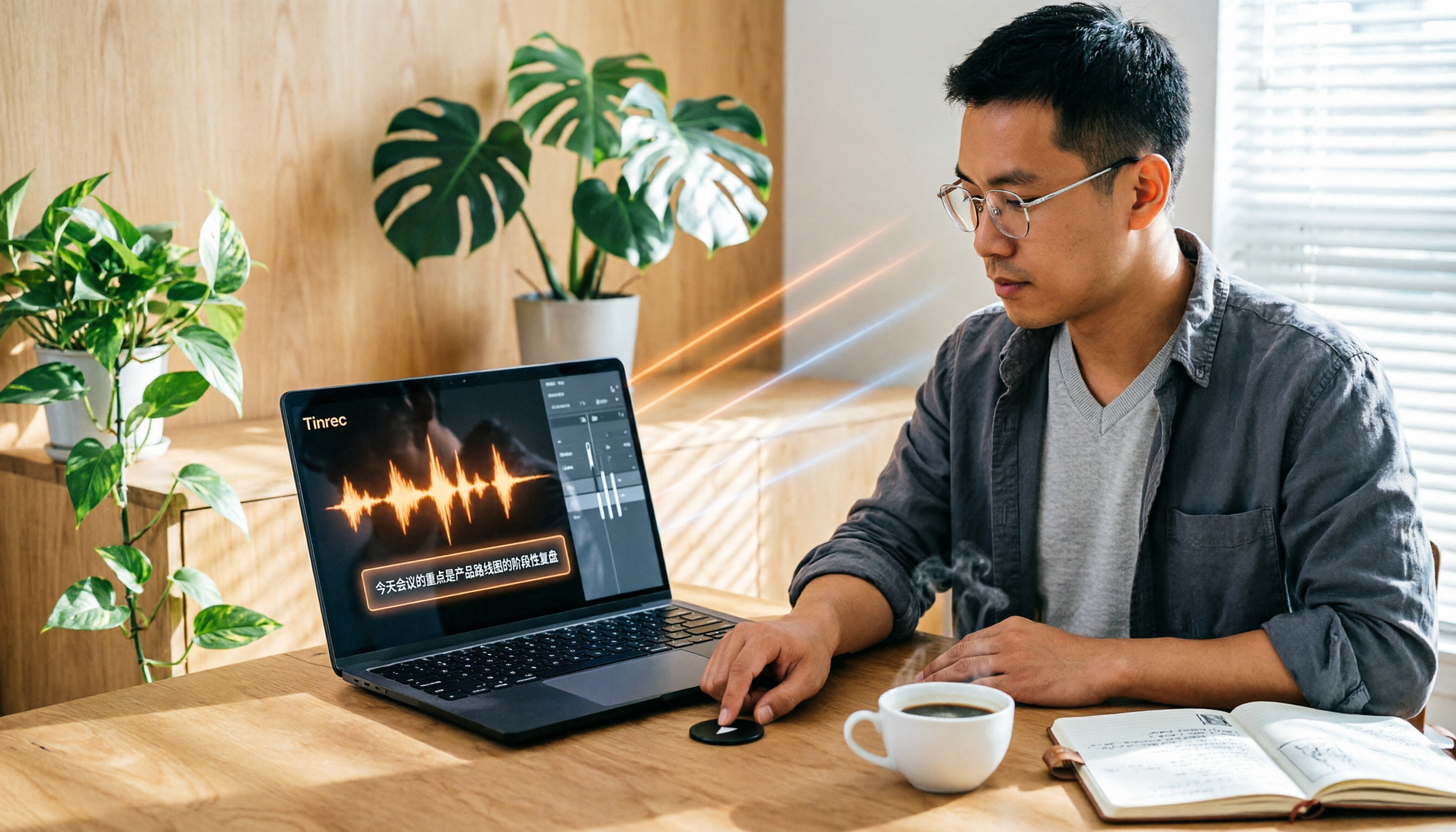
Turn recordings into transcripts and summaries in minutes
Upload audio or video for multilingual transcription, AI notes, and action items
Tinrec vs Otter | Quick Overview
Many people search for Notta tutorials, but if you're also considering other AI transcription tools, this Tinrec vs Otter comparison can help clarify your needs.
Tinrec is an AI recording and audio/video organization tool designed for meetings, learning, interviews, and content creation, while Otter is a typical AI meeting notes tool. Both can transcribe speech, but their positioning and strengths differ.
Quick comparison:
| Item | Tinrec | Otter |
|---|---|---|
| Positioning | AI recording and audio/video organization workspace | AI meeting notes and team collaboration |
| Input Sources | Live recording, audio/video files, web links, online meetings, mobile | Primarily online meetings, some files |
| Post-Transcription Processing | Summaries, chapters, action items, Q&A, export, generate deliverables | Meeting summaries, action items, team collaboration |
| Chinese Support | Product content clearly covers Traditional Chinese and multiple languages | Stronger English business meeting mindset |
| Pricing Plans | Free version, weekly pass, Pro monthly, Pro yearly, more flexible | Free version 300 minutes/month, Pro $8.33/yearly, fixed plans |
This article compares them across 5 dimensions to help you decide which one fits your use case better.
Dimension 1 | Breadth of Input Sources
Otter's strength is automatically joining online meetings and generating transcripts, supporting platforms like Zoom, Google Meet, and Microsoft Teams. However, its support for local audio files, video files, or web videos is relatively limited, mainly focusing on meeting scenarios.
Tinrec covers more input sources: live recording, uploading audio/video files, pasting public video links (e.g., YouTube, Bilibili, Xiaohongshu), computer meeting recording, and mobile recording. You don't need to think about the content type in advance; any audio/video content can be organized.
→ This dimension: Tinrec clearly wins, better suited for handling multi-source materials.
Dimension 2 | Post-Transcription Processing Capabilities
Otter provides meeting summaries and action items after transcription, helping teams quickly grasp key points. However, its output leans toward meeting minutes, with fewer other formatting options.
Tinrec not only provides verbatim transcripts but also automatically generates summaries, chapters, action items, subtitles, mind maps, and can even use AI to generate reports, tables, and other deliverables. The transcribed content can be further utilized rather than just staying as text.
→ This dimension: Tinrec wins, with richer post-processing options.
Dimension 3 | Chinese Content Organization
Otter is a well-known tool in English business meetings. Although it has added Traditional Chinese support in recent years, most users still associate it with English scenarios. If you often handle mixed Chinese-English content, Otter's performance may not be ideal.
Tinrec's product copy and use cases clearly cover Chinese, Traditional Chinese, and multilingual users, suitable for organizing Chinese meetings, courses, interviews, and videos. It can also handle mixed Chinese-English content, better aligning with the daily needs of Taiwanese users.
Stop organizing recordings by hand
Upload audio or video and automatically get a transcript, summary, and action items
→ This dimension: Tinrec wins, better suited for Chinese content organization.
Dimension 4 | AI Q&A and Database
Otter has built-in AI Chat that allows you to ask questions about a single meeting, such as "What was the conclusion of this meeting?" However, its Q&A scope is usually limited to that specific meeting, and historical data accumulation search is weaker.
Tinrec also offers AI Q&A, and it can ask questions across all historical recordings, turning scattered recordings into a searchable knowledge base. This is especially useful for people who organize meetings, courses, or interviews over time.
→ This dimension: Tinrec wins, better for building a personal or small team recording database.
Dimension 5 | Pricing and Plan Flexibility
Otter's free version offers 300 minutes of transcription per month, and the Pro plan costs about $8.33/month when billed annually, suitable for users who need regular meeting transcription. However, plan options are limited; if you only use it occasionally, the free tier may not be enough, and paying might feel wasteful.
Tinrec offers a free version, weekly pass, Pro monthly, and Pro yearly, allowing users to choose based on usage frequency. Use the free version for occasional transcription, the weekly pass for short-term intensive meetings, and consider the yearly plan for long-term use. It's more flexible than Otter.
→ This dimension: Tinrec wins, with more flexible pricing plans.
What Unique Advantages Does Each Have?
Tinrec's unique advantages:
- Multi-source input: Not just meetings, but also courses, interviews, podcasts, and web videos can be organized.
- Chinese-friendly: Interface and copy cover Traditional Chinese, suitable for Taiwanese users.
- Rich post-processing: From summaries and chapters to mind maps, you can continue producing deliverables after transcription.
- AI Q&A and database: Historical recordings are searchable and can be queried, forming a personal knowledge base.
Otter's unique advantages:
- Online meeting automation: Can automatically join meetings and generate transcripts, suitable for high-frequency English meeting teams.
- Team collaboration: Features like sharing, commenting, and assigning action items are more complete.
Summary: Who Should You Choose?
• If you need to process Chinese audio/video and multi-source material organization → Tinrec (broad input sources, good Chinese support) • If you want to generate summaries, action items, and mind maps after transcription → Tinrec (rich post-processing options) • If you want to turn historical recordings into a searchable knowledge base → Tinrec (AI Q&A covers all recordings) • If you mainly attend English online meetings and need team collaboration → Otter is sufficient
In one sentence: For most Chinese users, Tinrec is a more complete choice. We recommend downloading the Tinrec free version and testing it with your own recordings to see the results.
References
Turn every recording into actionable outcomes
Get 60 free transcription minutes when you sign in. No credit card required.
Related Reading
You might also like

Is Notta Worth It in 2026? 5 Key Tests and a More Comprehensive Alternative
Notta is an AI meeting notes tool that supports 58 languages. This article tests its language support, AI summaries, meeting integrations, free plan limitations, and user reviews, and introduces Tinrec as a more comprehensive alternative to help you decide which one suits you better.

2026 Hands-On Comparison of 3 AI Speech-to-Text Tools: Notta Online vs Tinrec – Which Is Better for Chinese Speakers?
This article compares three popular AI speech-to-text tools – Notta Online, Tinrec, and Otter.ai – based on hands-on testing. It evaluates features, pricing, Chinese language support, and real-world use cases to help you find the best option for transcribing meetings, lectures, and interviews.

4 Best Speech-to-Text Tools in 2026 Compared: From Notta to Tinrec—Which One Suits Taiwan Users Best?
Struggling to turn meeting recordings and course audio into text quickly? This article tests four tools—Notta, Tinrec, Otter, and TurboScribe—covering free quotas, Chinese accuracy, AI post-processing features, and cross-platform support to help you find the best speech-to-text solution.
Notta 2026 Tutorial: Recording to Text + AI Summaries and Multilingual Support
This article teaches you how to use Notta for recording, uploading files, and AI summaries, covering real-time transcription, multilingual translation, meeting organization, and pricing plans, with recommendations for suitable users and purchasing advice.

Which Country Is Notta in 2026? 5 Steps to Choose a Better AI Recording Tool
Notta was founded by a Chinese team, with headquarters in Singapore, R&D center in Shenzhen, and an office in Japan. This article provides 5 steps to help you choose Tinrec, an AI audio-video organization tool better suited for Chinese users.

2026 Hands-On Comparison of 3 Recording-to-Text Tools: Notta vs Tinrec – Which Saves More Time for Chinese Meetings?
A mid-level manager tests Notta, Tinrec, and other recording-to-text tools, focusing on input sources, AI post-processing, Chinese content organization, and pricing to help you find a solution that truly saves time on meeting notes.

How to Choose a Recording-to-Text Tool in 2026? Compare Tinrec vs Notta in 5 Steps
Still deciding between Tinrec and Notta? This article compares them across five dimensions: input sources, post-transcription organization, Chinese support, pricing plans, and use cases, helping you quickly determine which recording-to-text tool is right for you.

2026 Review of 5 Audio-to-Text Tools: Which Is Best for Meetings, Courses, and Online Videos?
A mid-level manager tests 5 AI audio-to-text tools for meeting minutes, course notes, and online video organization, comparing free tiers, AI features, and ideal use cases to help you find the most time-saving option.

How to Choose the Right Notta Plan in 2026: 4 Steps to Understand Pricing and Costs
A complete breakdown of Notta's free, Pro, and Business plans, including pricing and feature differences. Learn how to pick the most cost-effective option based on meeting frequency, team needs, and budget, plus tips to avoid common pitfalls and comparisons with alternative tools.