

Turn recordings into transcripts and summaries in minutes
Upload audio or video for multilingual transcription, AI notes, and action items
2026 Free Cantonese Recording-to-Text Solutions: 2 Tools Compared
Office workers dread meetings, and even more so, having to listen back to recordings to write meeting minutes. Looking for a free solution to save time? This time, we compare two free Cantonese recording-to-text tools: Tinrec, an AI recording and organizing tool, and Google Voice Typing, built into smartphones. Which one is right for you? Read on.
Tinrec vs Google Cantonese Voice Typing: Quick Overview
Tinrec is an AI recording and audio/video organizing tool. The free version offers 100 minutes of transcription per month and supports recording, uploading audio files, and web video links. Google Voice Typing is a built-in feature on Android and iPhone, completely free, but mainly for real-time dictation; it does not support uploading recording files.
| Comparison Item | Tinrec Free Version | Google Voice Typing |
|---|---|---|
| Monthly Fee | US$0 (100 minutes/month) | US$0 (unlimited) |
| Supported Platforms | iOS, Android, Web | iOS, Android (built-in) |
| Recording File Upload | Supported (MP3, M4A, WAV, etc.) | Not supported; real-time dictation only |
| Mixed Chinese-English | Supports multilingual mixing | Primarily single language; prone to errors |
| AI Features | Summaries, to-dos, AI Q&A | None |
Below, we compare them across five dimensions to see which is more suitable for Hong Kong office workers.
Dimension 1: Cantonese Recognition Accuracy
Google Voice Typing performs well for Cantonese recognition in quiet environments and short dictation, but when faced with long sentences, colloquial Cantonese, or slight background noise, it starts to stumble—often mishearing "唔該" as "唔乖" or dropping the "嘅" character entirely. For continuous conversation like meetings, accuracy drops significantly.
Tinrec, on the other hand, is optimized for Chinese and Cantonese content, especially colloquial Cantonese and mixed Chinese-English sentences, with much higher recognition stability. In a test using the same five-minute Cantonese meeting recording, Tinrec's transcript was basically usable without major edits.
→ This dimension: Tinrec clearly wins.
Dimension 2: Mixed Chinese-English Handling
Hong Kong people often mix English into their speech: "我哋下個 sprint 要 focus 喺 user retention 上面". Google Voice Typing gets confused in such situations, often misspelling or skipping English words, leaving the meaning incomplete.
Tinrec supports multilingual mixed recognition, handling mixed Chinese-English conversations more naturally. Especially for workplace terms and proper nouns like "KPI", "Agenda", and "deadline", Tinrec transcribes them accurately without turning them into Chinese.
→ This dimension: Tinrec wins completely.
Dimension 3: Recording File Upload and Long Recording Support
Google Voice Typing's biggest limitation is that it cannot directly upload recording files. If you have a one-hour meeting recording, Google Voice Typing cannot process it; you can only dictate in real-time during the meeting, and you have to stand still and speak into the phone, which is inconvenient.
Stop organizing recordings by hand
Upload audio or video and automatically get a transcript, summary, and action items
Tinrec supports uploading common audio formats like MP3, M4A, and WAV, and even allows pasting YouTube or Podcast links for transcription. For office workers, you can record first and organize later at your desk, without worrying about missing any content.
→ This dimension: Tinrec wins completely.
Dimension 4: AI Features (Summaries, To-Dos, Q&A)
Google Voice Typing has only one function: turning your voice into text. That's it. No summaries, no to-do lists, no AI Q&A. After getting a transcript, you have to read through it yourself to find key points.
Tinrec, on the other hand, not only provides transcripts but also automatically generates AI summaries, extracts action items, and even allows you to ask questions like, "Who is following up on the customer complaint in this meeting?" It will find the answer within the recording. This feature is a lifesaver for those who frequently write meeting minutes.
→ This dimension: Tinrec wins completely.
Dimension 5: Free Quota and Value for Money
Google Voice Typing is completely free with no time limits, which sounds great. But in practice, it is only suitable for short dictation, like replying to WhatsApp messages or writing memos. Once you need to process long recordings or meeting content, it cannot help; it's free but useless.
Tinrec's free version provides 100 minutes of transcription per month. While not a lot, it is enough for a few short meetings or one or two class recordings. More importantly, these 100 minutes are "effective time"—you can upload recordings and transcribe at your own pace without having to stay near the device. If you need more, you can consider upgrading.
→ This dimension: Tinrec offers better value.
What Unique Advantages Does Each Have?
Tinrec's Unique Advantages:
- Multiple Input Sources: Not just live recording, but also uploading audio files and pasting web video links, all in one workspace.
- AI Organization: Automatically generates summaries, to-dos, and chapters, and supports AI Q&A, so you don't have to read through transcripts manually.
- Cross-Platform Use: Available on mobile apps and web, with data syncing, so you can organize anytime, anywhere.
Google Voice Typing's Unique Advantages:
- Completely Free: No cost and no monthly limits, suitable for very light use.
- Ready to Use: Built into phones, no app download needed, ideal for short dictation like WhatsApp messages.
In summary, Google Voice Typing is positioned as "real-time dictation," while Tinrec is "recording organization." If you just want to quickly reply to a short message, Google is enough; but for meeting recordings, course audio, or even web videos, Tinrec is the tool that truly helps.
Conclusion: Who Should You Choose?
If you have the following needs:
- Need to process Cantonese meeting recordings and write minutes → Tinrec
- Need to upload recording files or video links and get automatic transcripts → Tinrec
- Want to ask AI about key points or to-dos after recording → Tinrec
- Only occasionally use voice input for a few words, no need for long recordings → Google Voice Typing
In one sentence: For most Hong Kong office workers, Tinrec's free version can solve 80% of pain points, especially for mixed Chinese-English meeting recordings. We recommend downloading Tinrec's free version and testing it with your own recordings before deciding whether to upgrade.
References
- 2026 Latest 4 Cantonese Recording-to-Text Tools Recommended: Solving Mixed Chinese-English and Meeting Minutes Pain Points - 秒聽錄音Blog
- 2026 Latest 5 Cantonese Speech Recognition to Text Software Recommendations: Solving Cantonese Meeting Minutes and Mixed Language Pain Points - 秒聽錄音Blog
- SoundType AI Ultra-Precise Transcripts, Voice to Text, AI Dictation - Google Play App
- How to Choose Google Voice Typing for Cantonese? 14 Recording-to-Text Tools Tested and Pitfall Guide - 秒聽錄音Blog
- 2026 Latest 6 Cantonese Recording-to-Text AI Tools Recommended: Solving Transcript Organization and Mixed Chinese-English Pain Points - 秒聽錄音Blog
Turn every recording into actionable outcomes
Get 60 free transcription minutes when you sign in. No credit card required.
Related Reading
You might also like

Tinrec vs UniScribe 2026: 5-Dimension Comparison for Cantonese Voice-to-Text
We tested two tools for transcribing Cantonese recordings, comparing them across five dimensions: transcription quality, AI organization, Q&A query, multi-source support, and export workflow, to help you decide which is more practical for professionals.

The Complete Guide to Cantonese Speech-to-Text in 2026: Free Tools and Practical Tutorial
This guide shows you how to use the free version of Tinrec to quickly convert Cantonese meeting, interview, and course recordings into text, with automatic summaries and to-do lists—perfect for mid-level managers and professionals looking to save time.

Tinrec Audio-to-Text in 2026: Cantonese Support and Automatic Meeting Minutes
A mid-level manager's hands-on comparison of Tinrec vs. Plaud Note across 4 key dimensions for Cantonese audio-to-text: accuracy, cross-platform, AI Q&A, and pricing. Learn how to use the free tier.
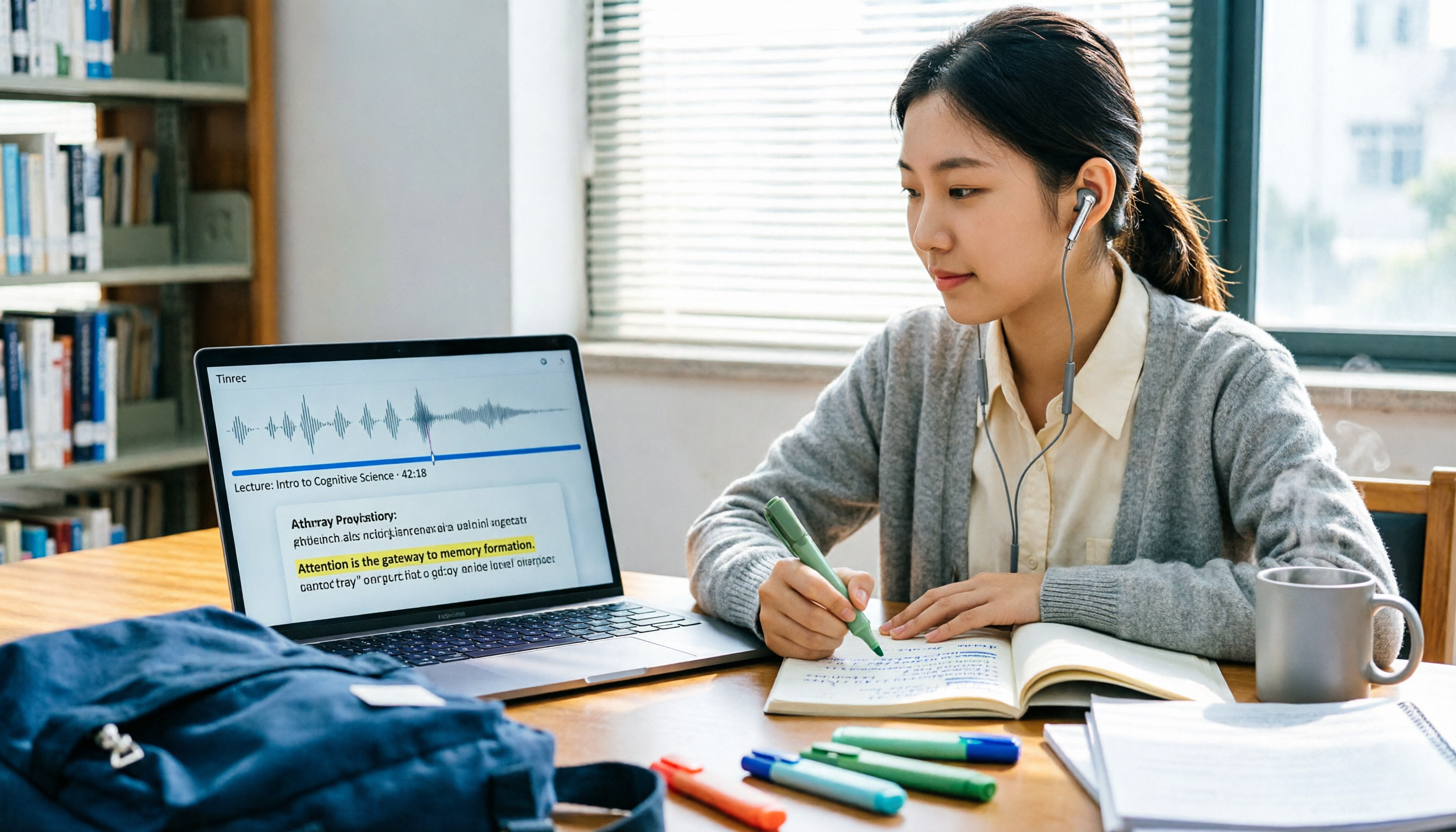
Tinrec Recording-to-Text Tutorial 2026: Is the Free Plan Enough? AI Summaries Help You Highlight Key Points
A student's hands-on review: Tinrec recording-to-text tutorial. The free plan offers sufficient credits, supports Chinese, and includes AI summaries and Q&A, turning classroom recordings into study notes.
Tinrec vs Otter.ai 2026: 5-Dimension Comparison – Which Free Cantonese Voice-to-Text Tool Is Right for You?
We tested two popular voice-to-text tools across five dimensions: accuracy, Cantonese support, AI features, free tier, and cross-platform compatibility, to help Cantonese speakers decide between Tinrec and Otter.ai.

2026 Free Cantonese Audio-to-Text Solutions: 4 Tools Compared
Cantonese audio-to-text tools are growing in number, but are the free plans sufficient? This article compares four tools—Tinrec, Otter.ai, Notta, and PLAUD Note—covering Cantonese recognition, free quotas, and AI features to help you find the best fit.

2026 Hands-On Comparison of 4 Cantonese Voice-to-Text Apps: Which One Saves You the Most Time on Meeting Notes?
We tested Tinrec, Plaud Note, Otter.ai, and Notta for Cantonese voice-to-text transcription, comparing accuracy, AI summarization, cross-platform support, and free tiers. Here's our practical review from a mid-level manager's perspective.

2026 Tested: 4 Cantonese Voice-to-Text Tools Compared – Which Has the Best Accuracy?
People on Dcard often ask how to convert Cantonese recordings to text. This article tests 4 tools, focusing on Cantonese accuracy, AI summaries, cross-platform support, and free tiers, to help you pick the best app for transcribing Cantonese meetings, classes, and interviews.

2026 Cantonese Voice-to-Text Tools Compared: Which Free Version Is Best for Professionals?
After testing multiple Cantonese voice-to-text tools, a mid-level manager found that the most critical factor in free versions isn't the number of minutes but the post-transcription organization. Using Tinrec as an example, this article shares practical uses for meetings, courses, and interviews, plus 4 key points to consider when choosing a tool.