
Turn recordings into transcripts and summaries in minutes
Upload audio or video for multilingual transcription, AI notes, and action items
"Just wrote down the last sentence, but the boss's next key point slipped away" or "A 1-hour meeting recording took 3 hours to transcribe manually"—this is the daily nightmare for many administrative staff, graduate students, and content creators. With so many transcription generators on the market, which one offers the best Chinese recognition? Which has the most generous free tier? Which can transform a mess of notes into bullet-pointed highlights?
This article reviews 11 mainstream speech-to-text tools in 2026 (including iFlytek, Feishu, Tinrec, Doubao, etc.) from the perspectives of recognition accuracy, AI summarization capabilities, cross-platform support, and cost. We provide a detailed comparison table and practical scenario analysis to help you make a quick decision.
Quick Navigation Conclusions:
- Prioritize team collaboration and ecosystem integration: Go for Feishu Minutes or DingTalk Flash Notes.
- Need deep hardware integration and offline capabilities: Consider iFlytek Tingjian or Huawei Notes.
- Want "record and act" with AI deep-dive queries: Try Tinrec (Instant Recording).
- Lightweight and free needs: Choose Doubao or Recording to Text Assistant.
I. Why You Need a New-Generation "AI Transcription Generator"?
Traditional voice recorders or early transcription software only solved the problem of "turning sound into text." But in 2026, users' pain points have shifted: after text is generated, how to quickly extract value?
New-generation AI transcription tools (such as Tinrec, Feishu Minutes, Tongyi Tingwu) have the following features, which are also the core criteria for this review:
- AI Summarization and Key Point Extraction: Automatically differentiate speakers, generate meeting minutes, conclusions, and action items.
- Multilingual Mixed Recognition: Solve recognition challenges for Chinese-English mixing or dialects (e.g., Cantonese, Taiwanese).
- Semantic Search Capability: No longer just Ctrl+F keyword search, but able to query "What did someone say about the budget?" like asking a person.
II. In-Depth Review of Mainstream Transcription Generators in 2026
Below, we categorize popular tools into three types based on use cases:
1. Collaboration & Ecosystem Type (Suitable for Enterprise Teams)
- Feishu Minutes: Praised by many as an all-rounder for "transcription + collaboration." Its core advantage is high accuracy up to 98%, supporting mixed Chinese-English speech and professional terminology recognition. Its strongest feature is collaboration: multi-user real-time annotation, comments, and automatic timeline generation. Pricing-wise, the basic plan offers 300 free minutes per month, ideal for small to medium teams.
- DingTalk Flash Notes: Deeply integrated with DingTalk ecosystem, suitable for government and enterprise users. Supports real-time transcription and offline use. After a meeting, it can generate a shareable link. However, in tests, real-time transcription has about a 3-second delay, and dialect recognition (e.g., Cantonese) is relatively weak at around 80%.
- Tencent Meeting: Native to the meeting app, no need to switch tools to start transcription. Suitable for ad-hoc meeting notes, but the free version has limited features and basic post-editing capabilities.
2. Professional Tech & Subtitle Type (Suitable for Media and Creators)
- iFlytek Tingjian: A veteran in speech recognition. Its advantage lies in excellent dialect support (Cantonese, Sichuanese, etc.) and dedicated hardware (voice recorder) for offline transcription with high security. The downside is higher cost and lack of team collaboration features like Feishu.
- NetEase Sight: A godsend for subtitle creation. It automatically generates SRT subtitle files with timestamps, supporting 8 languages including Chinese, English, and Japanese. Although transcription speed is slightly slower (16 min recording takes about 3 min), it's an excellent free/low-cost tool for self-media creators needing video subtitles.
Stop organizing recordings by hand
Upload audio or video and automatically get a transcript, summary, and action items
3. AI Workflow & Cross-Platform Type (Suitable for Personal Productivity & Knowledge Management)
- Tinrec (Instant Recording): A tool emphasizing a complete workflow from "recording to action." Unlike traditional tools, Tinrec not only provides high-accuracy multilingual recognition (including Taiwanese, Cantonese, Japanese, Korean, German, etc., 10 languages in total) but focuses on AI post-processing. It automatically generates meeting minutes and action items, and supports "AI Chat Query," allowing users to ask about recording details without replaying the entire file. Supports iOS, Android, and Web sync.
- Tongyi Tingwu: An efficiency tool from Alibaba, offering a long free trial for new users. Leveraging large models, it provides chapter overviews, mind maps, etc., suitable for long training sessions or course recordings.
- Doubao: An AI product from ByteDance, completely free and ad-free. Simple interface, supports real-time recording and file import. Suitable for students or individuals for lightweight daily notes. However, it is relatively weak in professional terminology recognition and team collaboration.
III. In-Depth Tool Comparison: Features, Pricing, and Use Cases
To help you choose more intuitively, we've compiled a comparison table of core dimensions:
| Tool Name | Core Advantage | Free Tier / Pricing Model | Supported Languages | Target Users |
|---|---|---|---|---|
| Tinrec | AI Chat Query, Action Item Extraction, Multi-device Sync | Free: 100 min/month; Basic: $4.9/month | Chinese, English, Japanese, Korean, Taiwanese, Cantonese, etc. (10 languages) | Professionals and students who value post-meeting execution |
| Feishu Minutes | Strong team collaboration, accurate mixed Chinese-English recognition | Basic: 300 free minutes/month | 19 languages for translation | Enterprise teams, international meetings |
| iFlytek Tingjian | Strong dialect recognition, hardware integration | Pay-per-minute or VIP subscription (higher cost) | Multiple languages, multiple dialects | Users with confidentiality needs or who rely on voice recorders |
| NetEase Sight | SRT Subtitle Export, no installation required | Free: 2 hours/day | 8 languages | Video creators, subtitle groups |
| Doubao | Completely free, minimalist interface | Currently fully free | Primarily Chinese | Students, light users |
| Recording to Text Assistant | Mini-program ready, zero learning curve | Free: 2 hours/month | Basic Chinese and English | Ad-hoc use, elderly users |
IV. Practical Tutorial: How to Efficiently Process Meeting and Study Recordings with Tinrec
After choosing a tool, integrating it into your workflow is key. Below, we use Tinrec as an example to demonstrate how to turn a chaotic meeting into a clear action list.
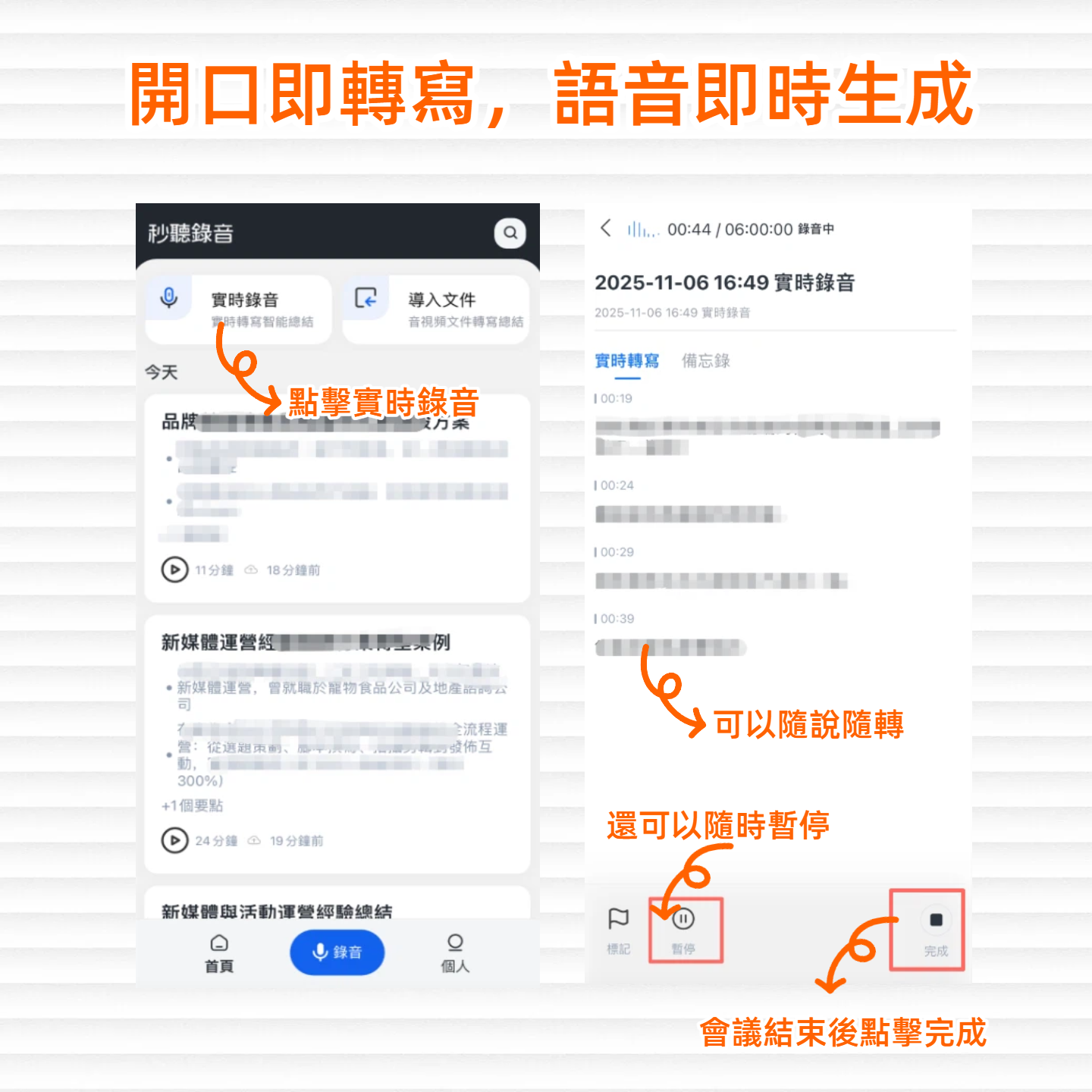
Step 1: Choose Recording Source
Tinrec offers multiple entry points for different scenarios:
- Live Meeting/Class: Use the mobile or web version to start real-time transcription. Text appears instantly as you record.
- Existing File Processing: If you have an audio file (MP3/WAV, etc.), use the Audio to Text feature to upload directly.
- Online Learning/Podcast: For YouTube tutorials or podcasts, paste the link to use the Podcast/Video to Text feature, saving the hassle of downloading files.
Step 2: AI Intelligent Analysis and Summarization
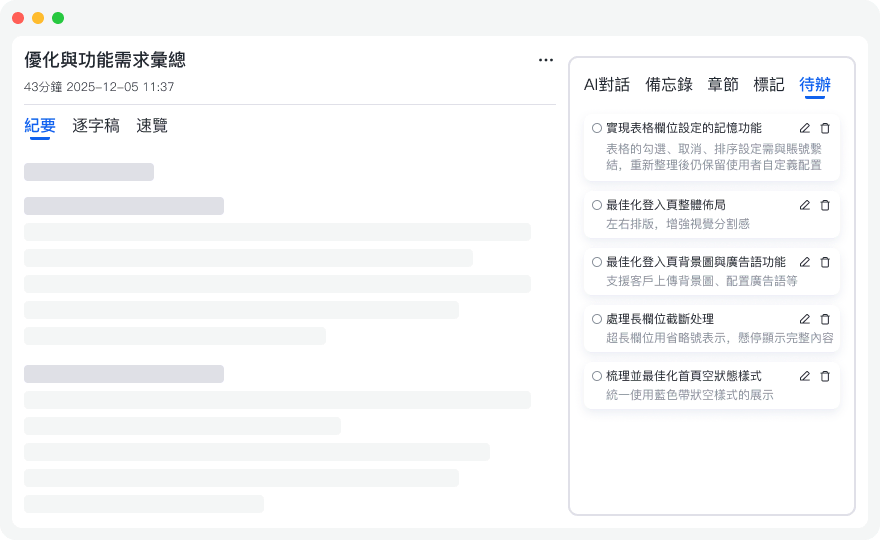
After recording, the system automatically transcribes. Don't just look at the raw text; leverage AI features:
- Speaker Identification: The system automatically labels different speakers for clarity.
- Generate Meeting Minutes: One-click generation of structured key summaries and conclusions.
- Extract Action Items: This is the most critical step. Tinrec auto-detects tasks like "Submit the budget by next Wednesday," preventing missed action points.

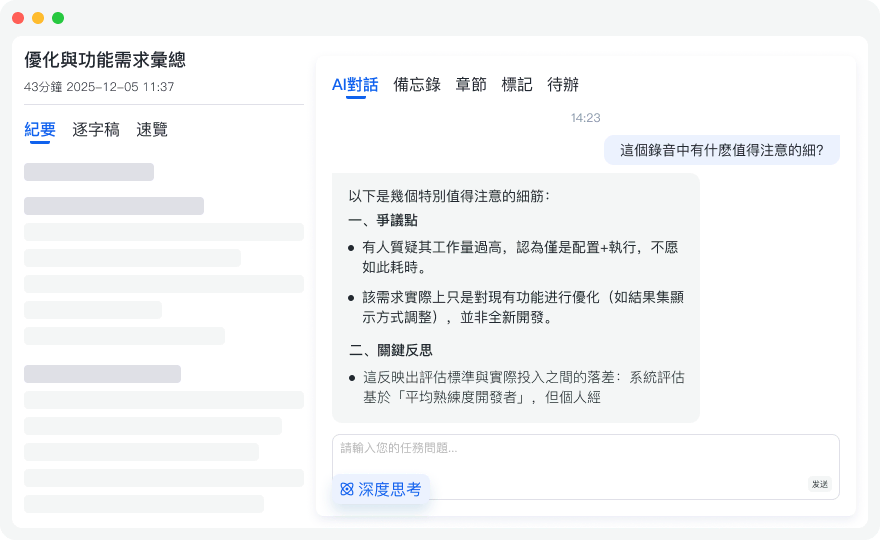
Step 3: Use "AI Chat" to Query Details
If the meeting is 2 hours long, replaying or reading the full transcript is time-consuming.
- Use the AI Chat Query feature. Simply type a question in the chat box, e.g., "What was the decision regarding the Q3 marketing budget?"
- The AI answers based on the recording content and marks timestamps, enabling true "dialogue with data."
V. Frequently Asked Questions (FAQ)
Q1: Are there any limitations when using iPhone for recording?
Most apps support iOS, but iPhone restricts call recording. To record phone calls or LINE calls, it's recommended to use external recording or a dedicated recording device. Tinrec supports both iOS and Android for live recording.
Q2: Do these tools support Teams or Google Meet?
Some tools like Tencent Meeting, Feishu, and DingTalk are built into the meeting software. For third-party tools like Tinrec, the typical approach is to use "system audio capture" on a computer or "side recording" with a phone, or upload the recorded meeting video to the Audio to Text feature for post-processing.
Q3: What are the typical limitations of free versions?
Most free versions limit "monthly transcription time" (e.g., Tinrec: 100 min/month, Feishu: 300 min/month) or "single file size." For frequent use, consider subscribing to a paid plan or using pay-as-you-go services.
Q4: Can transcription accuracy reach 100%?
Current top-tier solutions (iFlytek, Feishu, Tinrec) achieve about 95%–98%. Background noise, overlapping speakers, and heavy accents still affect accuracy. It's recommended to keep the recording device close to the speaker.
Q5: Is data privacy secure?
Enterprise-level tools (Feishu, DingTalk) typically have strict corporate security standards. For personal use, review each tool's privacy policy. Tinrec offers account deletion and data management features to ensure user control over their data.
Q6: I have many foreign language (Japanese/Korean) materials to process. Which tool is suitable?
NetEase Sight and Tinrec both support multilingual recognition. Tinrec supports 10 languages including Japanese, Korean, and German, with AI summarization and translation, making it suitable for overseas courses or cross-border meeting content.
Turn every recording into actionable outcomes
Get 60 free transcription minutes when you sign in. No credit card required.
Related Reading
You might also like

How to Follow Up on Project Meeting Action Items in 2026: A Complete 5-Step Guide
After a project meeting, action items often get lost in chat threads and lack clear owners. This article breaks down a complete 5-step process for following up on project meeting action items, from pre-meeting preparation, bot-free recording, AI summaries and action item extraction, to export tracking and closure documentation. It uses Tinrec as a practical demonstration tool and also covers 5 key considerations and common questions when choosing a meeting follow-up tool.

Meeting Minutes Email Template 2026: 5-Section Structure + 3 Scenario Examples
Stuck with the task of emailing meeting minutes after a meeting wraps up? This guide offers copy-paste meeting minutes email templates covering routine weekly meetings, client meetings, and cross-departmental decision meetings, plus common mistakes and 6 practical FAQs.
2026 Comparison of 4 Meeting Action Plan Tools: Which One Best Tracks Post-Meeting Actions?
Meetings end, but action plans go nowhere—the problem is often not the people, but that the tool only gives you a transcript. This article starts from 'whether post-meeting actions are captured' and outlines 5 key factors for choosing a meeting action plan tool. It compares Tinrec, Otter.ai, Fireflies.ai, and Notta in terms of recording method, to-do extraction, Chinese language performance, and team ownership, and includes 4 common pitfalls and selection advice.
4 AI Meeting Task Extraction Tools Compared in 2026: From Transcript to To-Do List
You have the meeting transcript, but no one remembers who's responsible for what. This article compares four tools—Tinrec, Otter.ai, Notta, and TurboScribe—from a task extraction perspective, covering four key decision points, hands-on experience, common pitfalls, and scenario-based recommendations to help you find the one that turns meeting noise into actionable signals.

4 Meeting Notes Tools Tested for 2026: Which One Turns Discussions into Actionable Plans?
Even the most detailed meeting notes are useless if no one follows up. This article covers 4 key points for writing meeting action plans, 3 common mistakes, and hands-on comparisons of Tinrec, Notta, Granola, and PLAUD Note on task extraction, post-meeting follow-up, and team collaboration.

2026 Free Post-Meeting Email Automation Options: 5 Tools Compared
Always sending post-meeting emails the next day? The problem isn't your writing—it's that meeting content isn't captured well. This article reviews the free tiers and limitations of 5 post-meeting email automation and assistance methods, and tests how Tinrec turns transcripts, AI summaries, and action items into one-click email material. Suitable for students and small teams.

3 Meeting Recap Email Templates Compared for 2026: Which Format Best Moves Projects Forward?
We break down three meeting recap email template styles and how to choose one, covering structure, examples, and common mistakes. Plus, learn how Tinrec turns meeting recordings into citable minutes, to-dos, and action lists so your post-meeting emails don't get ignored.

2026 Comparison of 4 Meeting Note Tools: Which One Actually Turns Meeting Conclusions into Action Plans?
Meetings end with conclusions, but no one follows through? This article starts from the real need to turn meeting conclusions into action plans, outlines 4 key purchasing points, and compares Tinrec, Notta, Otter.ai, and Granola on bot-free recording, AI summaries and to-dos, post-meeting Q&A, and team data retention, with prices and limitations, to help you choose the one that truly connects to execution.

2026 AI Follow-Up Email Tools Comparison: Tinrec Ensures No Post-Meeting Follow-Up Is Missed
The meeting ending is just the beginning of follow-up. This article tests 3 AI tools related to post-meeting follow-up emails, including Tinrec, Manus, and Genspark, covering meeting transcription, action item extraction, and email draft generation, helping you bridge the last mile from the meeting room to the inbox.