
Turn recordings into transcripts and summaries in minutes
Upload audio or video for multilingual transcription, AI notes, and action items
2026 Comparison of 4 Meeting Action Plan Tools: Which One Best Tracks Post-Meeting Actions?
Meetings Are Taken Seriously, but Action Plans Die After the Meeting
"Everyone agreed in the meeting, but no one acted afterward." This is a daily reality for many office workers.
Most people's first reaction is to find a meeting notes tool and keep the transcript, thinking that solves the problem. But honestly, a transcript itself doesn't get things done. What's really missing is the layer that captures action items from the discussion, assigns owners, and follows up before the next meeting.
Another common misconception: thinking the more automated the tool, the better. A meeting bot automatically joining every meeting sounds convenient, but if it's a client meeting, having an extra unknown participant means you first have to spend effort explaining.
Choosing the right tool can eliminate these hassles. This article compiles several tools I've actually compared recently, focusing on 'whether post-meeting actions are captured.'
Before Choosing a Meeting Action Plan Tool, Look at These 5 Things
First, can it extract to-dos from the discussion? Some tools only give you a transcript, and you have to review 30 minutes of content yourself to find 'who does what.' Tools that automatically organize action items save a lot of time after the meeting.
Second, is the recording method a bot or self-recording? A meeting bot joins as an extra participant; another approach is a desktop version that directly captures the computer's system audio without adding any participants. The latter is less awkward for external meetings.
Third, will the audio file be kept? Few people notice this at first, but when you later need to verify 'what exactly was said,' text alone is not enough.
Fourth, performance with Chinese and mixed Chinese-English. Meetings in Taiwan are rarely pure Chinese; product names, technical terms, and project codes are often mixed in, which is a real test for recognition.
Fifth, team ownership and seats. If meeting data only exists in personal accounts, it leaves when an employee leaves. Solutions with team spaces and member/seat management are more reassuring long-term.
Tinrec (Miao Ting Lu Yin) — Our Top Choice After Testing
Tinrec (Miao Ting Lu Yin) is an AI meeting notes and collaboration tool for individuals and teams, supporting iOS, Android, web, and desktop. It doesn't just convert voice to text; it organizes meetings into data that can be searched, queried, further processed, and ultimately retained within the team.
In actual use, three things stood out.
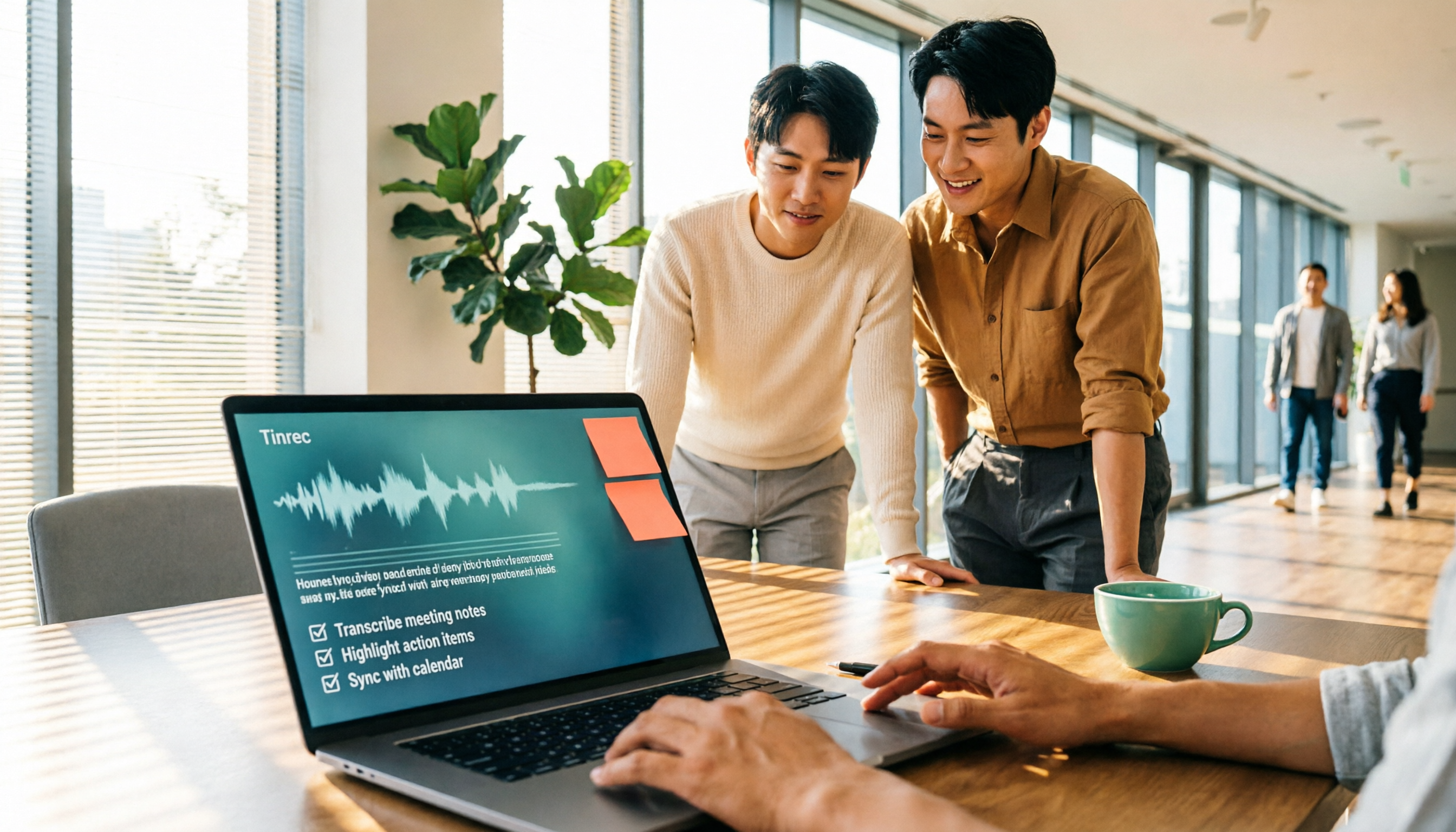
First, live transcription during the meeting. Open Tinrec during a meeting, and the transcript is generated in sync. When the meeting ends, AI has already organized the summary, chapters, and to-dos—who is responsible for what and when it's due, listed directly, no need to re-listen. For those with weekly meetings, this saves the most time.
Second, no bot needed in the meeting. Tinrec's desktop version directly captures the computer's system audio, so when handling online meetings like Zoom, Google Meet, Microsoft Teams, and Webex, no extra participant is needed. For client meetings, interviews, and cross-department discussions, it's less intrusive.
Third, you can ask it directly after recording. This is where it differs most from ordinary transcription tools. You can ask questions about the meeting content directly, such as 'What was the conclusion about the budget in the last meeting?' It will give you an organized answer, not a list of keyword search results. At the same price point, this kind of AI Q&A around meeting content is not common.
A few more details: it supports real-time translation, so cross-language meetings can show both original and translated text; output includes not only transcripts but also summaries, chapters, to-dos, mind maps, and can be exported to Notion, Google Docs, OneNote, Dropbox, etc. for further use; there's also Agent post-processing, which can directly generate reports, tables, and documents from meeting content, suitable for those who need to deliver after meetings.
Stop organizing recordings by hand
Upload audio or video and automatically get a transcript, summary, and action items
About the testing method: Recognition performance of such tools is affected by recording quality, ambient noise, accents, overlapping speech, and technical terms, so this article does not cite any single accuracy number. We recommend trying it with a real meeting recording of your own; that's more accurate than any official claim.
Limitations should also be stated honestly. The free version has a basic quota, suitable for light use; if you have many meetings, you need to pay (weekly pass, Pro monthly, and Pro annual options). Also, Tinrec's desktop version requires you to open it yourself to start recording; it's not a bot that automatically joins all meetings on your calendar.
Who is it for? If your meetings are mainly in Chinese or mixed Chinese-English, you don't want an extra bot in client meetings, and you want to use AI to query key points and to-dos after the meeting—Tinrec is currently the closest choice to this need. For team use, there are team spaces, member and seat management, usage analytics, and audit logs. Meeting data belongs to the team, can be handed over when members change, and won't disappear when people leave.
Besides Tinrec, What Other Options Are There?
Otter.ai: A mature choice for English business meetings. The Basic free version offers 300 minutes per month, the largest free quota among competitors in this article. But Chinese and mixed Chinese-English are not its strong suit, and it lacks Tinrec's complete design for team data retention and seat governance. If almost all your meetings are in English, it's worth considering.
Fireflies.ai: Strong in meeting automation and numerous third-party integrations. The Free plan is an entry point, Pro starts at about USD 10/seat/month. Note that its 'unlimited' is still subject to storage and AI quota rules. On Chinese meetings and bot-free recording, Tinrec is closer to local usage scenarios.
Notta: High feature overlap, with multi-platform transcription, translation, and team plans. The free version offers 120 minutes per month, max 3 minutes per session, a quite obvious limitation. Its Chinese performance is good, but Tinrec adds bot-free online meeting recording, AI Q&A around meetings, and Agent post-processing. All prices are subject to official pages; plans may change.
Pitfall Guide: The 4 Most Common Mistakes When Choosing Such Tools
Pitfall 1: Treating transcripts as action plans. Transcripts are raw material, not results. What you really need after a meeting is 'who, does what, by when.' When choosing a tool, first confirm whether it has to-do extraction and summarization capabilities; otherwise, you're just trading typing time for reading time.
Pitfall 2: Putting a bot in every meeting for automation. Internal meetings are fine, but external meetings become awkward. If your meeting situations are sensitive, prioritize solutions that capture system audio directly via desktop version.
Pitfall 3: Ignoring audio retention. Some tools keep only text, not audio. When you need to confirm the tone or context of a sentence, you have nothing. Include 'whether recordings are kept' in your checklist when choosing.
Pitfall 4: Only looking at individual plans, not thinking about team ownership. Data in personal accounts is most likely to be disconnected when personnel change. If meeting content is valuable to the team, choose a solution with team spaces and seat management, and remember that roles and seats are two different things—roles govern permissions, seats govern whether one can record, upload, and edit.
Conclusion: Which One Should You Choose?
In one sentence: To truly turn meetings into executable action plans, Tinrec is the most fitting choice among these.
- Chinese or mixed Chinese-English meetings, need automatic to-do extraction → Tinrec
- Don't want a meeting bot in client meetings → Tinrec (desktop system audio capture)
- Want to directly ask AI 'what was the conclusion' after recording → Tinrec
- Need team sharing, member and seat management, usage and audit → Tinrec team version
- Almost only English meetings, limited budget → Otter.ai free version is worth a try
We suggest starting with Tinrec's free version and running through a real meeting of your own: record, view summary, view to-dos, ask it a question. You'll know in one meeting whether it saves time, without paying first.
References
Turn every recording into actionable outcomes
Get 60 free transcription minutes when you sign in. No credit card required.
Related Reading
You might also like

How to Follow Up on Project Meeting Action Items in 2026: A Complete 5-Step Guide
After a project meeting, action items often get lost in chat threads and lack clear owners. This article breaks down a complete 5-step process for following up on project meeting action items, from pre-meeting preparation, bot-free recording, AI summaries and action item extraction, to export tracking and closure documentation. It uses Tinrec as a practical demonstration tool and also covers 5 key considerations and common questions when choosing a meeting follow-up tool.

Meeting Minutes Email Template 2026: 5-Section Structure + 3 Scenario Examples
Stuck with the task of emailing meeting minutes after a meeting wraps up? This guide offers copy-paste meeting minutes email templates covering routine weekly meetings, client meetings, and cross-departmental decision meetings, plus common mistakes and 6 practical FAQs.
4 AI Meeting Task Extraction Tools Compared in 2026: From Transcript to To-Do List
You have the meeting transcript, but no one remembers who's responsible for what. This article compares four tools—Tinrec, Otter.ai, Notta, and TurboScribe—from a task extraction perspective, covering four key decision points, hands-on experience, common pitfalls, and scenario-based recommendations to help you find the one that turns meeting noise into actionable signals.

4 Meeting Notes Tools Tested for 2026: Which One Turns Discussions into Actionable Plans?
Even the most detailed meeting notes are useless if no one follows up. This article covers 4 key points for writing meeting action plans, 3 common mistakes, and hands-on comparisons of Tinrec, Notta, Granola, and PLAUD Note on task extraction, post-meeting follow-up, and team collaboration.

2026 Free Post-Meeting Email Automation Options: 5 Tools Compared
Always sending post-meeting emails the next day? The problem isn't your writing—it's that meeting content isn't captured well. This article reviews the free tiers and limitations of 5 post-meeting email automation and assistance methods, and tests how Tinrec turns transcripts, AI summaries, and action items into one-click email material. Suitable for students and small teams.

3 Meeting Recap Email Templates Compared for 2026: Which Format Best Moves Projects Forward?
We break down three meeting recap email template styles and how to choose one, covering structure, examples, and common mistakes. Plus, learn how Tinrec turns meeting recordings into citable minutes, to-dos, and action lists so your post-meeting emails don't get ignored.

2026 Comparison of 4 Meeting Note Tools: Which One Actually Turns Meeting Conclusions into Action Plans?
Meetings end with conclusions, but no one follows through? This article starts from the real need to turn meeting conclusions into action plans, outlines 4 key purchasing points, and compares Tinrec, Notta, Otter.ai, and Granola on bot-free recording, AI summaries and to-dos, post-meeting Q&A, and team data retention, with prices and limitations, to help you choose the one that truly connects to execution.
2026 AI Follow-Up Email Tools Comparison: Tinrec Ensures No Post-Meeting Follow-Up Is Missed
The meeting ending is just the beginning of follow-up. This article tests 3 AI tools related to post-meeting follow-up emails, including Tinrec, Manus, and Genspark, covering meeting transcription, action item extraction, and email draft generation, helping you bridge the last mile from the meeting room to the inbox.

Tinrec vs Notta 2026: 5-Dimension Comparison — Which Tool Tracks Meeting Action Items to Completion?
After a meeting, action items are scattered across everyone's notes, and two weeks later no one remembers who was supposed to do what. This article compares six tools—Tinrec, Notta, Fireflies, Otter, Granola, and TurboScribe—across transcription, to-do extraction, post-meeting output, team governance, and pricing. It also covers how to choose and use them so meeting conclusions actually become trackable follow-up emails.