
Turn recordings into transcripts and summaries in minutes
Upload audio or video for multilingual transcription, AI notes, and action items
After the Meeting, Tasks Are Scattered in the Transcript—You Should Ask "Who's Responsible for What"
After a two-hour project meeting, you have the transcript and the summary, but no one remembers who's responsible for what's due next week. This is the reality for many teams.
The problem usually isn't transcription—it's task extraction: can the tool pull identifiable action items from a pile of conversation and assign owners and deadlines?
If you're comparing which tool to use, first determine three things: whether meetings are online or offline, whether content is primarily in Chinese or English, and whether you need to store data for team sharing. The answers will directly determine which tool you should choose.
Before Choosing an AI Meeting Task Extraction Tool, Understand These 4 Key Points
1. Granularity of task extraction. Some tools only give you a paragraph of "follow-up actions" summary text, while others can organize into a What/Who/When list. Only the latter can truly be pasted into task management tools.
2. Can you go back and verify against the original text? Task extraction is essentially AI inference, and errors are inevitable. If the tool retains recordings and transcripts, you can go back and confirm whether that's really what was said.
3. Handling mixed Chinese and English. Meetings in Taiwan are rarely pure Chinese; product names and technical terms are often mixed in. If recognition is unstable, task extraction will be off.
4. Can it connect to your workflow after the meeting? Extracted to-dos need to be exportable, queryable, and shareable with the team; otherwise, it's just another forgotten file.
Tinrec—Our Top Pick After Hands-On Testing
Tinrec is an AI meeting notes and collaboration tool for individuals and teams, supporting iOS, Android, and web, with a desktop version that handles online meetings. Its positioning isn't just "audio to text" but turning meetings into searchable, queryable, actionable data.
The most impressive part in practice is the "no bot" feature. When hosting Zoom, Google Meet, Teams, or Webex, you don't need to invite a meeting bot as an extra participant—Tinrec's desktop version directly captures the computer's system audio and generates a transcript while the meeting is ongoing. For client meetings, this matters more than you'd think.
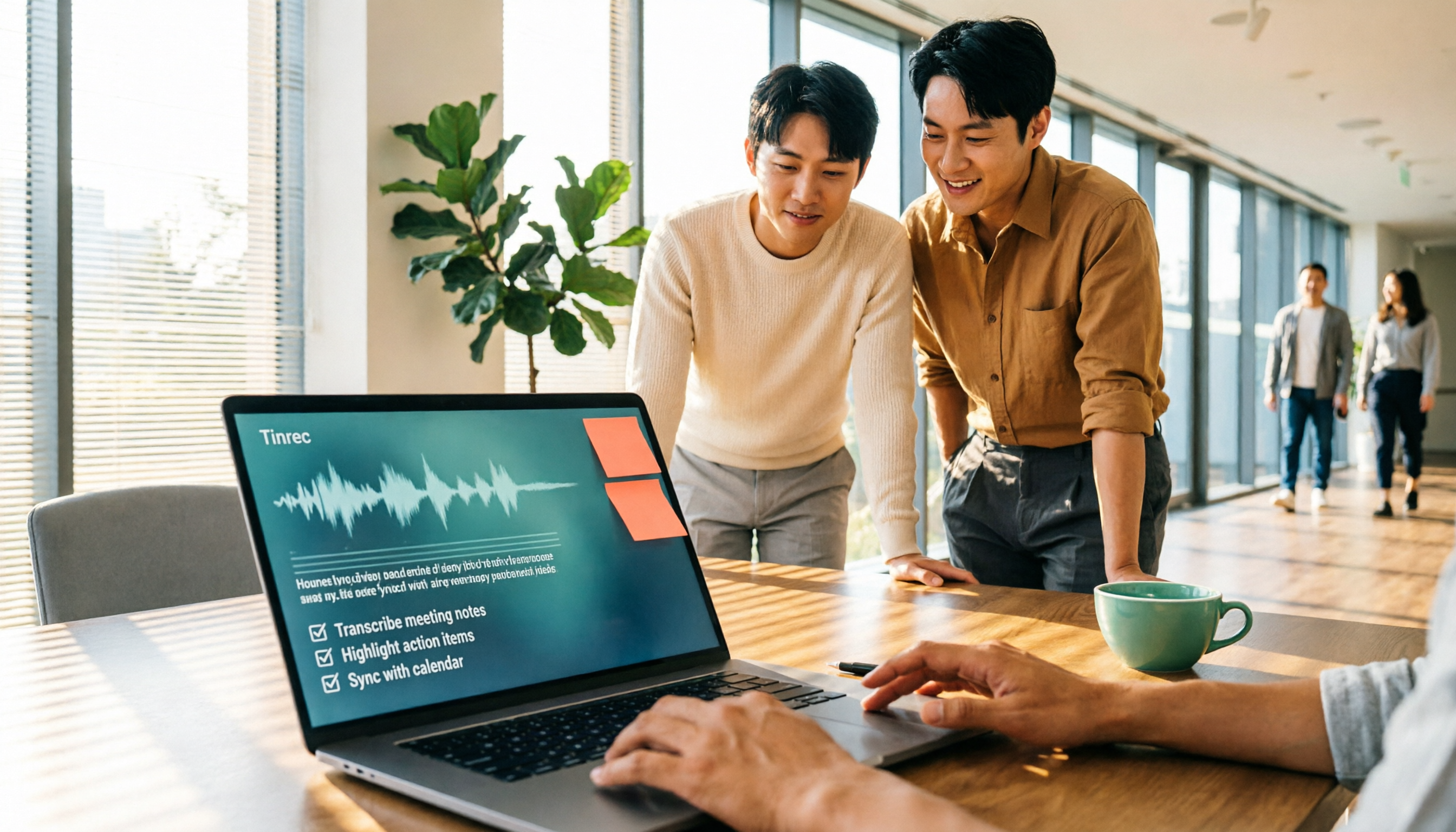
After the meeting is where it stands out. Once the transcript is generated, AI automatically produces a summary, chapters, and key points, and extracts action items from the discussion. If you just want a quick check, you can directly ask questions about the meeting content, such as "What items from this meeting require my cooperation?" It answers based on semantics, not a list of keyword search results. At the same price point, most tools are still stuck at the summary level.
Going further, it can convert results into reports, tables, or documents and export to Notion, Google Docs, OneNote, Dropbox, and other common tools for further processing. If there's a cross-language need during the meeting, it also supports real-time translation and bilingual comparison.
Pros:
- Desktop version records online meetings without a bot, no extra participant needed.
- Summary, chapters, and to-dos in one go; to-dos can be assigned to owners and times.
- Can ask questions about meeting content, and search across multiple past meetings.
- Complete experience for Chinese and mixed Chinese-English meetings, with team hotwords support.
Things to note:
Stop organizing recordings by hand
Upload audio or video and automatically get a transcript, summary, and action items
- Free version offers basic quota, good for trying out; for regular high-frequency use, consider the Pro plan.
- Importing files and web links consumes quota, not unlimited.
- Official accuracy rate is not guaranteed; recording quality, accents, and multiple people talking over each other can affect results. For important content, verify against the transcript.
For team use, consider Tinrec for Teams. It centralizes meeting data in an independent team space, with data owned by the team, not taken away when members leave. Management features include role and seat management (roles govern permissions, seats govern usage eligibility), team usage trends and details, audit logs, audio recycle bin, and team hotwords. Annual team payment is USD 199 per paid seat per year, about USD 16.58 per month; monthly payment is USD 29.80 per paid seat per month. Each paid seat provides 2,000 minutes of team shared import quota per month. Eligible new teams also get a 7-day trial. Prices and benefits are subject to the official purchase page.
Besides Tinrec, What Other Options Are There?
Otter.ai: A mature choice for English business meetings. The free version offers 300 minutes per month, quite generous. Pro annual payment is about USD 8.49 per user per month. If your meetings are almost entirely in English, it's sufficient. But for Chinese and mixed Chinese-English organization depth, as well as post-meeting query and post-processing, Tinrec's approach is more complete.
Notta: Good multi-platform transcription and translation. Free version offers 120 minutes per month (single session limit 3 minutes). Pro annual payment is about USD 8.17 per month. Suitable for those mainly doing file transcription. In contrast, Tinrec focuses more on desktop bot-free recording, team seats, and usage governance.
TurboScribe: Focuses on long files and batch transcription. Paid version supports up to 10 hours per file and up to 50 files at once, annual payment USD 120. If you have a large number of existing recording files, it's cost-effective. But it's not a meeting tool; it lacks Tinrec's real-time meeting recording, AI Q&A, and task extraction workflow.
Pitfall Guide: 3 Most Common Mistakes When Choosing These Tools
Pitfall 1: Only looking at transcription accuracy. Accuracy is a threshold, not the deciding factor. The real value of meeting notes is post-meeting task extraction and follow-up. Comparing only transcription makes it easy to choose a tool that's "good at typing but not at organizing."
Pitfall 2: Treating AI-generated to-dos as final. AI may misjudge proper nouns, tone, and references. Sending without proofreading can create misunderstandings. A safer approach is to verify against the transcript and then add decision context.
Pitfall 3: Ignoring team sharing and handover. If meeting data sits in personal accounts, historical context disappears when colleagues leave or transfer. Team space and seat design are long-term specifications to consider.
Conclusion: Which One Should You Choose?
- Need Chinese, mixed Chinese-English meetings, and post-meeting task extraction → Tinrec (summary, to-dos, Q&A in one)
- Don't want a meeting bot to join → Tinrec (desktop bot-free recording)
- Want to store meetings as team-searchable data → Tinrec for Teams (team space, seats, usage, and audit)
- Meetings almost entirely in English, zero budget → Otter.ai (free 300 minutes is plenty to try)
- Have a large number of existing recording files for batch transcription → TurboScribe (strong long-file and batch capabilities)
If you're not sure which one, we suggest starting with Tinrec's free version to experience the "meeting ends with a to-do list" workflow, then decide whether to upgrade.
References
- How to use AI for meeting minutes? How to organize meeting transcripts? | AI speech-to-transcript tutorial | 104 Career Power
- Organizing meeting minutes is painful? 5 NotebookLM "AI note transformation" tricks, accurate translation even with mixed Chinese-English and proper nouns | BusinessNext
- AI meeting notes organization tips! 6 steps to use Gemini Notebook and instruction templates, speech-to-text, mixed Chinese-English no problem | 104 Career Power
- Top AI meeting notes tools in 2026, time-saving must-have for meetings!
- Get meeting notes done! How to do AI speech-to-transcript? Gemini Notebook, Gemini, EchoScript operation analysis | 104 Career Power
Turn every recording into actionable outcomes
Get 60 free transcription minutes when you sign in. No credit card required.
Related Reading
You might also like

How to Follow Up on Project Meeting Action Items in 2026: A Complete 5-Step Guide
After a project meeting, action items often get lost in chat threads and lack clear owners. This article breaks down a complete 5-step process for following up on project meeting action items, from pre-meeting preparation, bot-free recording, AI summaries and action item extraction, to export tracking and closure documentation. It uses Tinrec as a practical demonstration tool and also covers 5 key considerations and common questions when choosing a meeting follow-up tool.

Meeting Minutes Email Template 2026: 5-Section Structure + 3 Scenario Examples
Stuck with the task of emailing meeting minutes after a meeting wraps up? This guide offers copy-paste meeting minutes email templates covering routine weekly meetings, client meetings, and cross-departmental decision meetings, plus common mistakes and 6 practical FAQs.
2026 Comparison of 4 Meeting Action Plan Tools: Which One Best Tracks Post-Meeting Actions?
Meetings end, but action plans go nowhere—the problem is often not the people, but that the tool only gives you a transcript. This article starts from 'whether post-meeting actions are captured' and outlines 5 key factors for choosing a meeting action plan tool. It compares Tinrec, Otter.ai, Fireflies.ai, and Notta in terms of recording method, to-do extraction, Chinese language performance, and team ownership, and includes 4 common pitfalls and selection advice.

4 Meeting Notes Tools Tested for 2026: Which One Turns Discussions into Actionable Plans?
Even the most detailed meeting notes are useless if no one follows up. This article covers 4 key points for writing meeting action plans, 3 common mistakes, and hands-on comparisons of Tinrec, Notta, Granola, and PLAUD Note on task extraction, post-meeting follow-up, and team collaboration.

2026 Free Post-Meeting Email Automation Options: 5 Tools Compared
Always sending post-meeting emails the next day? The problem isn't your writing—it's that meeting content isn't captured well. This article reviews the free tiers and limitations of 5 post-meeting email automation and assistance methods, and tests how Tinrec turns transcripts, AI summaries, and action items into one-click email material. Suitable for students and small teams.

3 Meeting Recap Email Templates Compared for 2026: Which Format Best Moves Projects Forward?
We break down three meeting recap email template styles and how to choose one, covering structure, examples, and common mistakes. Plus, learn how Tinrec turns meeting recordings into citable minutes, to-dos, and action lists so your post-meeting emails don't get ignored.

2026 Comparison of 4 Meeting Note Tools: Which One Actually Turns Meeting Conclusions into Action Plans?
Meetings end with conclusions, but no one follows through? This article starts from the real need to turn meeting conclusions into action plans, outlines 4 key purchasing points, and compares Tinrec, Notta, Otter.ai, and Granola on bot-free recording, AI summaries and to-dos, post-meeting Q&A, and team data retention, with prices and limitations, to help you choose the one that truly connects to execution.
2026 AI Follow-Up Email Tools Comparison: Tinrec Ensures No Post-Meeting Follow-Up Is Missed
The meeting ending is just the beginning of follow-up. This article tests 3 AI tools related to post-meeting follow-up emails, including Tinrec, Manus, and Genspark, covering meeting transcription, action item extraction, and email draft generation, helping you bridge the last mile from the meeting room to the inbox.

Tinrec vs Notta 2026: 5-Dimension Comparison — Which Tool Tracks Meeting Action Items to Completion?
After a meeting, action items are scattered across everyone's notes, and two weeks later no one remembers who was supposed to do what. This article compares six tools—Tinrec, Notta, Fireflies, Otter, Granola, and TurboScribe—across transcription, to-do extraction, post-meeting output, team governance, and pricing. It also covers how to choose and use them so meeting conclusions actually become trackable follow-up emails.