

Turn recordings into transcripts and summaries in minutes
Upload audio or video for multilingual transcription, AI notes, and action items
Have you ever counted: a 30-minute client call takes 30 minutes to talk, then another hour to summarize the key points—and you might still miss a critical commitment.
LINE has never had a built-in call recording feature, so even if you urgently need evidence, meeting notes, or to re-listen to an interview, you're out of luck.
In this article, I actually tested several methods, from Android to iPhone, from pure recording to post-processing, and put together a workflow that won't waste your time.
Why You Need a Complete "Record + Organize" Workflow?
Many people think installing a recording app is enough.
But after recording, you get a 30-minute or even 1-hour audio file.
Want to re-listen to find key points? Need a transcript? Want to recall what the client actually said?
These are the real time sinks.
For example:
- You have a LINE call with a client to discuss a proposal, they verbally agree to a condition, and later you need to report it to your manager, but you can't find that part of the conversation.
- You conduct user interviews, record 10 LINE calls, and when it's time to compile the report, just re-listening takes the whole afternoon.
- You discuss project progress with colleagues, and after the meeting, no one remembers the conclusions.
If you only solve "recording" but not "organizing," the problem remains.
So in the selection criteria below, I'll consider both recording stability and whether you can quickly convert the recording to text and find key points afterward.
Before Choosing LINE Call Recording Software, Understand These 4 Key Points
1. Platform Support: Are You on Android or iPhone?
This is the most practical question.
Android has third-party apps that can directly record LINE calls; iPhone, due to system restrictions, usually relies on speakerphone plus another device, or screen recording.
If you use both, consider cross-platform needs when choosing tools.
2. Auto-Recording vs. Manual Start
Some apps can automatically start recording during LINE calls, while others require you to press a button each time.
If you often forget to press the record button, auto-recording is safer.
3. Audio Quality and Stability
LINE calls are internet-based voice, so audio quality is affected by the network.
If a recording app can capture system audio directly, it will be much clearer than recording through the microphone.
This is especially important on Android.
4. What Do You Plan to Do with the Recording Afterward?
If you just need evidence, having the audio file is enough.
But if you need a transcript, summary, or to track action items, you need an AI tool that can convert audio to text and organize it.
That's where Tinrec excels.
Tinrec Turns LINE Call Recordings into Searchable, Organized Documents—Our Top Pick After Testing
Let's be clear: Tinrec itself is not a LINE call recording app.
It won't automatically record LINE calls.
You need to first use Cube ACR on Android to record the LINE call as an audio file, or on iPhone use speakerphone plus Voice Memos, then upload the audio file to Tinrec.
But why do I still put Tinrec as the top pick?
Because "recording" is just the first step; what happens next is where the real value lies.
Tinrec (秒听录音) is an AI meeting notes and collaboration tool that supports iOS, Android, and web.
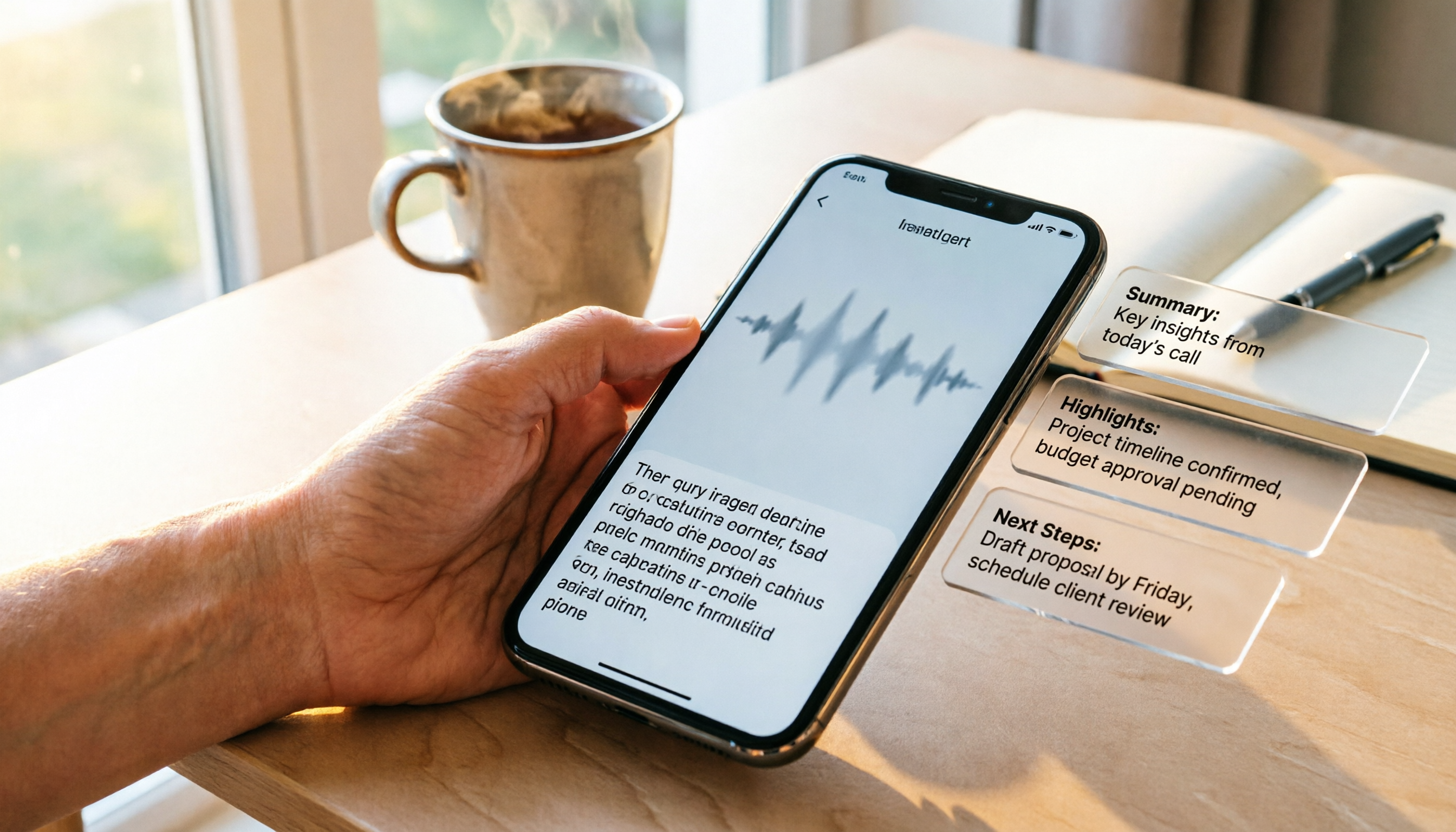
It can convert uploaded audio files into transcripts, automatically generating summaries, chapters, key points, and action items.
Here's a real workflow:
- You record the LINE call with Cube ACR on your phone.
- After recording, upload the audio file to Tinrec.
- In a few minutes, Tinrec gives you a transcript and meeting summary.
- You can directly ask Tinrec: "What three needs did the client mention?" "What was the conclusion?" "Who is responsible for which action items?"
- Finally, export the results to Notion, Google Docs, or OneNote.
That's Tinrec's strongest point—it doesn't just transcribe; it turns your recording into workable data.
Stop organizing recordings by hand
Upload audio or video and automatically get a transcript, summary, and action items
We tested a 5-minute LINE call recording (recorded with Cube ACR, with some background noise), and after uploading to Tinrec, the transcript accuracy was satisfactory, and the auto-summary captured three key points and two action items from the call.
Of course, actual results depend on audio quality; if the call is choppy or multiple people talk at once, accuracy will drop.
Tinrec's advantages:
- Supports multiple audio formats, including common LINE call recording formats like m4a and mp3.
- Not just transcripts, but also AI summaries, chapters, action items, and mind maps.
- You can ask follow-up questions about the recording content without manually searching.
- The free version includes basic credits, suitable for occasional call note organization.
Limitations to note:
- Tinrec doesn't actively record LINE calls; you need a separate recording app.
- The free version has usage limits; heavy users may need to consider a paid plan.
- For important content, it's recommended to cross-check with the original audio; AI can occasionally misinterpret.
Who is it for?
If you often need to turn LINE call content into meeting notes, interview transcripts, or want to quickly search past call highlights, Tinrec is a very worthwhile option to try.
Besides Tinrec, What Other Options Are There?
Cube ACR (Android)
Cube ACR is the most recommended LINE call recording app on Android. It's free, supports auto-recording, and can also record Messenger, WhatsApp, and other messaging apps.
But it only handles recording; it has no AI transcription or summary features.
If you only need to keep evidence, Cube ACR is enough; but if you need to organize content, you'll still need a tool like Tinrec.
iPhone Built-in Features + Speakerphone
Due to system restrictions, iPhone can't use apps to directly record LINE calls.
The common workaround is to turn on speakerphone and use another phone or a voice recorder to capture the speaker's sound.
This method is free, but audio quality is poorer, and you'll still need to manually organize afterward.
If you already have Tinrec, you can upload the recorded audio file and save time on transcribing.
External Voice Recorder
The most traditional method: put the LINE call on speakerphone and use a voice recorder to capture the audio.
The advantage is it doesn't take up phone storage and is ready to record instantly.
The downside is audio quality is heavily affected by the environment, and you still need to figure out how to transcribe the file afterward.
Tinrec can also handle the subsequent transcription and organization.
Pitfall Guide: 4 Common Mistakes When Choosing LINE Call Recording Software
Pitfall 1: Assuming LINE Has Built-in Recording
LINE has never offered a native call recording option.
If someone tells you can record without installing anything, that's impossible.
Pitfall 2: Ignoring Legal and Etiquette Issues
In Taiwan, recording without the other party's consent may be illegal.
Even if it's just for self-protection, it's recommended to inform the other party or at least check local laws.
Pitfall 3: Recording Without Organizing
If you record a bunch of audio files but never re-listen, it's like not recording at all.
Pairing with an AI tool like Tinrec turns recordings into truly usable data.
Pitfall 4: Buying Expensive Hardware Just to Record LINE Calls
Unless you have heavy recording needs, you don't need to buy a professional voice recorder or audio interface.
On Android, use Cube ACR; on iPhone, use speakerphone plus another phone, and pair with Tinrec for transcription—that's the lowest cost.
Summary: How Should You Choose?
In short:
- You only need to record LINE calls for evidence, and you're an Android user → Install Cube ACR.
- You're an iPhone user and want to record LINE calls → Turn on speakerphone and use Voice Memos or another phone to record.
- After recording, you want to transcribe, summarize, and find key points → Upload the audio file to Tinrec.
- Your team needs to share meeting notes and track action items → Use Tinrec's team space.
We recommend downloading Cube ACR first to record a LINE call, then uploading it to Tinrec's free version to try it out.
The free credits are enough for a few tries; if you like it, consider upgrading. There's no need to spend money upfront.
References
- How to Record Phone Calls and LINE Calls? Recommended Call Recording Apps for iPhone and Samsung
- LINE Call Recording Tutorial: 4 Methods to Record LINE Calls, Tested and Effective! [2025]
- LINE Can Finally Record Calls! No Need for External Devices—Use iPhone's Built-in System Feature
- LINE Call Recording Guide: 5 Methods to Record LINE Calls!
- LINE Call Recording Made Easy: A Complete Guide to Recording LINE Calls
Turn every recording into actionable outcomes
Get 60 free transcription minutes when you sign in. No credit card required.
Related Reading
You might also like

How to Record LINE Calls in 2026: iPhone Built-in Without Notification + Android Recording App Tested
Recording LINE calls is finally possible! This article tests the iOS 26 'Local Capture' feature on iPhone and Cube ACR on Android, teaching you how to record LINE calls without notifying the other party, and provides complete steps to download and save recordings.

2026 Free LINE Call Recording Solutions: 4 Tools Compared
LINE doesn't have built-in call recording, but you can use iPhone screen recording, Android Cube ACR, a voice recorder, or Tinrec. This article reviews 4 free solutions and recommends Tinrec as the top choice for recording-to-text, letting you generate meeting minutes directly after recording.

Tinrec vs Tenorshare 2026: 5-Dimension Comparison for Organizing Downloaded LINE Voice Messages
Downloading LINE voice messages is easy, but organizing them afterward is the real challenge. This article compares Tinrec and Tenorshare across 5 dimensions to help you find the best solution for saving and organizing your recordings.
2026 iPhone LINE Call Recording Test: Built-in Local Capture vs Tinrec AI Transcription
iPhone can finally record LINE calls! This article teaches you how to use the iOS 26 built-in 'Local Capture' to record, then compares Tinrec's AI transcription, summarization, and to-do extraction, so you don't just end up with an audio file.

How to Download LINE Voice Messages in 2026: 3 Tested Methods for iPhone, Android, and PC
LINE voice messages lack a direct download button. This article tests three methods—Keep, Share to Files, and third-party tools—comparing steps, formats, and use cases to help you permanently save LINE recordings to your phone or computer.

2026 Tested Comparison of 3 LINE Call Recording Methods: iPhone Built-in, Android App, Magmo Hardware – Which Is Most Reliable?
LINE doesn't have built-in call recording, but iPhone users can record for free via the integrated calling feature, Android users can use Cube ACR, or you can use the Magmo magnetic hardware. This article compares three mainstream solutions in terms of setup difficulty, recording quality, cost, and legal reminders to help you choose quickly.

2025 Hands-On Comparison of 2 LINE Voice-to-Text Tools: Tinrec vs Notta – Which Saves More Effort?
Want to turn downloaded LINE voice messages into transcripts or meeting notes? This article compares Tinrec and Notta across post-meeting organization, team spaces, bot-free recording, Chinese translation, and plan flexibility to help you decide which suits Taiwan users better.

The Complete Guide to Recording LINE Calls in 2026: 3 Ways to Bypass iPhone Limitations and Organize Transcripts with Tinrec
PTT users ask about LINE call recording every month. This guide, based on a student's hands-on experience, shows you how to first record the call, then use Tinrec to turn the audio into searchable, summarizable transcripts, saving you hours of re-listening.

2026 iPhone LINE Call Recording and Transcription Tools Buying Guide: 3 Tested and Recommended
iPhone can finally record LINE calls! This article teaches you how to use iOS 26's built-in local capture feature to record without notification, and tests 3 tools like Tinrec to turn recordings into searchable, actionable data.