

Turn recordings into transcripts and summaries in minutes
Upload audio or video for multilingual transcription, AI notes, and action items
Many users in Taiwan see Otter.ai's English reputation and assume it works just as well in Chinese. But after uploading a Traditional Chinese meeting recording, they find numerous errors in names and terminology, and proofreading takes longer than manual note-taking.
The issue isn't the tool itself, but the language optimization. This article compares Otter.ai and Tinrec in Chinese scenarios from a hands-on testing perspective, helping you avoid choosing the wrong tool.
Otter.ai vs Tinrec: Quick Overview
Otter.ai is a globally recognized AI meeting assistant with a mature English meeting ecosystem, but its Traditional Chinese support has been lacking. Tinrec (MiaoTing) is an AI meeting notes tool focused on Chinese and team collaboration.
| Category | Otter.ai | Tinrec |
|---|---|---|
| Core Positioning | AI meeting assistant, strong in English | AI meeting notes and team collaboration, optimized for Chinese |
| Traditional Chinese Support | Official support only for Simplified Chinese; high error rate for Traditional Chinese | Deep optimization for Traditional Chinese and mixed Chinese-English content |
| Online Meeting Recording | Bot joins or desktop app | Bot-free desktop recording |
| Pricing | Free plan: 300 minutes/month; Pro ~NT$540/month | Free plan available; flexible paid plans (see official website) |
This article compares five key dimensions to see which is better for Chinese speakers.
Dimension 1: Traditional Chinese Speech Recognition
Otter officially supports only Simplified Chinese, not Traditional Chinese. Taiwanese users report that names like "珮慈" and "弘哲" are almost always wrong on the first attempt, requiring manual addition to custom vocabulary. Mixed Chinese-English scenarios are worse, with significantly higher error rates.
Tinrec's core recognition engine is deeply optimized for Chinese contexts, handling not only Traditional Chinese but also mixed Chinese-English content. It also supports team-specific terms, allowing you to pre-set company names, product names, and technical jargon to greatly reduce proper noun errors.
→ This dimension: Tinrec clearly wins.
Dimension 2: Online Meeting Recording Method
Otter can join Zoom, Google Meet, and Teams meetings via a bot, but many participants find the extra bot intrusive, and it requires invitations and permissions. Although a desktop app has been introduced recently, the bot-centric workflow remains.
Tinrec takes a bot-free approach: the desktop app directly captures system audio, so no extra participants are needed. You can start recording by opening Tinrec during a meeting without disturbing others, which is especially friendly for privacy-sensitive or client meetings.
→ This dimension: Tinrec wins.
Dimension 3: Post-Meeting Organization and AI Q&A
Otter can generate summaries and action items after meetings, and offers Otter Chat for questions. However, if your Traditional Chinese transcription is already riddled with errors, the quality of summaries and Q&A will suffer.
Tinrec provides not only transcripts, summaries, chapters, and action items, but also AI Q&A. You can ask, "What was the budget cap the client mentioned earlier?" and the system will answer based on semantics, saving you from searching through the transcript. It can also generate reports and tables, and export to tools like Notion and Google Docs.
→ This dimension: Tinrec wins.
Dimension 4: Team Collaboration and Knowledge Retention
Otter's Business plan includes team management features, but the interface and logic are primarily designed for the English market, creating a disconnect for Chinese teams.
Stop organizing recordings by hand
Upload audio or video and automatically get a transcript, summary, and action items
Tinrec's team version provides a dedicated space where meeting data belongs to the team. When a member leaves, data can be transferred to others and doesn't disappear with the account. Admins can assign roles, manage seats, view usage, export audit logs, and benefit from a 30-day audio recycle bin to recover accidentally deleted files. This is practical for small and medium businesses that need to retain meeting records.
→ This dimension: Tinrec wins.
Dimension 5: Pricing and Free Plans
Otter's free plan offers 300 minutes per month, sufficient for occasional users. However, low Traditional Chinese accuracy means you might spend more time proofreading. The Pro plan costs about NT$540/month (depending on exchange rate), which isn't cheap.
Tinrec offers a free trial version, with paid plans including weekly, monthly, and annual options; team plans are billed separately. Since there's no fixed public pricing, it's recommended to download the free version and test Chinese accuracy with your own recordings before deciding.
→ This dimension: Tie, but Tinrec has a lower trial barrier.
What Are Their Unique Strengths?
Tinrec's Unique Strengths
- Bot-free recording: Desktop app captures system audio directly, no extra participants, more natural meetings.
- Chinese optimization and team-specific terms: Pre-set Traditional Chinese, mixed Chinese-English, and technical jargon for more accurate recognition.
- AI Q&A and multi-format export: Query meeting content like asking a person, generate reports and tables, export to common tools.
- Team space and data governance: Meeting data belongs to the team, clear roles and seats, audit logs and recycle bin for enterprise peace of mind.
Otter.ai's Unique Strengths
- Mature English meeting ecosystem: If you primarily have English meetings, Otter's integrations and accuracy remain strong.
- Many international tool integrations: Connects with numerous Western SaaS tools, suitable for global teams.
Conclusion: Which Should You Choose?
- If you need Traditional Chinese meeting notes, prefer no bots, and value team knowledge retention → Tinrec is more suitable.
- If you have purely English meetings, are deeply invested in the Otter ecosystem, and don't care about Traditional Chinese support → Otter works, but it's not recommended for Chinese scenarios.
In a nutshell: For most Taiwanese users, Tinrec is a more complete Chinese meeting notes solution. We recommend downloading the free version and testing Traditional Chinese recognition with a real meeting recording.
FAQ
Q1: Can Otter.ai really not transcribe Traditional Chinese at all? It's not that it can't at all, but official support is only for Simplified Chinese. Error rates for Traditional Chinese, Taiwanese accents, and mixed Chinese-English are high, so it's not recommended as a primary tool for important meetings.
Q2: Is Tinrec's free version sufficient? The free version includes basic quotas for recording, file import, summary generation, and transcription. If you only occasionally transcribe a recording, try the free version. If you have meetings weekly, consider a paid plan.
Q3: How can teams share meeting data? Tinrec's team version allows you to create a team space and invite members. Meeting data is stored in the team space, where members can view and play; only seats can record and upload.
Q4: Are there privacy concerns with recording and transcription? Any recording tool should comply with local laws and obtain participant consent. Tinrec's team version has audit logs and data governance, but for personal data storage location, refer to official documentation.
Q5: Can I export transcripts? Yes. Tinrec supports multiple export formats, including transcripts, summaries, and reports, and can export to third-party tools like Notion, Google Docs, and OneNote.
Q6: I already have an Otter subscription. Should I switch? If you primarily have English meetings, you can continue using Otter. But if you find Chinese proofreading takes too long, try Tinrec's free version with the same recording to compare Traditional Chinese transcription quality before deciding.
References
- What is Otter Chinese? 2026 AI Speech-to-Text Tool Review and Alternative Recommendations - MiaoTing Blog
- Otter.ai Doesn't Support Chinese? 2026 Best Chinese Speech-to-Text and AI Meeting Notes Alternative Recommendations - MiaoTing Blog
- Is Otter.ai Good in Chinese? 2026 In-Depth Review for Taiwanese Users (Including Alternatives)
- Does Otter.ai Support Chinese? Simplified Chinese Limitations, Free 300 Minutes, and Tutorial | Mason AI Lab
- Can Otter.ai Be Used in Chinese? 2026 Chinese Speech-to-Text Tool Review and Recommendations - MiaoTing Blog
Turn every recording into actionable outcomes
Get 60 free transcription minutes when you sign in. No credit card required.
Related Reading
You might also like

2026 Hands-On Comparison of 4 AI Meeting Recorders: Otter.ai vs. Tinrec—Which Saves More Time?
Tired of spending hours organizing meeting notes? This hands-on comparison reviews Tinrec, Otter.ai, Fireflies.ai, and Notta—four AI meeting recorders—covering Chinese accuracy, AI features, cross-platform support, and pricing to help you find the most time-saving option.

2026 Test: 3 Online English-Chinese Dictionaries Compared – Which Is Most Intuitive for Looking Up 'Otter'?
Trying to find the Chinese meaning of 'otter' but keep getting song lyrics? This article tests VoiceTube, Cambridge Dictionary, and EZABC, comparing pronunciation, definitions, example sentences, and memory aids to tell you which is best for quickly understanding this word.

Best Free Otter.ai Alternatives for Chinese in 2026: 3 Tools Compared
Otter.ai often struggles with Chinese speech recognition. We tested Otter, Notta, and Tinrec, comparing Chinese accuracy, bot-free recording, AI summaries, and to-do features to help you find the best meeting notes tool for Chinese-speaking users.

2026 Free Chinese Meeting Transcription Solutions: A Look at 1 Otter Alternative
Is Otter.ai limited in Chinese? This article introduces Tinrec as a free AI meeting transcription alternative for Chinese, covering features, use cases, and purchasing considerations.

2026 Hands-On Comparison of 2 AI Meeting Recorders: For Chinese Meetings, Is Tinrec Better Than Otter?
Looking for a Chinese alternative to Otter? This article compares Otter and Tinrec in real-world meeting scenarios for Taiwan users, covering Chinese speech recognition, bot-free recording, post-meeting organization, and team collaboration, to help you decide which is better for Chinese meeting needs.

2026 Test and Comparison of 5 Chinese Speech-to-Text Tools: Which One Is Better Than Otter for Users in Taiwan?
Is Otter.ai really not good at Chinese recognition? This article tests 5 mainstream speech-to-text tools, comparing Chinese accuracy, mixed Chinese-English handling, meeting notes, pricing, and team features to help you find the best AI meeting assistant for office workers in Taiwan.

Otter.ai vs Tinrec 2026: 5-Dimension Comparison – Which Is Better for Chinese Subtitles for Taiwan Users?
While Otter.ai supports Chinese, it officially only lists Simplified Chinese, which can lead to errors in Traditional Chinese (Taiwan) contexts. Tinrec covers Traditional Chinese and multilingual meeting transcription, offering bot-free recording, AI summaries, to-dos, and team spaces. This article compares the two across 5 practical dimensions to help you decide which is better for Chinese subtitle needs.

5 Best AI Subtitle Generators Compared in 2026: Which One Handles Chinese Subtitles Best?
Otter is not the best solution for Chinese subtitles. This article compares 5 popular tools to help you find the best one for Traditional Chinese users, using Tinrec as an example to show how to generate bilingual subtitles.
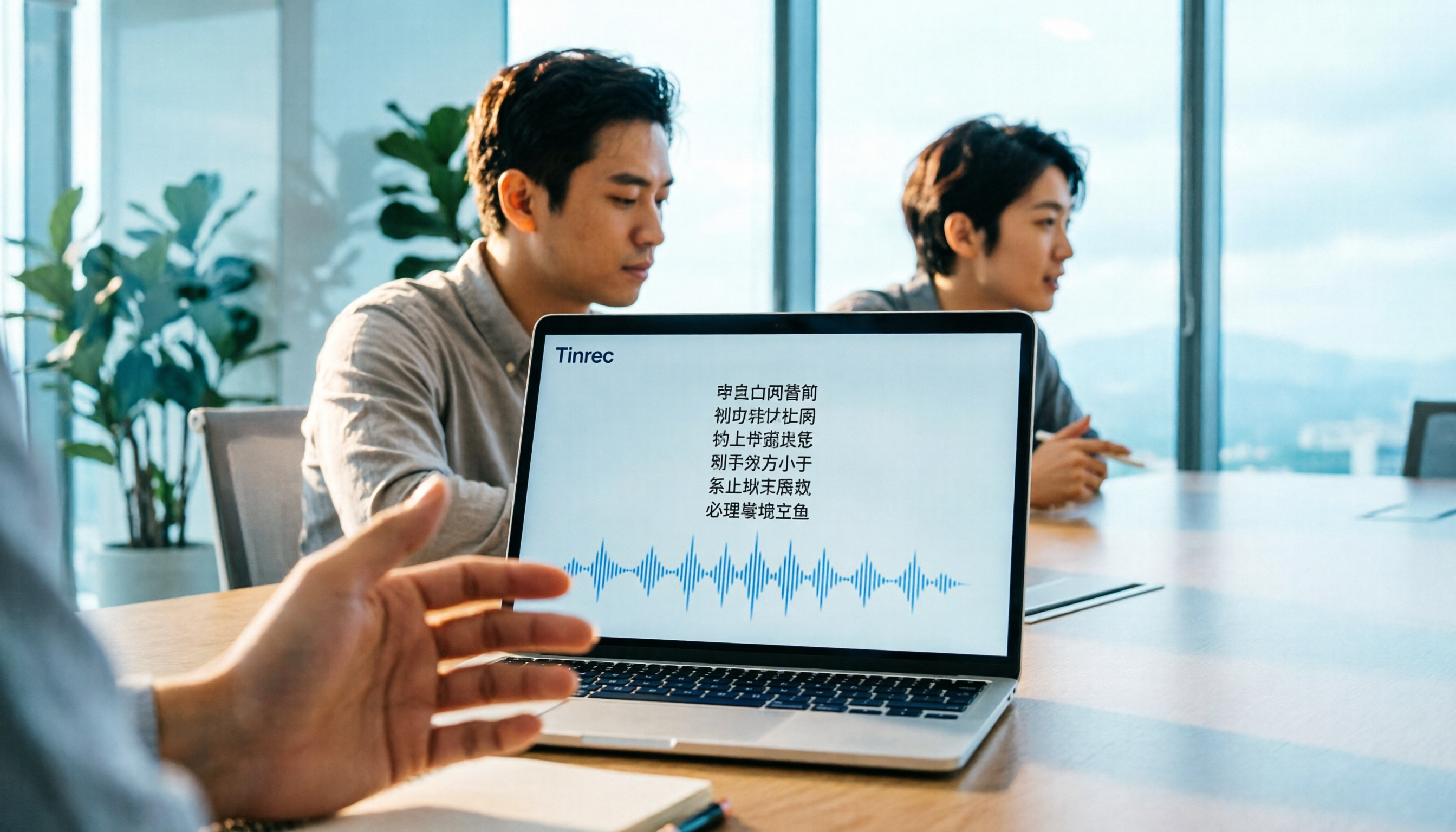
2026 AI Meeting Recorder Comparison: Otter.ai vs Tinrec for Chinese Meetings
This article compares Otter.ai and Tinrec (Miao Ting Lu Yin) across five key dimensions: Chinese meeting transcription, bot-free recording, post-meeting organization, team collaboration, and pricing, to help you quickly decide which is better for Chinese-language meetings.