
Turn recordings into transcripts and summaries in minutes
Upload audio or video for multilingual transcription, AI notes, and action items
Why Is Cantonese Speech-to-Text So Difficult?
If you're an administrative assistant in charge of meeting minutes, a journalist needing to transcribe interviews, or a busy student, you've likely faced this frustrating scenario: a 2-hour audio file filled with Hong Kong-style Cantonese full of 「Chinglish」 and various colloquial particles (啦、囉、嘅). Traditional speech input methods have extremely low recognition for such mixed contexts, leaving you to spend 3 or 4 hours 'listen and type'.
This article will help you solve the following problems:
- Which tool has the best recognition for Cantonese + English mixing?
- How to automatically generate 'key summaries' beyond simple transcripts?
- Horizontal review of the pros and cons of 5 mainstream tools in 2026.
Quick Navigation Conclusion:
- If you are a YouTuber/editor needing subtitles and valuing 'colloquial-to-formal conversion': prioritize Subanana.
- If you are a office worker/student aiming to 'organize content, take notes, track action items': prioritize Tinrec (秒聽錄音).
- If you only occasionally need to process short audio files: try Good Tape's free tier.
2026 Annual Review: 5 Cantonese AI Transcription Tools Compared
We selected the most discussed tools on the market for a horizontal comparison. For workplace and learning scenarios, simple 'transcription' is now basic; the real differentiator is 'whether it saves you time after transcription'.
| Comparison Dimension | Tinrec (秒聽錄音) | Subanana | Good Tape | OpenAI Whisper | Apple/Google Built-in |
|---|---|---|---|---|---|
| Core Positioning | Meeting/Learning Productivity Assistant | Video Subtitle Creation | Simple File Transcription | Open Source/Developer | Basic Voice Input |
| Cantonese Recognition | ★★★★★ (Supports Cantonese-English Mix) | ★★★★★ (Specialized in Colloquial) | ★★★★☆ | ★★★★☆ | ★★☆☆☆ |
| Real-time Recording | Supported (Record while Transcribing) | Not Supported (Upload Only) | Not Supported | Needs Interface | Supported |
| AI Smart Features | Meeting Minutes, Action Items, AI Chat | Colloquial-to-Formal | None | None | None |
| Applicable Scenarios | Meeting Notes, Class Notes, Interviews | Video Subtitling | Simple Transcripts | Technical Integration | Short Phrase Input |
| Free Tier | 100 minutes per month | Paid/Credit System | 3 files per month | Free with self-hosting | Completely free |
💡 Selection Advice
- Choose Subanana: If you're a video creator, its strongest feature is automatically converting '係唔係' to '是不是', greatly reducing subtitle proofreading time.
- Choose Tinrec: If you record audio to 'review key points' or 'send meeting minutes'. Because it not only gives you text but also summarizes 'who said what' and 'what to do next'.
Tinrec (秒聽錄音): Not Just Transcription, But a 'Second Brain'
Among many tools, Tinrec's design logic is closest to the real workflow of 'workplace and learning'. Many tools treat 'outputting a transcript' as the end goal, but Tinrec sees it as just the starting point—what you really need is to understand the content.
Stop organizing recordings by hand
Upload audio or video and automatically get a transcript, summary, and action items

1. Addressing the Pain of 'Chinglish'
Cantonese meetings often include sentences like "Send 個 email 俾 client confirm 個 schedule". Tinrec's model is optimized for such multilingual mixed scenarios, smoothly recognizing switches without garbled characters due to English interspersion.
2. From 'Dead Text' to 'Live Information'
Traditional transcripts often exceed 10,000 characters, making review exhausting. Tinrec's core value lies in:
- Intelligent Speaker Identification: Automatically marks whether it's the Manager or David speaking.
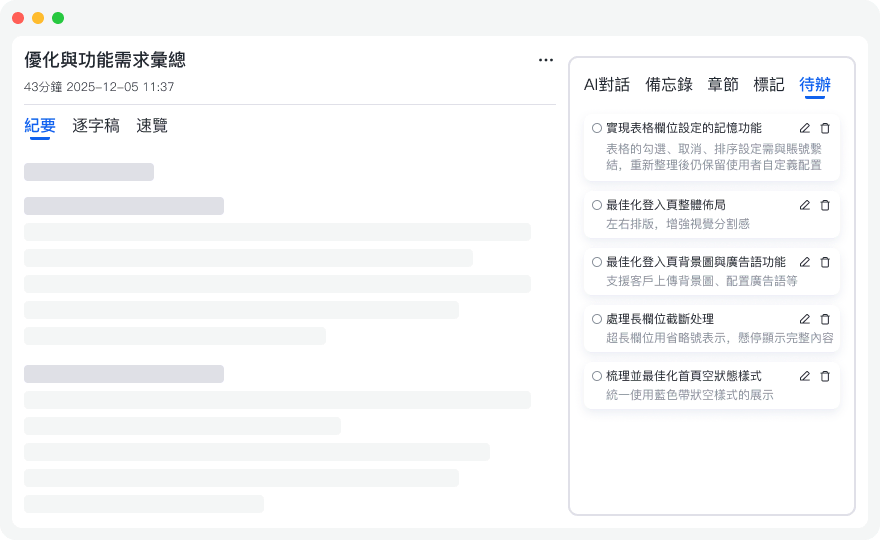
- AI To-Do Action Items: The system automatically extracts sentences like 'Submit report by next Wednesday' and lists them as a To-Do List.
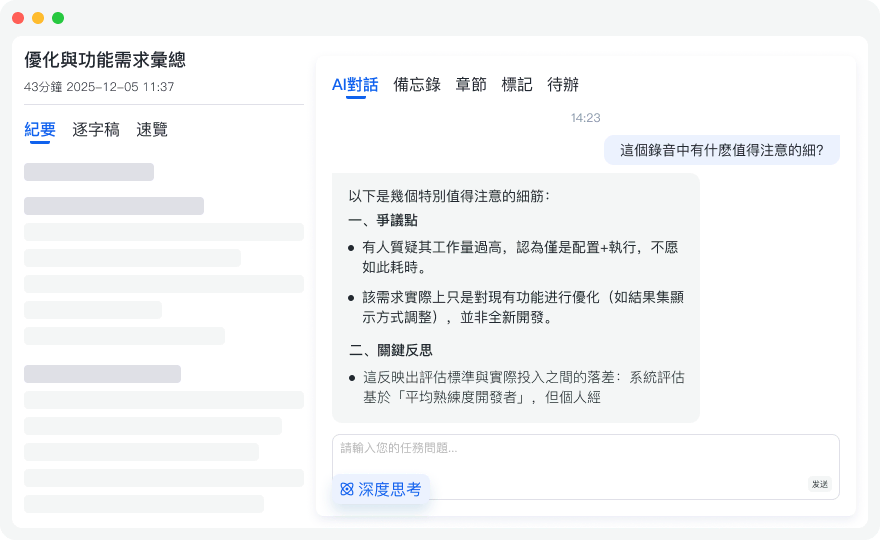
- AI Chat Query: This is the most praised feature. Instead of Ctrl+F searching for keywords, you can directly ask AI: 'What was the conclusion regarding the budget in this meeting?' and it will answer based on the recording content.
Practical Tutorial: How to Efficiently Organize Cantonese Meetings with Tinrec
Below is a demonstration of how to condense a 1-hour department meeting into concise meeting notes within 5 minutes.
Step 1: Start Real-Time Recording or Import File
- Scenario A (In-person): Open the Tinrec app or web version, click 'Start Recording'. Supports phone and PC sync; it's recommended to place the phone in the center of the table during meetings.
- Scenario B (File): If you already have a recording file or want to organize a Cantonese interview from YouTube, use the 'Import Audio/Video' function.
Step 2: Language Settings and Transcription
Before starting, ensure the recognition language is set to 'Cantonese'. Tinrec will transcribe speech to text in real-time as you record, allowing you to listen and watch text output simultaneously to ensure nothing is missed.
Step 3: Use AI to Extract Action Items
After recording, don't rush to read the transcript. Click the 'AI Summary' button, and the system will generate a structured note including:
- Summary: Meeting key points in one sentence.
- Topic Details: Which subjects were discussed.
- To-Do Items: Who needs to do what and by when.
Step 4: Ask AI for Details
If you forget specific details while writing an email, use the 'AI Chat' window on the right:
You ask: 'What was David's specific opinion on the marketing budget?' Tinrec answers: 'David mentioned that the Q3 budget could be increased by 10%, but only if the ROI reaches 1.5. He suggested focusing funds on social media advertising first.'

Frequently Asked Questions (FAQ)
Q1: Can Cantonese recognition distinguish between 'colloquial' and 'formal' speech?
Most AI tools (including Tinrec) primarily faithfully record 'audio content', meaning if you say '係' it writes '係'. If you need to convert colloquial to formal written language (e.g., '係' to '是'), it is recommended to use Tinrec's AI Summary feature, which can rewrite the colloquial transcript into a formal written summary.
Q2: Audio files are very long; is the free version enough?
Tinrec offers 100 minutes of free recording per month, usually sufficient for students or occasional meeting users. For heavy users (like journalists or secretaries), the Basic version at $4.9 per month provides 600 minutes, which is very cost-effective compared to hiring a human transcriber (usually hundreds of Hong Kong dollars per hour).
Q3: Is my privacy secure? Will my meeting records leak?
This is a top concern for enterprise users. Tinrec uses encrypted transmission technology; recordings and text are only accessible by the user. Compared to fully open-source tools, commercial software typically has stricter privacy policies and data protection mechanisms.
Q4: Will a phone call interrupt recording?
It is recommended to enable 'Airplane Mode' or 'Do Not Disturb' when recording on your phone. Although Tinrec supports background recording, incoming calls often force the system to take over the microphone, causing recording interruption.
Q5: Does it support video-to-text?
Yes. You can upload mp4 files or directly paste a YouTube link, and Tinrec will parse the Cantonese audio and generate notes—very useful for organizing online courses or news reports.
Q6: How is recognition in noisy, multi-person environments?
Background noise is the enemy of all speech recognition. Although Tinrec has noise reduction, it's recommended to stay as close as possible to the speaker or use a directional microphone. If multiple people speak simultaneously, the AI may tag it as a single speaker, which can be manually corrected later.
Turn every recording into actionable outcomes
Get 60 free transcription minutes when you sign in. No credit card required.
Related Reading
You might also like

2026 Best 4 Transcription Apps Tested: Free Student Plans and AI Summaries Compared
A student's real-world test of 4 transcription apps in 2026: from lecture notes and group discussions to finals review, comparing free tiers, Chinese recognition, and AI summary Q&A. Sharing why I kept Tinrec and my pitfalls.

How to Transcribe iPhone Recordings in 2026: 5-Step Tutorial and Tinrec Comparison
The built-in Voice Memos transcription on iPhone is free and easy to use, but it often falls short when meetings become a weekly routine, materials are scattered across phone and computer, and content needs to be shared with a team. This article first walks you through the 5 steps of iPhone recording-to-text, then compares how Tinrec differs in online meeting recording, AI summary Q&A, and team collaboration.

Tinrec vs 雅婷逐字稿 2026: 5-Dimension Comparison of Free Audio-to-Text Apps
When meeting, class, or interview recordings sit on your phone and you want a free audio-to-text app, most tools either have limited quotas or only provide transcripts. This article compares Tinrec and 雅婷逐字稿 across 5 dimensions, covering free plans, Chinese transcription, AI summaries, online meeting recording, and team collaboration, to help you decide which one fits your use case.

4 Free AI Audio-to-Text Tools Tested in 2026: Which Free Tier Is Most Generous?
How do you choose a free audio-to-text AI? We cross-compared 4 tools using the same mixed Chinese-English meeting recording, breaking down the real limits of free tiers, post-meeting outputs, online meeting recording methods, and team data ownership. We conclude with clear recommendations for different budgets and use cases.

5 Free Audio-to-Text Tools Compared in 2026: Which Is Right for You — Tinrec, Yating, or cSubtitle?
Searching Dcard for free audio-to-text tools but finding limited free quotas, unstable Chinese recognition, and still having to organize meeting notes manually? This article compares 5 common tools side by side and uses Tinrec as an example to show how to build a smoother meeting-notes workflow — from recording and transcription to summaries, action items, and team collaboration.

2026 Comparison of 4 Audio-to-Text Tools: Which Transcripts Are Actually Ready to Use?
A hands-on comparison of 4 audio-to-text tools, covering how they capture online meetings, their performance with Chinese and mixed Chinese-English speech, post-transcription summaries and AI Q&A, and team seat management and handover. We explain how to choose based on different budgets and use cases, and highlight the 4 most common pitfalls before purchasing.

2026 Comparison of 4 Audio-to-Text Apps: Are Free Tiers Enough for Students?
Starting from questions in PTT discussion threads, I tested 4 audio-to-text apps over a full semester using class recordings and group meetings. I compared real-time transcription, free tiers, post-meeting AI summaries, and cross-platform export, explaining why Tinrec was the one I kept, and who Notta, PLAUD, and Otter.ai are best for.

Free Audio-to-Text Solutions in 2026: 5 Options Compared
Transcribing recordings is a lifesaver for busy professionals, but free tools often disappoint. This article uses Tinrec as a primary example to outline free ways to get started with audio-to-text in 2026, compares 5 plans from free to team versions, and breaks down core capabilities like real-time transcription, bot-free meeting recording, AI summaries and action items, and AI Q&A, so you know which one is worth using.

5 Best Audio-to-Text Apps in 2026: Free Tiers and AI Summaries Compared
We tested audio-to-text apps on free tier limits, Chinese and mixed Chinese-English recognition, and post-meeting organization. We break down 5 key buying factors and 4 common pitfalls, then take a deep dive into Tinrec's bot-free online meeting recording, AI summaries, action item extraction, AI Q&A, and team workspace. Finally, we give clear recommendations based on budget and use case.