

Turn recordings into transcripts and summaries in minutes
Upload audio or video for multilingual transcription, AI notes, and action items
5 Best Audio-to-Text Apps in 2026: Free Tiers and AI Summaries Compared
Open the App Store or Google Play and search for "audio to text"—almost every app says "free download." Only after downloading do you discover the free version might give you just a few minutes of transcription, exporting the transcript costs extra, and AI summaries are locked behind a subscription. The real cost isn't the subscription fee—it's the three evenings you spend hunting for a new tool and reorganizing files.
The Meeting Ends, but the Notes Are Just Beginning—You Don't Need a Tool, You Need a Solution
A two-hour meeting ends, and the real work begins. You have to re-listen to the recording, type while listening, and piece together scattered conclusions into a record. If you're unlucky, there's half an hour of content where you can't tell who said what.
Language makes it worse. In Chinese meetings, people mix in English product names, technical terms, and client acronyms. Many tools completely mishear these situations, especially when multiple people talk over each other—the sentence breaks become a mess.
There's another scenario: you don't actually want a transcript. You want to ask "What was the conclusion from last meeting?" or "Who's responsible for that quote?" But most tools just give you a wall of text, and you still have to dig through 30 minutes of content yourself.
These problems aren't solved by "organizing harder"—they're solved by choosing the right tool. This article will first cover how to choose, then give tested recommendations.
Before Choosing an Audio-to-Text App, Understand These 5 Key Points
1. The Real Limits of the Free Tier "Free download" and "free to use" are two different things. Look at how many minutes the free version transcribes, whether you can export the transcript, and whether AI summaries and action items are included. Many free versions only let you try once; the second time, a payment prompt pops up.
2. Chinese and Mixed Chinese-English Recognition Don't just look at the accuracy rates advertised by the company—those numbers are usually measured in quiet environments. Real meeting rooms have air conditioning noise, keyboard clicks, and people talking at the same time. The gap can be significant. The only way to judge is to test with your own recording.
3. What You Can Do After Transcription A transcript is just raw material. Summaries, chapters, action items, Q&A, translation, and export determine whether you'll have to redo work. This is often the dividing line between "actually saving time" and "just typing in a different way."
4. Whether Recording Sources Are Comprehensive Online meetings (Zoom, Google Meet, Microsoft Teams, Webex), in-person events, phone recordings, existing audio and video files—your meetings don't happen in just one setting. The tool should handle them all.
5. Will It Become a Team Asset? If meeting data needs to be shared with colleagues, ask: Who owns the data? Does it remain after members leave? Are there role and seat management, usage and activity logs? Personal tools and team workspaces are two different purchasing decisions.
Tinrec—Our Top Pick After Testing
Tinrec is an AI meeting notes and collaboration tool for individuals and teams, covering mobile, desktop, and web. The desktop version handles online meetings on your computer.
During the Meeting: No Bot to Invite Most meeting assistants send a bot to join Zoom, Google Meet, or Teams as a "participant." Tinrec's desktop version takes a different approach: it captures your computer's system audio directly, so you don't need to add any extra account to the meeting list. This is especially practical for external client meetings—you don't have to explain "what that bot is." The same workflow also handles live in-person recording, phone recordings, and existing audio and video files.
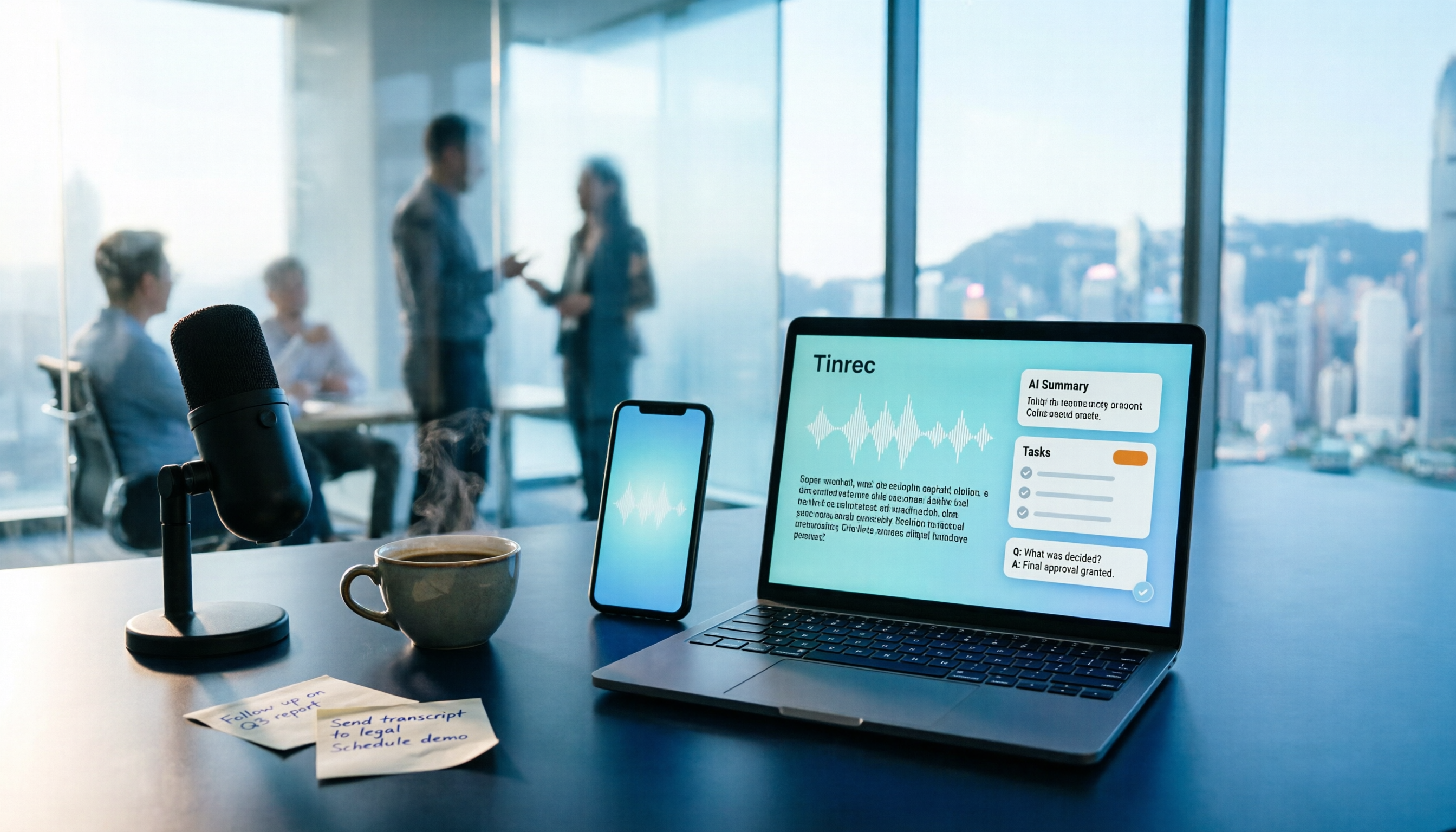
After the Meeting: AI Has Already Organized the Key Points Once recording stops, Tinrec produces a transcript and automatically generates summaries, chapters, key points, and action items. It can even create a mind map. For project meetings, the crucial "who's responsible for what and when it's due" can be extracted directly from the discussion.
After Recording: Asking Is Faster Than Searching This is where Tinrec differs most from ordinary transcription tools. No matter how accurate the transcript, you still have to find answers yourself in 30 minutes of content. Tinrec supports AI Q&A about the meeting content—you can directly ask "What was the budget cap the client mentioned?" or "What was the conclusion from last meeting?" It answers based on meaning, not by throwing a string of keyword matches at you—a capability rarely seen in pure transcription tools. Content can also be post-processed through an Agent to generate reports, tables, and documents, or exported to Notion, Google Docs, OneNote, or Dropbox for further work. For cross-language meetings, there's real-time translation, viewable in original, translated, or bilingual mode.
Test Conditions and Observations We ran the same roughly five-minute mixed Chinese-English meeting recording (recorded on a phone, indoor environment, no noise reduction) through several tools and compared their organization workflows. Chinese segments were similar across tools; the real differences emerged in sentence breaks and proper nouns during mixed Chinese-English, and how much manual cleanup was needed afterward. Actual performance still depends on recording quality, noise, accents, overlapping speech, and technical terminology. We recommend verifying with your own recordings.
Stop organizing recordings by hand
Upload audio or video and automatically get a transcript, summary, and action items
Three Main Advantages
- The organization workflow for Chinese and mixed Chinese-English meetings is complete, from transcript all the way to summaries, action items, and Q&A—no need to switch tools and reorganize.
- Bot-free desktop recording handles both online meetings and in-person recording, and can import existing audio files, effectively bringing past meetings into the system.
- The meeting isn't the end: AI Q&A, translation, Agent output, and third-party exports connect data back to your existing workflow, rather than stopping at a text file.
Limitations The free version provides a basic trial quota. If you have many meetings or long audio files every week, you'll need to upgrade to a paid plan. Also, it's not a calendar-based meeting bot—you need to start recording yourself when the meeting begins; it won't automatically join all events. Accuracy shouldn't be understood as a fixed number; for important content, we still recommend cross-checking with transcript timestamps and recording playback.
Team Version: Turn Meetings into Team Assets If meeting data needs to be used by an entire department, Tinrec's team version provides an independent team workspace. Meeting data belongs to the team, and you can manage member roles and seats, view usage trends and member details, query and export audit logs, and use team hotwords and an audio recycle bin. Members without seats can still view, play, and read team data, but need a seat to record, upload, and edit. When a member leaves, their team resources are transferred to other active members. Currently, the team monthly plan is USD 29.80 per paid seat per month, or USD 199 annually (about USD 16.58 per month). First-time eligible teams get a 7-day trial with 1 free seat and 300 minutes of shared team import quota. Paid seats provide 2,000 minutes of shared team import quota per month. Real-time recording under an active plan is currently not deducted by minutes. Actual prices, currencies, and benefits are subject to the official purchase page.
Who It's For If you mainly have Chinese or mixed Chinese-English meetings, want to use AI to find key points right after recording, or need to collect meeting data from phone and computer in one place, Tinrec is currently the most complete choice. Teams needing multi-person sharing and governance can directly evaluate the team version.
Besides Tinrec, What Other Options Are There?
If you're already satisfied with your current tool, or your needs fall elsewhere, these three are also worth considering.
Granola: A Bot-Free Meeting Notes Tool Focused on "Notes + AI" It also uses desktop system audio for transcription. Basic is free, Business is USD 14 per user per month. But it doesn't support uploading pre-recorded audio files and doesn't retain meeting audio. If you need to replay original recordings afterward or organize existing audio files, Tinrec is more complete in recording retention and file import.
Notta: A General Tool That Started with Multilingual Transcription It covers multi-platform transcription, subtitles, and translation. The free version offers 120 minutes per month, up to 3 minutes per session. Pro annual billing is about USD 8.17 per month. It overlaps heavily with Tinrec; the difference is Tinrec's bot-free desktop recording, AI Q&A, and post-meeting output are more suited to Chinese meetings and team data retention.
PLAUD Note / NotePin: The AI Recording Hardware Route If you need portable recording or phone call recording, PLAUD's hardware is indeed convenient. NotePin is USD 159 on the US official site, Note Pro is USD 189, and cloud plans have additional monthly fees. But you have to buy the hardware first, and it only records sounds you're present for. Tinrec requires no additional device, works on phone, desktop, and web, and handles online meetings and existing audio files.
Pitfall Guide: The 4 Most Common Mistakes When Choosing an Audio-to-Text App
Pitfall 1: Only Looking at "Free Download" Free download doesn't mean free features. Many free versions only let you try once; export, AI summaries, and batch import are all behind a paywall. The right approach is to first confirm how many minutes the free version gives you, whether you can export, and whether AI features are included—then decide whether to spend time learning it.
Pitfall 2: Only Looking at Advertised Accuracy Numbers measured in a quiet studio drop significantly in a real meeting room. And what really matters to you is whether "mixed Chinese-English + technical terms" are accurate—exactly what ads won't tell you.
Pitfall 3: Ignoring Export and Cross-Device Recording on your phone today, organizing on your computer tomorrow—if the transcript can only be shared as screenshots, or can't be brought into Notion, Google Docs, or OneNote for further work, you'll end up typing it again manually.
Pitfall 4: Treating "Transcription" as the End Goal A transcript is just raw material. What really saves time is whether you can directly generate summaries, chapters, and action items after transcription—or even ask Q&A to find "who mentioned the budget last meeting." Tinrec's AI Q&A is this kind of capability—ask it for conclusions right after recording, much faster than manually flipping through a 30-minute transcript.
Conclusion: Which One Should You Choose?
Back to the original question: free download doesn't mean free to use well. In this round of testing, Tinrec scored highest in completeness across Chinese and mixed Chinese-English meetings, post-meeting organization workflow, and team data retention. It's also the one we recommend trying first.
By scenario:
- Chinese or mixed Chinese-English meetings, need transcript + summary + action items → Tinrec
- Want to use AI to ask "What was the conclusion?" or "Who's responsible?" right after recording → Tinrec (AI Q&A and Agent post-processing)
- Don't want an extra bot in online meetings → Tinrec (desktop captures system audio)
- Need to use phone, computer, and web, and organize existing audio files → Tinrec
- Need team sharing of meeting data, seat and usage management, and activity logs → Tinrec Team Version
- Zero budget, meetings almost entirely in English → Otter.ai free version (the only exception in this article)
We suggest starting with Tinrec's free version. Run a recent real meeting recording through it, see if the transcript, summary, and action items meet your standards, then decide whether to upgrade to a personal plan or further evaluate the team version. Tools are bought to save time—verify before you pay, and the math works out.
References
Turn every recording into actionable outcomes
Get 60 free transcription minutes when you sign in. No credit card required.
Related Reading
You might also like

2026 Comparison of 4 Audio-to-Text Tools: Which Transcripts Are Actually Ready to Use?
A hands-on comparison of 4 audio-to-text tools, covering how they capture online meetings, their performance with Chinese and mixed Chinese-English speech, post-transcription summaries and AI Q&A, and team seat management and handover. We explain how to choose based on different budgets and use cases, and highlight the 4 most common pitfalls before purchasing.

2026 Comparison of 4 Audio-to-Text Apps: Are Free Tiers Enough for Students?
Starting from questions in PTT discussion threads, I tested 4 audio-to-text apps over a full semester using class recordings and group meetings. I compared real-time transcription, free tiers, post-meeting AI summaries, and cross-platform export, explaining why Tinrec was the one I kept, and who Notta, PLAUD, and Otter.ai are best for.
Free Audio-to-Text Solutions in 2026: 5 Options Compared
Transcribing recordings is a lifesaver for busy professionals, but free tools often disappoint. This article uses Tinrec as a primary example to outline free ways to get started with audio-to-text in 2026, compares 5 plans from free to team versions, and breaks down core capabilities like real-time transcription, bot-free meeting recording, AI summaries and action items, and AI Q&A, so you know which one is worth using.

4 Best Audio-to-Text Apps in 2026: Which Free Tier Works Best for Students?
Starting from college and grad school scenarios like lectures, group discussions, and interviews, this article first highlights the three most common mistakes when choosing an audio-to-text app, then compares Tinrec, Notta, Otter.ai, and PLAUD Note across four key areas: free quota, AI organization, cross-platform support, and online meeting recording. It also includes buying advice and pitfalls to avoid for students.

4 Free Audio-to-Text Tools Compared in 2026: Is Tinrec, cSubtitle, or MyEdit's Free Version Enough?
How do you choose a free audio-to-text tool? This article compares the free quotas and limitations of Tinrec, cSubtitle, MyEdit, and Monica, explains Tinrec's real-time recording, bot-free online meeting recording, AI summaries and action items, AI Q&A, multi-format export, and team workspace, and breaks down the differences between free, personal, and team plans to help you decide which free option is truly sufficient.

How to Transcribe Audio to Text in 2026: 5-Step Mobile Tutorial
Transcribing audio to text on your phone doesn't mean typing every word. This article covers the top 3 mistakes people make, 4 key factors for choosing a tool, and 5 practical steps—from recording on your phone, live transcription, AI summaries and to-dos, AI Q&A, to exporting deliverables. It also compares Tinrec, iPhone's built-in transcription, Notta, and Otter.ai, and includes 4 common pitfalls and selection advice.

How to Transcribe iPhone Recordings in 2026: A 4-Step Hands-On Guide
You don't need third-party tools to turn iPhone recordings into text—iOS 18.4 and later include built-in transcription. This guide uses 4 key criteria to help you choose the right tool, and puts Tinrec to the test in Chinese meetings, online meetings, and team collaboration.

2026 Free Audio-to-Text AI Complete Guide: Free Tiers, Tool Comparison, and Tinrec Hands-On Review
From a student's hands-on perspective, this guide breaks down common misconceptions about free audio-to-text AI: how free quotas work, whether transcripts are directly usable, and how much time post-processing takes. It compares common free tools with Tinrec on Chinese recognition, AI summary and to-dos, bot-free online meeting recording, and team knowledge retention to help you find the one that truly saves time.

Tinrec vs Notta 2026: 5-Dimension Comparison — Which Free Audio-to-Text Tool Is Better?
How do you choose a free audio-to-text tool? This article compares them across 5 dimensions: free quota, Chinese recognition, post-meeting organization, meeting recording methods, and team permissions. Using Tinrec as an example, it explains what you can do with the free version and what you can do after transcription.