

Turn recordings into transcripts and summaries in minutes
Upload audio or video for multilingual transcription, AI notes, and action items
Why You Need a Meeting Transcription Tool?
I attend about 15 meetings a week—team meetings, project status updates, one-on-ones, and cross-departmental coordination. The most annoying part used to be not the meetings themselves, but what came after. Every meeting left a pile of decisions and action items to sort out. I tried handwritten notes, but I'd miss things when busy; I tried recording and listening back, but a 1-hour recording took 3 hours to replay and type up. Then I started using AI transcription tools, which saved me that time. This article compiles the 5 tools I've tested, including paid and free options, so you don't have to waste time trying them all like I did.
Option 1: Tinrec—The Most Complete AI Meeting Notes and Collaboration Assistant
Let me start with Tinrec, which I currently use as my primary tool. It's not just a simple transcription tool; it turns meetings into searchable, collaborative, trackable team assets. A few things that stood out to me:
- No need to invite meeting bots: Tinrec's desktop app directly captures your computer's system audio, so when you're on Zoom, Google Meet, Teams, or Webex, you don't have to add a bot. Just open Tinrec and it records and transcribes as you go. This keeps meetings clean and avoids adding an unfamiliar participant.
- Keep asking questions after transcription: This is my most-used feature. After a meeting, I can ask, "What was the budget cap the client mentioned?" or "What were the main reasons for the project delay?" Tinrec finds answers from the transcript and cites sources. This is much faster than scanning the transcript manually.
- Team spaces are key: Our department stores meeting recordings and transcripts in a team space, so new hires can search past meetings without asking around. And when members leave, the data stays with the team—it doesn't leave with them.
- Pricing: There's a free version for individuals to try. Pro monthly or annual plans are suitable for regular use; the team plan is about USD 29.8 per paid seat per month (monthly billing) or USD 199 per seat per year (annual billing). Check the official site for details.
Who it's for: Those who need to manage both personal and team meeting data, and value Chinese transcription and post-meeting organization.
Option 2: Otter.ai—A Mature Assistant for English Business Meetings
Otter is popular abroad and was one of the first I tried. Its strengths are real-time transcription for English meetings, speaker separation, and AI Chat. Pricing: Basic is free with 300 minutes per month; Pro is about USD 8.49 per user per month (annual billing), including 1,200 minutes of in-app recording and 10 file imports per month. Business plans offer unlimited meetings and more admin features. But my pain point: its performance on mixed Chinese meetings wasn't as expected, and its focus leans toward the English market. If you primarily have English meetings, Otter is a good choice; but if your team speaks mostly Chinese, read on.
Option 3: Notta—A Multilingual Transcription and Translation Tool
Notta overlaps significantly with Tinrec, supporting multi-device transcription, translation, file imports, and team plans. The free version offers 120 minutes per month, with a max of 3 minutes per session; Pro is about USD 8.17 per month (annual billing) for 1,800 minutes per month; Business is about USD 16.67 per seat per month (annual billing), offering unlimited transcription and role-based permissions. Notta's translation feature is good, but its strengths lean toward file transcription and subtitles; its post-meeting AI Q&A and team knowledge management aren't as comprehensive as Tinrec's.
Stop organizing recordings by hand
Upload audio or video and automatically get a transcript, summary, and action items
Option 4: TurboScribe—High-Value Long-File Transcription
If you need to transcribe large volumes of long audio or video files, TurboScribe is worth a look. The free version allows 3 files per day, with a max of 30 minutes per file; Unlimited is USD 120 per year (about USD 10 per month), supporting files up to 10 hours or 5GB, with batch uploads of up to 50 files. It transcribes quickly, but it's primarily for file transcription—no live meeting recording or team collaboration spaces. It's suitable for researchers or those needing large volumes of interview transcripts.
Option 5: CLOVA Note—Free and Fast Speech-to-Text
This is a free tool developed by LINE; you just need a LINE account to use it. Based on online reviews, it recognizes speech quickly—some say it can transcribe a 3-hour recording in under 30 seconds (actual speed varies by file size and network)—and it can distinguish between speakers. It's generous for a free tool, but its features are basic: no AI Q&A, team spaces, or automated meeting summaries. If you have zero budget and need occasional transcription, start with this.
With So Many Options, How Do You Choose?
Here's my bottom line:
- For the most complete post-meeting processing (transcription + AI Q&A + auto-summaries + team spaces) → Tinrec, currently the only one with all these features.
- For primarily English meetings and need mature English transcription → Otter.
- For large volumes of long-file transcription and batch processing → TurboScribe.
- For zero budget and occasional transcription → CLOVA Note.
- For multilingual translation and subtitles, but no deep team collaboration → Notta.
For my team's scenario—15 meetings a week, half in Chinese, needing to track action items and preserve meeting history—Tinrec is the best fit. It may not be #1 in every category, but it integrates meeting notes, Q&A, action items, and team collaboration most seamlessly.
5 Things to Know Before Using Meeting Transcription Tools
- Get consent from participants: Recording and transcription involve personal privacy. Inform everyone before the meeting, especially for client or cross-departmental meetings. It's not just polite; it's also about compliance.
- Audio quality determines transcription quality: Clear microphone pickup and avoiding overlapping speech will greatly improve accuracy. AI isn't magic; poor recordings will still produce errors.
- Transcripts aren't the end goal: After transcription, be sure to use AI summaries and action-item extraction (Tinrec has these); otherwise, you're just swapping typing time for reading time.
- Free plans usually have limits: For example, Otter Basic gives 300 minutes per month, and Notta's free version caps sessions at 3 minutes. Calculate if that's enough. If you're in meetings daily like me, you'll hit the limits quickly.
- Centralize team data: If your meeting notes are scattered across personal devices and chat apps, they might as well not exist. Use features like Tinrec's team spaces to store everything in one place, so new hires and managers can find what they need.
Summary
Meeting transcription tools have truly solved not just the "typing" problem, but made meeting content searchable, queryable, and trackable. Each of these 5 tools has its strengths, but if you want a one-stop solution for Chinese meetings plus team collaboration, Tinrec is the smoothest I've used so far. You can start with the free version and consider a paid plan if it works for you—stop manually organizing meeting notes.
References
- Meeting Ink - 2026 AI Meeting Notes Tool Test: 7 Speech-to-Text and Summary Speed Comparison | Meeting Ink - AI Meeting Notes Assistant, Automatic Transcript and Summary
- Master Meeting Notes! How to Use AI for Speech-to-Text: Gemini Notebook, Gemini, EchoScript Tutorial | 104 Career Force
- How to Use AI for Meeting Minutes? How to Organize Meeting Transcripts? | AI Speech-to-Text Tutorial | 104 Career Force
- Online AI Speech, Video, Audio File to Text - Free Trial - cSubtitle
- Tested: 4 Best Online Speech-to-Text Tools, Free to Convert Audio Files to Transcripts
Turn every recording into actionable outcomes
Get 60 free transcription minutes when you sign in. No credit card required.
Related Reading
You might also like

How to Take Meeting Notes on iPhone 16 in 2026: 5 Steps from Recording to AI Summary
Using iPhone 16 for meetings—the real pain isn't the meeting itself, it's the post-meeting cleanup. This article, from the perspective of a mid-level manager who holds 15 meetings a week, breaks down the practical approach to meeting notes on iPhone 16, tests tools like Tinrec and Apple's built-in Notes, and tells you which tool to use for which scenario and where the pitfalls are.

iPhone 17 Meeting Notes Showdown 2026: Built-in Voice Memos vs Tinrec — Which Is Enough?
The most common mistake iPhone 17 users make with meeting notes is thinking that 'record + paste into AI later' solves everything. This article compares iPhone 17's built-in Voice Memos and Tinrec across features and workflow—from recording capture, transcript post-processing, online meetings, Chinese-language experience, team collaboration, to pricing and quotas—to help you decide which fits your meeting style.

iPhone Meeting Notes in 2026: Built-in Notes vs. ChatGPT Workflow vs. Tinrec — Which Saves the Most Time?
Is the iPhone Notes voice transcription good enough for meeting minutes? Starting from the real pain points of a mid-level manager with 15 meetings a week, this article tests and compares three approaches: the built-in iPhone Notes recording, a manual Voice Memos + ChatGPT workflow, and Tinrec. It outlines 4 key buying criteria and 4 common pitfalls, and honestly explains each option's limitations and best-fit scenarios.

Google Transcript Tools vs Tinrec (2026): 5-Factor Comparison for Chinese Meeting Notes
Google's transcript tools are free and easy to use, but they are split across three workflows: voice typing in Google Docs, AI Studio, and Android Live Transcribe. In meeting scenarios, they often struggle with audio capture and post-meeting organization. This article compares Google and Tinrec (秒听录音) across five dimensions—online meeting audio capture, Chinese recognition, summarization and action items, AI Q&A and export, and team collaboration—to explain which tool suits which situation.

How to Get Google Meet Transcripts in 2026: 5 Steps from Captions to AI Meeting Notes
Just finished a meeting and realized you don't have the transcript? This guide breaks down how to obtain Google Meet transcripts in 5 steps, compares built-in transcripts, SeaMeet, Notta, and Tinrec, and clarifies permissions, Chinese recognition, post-meeting organization, and team archiving.
Best Free AI Meeting Notes for iPhone in 2026: 4 Options Compared
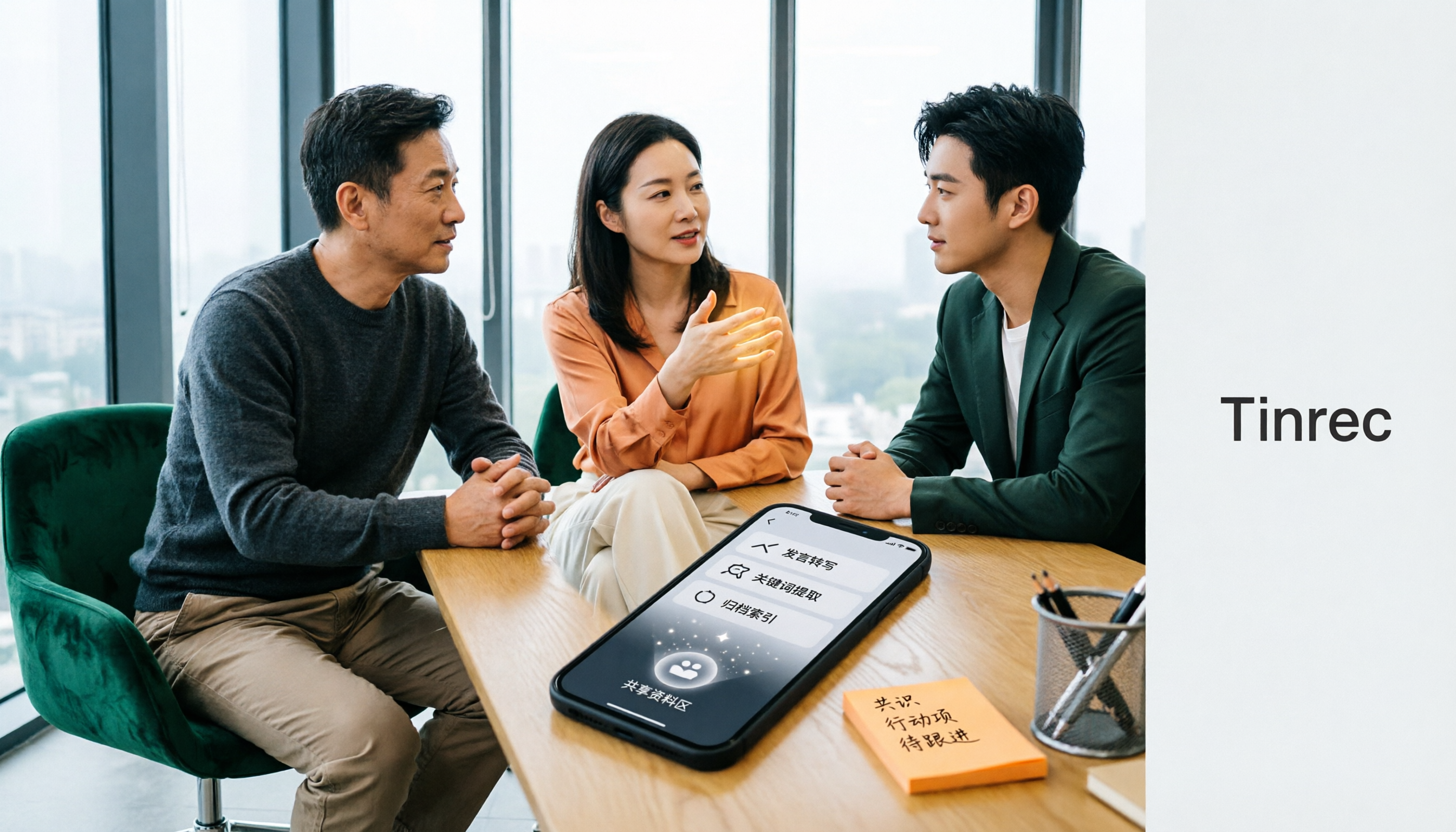
Looking for an AI meeting notes app on iPhone? The real challenge isn't features—it's whether the free tier is enough and if the output is usable. This guide breaks down 4 iPhone-compatible AI meeting note solutions across four dimensions: free tier format, post-meeting output, cross-device use, and team collaboration. It also explains how Tinrec differs in Chinese meetings, bot-free recording, and team knowledge retention.
2026 Google Meet Note-Taking Showdown: Is Gemini's Auto Notes Enough?
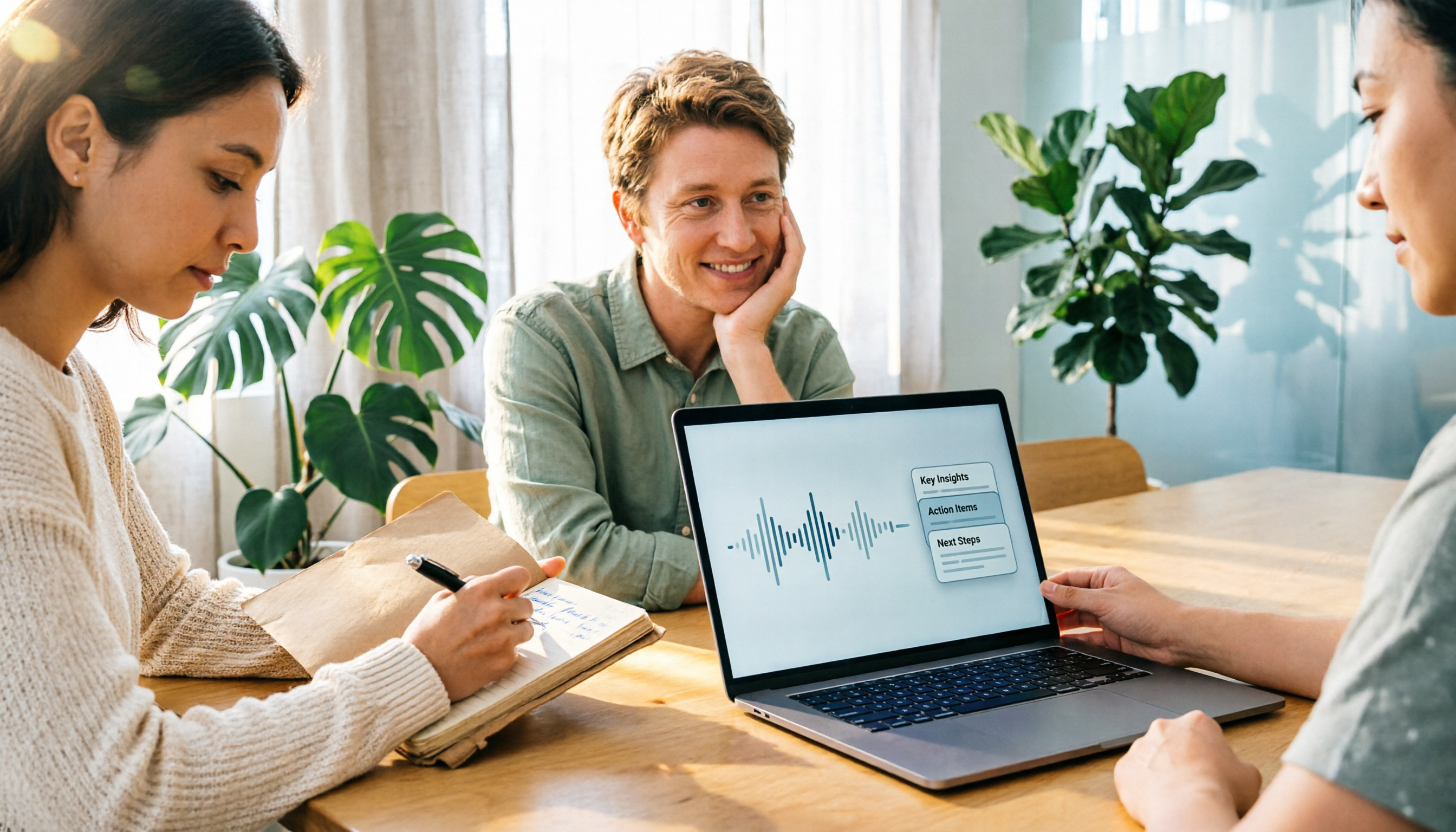
Google Meet's built-in Gemini 'Take notes for me' is convenient, but it may not be the best fit for every team. This article uses four key decision points to compare Gemini auto notes, Tinrec, Otter.ai, and Granola, explaining where meeting notes should live, how they'll be used afterward, and the four most common pitfalls when choosing a solution.

Google Meet Gemini vs Tinrec: Which Meeting Notes Tool Saves More Time in 2026?
Google Meet's built-in Gemini can transcribe and summarize meetings, but recording and transcripts are plan-restricted, and captions can't be copied directly. This hands-on comparison of Tinrec and Google Meet's built-in meeting notes across 6 dimensions—recording method, post-meeting output, cross-platform support, Chinese-language experience, team management, and pricing/quotas—helps you decide which fits your meeting scenario.

2026 iPhone Meeting Recorder Apps: Free Plans Compared — Free, Weekly, and Pro
A student's hands-on guide to choosing a free plan for iPhone meeting recorder apps, debunking myths like 'free download doesn't mean free use,' and using Tinrec as an example to explain which scenarios suit the free version, weekly pass, Pro monthly, and annual plans.