

Turn recordings into transcripts and summaries in minutes
Upload audio or video for multilingual transcription, AI notes, and action items
Two Hours in a Meeting, Two More Transcribing—You Don't Need a Tool, You Need a Solution
It's Tuesday at 3 PM, the meeting just ended, and you're staring at the recording on your computer, dreading the thought of listening, typing, pausing, and replaying to turn two hours of discussion into a decent meeting summary. You open a text editor, fingers on the keyboard, but you don't know where to start.
This "tired from the meeting, even more tired after" state is something many office workers experience at least once a week. If you're unlucky, the meeting includes a mix of Chinese and English, colleagues talking over each other, and microphone volume fluctuating—making transcription even more painful.
Choosing the right speech-to-text tool isn't about looking cool; it's about genuinely saving time on repetitive listening and typing. In this article, I tested 4 free speech-to-text tools from the perspective of Chinese meeting transcription to give you a no-regret choice.
Before Choosing a Speech-to-Text Tool, Understand These 4 Key Points
Accuracy: Don't Just Look at Official Numbers. Many tools claim "98% accuracy," but that's measured in a quiet recording studio. Real meetings have keyboard clicks, air conditioning noise, and people talking over each other, which significantly reduces accuracy. Use your own recordings to test the free trial to see actual performance.
Free Quota: Is It Enough for One Meeting? Some tools' free versions only allow 3 minutes per session, which is useless for a typical 30-minute meeting. First, check if the free version can handle your usual recording length before deciding whether to pay.
What You Can Do After Transcription: A Transcript Alone Isn't Enough. A transcript is just the first step. If the tool can auto-summarize, extract action items, and let you find key points via Q&A, it truly saves you time on follow-up work.
Chinese Support: Especially Important for Users in Taiwan. Recognition of mixed Chinese-English, Taiwanese terms, and proper nouns directly affects how much time you spend proofreading. Many foreign tools underperform here.
Tinrec (秒听錄音) – The Best Free Starting Point for Chinese Meetings After Testing
Tinrec is an AI meeting notes and collaboration tool that supports live recording, bot-free online meeting transcription, audio file import, and real-time translation. Its free version lets you experience recording, import, summarization, and transcription with basic credits, while paid plans include a weekly card, Pro monthly, and Pro yearly, suitable for different usage frequencies.
Let me start with my favorite part: No need to invite a meeting bot. Tinrec's desktop version directly captures system audio, so for Zoom, Google Meet, or Microsoft Teams meetings, you just open Tinrec and it records and transcribes in real time—no extra bot participant interrupting the discussion. This is a big plus for teams that don't like seeing unfamiliar bots in meetings.
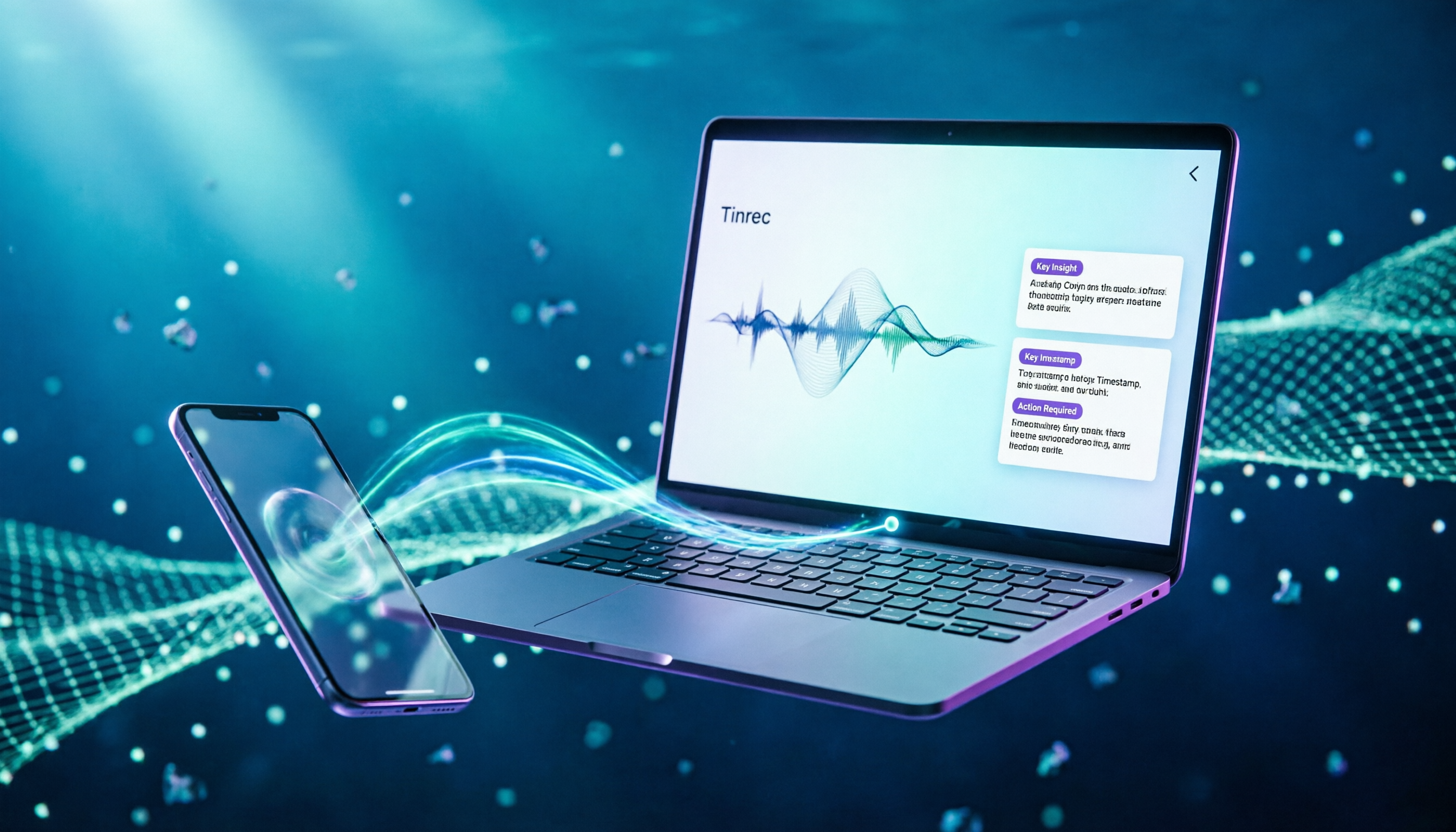
After recording, it automatically generates a transcript, AI summary, chapters, and action items. I tested it with a 25-minute Chinese product meeting recording: the transcript was clearly segmented, the AI summary pulled out three key decisions, and action items listed owners and deadlines. Even better, you can ask Tinrec directly, "Who mentioned the budget in the last meeting?" and it answers based on semantics, not just keyword search results. Few free tools in this price range offer this feature.
Pros:
Stop organizing recordings by hand
Upload audio or video and automatically get a transcript, summary, and action items
- Chinese experience tailored to Taiwanese users: Stable recognition of mixed Chinese-English and common terms, so you don't have to keep fixing typos.
- Complete post-transcription workflow: Summaries, action items, AI Q&A, and multi-format export—not just a transcript.
- Cross-platform support: Available on iOS, Android, and web, so you can record on your phone and organize on your computer without gaps.
Limitations to note: The free version doesn't publicly specify a fixed number of minutes; check the official website for actual credits. If you have heavy daily transcription needs, you'll need a paid plan. But for those meeting 2–3 times a week, the free version is usually enough to experience the full workflow.
Who is it for? If you frequently need to transcribe Chinese meetings, don't want bots in meetings, and want to use AI to find key points after recording, Tinrec is currently the most convenient free starting point.
Beyond Tinrec: Other Free Options
Otter.ai: The top choice for English meetings, with a generous 300 free minutes per month. However, its Chinese experience isn't as tailored to Taiwanese users as Tinrec's. If you mainly record English content, Otter.ai is a better deal than Tinrec; for Chinese meetings, try Tinrec first.
Notta: The free version offers 120 minutes per month, but each session is capped at 3 minutes, which is too restrictive for typical meeting recordings. Tinrec's free version lets you fully experience live recording, summarization, and AI Q&A without hitting a per-session limit right away.
TurboScribe: The free version allows 3 files per day, with a max of 30 minutes per file, suitable for transcribing pre-recorded audio or subtitles. However, it doesn't support live meeting transcription or AI Q&A. If you only need to batch-transcribe old recordings, TurboScribe is cost-effective; for online meetings, Tinrec is more complete.
Pitfall Guide: 3 Common Mistakes When Choosing Speech-to-Text Tools
Pitfall 1: Only Looking at Official Accuracy Claims. Many tools claim 98% in quiet environments, but real meetings have noise, interruptions, and accents, reducing accuracy. Always test with your own recordings, not just ads.
Pitfall 2: Ignoring Per-Session Length Limits in Free Versions. Some tools have a decent total monthly quota, but each session is limited to 3–5 minutes, which is useless for meeting recordings. First, check if your typical recording length can be processed fully.
Pitfall 3: Using the Tool Only for "Speech-to-Text." If you only use it to generate transcripts, you're using only a third of its capability. Tools like Tinrec's AI Q&A let you ask "What was the meeting conclusion?" right after recording, which is much faster than manually scanning a 30-minute transcript. When choosing a tool, look at post-transcription features, not just transcription itself.
Summary: Which Free Version Should You Choose?
If you mainly handle Chinese meetings and want to start with a free version, Tinrec is the most reliable starting point. Its bot-free recording, Chinese experience, and AI Q&A are hard to find together in other free tools.
Scenario-based recommendations:
- Chinese meetings + want AI summary/Q&A → Tinrec (try the full workflow with the free version)
- English meetings + need large free quota → Otter.ai (300 minutes/month)
- Only transcribe pre-recorded audio, no live meetings → TurboScribe (3 files/day)
- Recordings over 3 minutes + need Chinese → Avoid Notta's free version; try Tinrec directly
I recommend starting with Tinrec's free version, running your own meeting recording through it, and if the summary and Q&A genuinely save you time, then consider upgrading. No need to spend money upfront.
References
- Online AI Speech, Video, Audio to Text - Free Trial - cSubtitle
- [AI Voice Notes] 5 Highly Recommended AI Transcription Tools! Generate Transcripts and Meeting Minutes, Free vs. Subscription, Pros and Cons | 104 Career Force
- Tested: 4 Best Online Speech-to-Text Tools, Free to Convert Audio to Transcript
- Unlimited Time! 3 Free AI Transcript Tools, Highly Recommended! AI Voice Notes for Meeting Minutes, Slides, Mind Maps | 104 Career Force
- Audio to Text - Free Speech-to-Text Tool
Turn every recording into actionable outcomes
Get 60 free transcription minutes when you sign in. No credit card required.
Related Reading
You might also like

2026 AI Meeting Notes Comparison: Which Tool Delivers Google Meet Minutes Fastest?
Many assume Google Meet automatically provides AI meeting notes, but built-in notes have account and language restrictions, and live captions can't be copied directly. This article addresses common misconceptions, walks through Tinrec desktop's bot-free recording workflow for automatically generating transcripts, summaries, and action items after Google Meet, and lists 5 buying checkpoints and FAQs.

2026 Comparison of 3 iPhone Recording Organization Tools: Can't Find Recordings? Which Saves the Most Time Transcribing?
When you can't find an iPhone recording, it's usually not because the file disappeared, but because the recording never had a fixed home. This article first helps you check three locations: Voice Memos, iCloud, and the Files app, then compares Tinrec, Otter.ai, Notta, and TurboScribe on transcription, AI Q&A, and team organization, including free tier limits and 3 common pitfalls to avoid.

How to Transfer Apple Watch Voice Memos to iPhone in 2026: iCloud Sync + Transcript Guide
There's no 'transfer' step for Apple Watch recordings—it's all about whether iCloud Voice Memos sync is on. This guide walks you through 3 steps to set it up, find the 'Watch Recordings' folder, and troubleshoot 5 common sync failures. Plus, from a manager's post-meeting perspective, we compare Voice Memos vs. Tinrec on transcripts, summaries, action items, AI Q&A, and team collaboration.

2026 AI Meeting Notes Guide: Tinrec vs Plaud Features and Buying Advice
Searching for 'AI meeting notes recommendations' often brings up hardware reviews like Plaud, but for most students the real challenge is organizing recordings afterward. Based on my own experience, this guide explains the differences between Tinrec and Plaud in cost, online meeting handling, post-meeting outputs, and team collaboration, and covers free tier limits, plan structures, and key buying considerations.

2026 AI Meeting Recorder Comparison: Which Free Version Is Actually Enough?
We tested the free versions of five AI meeting recorder tools in 2026, comparing free quotas, online meeting support, Chinese transcription, post-meeting summaries, and AI follow-up Q&A. Tinrec performed most completely for Chinese meetings, bot-free recording, and post-meeting organization workflows. This article also honestly lists the free limitations and ideal users for Otter.ai, Notta, Granola, and PLAUD.
5 Ways to Transfer iPhone Voice Memos to Windows in 2026: Which Is Fastest and Lossless?
Most people get stuck after saving iPhone voice memos to Files when trying to move them to a Windows PC. This hands-on test compares five transfer methods—speed, file size limits, and downstream organization costs—and explains why transferring the audio is only half the battle; the real time sink is transcription, extracting key points, and turning recordings into usable data.

2026 AI Meeting Notes Tool Comparison: Tinrec vs Notta — Which Is Better for Chinese Meetings Across 5 Key Dimensions?
The biggest pitfall when choosing an AI meeting notes tool is focusing only on transcription accuracy. This comparison starts from the question "where should meeting data ultimately live?" and evaluates Tinrec and Notta across 5 dimensions: Chinese meeting input sources, online meeting capture methods, post-meeting outputs, team governance, and pricing/quotas — helping you decide which tool better fits your workflow.

2026 AI Meeting Notes Tools Compared: Which Turns Transcripts into Actionable Meeting Records?
We tested 3 AI meeting notes tools in 2026, comparing transcripts, summaries, action items, AI Q&A, exports, and team permissions. Includes a ready-to-use meeting record template and pitfalls to avoid, helping you spend less time on post-meeting work.

How to Take AI Meeting Notes in 2026: 5 Steps from Recording to Team Summary
A common AI meeting notes approach on PTT is to transcribe first and then ask AI to organize, but what really affects efficiency is whether meeting data can be searched, queried, and handed over. This article breaks down the process in 5 steps and compares Tinrec, Otter.ai, Notta, and Granola on differences in Traditional Chinese meetings, bot-free recording, and team governance.