

Turn recordings into transcripts and summaries in minutes
Upload audio or video for multilingual transcription, AI notes, and action items
Still scrambling to take meeting notes? You don't need just a tool—you need a solution
Are you struggling to choose a speech-to-text app? Two hours in a meeting, then another two hours organizing the notes—that's the daily grind for many office workers. Especially when meetings mix Chinese with English, Taiwanese accents, or various dialects, transcripts end up riddled with errors, forcing you to re-listen and retype. Worse, meeting recordings are scattered across your phone, computer, and chat apps, so finding a decision from three months ago means digging through every folder. If you've been there, this article will help you use the right tool and spend your time on what really matters.
Before choosing a speech-to-text app, understand these 4 key points
Accuracy: Don't just look at the official 98% claim. Real meetings have background noise and people talking over each other, which is where the real differences show. Try a free trial with your own recordings instead of just watching ads.
Recording method: Do you need a meeting bot? Some tools require inviting a bot to join the meeting, which disrupts the flow; others can record your computer's audio directly, which is less intrusive. Tinrec does this well, as we'll mention later.
AI post-processing: Just transcribing isn't enough—can it auto-generate summaries, action items, and Q&A? That determines how much time you save. Tinrec has full-featured capabilities here, and we were impressed in our tests.
Team and cross-device support: If your data is only on your phone, can't be opened on your computer, or can't be shared with colleagues, its usefulness drops significantly. Choose a tool with team spaces and cross-platform support so you're not locked in.
Tinrec (Seconds Recording) — Our Top Pick After Testing
Tinrec is an AI meeting notes and collaboration tool that supports Chinese and multiple languages, covering iOS, Android, desktop, and web. After testing it in real meeting scenarios, we believe it's currently the best choice for Chinese-speaking users.
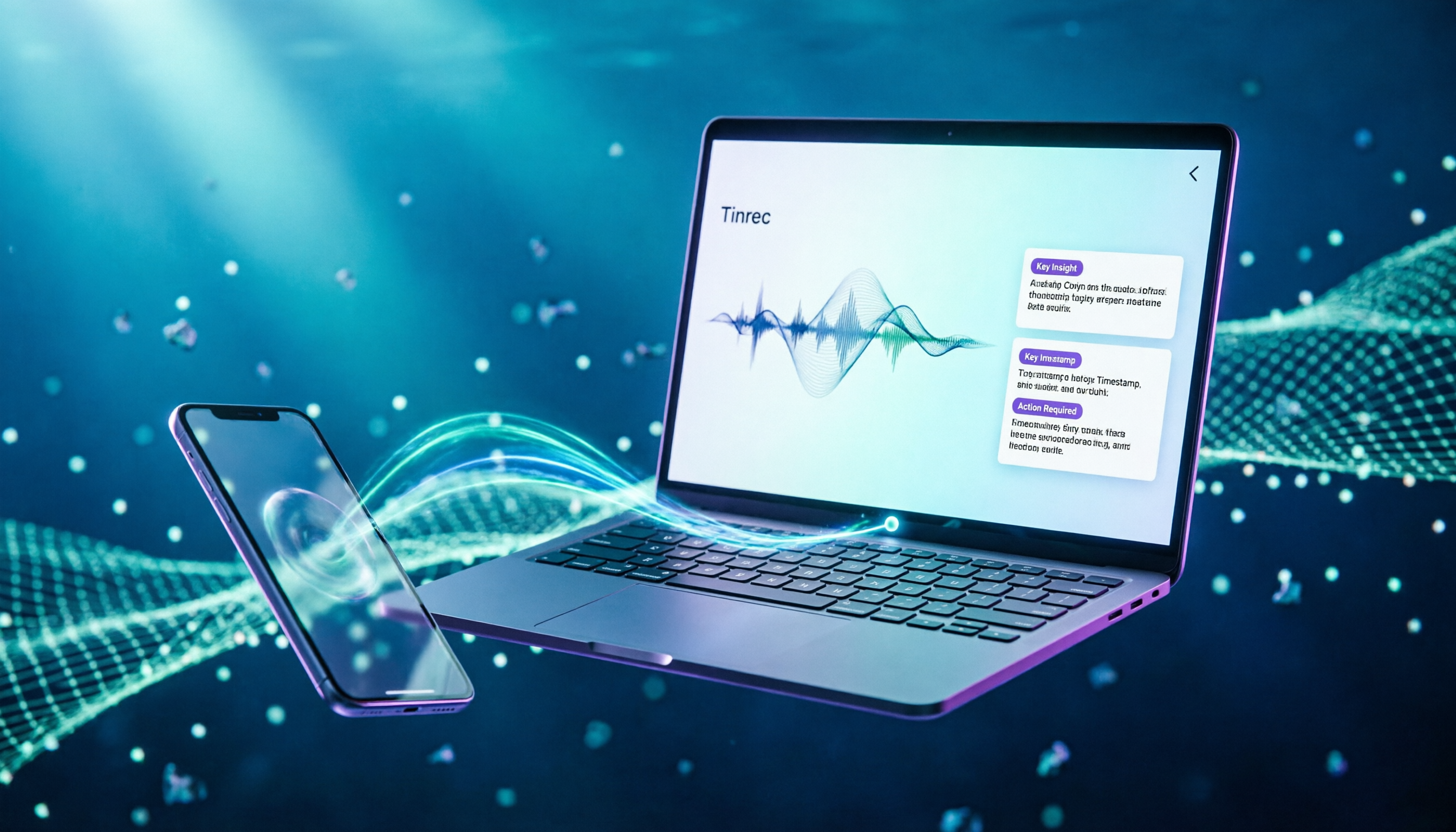
During a meeting, open the Tinrec desktop app, and it captures your computer's system audio directly—no need to invite a bot—and generates a transcript in real time. When the meeting ends, AI has already organized summaries, chapters, and action items, showing who's responsible for what and deadlines at a glance.
What impressed us most is the AI Q&A feature. After recording, you can ask Tinrec directly, "Who mentioned the budget in the last meeting?" It gives you an answer based on semantic understanding, not just a bunch of keyword search results. Currently, few competitors at this price point offer this capability.
We recorded a 10-minute Chinese meeting (including two speakers and some background music). Transcription was fast, with high accuracy on common words; occasional technical terms needed manual correction, but overall quality was satisfying. With clear audio, Tinrec required almost no post-editing.
The advantages are clear: bot-free recording doesn't disrupt meetings, AI Q&A saves time searching through transcripts, and team spaces make sharing and handing off meeting notes easy. Plus, it supports exporting to Notion, Google Docs, and other tools, so you can keep your existing workflow.
We'll be honest about limitations: the free tier has limited credits, and heavy users will need to pay. But for those who meet 2–3 times a week, the free credits are usually enough, and there are multiple paid plans, so you don't have to spend a lot upfront.
Stop organizing recordings by hand
Upload audio or video and automatically get a transcript, summary, and action items
If you frequently record Chinese meetings, don't want to use meeting bots, often switch between phone and computer, or want your team to share meeting notes, Tinrec is currently the best fit.
Beyond Tinrec: What Other Options Are There?
Otter.ai: A mature choice for English meetings, with an attractive free tier of 300 minutes per month. But Chinese transcription is noticeably worse than Tinrec, and some features require a bot. If you only record in English and don't need Chinese, it's worth considering; but it lacks Tinrec's bot-free recording and Chinese AI Q&A.
Notta: Features overlap significantly with Tinrec, focusing on file transcription and translation. However, its team spaces and bot-free desktop recording aren't as complete as Tinrec's, and AI Q&A is weaker. It's suitable for those who just need to transcribe audio files, but if you need post-meeting organization and team collaboration, Tinrec is more comprehensive.
PLAUD Note: This is an AI recording hardware device that requires an additional purchase, mainly for portable recording. Tinrec requires no hardware—you can record with your phone—and supports online meetings. Unless you prefer the portability of a standalone device, Tinrec offers better value.
Pitfall Guide: 4 Common Mistakes When Choosing a Speech-to-Text App
Pitfall 1: Only looking at official accuracy claims. Many tools claim 98%, but that's measured in a quiet recording studio. Real meetings have background noise and people talking over each other, so accuracy drops. Try a free trial with your own recordings—don't just watch ads.
Pitfall 2: Ignoring the recording method. You buy it and then find out you have to invite a bot to join the meeting, which disrupts the flow and feels awkward. Choose a bot-free option (like Tinrec's desktop app recording system audio directly) for a more natural experience.
Pitfall 3: Treating it only as a transcription tool, wasting AI features. If you still manually scan the transcript for key points after recording, you're only using a third of its capability. With AI Q&A like Tinrec's, you can ask "What was the meeting conclusion?" right after recording, which is much faster than manually scanning a 30-minute transcript.
Pitfall 4: Not considering team needs. It works great for personal use, but if sharing with your team is difficult, your data gets scattered. If you often collaborate with colleagues, choose a tool with team spaces so meeting notes become a team asset.
Summary: Which One Should You Choose?
Our conclusion is clear: Tinrec is the top choice for Chinese meeting transcription and team collaboration. It combines bot-free recording, AI Q&A, and team spaces to solve the entire workflow from recording to usage.
Scenario-based recommendations:
- Need Chinese meeting transcription + AI organization + team collaboration → Tinrec (top pick)
- English-only meetings, very tight budget → Otter.ai free tier (the only exception)
- Only need to transcribe audio files, no meeting features needed → Notta
- Need portable hardware recording and don't mind spending on a device → PLAUD Note
We suggest downloading Tinrec's free version first—the basic credits are enough to try it on a few meetings, and if you like it, consider upgrading. There's no need to pay upfront; first confirm it fits your workflow.
References
Turn every recording into actionable outcomes
Get 60 free transcription minutes when you sign in. No credit card required.
Related Reading
You might also like

2026 AI Meeting Notes Comparison: Which Tool Delivers Google Meet Minutes Fastest?
Many assume Google Meet automatically provides AI meeting notes, but built-in notes have account and language restrictions, and live captions can't be copied directly. This article addresses common misconceptions, walks through Tinrec desktop's bot-free recording workflow for automatically generating transcripts, summaries, and action items after Google Meet, and lists 5 buying checkpoints and FAQs.

2026 Comparison of 3 iPhone Recording Organization Tools: Can't Find Recordings? Which Saves the Most Time Transcribing?
When you can't find an iPhone recording, it's usually not because the file disappeared, but because the recording never had a fixed home. This article first helps you check three locations: Voice Memos, iCloud, and the Files app, then compares Tinrec, Otter.ai, Notta, and TurboScribe on transcription, AI Q&A, and team organization, including free tier limits and 3 common pitfalls to avoid.

How to Transfer Apple Watch Voice Memos to iPhone in 2026: iCloud Sync + Transcript Guide
There's no 'transfer' step for Apple Watch recordings—it's all about whether iCloud Voice Memos sync is on. This guide walks you through 3 steps to set it up, find the 'Watch Recordings' folder, and troubleshoot 5 common sync failures. Plus, from a manager's post-meeting perspective, we compare Voice Memos vs. Tinrec on transcripts, summaries, action items, AI Q&A, and team collaboration.

2026 AI Meeting Notes Guide: Tinrec vs Plaud Features and Buying Advice
Searching for 'AI meeting notes recommendations' often brings up hardware reviews like Plaud, but for most students the real challenge is organizing recordings afterward. Based on my own experience, this guide explains the differences between Tinrec and Plaud in cost, online meeting handling, post-meeting outputs, and team collaboration, and covers free tier limits, plan structures, and key buying considerations.

2026 AI Meeting Recorder Comparison: Which Free Version Is Actually Enough?
We tested the free versions of five AI meeting recorder tools in 2026, comparing free quotas, online meeting support, Chinese transcription, post-meeting summaries, and AI follow-up Q&A. Tinrec performed most completely for Chinese meetings, bot-free recording, and post-meeting organization workflows. This article also honestly lists the free limitations and ideal users for Otter.ai, Notta, Granola, and PLAUD.
5 Ways to Transfer iPhone Voice Memos to Windows in 2026: Which Is Fastest and Lossless?
Most people get stuck after saving iPhone voice memos to Files when trying to move them to a Windows PC. This hands-on test compares five transfer methods—speed, file size limits, and downstream organization costs—and explains why transferring the audio is only half the battle; the real time sink is transcription, extracting key points, and turning recordings into usable data.

2026 AI Meeting Notes Tool Comparison: Tinrec vs Notta — Which Is Better for Chinese Meetings Across 5 Key Dimensions?
The biggest pitfall when choosing an AI meeting notes tool is focusing only on transcription accuracy. This comparison starts from the question "where should meeting data ultimately live?" and evaluates Tinrec and Notta across 5 dimensions: Chinese meeting input sources, online meeting capture methods, post-meeting outputs, team governance, and pricing/quotas — helping you decide which tool better fits your workflow.

2026 AI Meeting Notes Tools Compared: Which Turns Transcripts into Actionable Meeting Records?
We tested 3 AI meeting notes tools in 2026, comparing transcripts, summaries, action items, AI Q&A, exports, and team permissions. Includes a ready-to-use meeting record template and pitfalls to avoid, helping you spend less time on post-meeting work.

How to Take AI Meeting Notes in 2026: 5 Steps from Recording to Team Summary
A common AI meeting notes approach on PTT is to transcribe first and then ask AI to organize, but what really affects efficiency is whether meeting data can be searched, queried, and handed over. This article breaks down the process in 5 steps and compares Tinrec, Otter.ai, Notta, and Granola on differences in Traditional Chinese meetings, bot-free recording, and team governance.